Hi, I have one more question. I was reading through your lib.
There seems to be a major issue in it. It appears that as written any signer can withdraw arbitrary SOL from the bridge_vault by passing:
amount > 0
proof = vec![1]
unused nullifier
expiration_slot >= current slot
Was this intentional for testing?
Basically your withdraw function is completely unauthenticated. Since this is still in dev, I'm not gonna fault you for it, just curious
@PerkinsFund@mol_tr1 Correct. v0.5.0-rc3, pre-mainnet. Audit + MPC ceremony + on-chain quorum attestation are the open items. Tracked publicly:
github.com/paraloom-labs/…
Mainnet ships when those close.
Production note/key/nonce randomness: thread_rng (ChaCha CSPRNG).
privacy_deposit.rs:52
paraloom_cli.rs:425-426
private_job.rs:146
Only fixed seeds are under #[cfg(test)]: batch.rs:228, types.rs:350.
If you meant PDA seeds those are public by design.
Point to the production line you mean.
Fair callout. That's in the v0.6.0 milestone - the compute layer's pool retrieval / decryption flow.
v0.5.0-rc3 ships the privacy payments layer; compute is alpha and tracked separately.
The "not yet implemented" markers are intentional - we tag every gap explicitly so the audit firm sees them, not hidden.
Full roadmap: docs.paraloom.io
@germanarc1 Appreciate it. Quick fit test (from the use-cases page) the on-chain link between X and Y should be hidden;
Z can be public. If that holds for you, the primitive fits.
Happy to dig in - heads up it's devnet + CLI/Rust today, SDK's still roadmap.
The private-payment half is already live on devnet: in-pool transfers hide both counterparties and the amount. The one caveat we're upfront about - the
deposit/withdraw at the pool boundary is public;
what's hidden is the link and the in-pool amount.
Escrow itself isn't built.
The shielded pool handles the private cash-flow, but the conditional-release/dispute logic is application-layer on top of the primitive - plausible to build, not shipped, and not something we'd put on the roadmap before it's real. Docs are honest about exactly this line: paraloom.io/docs/use-cases
a year ago, privacy in crypto was forgotten and ppl got annoyed w me for spamming it
now, everyone is trying to add "privacy" to their thing
while most of it is beta chasing, it does still spread the word
we have until president AOC to legalize private money for all
faster
A note from this morning.
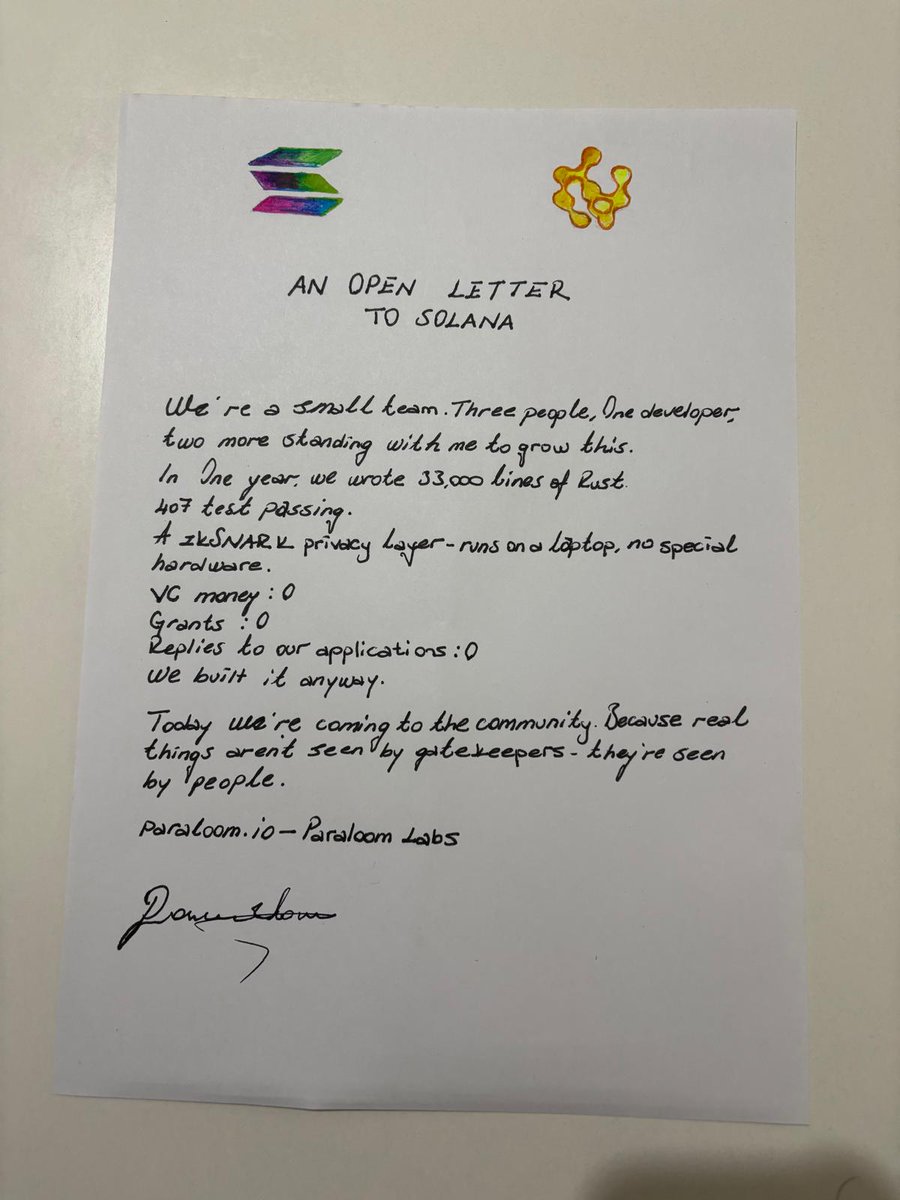
Last night we said: "real things aren't seen by gatekeepers - they're seen by people."
Tonight 1,700+ people proved that true.
That's not a market cap. That's a thesis confirmed.
The work continues - same code, same team, more eyes now.
Thank you for showing up.
This is exactly the framing. Pump fun was the only door that opened after grants didn't.
Fee mechanism, visibility, fair launch - all reasons it made sense as a starting point.
Migration to validator-aligned tokenomics post-audit is on the table. The treasury vesting (3-month cliff, quarterly unlocks) was designed with that flexibility in mind.
It feels to me that everyone is thinking about the same things right now. How is it possible that a tek like this couldn't find any funding?
I understand the rationale behind the Pumpfun launch. You need funding, fee mechanism is solid on pumpfun, visibility too.
I could imagine that a migration at some point could be a good idea.
Funny thing.
Solana was originally called "Loom."
We named our project Paraloom.
Para- (privacy) + loom (Solana's roots).
Built it for a year before noticing. Some circles close themselves.
Not wrong. It was a tradeoff: pump.fun made the launch visible to the people we couldn't reach through grants
(3 applications, 0 responses).
Treasury is locked, fair launch, no insider allocation.
Credibility now has to be re-earned through the work audit, ceremony, mainnet.
We accept the cost.
@germanarc1 Thanks. Shipping in stages is the only honest way when the trust assumptions are still narrowing.
Audit + threshold sigs land before mainnet - that's the line.
@paraloomlabs so the current trust model is essentially the L2 coordinator , threshold sigs post audit will be the real test. makes sense to ship it in stages. good job i like it.
Why we made validators run on laptops:
Some privacy protocols (Aztec, Aleo) need GPUs and specialized hardware to run nodes.
This shrinks validator sets and concentrates power.
We made it different. Verify-only nodes. Groth16 proof verifies in 10ms on one CPU core, 192 bytes per proof.
Your laptop runs a validator. 1 SOL minimum stake. Privacy without decentralization isn't privacy.
It's a permissioned database with extra steps.
Solid technical question - deserves a full answer with the actual code references.
Short version: off-chain BFT consensus (7-of-10), single L2 authority submits to the Anchor program today. On-chain quorum attestation via threshold validator sigs is the next hardening step before mainnet - exactly what the audit is for.
Full thread on the consensus -> submission flow coming tomorrow.
docs.paraloom.io/docs/consensus