Sabitlenmiş Tweet
jace
78 posts


jace retweetledi

Announcement 📢
We are giving 6 hours of extensive Swing Trading Learning content for FREE
Use this opportunity to understand how I swing trade and made 1500%+ Returns in last 4 years through swing trading
Like, Retweet and Follow my handle to know more.
English

Commodities unify the global economy
So understanding them clearly is essential.
Let know if you’d like the file
2 points:
1) First principles
Two key commodity price drivers:
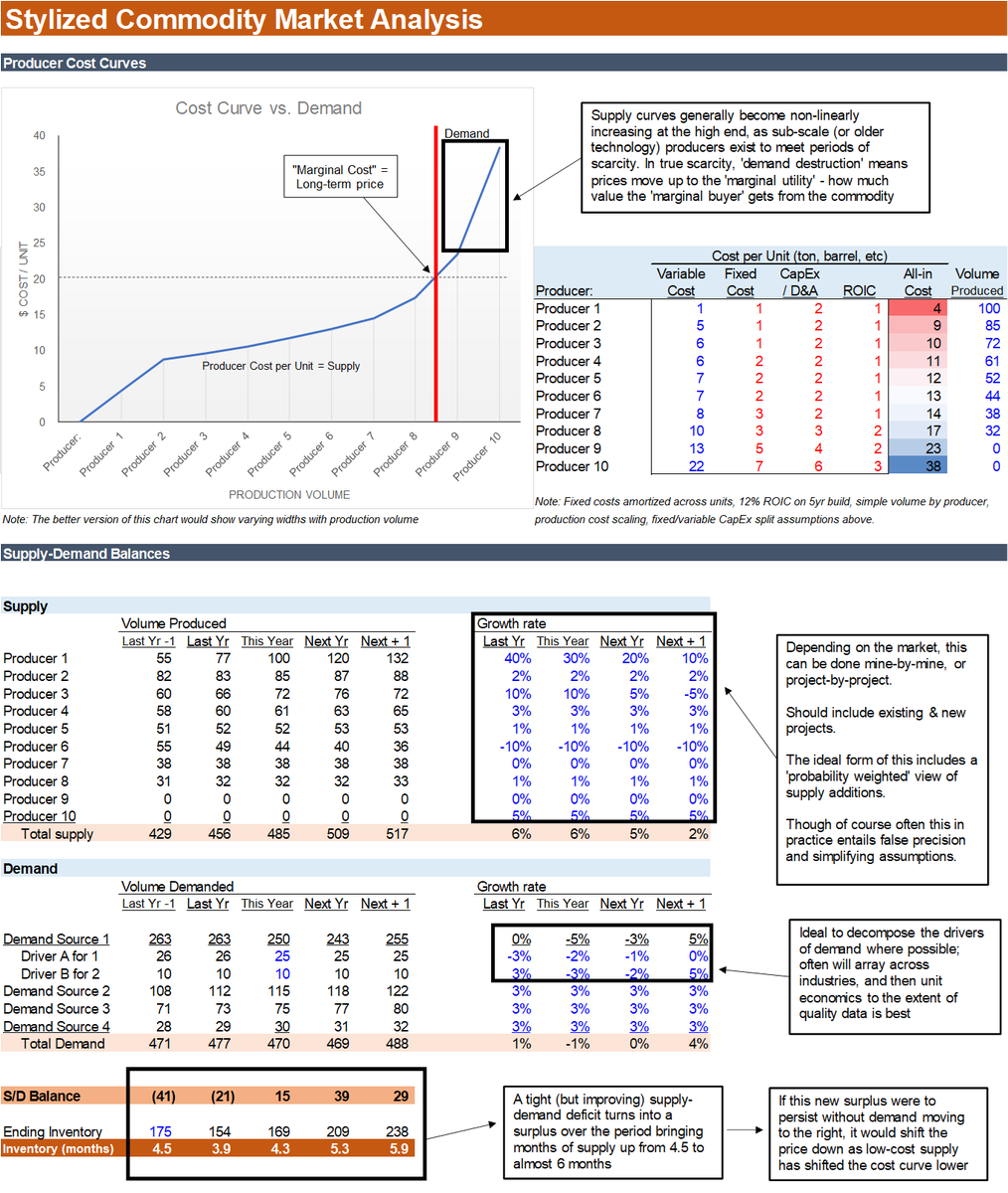
a) the "cost curve" and
b) "supply-demand" balances
The cost curve looks at producers of a commodity, and ranks each by its cost.
There is almost always a spread between low and high, so the curve slopes upward to the right (cost on Y, output on X).
In theory, a commodity's 'correct price' is the "marginal cost" of its production -- the point where the cost curve intersects demand.
Meaning:
If the market demands some commodity amount, producers compete for market share on price. The lowest they will go is the highest cost producer's breakeven. The reason not to go lower (despite their ability to afford it) is that below this, the 'highest cost producer' would go out of business. That would leave the market undersupplied, driving prices back up. So the equilibrium in theory should land at exactly where demand meets the cost curve.
Supply-demand balances ('S&Ds') deal with the many flaws in this theory.
In reality, demand shifts constantly, capacity takes years to build, and frictions abound.
So S&Ds model whether the market is supplying more or less than demand.
S&D intuition is straightforward: supply above demand leads to growing inventories and lower prices. Supply below demand depletes inventories, pushing up prices to induce new supply.
2) Nuances
But from this clean start, complexity expands in all directions:
- Meaning of 'cost': In theory, the price-setting cost should be the full variable + fixed + cost to build + return on capital. In practice, this varies by commodity and, within each commodity, by the market and S&D environment.
- Demand expectations matter most. Growing inventories can actually mean high prices, as some stock inventory ahead of demand (or speculate on price - one of many circularities).
- Sub-markets: Local S&Ds (mediated by transportation cost/infra/contracts), quality-grade differences, etc. The parts typically move together, but there are exceptions.
'Value-to-weight' is one heuristic: higher the value-to-weight predicts more uniformity across geographies & grades.
- 'Demand destruction': Prices also impact demand. In S&D scarcity, price-setting can even flip to buyer 'marginal utility'.
- Storage & forwards: Curves in contango vs. backwardation vary as a function of storage cost, expectations, and more.
There is much more to cover:
- Cyclicality & valuation across time and environment
- Commodity vs. equity dynamics
- Vast depth within each commodity
- Cross-commodity relationships
- Currency impacts on curves
- Diligence paths & differentiation in research
Among others.
But the core intuitions matter -
Not only as a basis to understand each market,
But to start putting all the pieces together,
In a connected global economy.
That's all for now.
Let know if you'd like the file.
English
jace retweetledi



jace retweetledi

@VVVStockAnalyst What all technical indicators can we use on Zerodha to analyse stocks ? Few of them seem unavailable on Zerodha.
English


Its getting cold, can't wait for winter vacations to start
HAHAHAHAHAHAHAHAHAHAHAHAHAHAHAHAHAHAHAHAHAHAHAHAHAHAHAHAHAHAHAHAHAHAHAHAHAHAHAHAHAHAHAHAHAHAHAHAHAHAHAHAHHAHAHAHAHAHAHAHAHAHAHAHAHAHAHAHAHAH
Filipino
QAM
If anyone looking to get an insight on #Nykaa #IPO do give a read on the article by @itsTarH
investkaroindia.substack.com/p/nykaadeepdiv…
#StocksToBuy #technology #business #COSMETICS #finance #Twitter
English
jace retweetledi

9-months of planning & discussions of a shared vision for sustainablity in football & wider society.
So happy to have joined the @FGRFC_official journey. Loads more to come in the future to help our 🌏 #WeAreFGR
English
jace retweetledi