Israel, Hezbollah locked in fierce battle and Tony Abbott laments Orbán’s defeat open.substack.com/pub/deepcutnew…
English
Pat Duran
12.2K posts
The new director of Netanyahu's Press Office, Eli Hazan, said he deliberately fabricates fake news as a communications tactic: "The truth doesn't matter anymore. The facts don't matter anymore," adding: "We need to be Trump."





Wow: Mosab Hassan Yousef destroys Cenk Uyghur. “You are a parasite, a bottom feeder.”



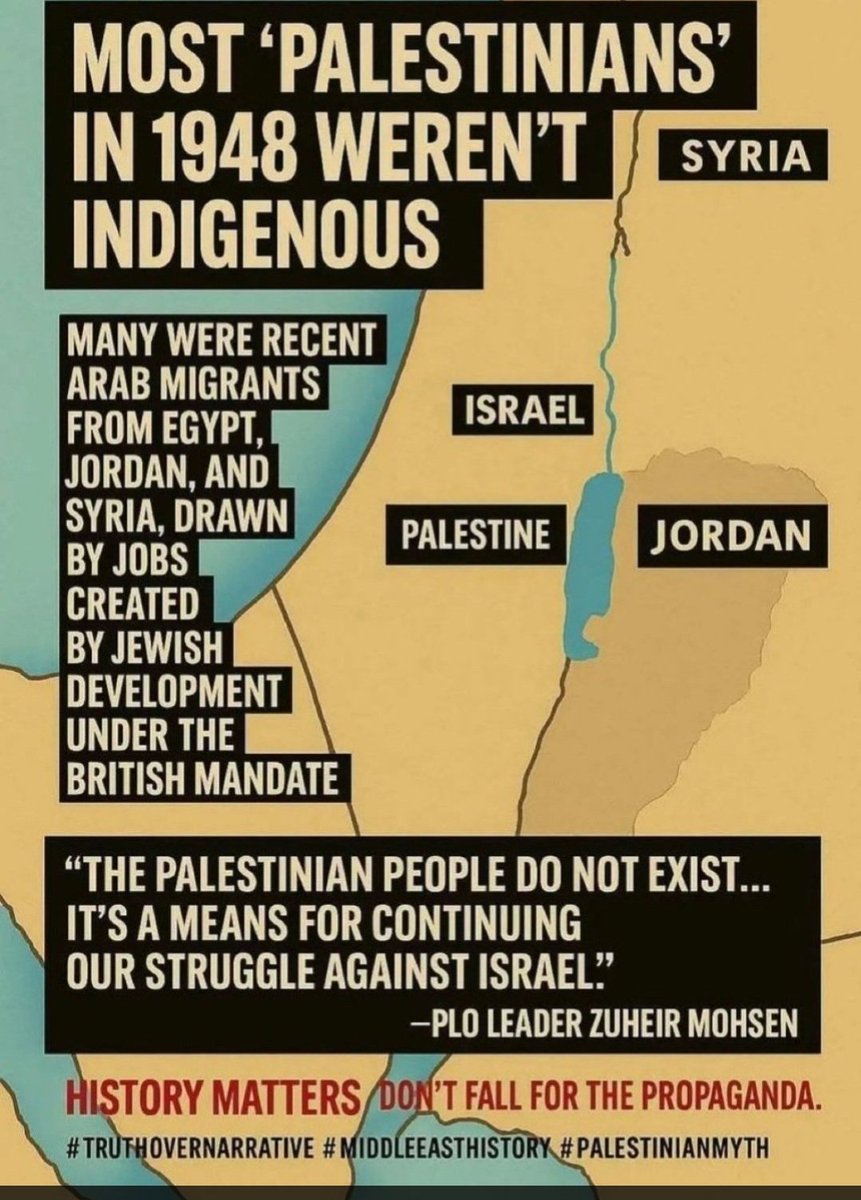
Arab immigration into the Land of Isreal in the 19th and 20th centuries: "Much less famously, a large and diverse non-Jewish immigration to Palestine (meaning here, roughly Gaza, the West Bank, and the northern half of the State of Israel), mostly Muslim, has also taken place. These immigrants included Arabs, Muslims, and many others. They and their descendants probably make up a majority of the population now called Palestinian. Palestinians, in other words, are not an aboriginal, autochthonous, first, indigenous, or native people. They are also as ethnically diverse. The scale of this non-Jewish immigration was once well known, as the Churchill and Roosevelt quotes above indicate. It has, however, long since disappeared from view, replaced by a fable about a homogeneous people living on the land since the deepest antiquity. This article seeks to restore the historical record by reviewing non-Jewish immigration to Palestine during the century from the 1840s until the creation of Israel in 1948; then it examines the fairytale that displaced that record. A future article will take up non-Jewish immigration since 1948 to the State of Israel. Many invaders brought new cohorts of settlers, thereby adding new strata of population. For example, after Egypt’s conquest of Palestine in 1831, 6,000 Egyptian peasants moved to Palestine. Significantly, they maintained a cultural distinctiveness across nearly two centuries. The German Philip Baldensperger, a long-time resident of Palestine, observed in 1913 that “we find entire villages of Egyptians all along the plains of the Philistines, from the river of Egypt [i.e., the Nile]* to Jaffa, – descendants of those of 1831, and who continue unmixed.” In 2013, Israeli scholars Gideon Kressel and Reuven Aharoni noted that their descendants still “have not assimilated entirely into the local Arab population.” The same applies to several other communities, notably the Circassians. Muslim immigration was not entirely spontaneous. Fearing another Western-oriented, non-Muslim population like the Armenian one, Ottoman rulers encouraged Muslims to move to Palestine. Sultan Abdülhamid II (r. 1876-1909), once commented that “We cannot view Jewish immigration favorably. We could only open our borders to those who belong to the same religion as we do.” Thus, Alan Dowty of Notre Dame University explains: The influx of European settlers, even in small numbers, galvanized the Ottoman government also to move to increase the Muslim dominance in the population. The sultan purchased some lands in his own name and brought in Muslim settlers from places as diverse as Algeria, Egypt, Bosnia, and the Caucasus. If it were to develop into a demographic war, the Turks were not going to lose by default. As in earlier decades, imperial and Zionist need for labor spurred further non-Jewish immigration. The British needed workers to build their infrastructure, such as military bases, and they (in Avneri’s description) “preferred Egyptian, Syrian or other foreign laborers to the Jewish immigrant.” This stimulated further non-Jewish immigration, which still encountered few obstacles to enter Palestine. Booming Zionist economic activity attracted yet more Muslim workers, employed mostly in agriculture, building, and services. Joan Peters, author of a book on this topic, compares the non-Jewish population of the future mandate’s territory in 1893 and 1947. Dividing it into three subregions according to the intensity of their Jewish settlement—none, some, and much—she finds that non-Jews increased over that period by, respectively, 116, 185, and 401 percent. In other words, many of today’s Palestinians acquired that ethnicity via their contribution to the Zionist project. Officialdom both far away (such as Churchill and Roosevelt) or nearby understood this. Thus, C.S. Jarvis, British governor of the Sinai in 1922-36, noted the illegal Arab immigration coming not only “from the Sinai, but also from Transjordan and Syria.” The price of real estate soared, with the British-sponsored Peel Commission reporting in 1937 that a “shortfall of land is, we consider, due less to the amount of land acquired by Jews than to the increase in the Arab population.” Egyptian immigration to Palestine increased after World War I, due in part to the jobs and the much higher standard of living, facilitated by improved security and transportation, especially a railroad link opened in 1918. Young men who successfully pursued opportunities in Palestine often sent for their families. In 1937, the Peel Commission heard that “There are Egyptians who are spread throughout Eretz-Israel, some of whom have made their sojourn permanent.” Jarvis pointed to the economic attraction of Zionism: “it is very difficult to make a case out for the misery of the Arabs if at the same time their compatriots from adjoining states could not be kept from going in to share that misery.” Winston Churchill concurred: Why is there harsh injustice done if people [Zionists] come in and make a livelihood for more and make the desert into palm groves and orange groves? Why is it injustice because there is more work and wealth for everybody? There is no injustice. The injustice is when those who live in the country leave it to be a desert for thousands of years.” Confirming their views, the University of Illinois’ Fred M. Gottheil documents the universal human propensity to migrate toward greater economic opportunities, the Palestinian pattern of doing precisely this, and the greater economic opportunities in Palestine than in neighboring countries. He understatedly concludes that “consequential immigration of Arabs into and within Palestine occurred.” Of course, not all Muslim migrants came to work for Zionists; some came to assault them, including two famous leaders: Fawzi al-Qawuqji from Lebanon and Izz ad-Din al-Qassam from Syria; the latter’s legacy remains alive, commemorated by Hamas as the name of its militia. The authoritative Encyclopædia Britannica of 1911, written by Irish archeologist Robert Alexander Stewart Macalister, lists no less than 23 ethnicities under the “Palestine” entry: Afghan, Algerian, Armenian, Assyrian, Bedouin, Bosnian, Canaanite, Circassian, Crusader, Egyptian, German, Greek, Italian, Jewish, Kurd, Motawila, [1] Nowar, [2] Persian, Roman, Samaritan, Sudanese, Turkish, and Turkoman. Long as this list is, Macalister missed a number of ethnicities (including the Arabian, Chechen, Ethiopian, Iraqi, Lebanese, and Yemeni). He further found that “no less than 50 languages [were] spoken in Jerusalem as vernaculars.” Toponyms in common Palestinian surnames commemorate these origins. They include, going from west to east: al-Mughrabi (North Africa), al-Masri (Egypt), al-Yamani (Yemen), al-Hijazi (Saudi Arabia), al-Lubnani and al-Tarabulsi (Lebanon), al-Shami, al-Halabi, and al-Hourani (Syria), al-Iraqi, al-Baghdadi, and al-Tikriti (Iraq). The family name al-Ifranji, meaning “the Frank,” even memorializes the Crusader colonizers. Arabians are particularly conspicuous. The Jerusalem family called Al-Husseini claims to be descended from Hussein, the grandson of the Islamic prophet Muhammad, implying roots in Arabia; the two dominant Palestinian politicians of the twentieth century, Amin al-Husseini and Yasir Arafat (birth name: Mohammed Abdel Rahman Abdel Raouf Arafat al-Qudwa al-Husseini) belonged to this family. Saeb Erekat, a top Palestinian negotiator, belonged to the Huweitat clan from the vicinity of Mecca. British authorities paid minute attention to Jewish immigration but nearly ignored its non-Jewish counterpart, making numbers about the latter vague. As an example of this uninterest, a severe shortage of workers attracted thousands of illegal Egyptian and other Arab laborers during World War II, many of whom settled permanently without the authorities paying them attention. A 1946 Survey of Palestine prepared for the Anglo-American Committee of Enquiry made no effort to estimate their numbers but vaguely noted that “inhabitants of neighboring countries, attracted by the high rates of wages offered for employment on military works, entered Palestine illegally in considerable numbers during the War.” Even more vaguely, the report continues: For example, in 1942, Egyptian labour was brought into southern Palestine by civilian contractors to the military forces without any agreement with the civil administration; these contractors were employed on the construction of camps and aerodromes. No estimates are available of the numbers of foreign labourers who were so brought into the country by contractors or who entered individually in search of employment on military works. Peters rightly says of British rule, “there was not even a serious gauge for considering the incidence of Arab immigration” into Palestine. The British eventually tried to compensate for their vagueness in 1947 by offering an estimate of 37,000 Arab immigrants to Palestine over the whole of the prior thirty years. Others counted much larger numbers. The Jewish Agency estimated that 20,000 Syrians from the Hauran district (or Houran, just east of the Golan Heights) entered Palestine during a seven-month period in 1934, two-thirds of whom stayed. Also in 1934, the governor of Hauran, Tewfik Bey El-Huriani, confirmed this number, estimating that 30,000-36,000 Hauranis had recently entered Palestine and settled there. Avneri found that “during the period of the Mandate the country [i.e., Palestine] had absorbed 100,000 legal and illegal Arab immigrants and their offspring.” Leftist American journalist Albert Viton reported in 1936 that “Not only has Palestinian Arabia been enriched by Jewish immigration, but Palestine has become the center of attraction for the whole Near East. Tens of thousands of Arabs enter illegally every year in search of work.” In a 1948 report from Mandatory Palestine, future U.S. senator Robert F. Kennedy (who twenty years hence would be assassinated by a Palestinian) concurred: “The Jews point with pride to the fact that over 500,000 Arabs, in the 12 years between 1932 and 1944, came into Palestine to take advantage of living conditions existing in no other Arab state.”meforum.org/middle-east-qu…
There you have it. “Palestinian” Hamas official: “We are not indigenous. We are Arabs. Stop telling us where we’re from. We’re all from other foreign lands.” “Al-masri. We are from Egypt”