

pd
110 posts

“This is why trading is fundamentally a performance discipline, not an analytical one. The constraint isn't what you know. It's what you can execute when your cortisol is elevated and your amygdala is lighting up like a Christmas tree.
The professionals who survive aren't smarter. They've developed emotional calluses. They've built systems that remove decision-making from the heat of the moment. They've done the reps—taken hundreds of losses, watched hundreds of winners retrace—until their nervous system stops treating each trade like a life-or-death event.
This is also why "trading discipline" isn't built by reading more books. It's built through systematic desensitization. Through taking small enough positions that losses don't trigger your fight-or-flight response.”
👇👇👇
TheMarketBank - Trader 📈@themarketbank
The knowledge-execution gap is where most trading careers go to die. You've read the books. You know the rules. Cut losses early. Let winners run. Don't revenge trade. Take the loss and move on. It's all painfully obvious when you're reading it on a Sunday afternoon with a cup of coffee. Then the market opens. Your well-rehearsed plan encounters a losing streak. Three stops hit in a row. Your account is down 6%. You KNOW the right move is to take a break, review your process, maybe reduce size. But that's not what happens. What happens is your brain starts negotiating. "Just one more trade to get back to break-even." This isn't stupidity. This is loss aversion doing exactly what evolution designed it to do. Kahneman and Tversky demonstrated that losses hurt roughly twice as much as equivalent gains feel good. Your nervous system is screaming at you to make the pain stop NOW. The rational part of your brain—the part that read the books—is fighting a losing battle against millions of years of evolutionary wiring. The gap between knowing and doing isn't about information. It's about emotional regulation under stress. Consider the classic example: you're in a winning position. It's up nicely. Your plan says let it run to your target. But it starts to retrace slightly. Suddenly you're gripped by the fear that this winner will turn into a loser. You bail early. You've just demonstrated perfect knowledge of the rule "let winners run" while simultaneously violating it. Why? Because in that moment, the anxiety of potentially losing an unrealized gain overwhelmed your commitment to the plan. The emotional cost of watching profit disappear exceeded your intellectual commitment to the strategy. This is why trading is fundamentally a performance discipline, not an analytical one. The constraint isn't what you know. It's what you can execute when your cortisol is elevated and your amygdala is lighting up like a Christmas tree. The professionals who survive aren't smarter. They've developed emotional calluses. They've built systems that remove decision-making from the heat of the moment. They've done the reps—taken hundreds of losses, watched hundreds of winners retrace—until their nervous system stops treating each trade like a life-or-death event. This is also why "trading discipline" isn't built by reading more books. It's built through systematic desensitization. Through taking small enough positions that losses don't trigger your fight-or-flight response. Through keeping detailed journals that force you to confront the gap between what you said you'd do and what you actually did. Through building pre-commitment mechanisms—automated stops, position size limits, mandatory breaks after losses—that execute the plan even when your emotional brain is in open revolt. The brutal truth is that most traders never close this gap because they're unwilling to do the unglamorous work of emotional conditioning. They'd rather believe they just need a better strategy, a better indicator, a better signal provider. Anything except confronting the fact that they already know what to do—they just can't make themselves do it when it matters. The market doesn't care about your knowledge. It only cares about your execution. And execution under pressure is an emotional skill, not an intellectual one. themarketbank.com
English
@aw_trades_ Lucid allows Sierra Charts as a platform. It's missing in your list. Maybe you wanna add that in there... adding data feeds would also help.. Denali / Rithmic /CQG over local vendors etc - my 2 cents
English

been building this for 3 months and it’s FINALLY LIVE
awtrades.co - my home base for everything. bloop pro, prop firm deals, and a rewards program where I give 50% (HALF) of my affiliate commission back to you as points for free accounts
education library and a LOT more coming…
English

🚨The most dangerous idea in math isn’t 0.
It’s the fibonacci sequence: 0, 1, 1, 2, 3, 5, 8, 13, 21, 34, 55, 89, 144…
Because if this pattern is real, reality isn’t random.
And if reality isn’t random, neither are you.
I’ve explained it in this article.
But tell me:
Is it a coincidence… or code?
Darshak Rana ⚡️@thedarshakrana
English
@DrDeannaCole 🙏... Thanks Doc, I am greatful for your honesty (so badly needed in this space).....Your statement has made things easy and difficult for me... Easy cause I know where to Not look... Difficult cause I don't know where to look next.... Wishing you luck and success.. Take care
English
@pdx999 Just reach out to support@raentrading.com and have a chat with us. Your DMs on here are locked.
English
@Raentrading
Hi,
I have a question with regards to “Commissions” in the Evaluation Phase and Live Environment.
Is there any way that the commissions can be prorated based on the product being traded?
Please allow me to explain this with the help of an example
English
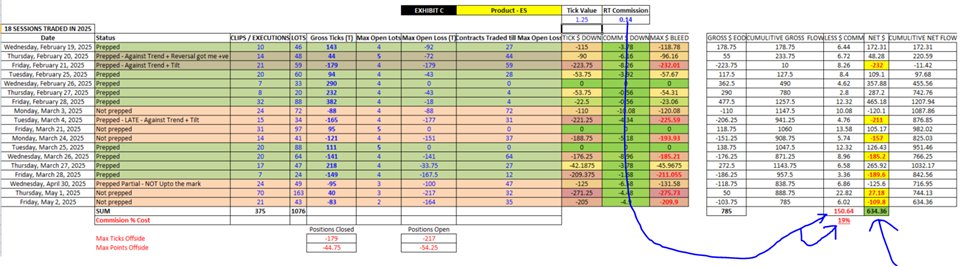
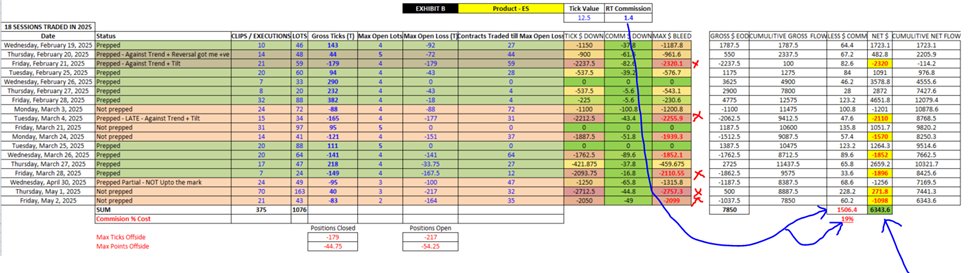
Following are details of 18 Sessions traded.
Exhibit A - All of these were traded using Micros (MES). Tick Value 1.25$ & Commission Round Trip 1.4$
Exhibit B – Exactly same Executions. However, MES is replaced by ES (for an example). Tick Value 12.5$ & Commission Round Trip 1.4$
English
"Successful Trader's Morning Routine."
A beautiful room.
A large bed.
A slow morning with freshly brewed coffee and a carefully prepared breakfast.
The camera follows them to a clean desk with multiple monitors.
They sit down, relaxed, confident, in control.
You've watched this.
And somewhere inside, you thought: I want that life.
That feeling is not an accident.
It was designed.
What you should learn from that video is not how that trader starts their morning.
It is how much work went into making that video look that effortless.
The lighting was considered.
The angle was chosen.
The script — even if it looks unscripted — was planned.
The editing took hours.
The thumbnail was tested.
The title was optimized.
This person didn't just press record.
They produced a piece of content designed to hold your attention.
And it worked.
But the problem is not the video.
The problem is what happens inside you while you watch it.
You see the result — the calm, the confidence, the lifestyle — and your brain skips to the conclusion: if I find the right strategy, I can have that too.
But what you didn't see is what built that calm.
It doesn't appear in the video because it doesn't look good on camera.
It looks like this:
Sitting alone at a desk, running the same system through a massive sample of trades by hand, recording every result, not to find a winner but to understand what the system produces across a large sample.
It looks like adjusting position size — not based on how much you want to make, but based on what your tested data says is the worst your system can do to you.
It looks like practicing execution over and over until following the rules requires no thought, no effort, no internal negotiation.
It looks like experiencing the worst drawdown your system can produce — in practice — so many times that when it happens with real money, you feel nothing.
No one films this.
No one watches this.
No one clicks on a thumbnail that says: "Watch me test the same system again."
And no one films "My routine for preparing the script, lighting, and planning for filming my morning routine."
But this is the work.
The morning routine video shows you the life that comes after the work is done.
It doesn't show you the work.
And because it doesn't show you the work, you start to believe the work doesn't exist.
You start to believe that the right strategy, the right indicator, the right entry is what separates you from that life.
It isn't.
What separates you from that life is the hours of preparation that no one puts a spotlight on.
Testing your system until you know everything it can produce.
Practicing until execution is automatic.
Sizing your position from data, not desire.
Building belief through experience, not through watching someone else's highlight reel.
This is not glamorous.
You will not want to post it on social media.
You will not feel inspired while doing it.
But this is where the edge is built.
Not at the clean desk with the coffee.
At the messy desk with the spreadsheet.
You won't admire it.
But that is where the truth is.
The books go deeper 📚
payhip.com/YumiSakura/col…

English
@Raentrading Please note, this is not about hedging the initial long position... its about speculative optimisation.. A response on this would be appreciated... Thanks
English
@Raentrading . Id want to take advantage of that Short scalp without giving up my positional long. One way of doing it is to take the Scalp short using Minis but that pushes my Risk 10x. Is there anyway around this ?
English

Most traders stay stuck because they're trading alone.
No oversight. No feedback. No one to catch the pattern you can't see from inside it.
Cohort 006 is open.
Professional trading desk. Real capital. Institutional infrastructure.
TT Pro. LiveSquawk. Weekly live sessions with senior traders.
$389/mo in Phase 1 (refunded with your first withdrawl). Phase 2 is free. Your trading is the interview.
English