Pekka Vartiainen

36 posts

Pekka Vartiainen banner
Pekka Vartiainen

Pekka Vartiainen

@pecsi_max

Resident doctor in pediatrics & postdoctoral researcher - https://t.co/FkgxLBGl5w

Helsinki, Finland Katılım Şubat 2015
119 Takip Edilen72 Takipçiler
Pekka Vartiainen retweetledi

Tuomo Hartonen
Tuomo Hartonen@tuomohartonen·
Seeing some black on white makes it feel a little bit less unbelievable! None of the work would have been possible without all the colleagues I had pleasure to work with during my PhD. The biggest thanks go to Jussi Taipale and Teemu Kivioja who supervised the work.
Tuomo Hartonen tweet media
English
0
1
8
216
Pekka Vartiainen retweetledi
Eliisa Kekäläinen
Eliisa Kekäläinen@lettipitko·
Honoured to receive the #ERCStG - my team will try to figure how we could better protect the human thymus during stem cell transplantation for the benefit of patients undergoing this extreme treatment. Thank you @ERC_Research - now the work begins 💪🏻
University of Helsinki@helsinkiuni

Eight of our researchers have been awarded prestigious ERC Starting Grant by @ERC_Research 🤩 Congrats to 🔷@Maxime_Grandin 🔷@KamilMamak 🔷Alexander Mühleip 🔷@MNakonechnyi 🔷Jonathan Valk 🔷@VirveMarionneau 🔷Nanna Myllys 🔷@lettipitko helsinki.fi/en/news/univer… #ERCStG

English
19
2
85
4.1K
Pekka Vartiainen retweetledi
Tuomo Hartonen
Tuomo Hartonen@tuomohartonen·
How well do EHR-based scores predict disease onset compared to PGS? Can we predict disease onset in Finland using EHR-scores trained in the UK or Estonia? To find out what our @intervene_eu study discovered, come see our poster at #ESHG2024 on 3.6. at 15:45
Tuomo Hartonen tweet media
English
0
5
16
1.1K
Pekka Vartiainen retweetledi
FIMM HelsinkiUni
FIMM HelsinkiUni@FIMM_UH·
FIMM Dissertation! Mattia Cordioli will defend his doctoral dissertation "Leveraging large-scale biobanks for genetic discovery and better public health" on 11 June. Associate Professor Zoltán Kutalik, University of Lausanne, will serve as the opponent: helsinginyliopisto.etapahtuma.fi/Kalenteri/Engl…
FIMM HelsinkiUni tweet media
English
1
3
15
766
Pekka Vartiainen
Pekka Vartiainen@pecsi_max·
👇 @PALKO_HTA kudos, especially for considering the young siblings as risk factor, it's supported by many studies and can lead to better targeting! The work continues @HeinonenSanttu @RhedinSamuel @DrSakari et al - can we refine risk stratification to be even more useful?
Andrea ganna@andganna

Nice to see the Finnish national recommendation for the use of nirsevimab for RSV prevention in infants are based on the findings we published on @LancetDigitalH thelancet.com/journals/landi… From research to translation in just a few months!

English
0
1
4
729
Pekka Vartiainen retweetledi
Veera Rajagopal 
Veera Rajagopal @doctorveera·
Beautiful human genetics discovery of a missense variant in VE-PTP (aka PTPRB) that increases the risk of central serous chorioretinopathy (CSC) and varicose veins, but decreases risk of glaucoma. ​ VE-PTP encodes vascular endothelial-protein tyrosine phosphatase (removes phosphate), which is a natural inhibitor of tyrosine kinase receptors (adds phosphate) in vascular endothelial cells. ​ There is a huge literature on the vascular receptor tyrosine kinases (aka angiopoietin receptors), namely TIE1 and TIE2, that bind to its ligands angiopoietin 1 and 2 and regulate angiogenesis (en.wikipedia.org/wiki/Angiopoie…). ​ TIE2 (aka TEK) is specifically expressed in vascular endothelial cells. Researchers discovered VE-PTP in mice in 1999 by searching specifically for proteins with phosphatase activity that are bound to angiopoietin receptors in endothelial cells in the blood vessels of the brain (nature.com/articles/12029…). ​ Both TIE2 and VE-PTP are essential for blood vessel formation and patterning during embryo development, and so complete loss is incompatible with life. ​ The earliest human genetic discoveries related to TIE2 were from the early 1990s. Linkage analysis of large families with venous malformations pointed to a region in chromosome 9p. Soon it became apparent that the causative mutation was a gain of function missense mutation (pubmed.ncbi.nlm.nih.gov/8980225/). ​ TIE2's link with glaucoma come from early mouse studies that showed, if you delete either TIE2 or its both ligands (Angpt1 and 2) during the late embryonic development, you bypass embryonic lethality, but the mice still develop severe glaucoma due to abnormal development schlemm's canal required for aqueous humor drainage in the eye (ncbi.nlm.nih.gov/pmc/articles/P…) Later, human genetic confirmed this finding. Partial loss of TIE2 causes primary congenital glaucoma (ncbi.nlm.nih.gov/pmc/articles/P…). ​ These discoveries formed the basis of development of VE-PTP inhibitors to activate TIE2 (as VE-PTP is a natural antagonist of TIE2) for the treatment of open angle glaucoma (tvst.arvojournals.org/article.aspx?a…). ​ So far, no strong human genetic findings have surfaced for VE-PTP. Now, Rämö, Gorman, Weng, et al. report phenotypic consequences of a naturally occurring low-frequency missense variant that decreases VE-PTP function. ​ Fascinatingly, the phenotypic profile of partial loss of VE-PTP look inverse of the phenotypic profile of partial loss of TIE2. - While TIE2 deficiency causes glaucoma, VE-PTP deficiency protects against glaucoma. - While TIE2 over activation causes venous malformation, VE-PTP deficiency increases risk of varicose veins and serous chorioretinopathy (caused by increased fluid permeability of choroidal blood vessels resulting in fluid escaping to behind the retina and detachment). ​ Some interesting questions to answer: Are varicose veins and chorioretinopathy are merely developmental consequences of VE-PTP deficiency ? Will post-natal deletion of VE-PTP recapitulate these phenotypes in mice? This is important to know to assess adverse effects of VE-PTP inhibitors. ​ Similar to how VE-PTP inhibition is explored to treat open angle glaucoma, will TIE2 inhibition help treat chorioretinopathy? ​ Rämö, Gorman, Weng, et al. medRxiv 2024 medrxiv.org/content/10.110…
Veera Rajagopal  tweet media
English
0
8
37
10.2K
Pekka Vartiainen retweetledi
Feiyi Wang
Feiyi Wang@feiyi_wang·
T1D and other autoimmune diseases (AIDs) co-occur in families. How parental AIDs impact T1D risk in offspring and how much of the familial risk is explained by HLA and non-HLA variants? 👩🏻‍🦱🧔🏻‍♂️👶🏻 Find out more from this thread 🧵 and our new preprint ⬇️!medrxiv.org/content/10.110…
English
1
14
32
10.1K
Pekka Vartiainen retweetledi
Andrea ganna
Andrea ganna@andganna·
Yes! The system works. We accessed the data, processed, cleaned, and sent it back for others to use. No gatekeeping. All data should be accessible not by contacting researchers but via impartial, third-party institutions.
Andrea ganna tweet media
English
0
16
68
5.5K
Pekka Vartiainen retweetledi
Pekka Vartiainen
Pekka Vartiainen@pecsi_max·
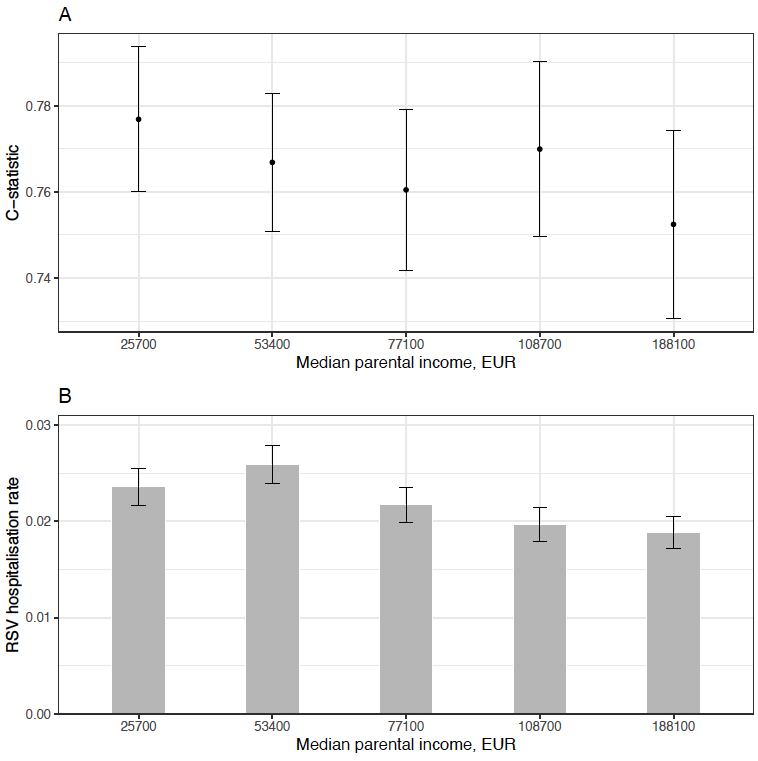
@BontLouis Studying prediction equity should also be done within the population, and we actually did this. We studied model fairness by comparing the C-statistic across parental income quintiles. Equal (or slightly better) c-stat in lower income vs higher income families.
Pekka Vartiainen tweet media
English
0
0
0
44
Pekka Vartiainen
Pekka Vartiainen@pecsi_max·
Which children need #RSV immunoprophylaxis the most? A fine example on solving timely clinical problem with unique data and hardcore methods. Check the paper, rsv-risk.org and 🧵 Work continues with @RhedinSamuel @andganna @HeinonenSanttu @DrSakari et al!
The Lancet Digital Health@LancetDigitalH

NEW Research: "Risk factors for severe respiratory syncytial virus infection during the first year of life: development and validation of a clinical prediction model". @pecsi_max @andganna @helsinkiuni @karolinskainst #RSV Read it here: thelancet.com/journals/landi…

English
1
0
4
317
Pekka Vartiainen
Pekka Vartiainen@pecsi_max·
@BontLouis Our data is from high-income countries 🇫🇮🇸🇪 having a distinct RSV epidemic pattern, and a risk prediction model in e.g. tropical regions is probably different than the one just published. But the predictors and the model can be adapted, modified or recalibrated!
English
0
0
0
28
Pekka Vartiainen
Pekka Vartiainen@pecsi_max·
Oh boy, looks like research efforts continue in Norway! Based in Oslo, we aim to leverage the unique Nordic datasets (@theCEFH @FinnGen_FI @karolinskainst...) to study risks and consecuences of infections in childhood. Deeply thankful for @SohlberginS for the postdoc grant!
English
3
2
26
1.4K
Pekka Vartiainen
Pekka Vartiainen@pecsi_max·
Check this thread and data resource profile for official release of FinRegistry! An impressive integration of all Finnish people's data. This will open amazing possibilities for research, in Finland and internationally.
Andrea ganna@andganna

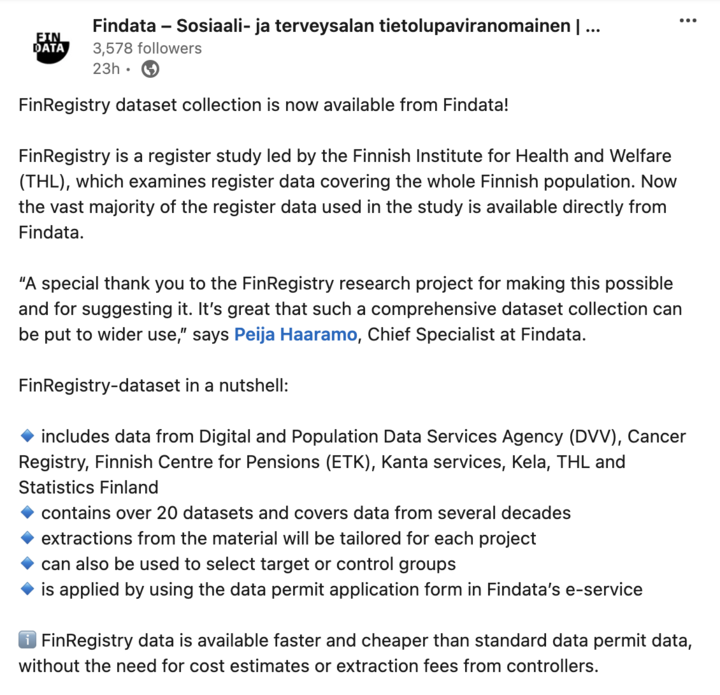
Very thrilled to formally introduce FinRegistry and Risteys - risteys.finregistry.fi But before getting into details. Do you know that any researcher in 🇪🇺can access FinRegistry data via @FindataFi ? It is easy, secure, and under a clear legal framework academic.oup.com/ije/advance-ar…

English
0
2
8
788
kzguro
kzguro@kristinazguro·
Leaving FIMM Helsinki as an @intervene_eu visitor after an enriching period. I feel fortunate to have met so many brilliant researchers and to have worked with such an amazing team #dsgelab led by @andganna. Grateful for the experience gained and memories made. Thank you all!
English
2
0
9
727
Pekka Vartiainen retweetledi
Emmi Helle
Emmi Helle@EmmiHelle·
Proudly presenting our preprint (thread): Maternal diabetes and overweight as risk factors for congenital heart defects in offspring - A nationwide register study from Finland medrxiv.org/content/10.110… 1/7
English
1
6
19
1.9K
Pekka Vartiainen
Pekka Vartiainen@pecsi_max·
@anders_hviid indeed, a good point. Another thing that probably - and unfortunately - differs between regions and countries
English
0
0
0
29
Pekka Vartiainen
Pekka Vartiainen@pecsi_max·
@anders_hviid Or maybe even simpler model would be even more useful, for example a decision rule for a specific mAb? Would be very happy to hear suggestions or comments!
English
0
0
0
61