
Pedro Gull
72.2K posts
Pedro Gull
@pedrogull
Fisioterapeuta y preparador fisico (RP). Physical-therapist and Physical Trainer.
Katılım Şubat 2010
5K Takip Edilen1.5K Takipçiler
@pedrogull @poetwithpace @JohnGoldman @Alan_Couzens En mi caso justo ahí, aveces también cerca del cierre o junta cuando me la pongo
Español

@inaki_delaparra @poetwithpace @JohnGoldman @Alan_Couzens Gracias, pensé que era yo!, en mi caso se agrietan cerca del sensor.
Español
@pedrogull @poetwithpace @JohnGoldman @Alan_Couzens Yo cambio de bandaż casa año pero el cerebro funciona solo necesito nueva banda, no importa so uso Garmin o Polar es lo mismo se acaban rápido…
Español
@inaki_delaparra @poetwithpace @JohnGoldman Hola @inaki_delaparra que tal?, te quería comentar también lo hice con @Alan_Couzens, desde que cambie H10 hace 5 años he dañado 3 cintas, no sé si es mi sudor PH, veo que otros les dura más tiempo, cuál es tu experiencia en duración?
Español
Pedro Gull retweetledi

If sessions often feel too big:
Make the goal smaller.
Dial it back until it feels manageable.
Sometimes that’s just 60 minutes in zone 1.
A simple out-and-back on the bike path.
Consistency starts when sessions stop feeling like a big deal.
English
Reading is not "hard", the real problem is that we have become uncomfortable with effort that does not give instant feedback...
English
Pedro Gull retweetledi

What does 1,000 kcal of low-intensity exercise look like for the average person?
Assuming...
- 75kg (165lb) bodyweight
- Max HR 170 bpm
- Rest HR 50 bpm
- VO2max of 50ml/kg/min
2hrs total of...
- Easy Cycling - 140W @ 110bpm (~65% MHR) 🚴♀️
- Jog/Walk - 8:30/k (13:30/mi) @ 110bpm (~65% MHR) 🏃♂️🚶
Alan Couzens@Alan_Couzens
1,000 kcal of low-intensity exercise every day keeps the Doctor away. 2,000 kcal of low-intensity exercise every day keeps the competition at bay.
English
Pedro Gull retweetledi

AE should be prioritized over RE for reducing blood pressure.
“Aerobic exercise consistently produces significant reductions in ambulatory (24-hour) BP, lowering systolic/diastolic BP by ~ 5/3 mmHg. In contrast, resistance training, whether dynamic or isometric, has not demonstrated significant hypotensive effects on ambulatory BP”


English
II was sick last week & I read every Stephen Seiler paper I could get my hands on.
The famous ones. The obscure ones. The 2007 autonomic nervous system study nobody talks about.
Here's what I learnt — and why most amateurs are training in exactly the wrong zone.
roadmancycling.com/blog/stephen-s…
English
Pedro Gull retweetledi
Something not appreciated enough…
Easy aerobic training isn’t just physical...
It’s "relax and recover" nervous system training.
Without it, both body and mind lack balance.
Build more “calm” into your system →
you don't just get better performance, you get a better life! 🌲🚶
brian mackenzie@brianmackenzie
The aerobically limited athlete will be state dependent on chasing the burn (pH)/glycogen/>SNS/hormones. They will be psychologically tied to an identity that isn’t doing enough. Their nervous system will literally protect and chase this state.
English
Pedro Gull retweetledi
Higher cardiac vagal control (HRV) may buffer anxiety-related elevations in sympathetic activity.
“The association between anxiety and MSNA became nonsignificant in individuals with a resting RMSSD exceeding ≈65 ms.”
Note that AE improves HRV & reduces anxiety & SNS activity.

English
Pedro Gull retweetledi
Women are not limited by physiology, they’re limited by how we coach them.
→ More efficient for endurance
→ Faster recovery in strength
→ More sensitive to energy deficits
Same system ≠ sensitivity
Most coaches ignore that...
Here’s what changes everything ↓ (link below...)

English
Pedro Gull retweetledi

Este tanque genera olas de hasta 3 metros y corrientes de 10 nudos, es uno de los simuladores más avanzados del mundo y se usa para entrenar equipos de rescate de Corea del Sur y Japón. ¡Increíble!
Español
Pedro Gull retweetledi
A real masterclass in this week’s #MSMRL - where @inaki_delaparra & I sit down with world-class coach @joelfilliol on the biggest mistake in endurance training right now:
“Zone 2 has started to creep up.”
“What used to be easy training… isn’t really easy anymore.”
“The error with Zone 2? It accumulates.”
Most athletes aren’t overtraining.
They’re just doing their “easy” training too hard!
This one is worth a few listens!
Full podcast 👇
English
Pedro Gull retweetledi

🚨The updated Metabolic Map.
Yesterday I said the Metabolic Map I proposed in 2013 needed to evolve. That map helped me and others translate complex laboratory findings into practical guidance for training and performance.
Today I’m sharing the updated model.
In my view, this represents a shift in how we should understand exercise metabolism.
For over two decades, I focused on what the body burns, fat vs carbohydrates, and how lactate serves as a powerful proxy of that process.
After many years of working with world-class athletes, patients and laboratory research, my view is clearer: exercise metabolism is a continuum of metabolic states, defined by the relationship between glycolysis and mitochondrial capacity.
From equilibrium to drift to overload.
Lactate is the signal of where the system stands, and how we can track metabolism across all exercise intensities.
Full article: @inigosanmillan/note/p-193581258?r=2nunp3&utm_medium=ios&utm_source=notes-share-action" target="_blank" rel="nofollow noopener">substack.com/@inigosanmilla…

English
@georgepoth67 @Alan_Couzens And then you tell him that his recovery run is a walk at 14 min/km!!
English

@Alan_Couzens Me, when I tell fellow runners with a 10k best of 59:47 doing "recovery" runs at a faster pace than they did in their race. Yes, this is real.

English
See, the thing is...
Athletes who use "gadgets" develop much better feel.
Because the feel becomes calibrated.
An athlete who has never tested lactate before that you tell to go for an "easy" run under their first threshold will be completely wrong 99.9999% of the time.
Sometimes, it's really wrong, like 3-4 mmol/L levels of wrong!
An athlete, with a long history of lactate testing, however, will nail this point with 99.999% accuracy.
It's not gadgets or feel it's gadgets + feel in a never-ending loop of self-knowledge and self-improvement.
Alan Couzens@Alan_Couzens
I'm traveling internationally later this week. If my pilot gets on the intercom and says... "I'm done with gadgets, I'm gonna fly by feel today" I'll be getting off that plane.
English
I'm traveling internationally later this week.
If my pilot gets on the intercom and says...
"I'm done with gadgets, I'm gonna fly by feel today"
I'll be getting off that plane.
English
@Alan_Couzens @Dad__Miles @Michael_Easter @Brady_H @feelthebyrn1 Hi Alan, it's happened to me with the H10, in 5 years I've damaged 3 straps, I don't know if it's my sweat pH it when the HRV goes crazy...But if it cracks at the edge of the sensor.
English
@Dad__Miles @Michael_Easter @Brady_H @feelthebyrn1 Biggest issue that I had with Garmin straps is durability - they become less good more quickly. Especially an issue for HRV, where interference of a dodgy strap can significantly impact the numbers.
English
Runners and run coaches, what's your favorite running gear and the gear you recommend most often?
Be creative: tech, shoes, apparel, food, recovery stuff, etc all count.
@Brady_H @Alan_Couzens @feelthebyrn1
English
Pedro Gull retweetledi

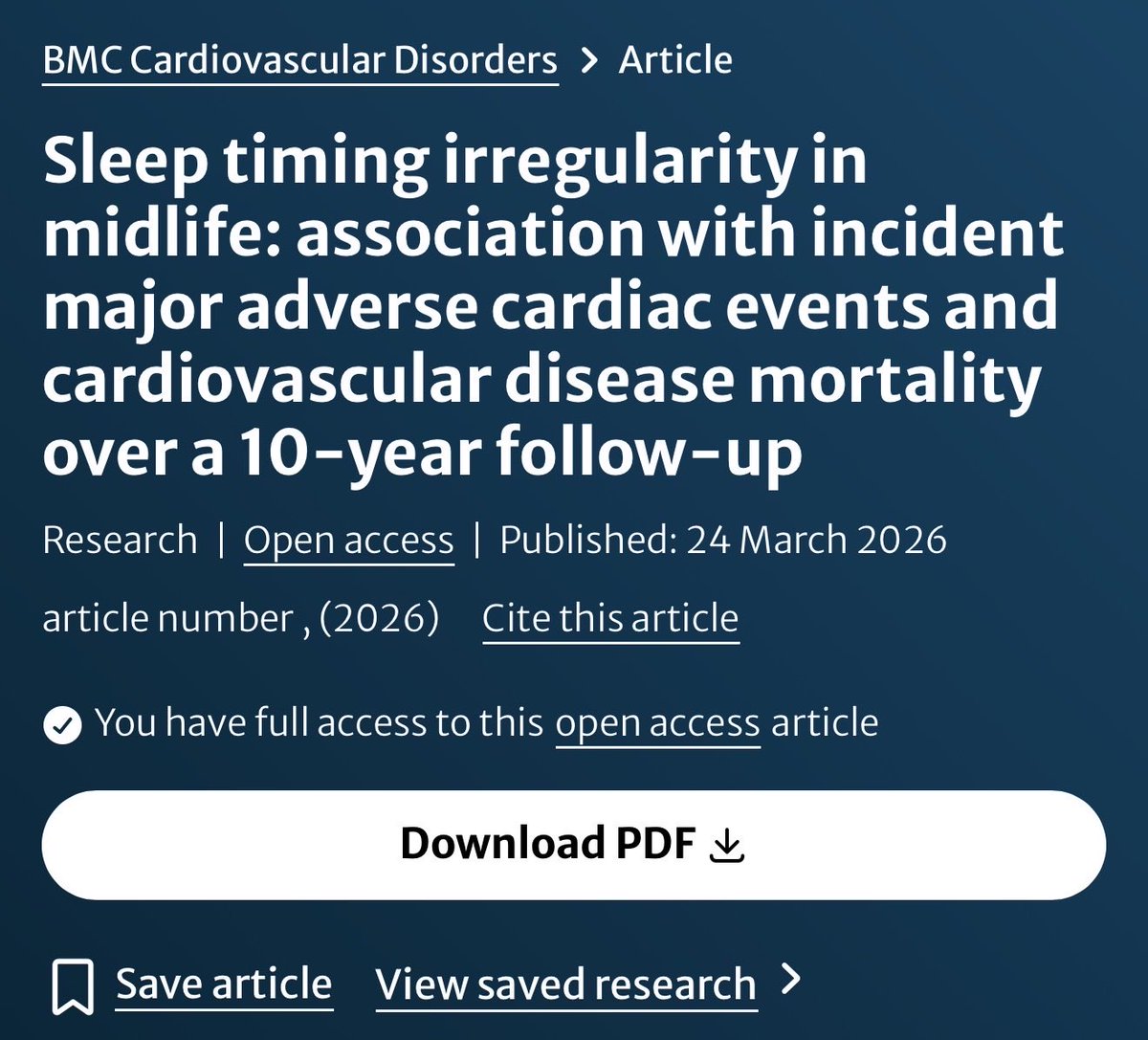
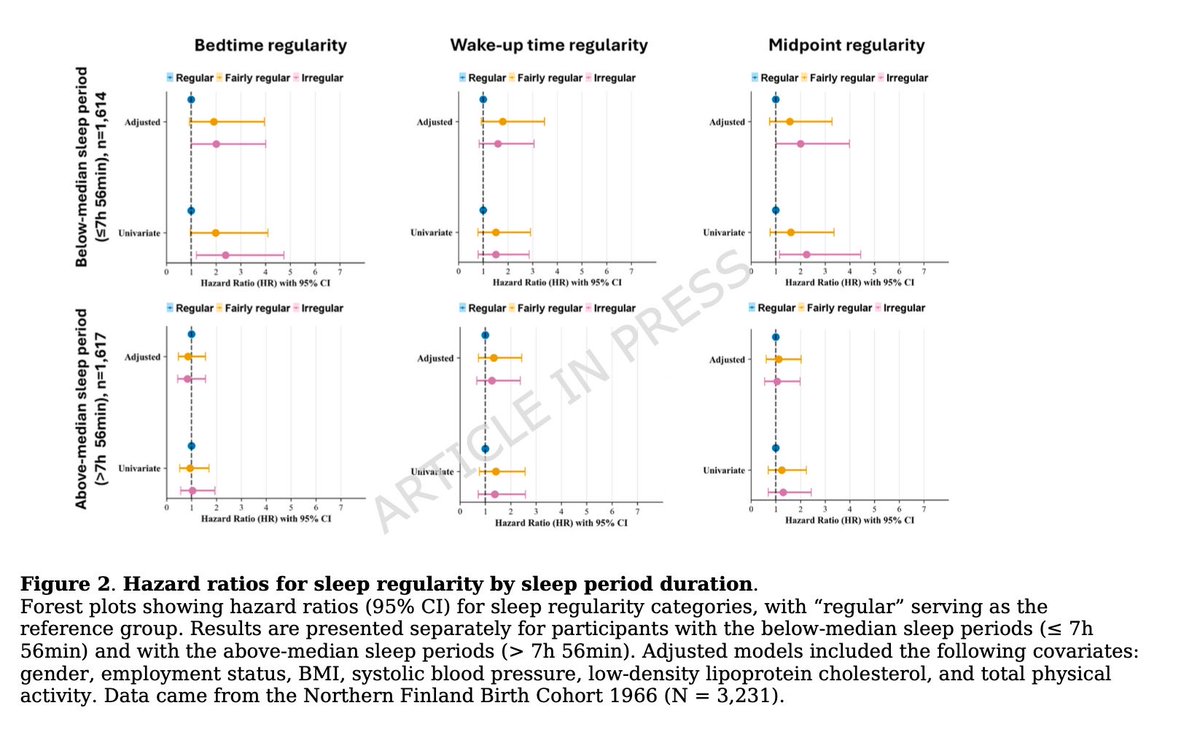
If you’re not getting enough sleep, then sleep consistency becomes much more important.
This study found that people whose bedtime varied by ~1.5 hours from night to night had *double* the risk of a major adverse cardiovascular event if they got <8 hrs of sleep.
No real risk increase among “irregular” sleepers getting >8 hrs per night.

English