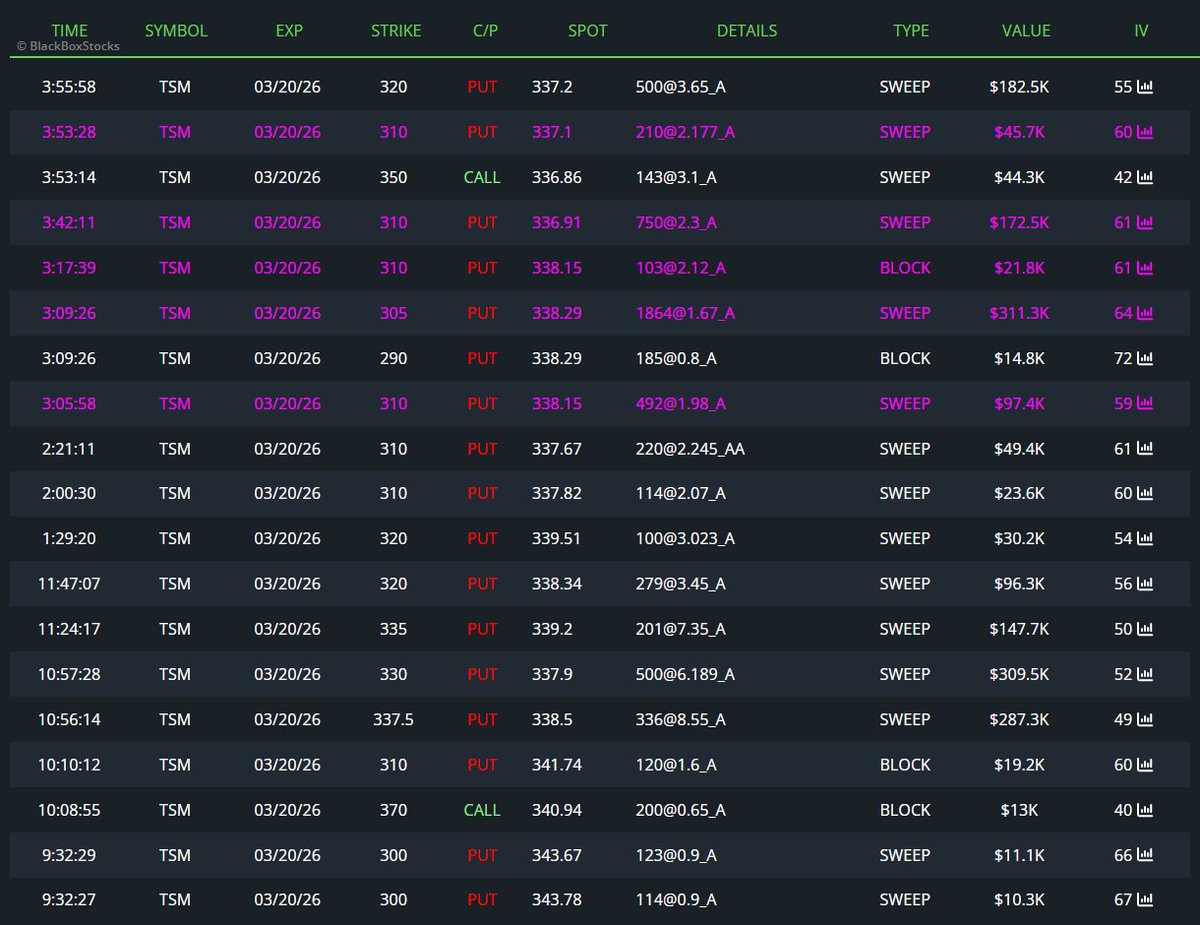
🚨 Someone knows something about $TSM
All day today — PUT sweeps. Over and over.
🔴 1864 contracts @ $1.67 — $311K
🔴 500 contracts @ $6.19 — $309K
🔴 336 contracts @ $8.55 — $287K
All expiring March 20. All hitting the ASK (aggressive)
When smart money sweeps puts this aggressively, retail shouldn't be on the other side. 👀
$TSM is worth watching closely into next week. 🍿
🚨BREAKING: SecDef Pete Hegseth stares right at the press and goes scorched earth, spelling out their insanity. I could watch this all day.
"You, and I mean specifically YOU, the press, you cheer against Trump so hard, it's in your DNA and in your blood to cheer against Trump, because you want him not to be successful so bad, you have to cheer against the efficacy of these strikes. You have to hope maybe they weren't effective."
"Maybe the way the Trump administration is representative isn't true. So let's take half truths, spun information, leaked information, and then spin it, spin it in every way we can to try to cause doubt and manipulate the mind, the public mind, over whether or not our brave pilots were successful."
"How many stories have been written about how hard it is to, I don't know, fly a plane for 36 hours? Has MSNBC done that story? Has Fox? Have we done the story how hard that is?"
"There are so many aspects of what our brave men and women did that because of the hatred of this press corps are undermined because people are trying to leak and spin that it wasn't successful. It's irresponsible."
"You're undermining the success of incredible B-2 pilots and incredible F-35 pilots and incredible refuelers and incredible air defenders who accomplished their mission."
"How about we talk about how special America is, that only we have these capabilities? I think it's too much to ask, unfortunately, for the fake news. So we're used to that."
Do you firmly support Pete Hegseth on this?
A. Huge Yes
B. No
IF Yes, Give me a THUMBS-UP👍!!
MAKE THIS GO VIRAL ON 𝕏. LET’S GO 👏
Global religion inspired terror attacks committed by the top 5 religions in the world in the last 50 years:
1. Christianity: ~50
2. Islam: ~67,000
3. Hinduism: ~10
4. Buddhism: ~5
5. Judaism: ~100
What pops out at you?
Not compatible.
⚡ TL;DR: Tesla's "armored bridge" battery patent at a glance
⚖️ The problem: Normal battery charging causes internal swelling, forcing the sharp, microscopic cliff-edges of the cathode to cut into the delicate separator, leading to catastrophic short circuits.
💡 The solution: Tesla engineered a way to taper that sharp cliff into a gentle slope, covering it with a rapidly curing liquid armor that bridges the gap and neutralizes the threat.
🔬 This isn't a random coating; the taper is a precisely calculated ramp (between 0.1 and 20 degrees) designed to spread and dissipate mechanical stress harmlessly.
🧪 Using a two-part mixture (isocyanates and amines), automated nozzles apply a liquid that instantly cures under UV light into a tough, flexible polyurea shield.
🔋 This armor is explicitly designed to work with Tesla's next-generation "dry electrode" manufacturing (using fibrillized binders), eliminating the need for toxic wet solvents.
⚙️ The liquid armor is applied continuously onto massive, high-speed electrode sheets, curing in fractions of a second to prevent production bottlenecks.
🛡️ Testing proves this polyurea bridge survives weeks submerged in boiling, highly corrosive battery acid without losing its structural integrity or flexibility.
🚀 The bottom line: This microscopic armor solves major structural failure points in the massive 4680 cells, directly translating to higher factory yields, fewer dead batteries, and vastly lower production costs.
BREAKING 🚨 @Tesla HAS ENGINEERED A RAPIDLY CURING POLYMER BRIDGE FOR ITS BATTERY ELECTRODES TO SAVE MILLIONS OF SCRAPPED CELLS AND SLASH PRODUCTION COSTS BY UP TO 50% 🐳
When we think about battery degradation, we usually picture chemical breakdown over time. But inside every cylindrical cell, a violent mechanical war is fought every single time you plug in your car.
As the battery breathes and swells during charging and aggressive acceleration, the sharp internal edges of the electrodes act like microscopic knives pressing against the delicate separator. It is a hidden structural nightmare that routinely causes catastrophic internal short circuits.
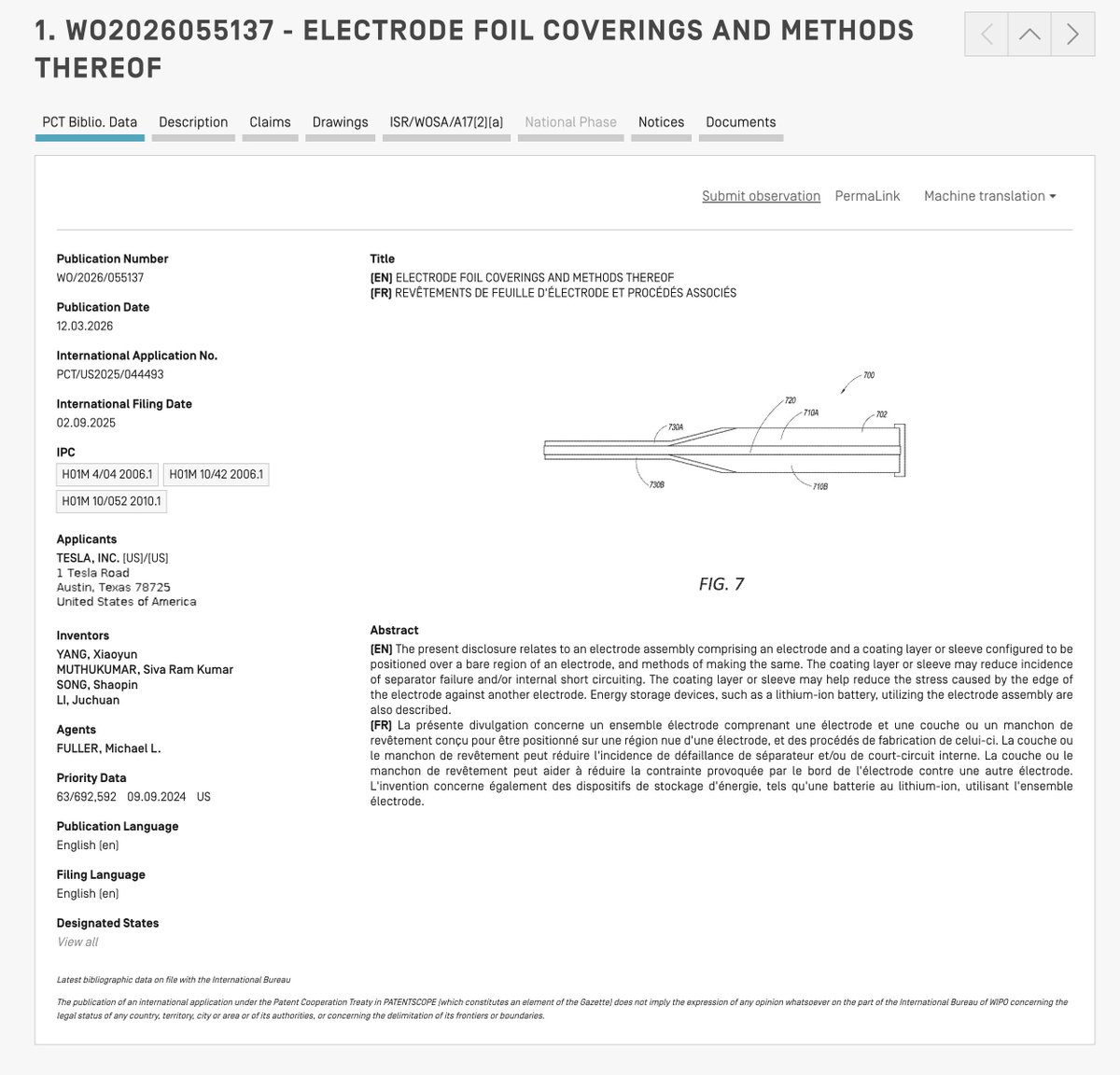
Enter Tesla and a brilliant new manufacturing process designed to neutralize this threat entirely. Just published on 12 March 2026 under the title "ELECTRODE FOIL COVERINGS AND METHODS THEREOF", patent WO 2026/055137 reveals exactly how Tesla is deploying a rapidly curing polymer bridge to shield these vulnerable edges.
This is not just a minor tweak to battery chemistry. It is a fundamental redesign of the electrode architecture. By acting as a liquid armor, this coating physically bridges the microscopic cliff between active material and bare metal, unlocking a new level of durability for millions of future vehicles.
To understand why this armored bridge is so revolutionary, we first need to look closely at the microscopic battlefield it was designed to protect.
⚖️ The problem: Mechanical stress and the anode overhang dilemma
In standard cylindrical battery cells, the internal components are tightly rolled together like a dense metallic jelly roll. This roll consists of the anode, which is the negative side, the cathode, which is the positive side, and a separator, which acts as a thin physical barrier to keep them from touching.
A core problem stems from a specific design necessity called the anode overhang. In a wound cylindrical cell, the negative anode layer must be slightly wider and longer than the positive cathode layer.
This extra material is crucial to prevent lithium plating, a dangerous condition where metallic lithium builds up on the edges and can spark a fire or permanently damage the battery.
However, this extra width creates a hidden geometry problem. The active chemical material on the cathode is coated onto a metallic backing known as a bare foil. Where that thick chemical coating abruptly stops and drops down to the flat metal, it creates a sharp structural cliff that presses directly into the overhanging anode layer.
Every time you charge and discharge your car, the battery cell naturally breathes, swelling and shrinking with the flow of energy. During this constant movement, this microscopic cliff acts like a tiny knife edge rubbing against the internal components.
This causes localized buckling, meaning the fragile internal layers warp and crumple under the concentrated pressure. Eventually, this friction leads to the tearing of the thin separator.
Once that protective barrier is breached, the positive and negative sides touch directly, causing an internal short circuit and a completely dead battery cell.
Faced with this inevitable physical friction, Tesla had to find a way to eliminate that destructive cliff entirely. Their answer is elegantly simple in concept, but incredibly complex in execution.
💡 Tesla's solution: Tapered edges and protective sleeves
Instead of leaving a harsh drop off where that dense chemical paste ends, Tesla engineers designed a way to physically taper the edge. Much like building a gentle ramp instead of a sharp cliff, they gradually reduce the thickness of the electrode film down to the bare metal foil.
On top of this newly smoothed slope, they apply a specialized curable coating, which is essentially a liquid polymer that hardens into a tough armor. Alternatively, they can deploy a pre-formed armored sleeve, acting as a dedicated non-conductive bridge, right over this vulnerable transition zone.
This creates a smooth, continuous surface that distributes mechanical stress evenly across the cell. This gentle slope allows the battery to breathe and expand safely without tearing its internal layers.
Even better, this protective layer physically blocks the exposed metal from touching the opposing layers, completely neutralizing the risk of accidental electrical shorts.
But creating a smooth slope at the microscopic level requires more than just a guess. It requires exact, calculated geometry to guarantee the stress is properly deflected.
🔬 Microscopic math: Precision engineered tapers
Tesla is not just smoothing out the edge randomly. The patent reveals extreme precision in how the active material is shaped.
The tapering gradient, representing the exact mathematical angle of the slope down to the bare metal, is strictly controlled between 0.1 and 20 degrees. To picture this, a 0.1 degree slope is an almost imperceptibly flat and elongated runway, while 20 degrees is a more noticeable but still gentle ramp.
The length of this microscopic slope stretches out from half a millimeter, roughly the thickness of a fingernail, up to 10 millimeters depending on the specific battery cell design. By mathematically extending the drop off over this physical distance, the mechanical stress is effectively dissipated.
Just like a snowshoe spreads a person's weight over a wide patch of snow to keep them from sinking, this ramp serves as the physical foundation for the armored bridge, completely preventing the stress from concentrating at a single microscopic point that could puncture the battery.
While the math behind the slope provides the structural foundation, the real magic lies in the high tech physical material used to lock that slope into place.
🧪 The two part chemical armor: Isocyanates and amines
The protective liquid coating is actually a highly specific, rapid curing binary system. This means it is a two part liquid mixture that hardens almost instantly when combined, much like the heavy duty epoxy glue you might mix at home for a tough repair.
To prevent the materials from solidifying inside the machinery, the manufacturing equipment keeps the two liquid components completely separate until the exact moment of application.
The first chemical component utilizes isocyanates, while the second relies on amines. These are highly reactive chemical building blocks that remain perfectly stable on their own but lock together instantly and permanently the moment they are introduced to one another.
When these two liquids are mixed directly over the bare foil and the newly tapered electrode edge, they instantly react to form a durable, polyurea armored sleeve. Polyurea is an incredibly tough, flexible, and rubbery plastic material. It is often used in industrial settings to waterproof roofs or line the beds of heavy duty pickup trucks to prevent scratching and denting.
This chemical reaction is extremely fast and can be fully hardened into its final state by intense beams of ultraviolet light or a quick blast of heat in as little as a tenth of a second. This lightning fast drying time is an absolute requirement for maintaining the blistering pace of Tesla's high speed continuous manufacturing lines without causing production bottlenecks.
As impressive as this rapid chemical reaction is, its true value is revealed when you look at exactly what kind of battery manufacturing it was designed to integrate with.
🔋 The dry battery electrode connection: Fibrillized binders
Perhaps the most significant detail hidden in the patent is the explicit compatibility with dry battery electrode manufacturing. This is a highly sought after production method where the battery components are mixed and applied as dry powders rather than the traditional wet chemical slurries.
The document specifically notes that this tapered sleeve process works perfectly with free standing, self supporting electrode films. Instead of behaving like wet paint that needs a metal backing just to hold its shape, these films act more like a solid, rollable sheet of dough.
Crucially, they are created without toxic wet solvents, which are the harsh liquid chemicals typically used to mix standard battery pastes that later require massive, energy hungry ovens to bake away.
It mentions fibrillizing the binder components to create a web of structural support. Binder components act as the microscopic glue holding the active energy powders together.
Fibrillizing is the physical process of stretching this glue under pressure until it forms millions of tiny, thread like fibers. You can picture this like pulling apart a cotton ball or stretching melted cheese to create an interlocking net that locks the entire chemical mixture firmly in place.
This proves that this polymer bridge technology is designed to integrate directly into next generation dry coating lines. By eliminating the expensive wet processing steps, this setup unlocks massive cost savings, higher manufacturing yields, and vital energy density improvements. This means Tesla can pack far more driving range into the exact same physical space for future cell production.
Of course, unlocking a next generation battery architecture is only half the battle. To matter to Tesla's bottom line, it has to be produced at a mind bending scale.
⚙️ Manufacturing at scale: Built for speed
For anyone evaluating a technology company for long term value, manufacturing efficiency is the ultimate metric. Tesla designed this protective coating process to be heavily automated. Specialized machinery and precise robotic dispensers handle the delicate chemical applications without requiring slow manual intervention.
They can process a massive multilane electrode sheet, which is essentially a giant, continuous roll of material that contains several wide strips of active battery chemistry running side by side.
As this massive sheet unrolls at high speeds, precision nozzles are applying the liquid coating to the bare foil lanes in continuous motion. These exposed strips of conductive metal run down the length of the sheet, acting much like parallel highway lanes where the protective liquid armor is sprayed down without ever stopping the production line.
After a quick ultraviolet cure sets the liquid mixture into a tough solid plastic, the process is complete in just fractions of a second.
Once this armor is set, the large sheet is sliced into individual coated electrode assemblies. These assemblies are the final, perfectly sized individual strips of battery materials, fully protected along their edges and ready to be rapidly rolled into finished cells.
Once these millions of perfectly armored cells roll off the line, they face one final and relentless hurdle.
🛡️ Uncompromising stability: Surviving the electrolyte
A battery interior is an incredibly harsh chemical environment, acting much like a boiling cauldron of corrosive liquids. Tesla rigorously tested these newly formed armored bridges by soaking them in highly reactive battery electrolyte.
This electrolyte is the critical conductive fluid that allows electricity to flow by ferrying charged particles back and forth between the positive and negative ends of the cell. To prove this armor would survive in the real world, they submerged it in this corrosive fluid at elevated temperatures for weeks on end. This perfectly mimics the extreme internal heat generated when a car is driven hard or rapidly charged.
The patent data shows the cured material remains perfectly stable in this hostile environment, retaining its structural integrity to ensure it does not dissolve or fall apart over time.
It also maintains a high tensile strength, meaning it can be continuously stretched and pulled by the swelling battery components without ever snapping. It even holds onto its crucial rubbery flexibility without degrading.
It forms an electrochemically stable barrier, serving as a permanent physical wall that refuses to chemically react with the battery liquids or break down under intense electrical currents. This armor easily outlasts the daily wear and tear of driving and aggressive charging cycles.
Surviving that brutal internal environment proves the engineering actually works. But the real question is how this microscopic victory translates to the macro scale of Tesla's global ambitions.
🚀 How this patent contribute to Tesla's now and future
This innovation is a prime example of how aggressive engineering at the microscopic level drives massive shifts in overall product reliability and financial success. The core invention of this patent is the liquid polymer armor applied over a mathematically tapered electrode edge.
For Tesla today, this translates immediately to higher manufacturing yields. Because this ultra fast curing liquid can be applied continuously at high speeds, fewer defective battery cells are thrown into the scrap bin directly off the assembly line, immediately improving profit margins.
This liquid armor is absolutely critical for the success of the highly anticipated 4680 battery program. Because the 4680 cell is significantly larger than older batteries, that internal metallic jelly roll is massive. When a larger cell like this charges and discharges, the physical swelling and shrinking is dramatically amplified.
Without a protective bridge, the risk of a sharp edge slicing through the delicate separator is much higher. By applying this precision tapered sleeve, Tesla completely neutralizes this amplified threat, allowing them to safely build massive, energy dense cells without sacrificing long term reliability.
Furthermore, the 4680 program is the exact testing ground for Tesla's next generation dry battery electrode manufacturing. Tying this protective sleeve directly to dry processing shows a clear path to dominating global battery cell production costs.
Since this patent explicitly highlights compatibility with those dry, fibrillized powders, it acts as a vital puzzle piece to stop edge failures and push massive 4680 manufacturing yields to highly profitable levels by bridging the gap between active materials and bare foil.
In the long term, this drastic reduction in catastrophic failure rates translates directly to fewer costly warranty replacements for dying car batteries. The enabled dry coating process also completely removes the need for massive drying ovens, shrinking the physical footprint of future Gigafactories and slashing electricity bills.
For anyone tracking the underlying value of the company, these quiet and highly scalable manufacturing improvements are exactly the kinds of compounding technological moats that secure long term dominance in the automotive sector.
🚨 BREAKING: Trump says any Senator who votes against the SAVE America Act should be RUN OUT OF OFFICE
This should INCLUDE those who refuse to support enforcing the talking filibuster
REFUSING to enforce the filibuster is a vote AGAINST the bill!
In war, nations usually flee. Cities empty out, and roads turn into long routes of exile.
But have you ever seen a nation that, in the midst of war, does not run away but instead returns home? Have you seen a city where, under the shadow of bombs, the night lights are still on and life continues to flow through its streets?
If you have not, now you do. This is #Iran. A land that has accepted war in order to be freed from a far greater destruction.
The calm of the people comes from two things: a bitter trust that the attacker will not target unarmed civilians, and a surrender to a fate from which they see no escape. And that may be the saddest truth of all.
I interviewed two Israeli Air Force pilots who are part of the operation in Iran. When I asked what it felt like to enter Iranian airspace for the first time, one of them said:
“You find yourself thinking, what do these people, so far away from us, actually want from us? They have a huge and beautiful country. Right now full of snow and lakes. Truly a very, very beautiful place. What do they want from us, this small piece of land? It’s such a strange feeling.”
I asked Claude to rank the top 10 stocks best positioned for the agentic (Openclaw) AI wave.
This is the list he gave me:
1. $NVDA - GPU infrastructure powering all AI agents
2. $MSFT - Copilot ecosystem, Azure, OpenAI partnership
3. $GOOGL - Gemini models, Cloud, agentic Search
4. $AMZN - AWS Bedrock, Alexa+, logistics automation
5. $CRM - Agentforce embedded in enterprise workflows
6. $NOW - IT/enterprise workflow automation natural fit
7. $PLTR - AI agents in government and defense
8. $CRWD - Securing the expanding agentic attack surface
9. $MDB - Database layer for agent memory and context
10. $PATH - RPA-to-agent pivot with high upside
Is Claude correct?
Nothing humbles you like telling your OpenClaw “confirm before acting” and watching it speedrun deleting your inbox. I couldn’t stop it from my phone. I had to RUN to my Mac mini like I was defusing a bomb.