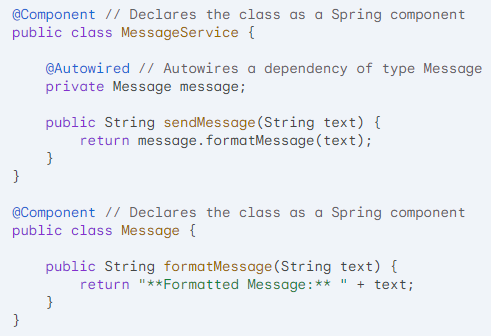
Spring Framework with its annotations offers several benefits that make it one of the most popular and powerful frameworks for Java application development. ☕️🌱 #SpringIsHere#java#JavaPower#Spring
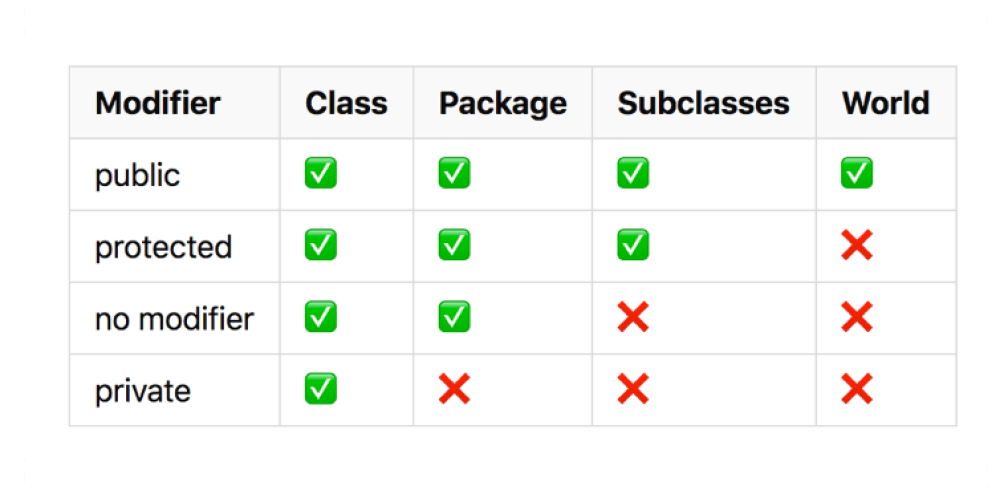
The access modifiers private, protected, public, and default can be applied to both variables and methods.
The access modifiers abstract and final can only be applied to classes, methods, and variables.
The access modifier native can only be applied to methods.
1) private - An access modifier that restricts the visibility of a class member to the class in which it is defined. Only members of the class can directly access private members.
2) protected - An access modifier that restricts the visibility of a class member to the class in which it is defined and its subclasses. Protected members can be accessed from the class in which they are defined, its subclasses, and classes in the same package (but not from outside the package).
3) public - An access modifier that makes a class member accessible from anywhere in the program. Public members can be accessed from any class, regardless of the package.
4) abstract - An access modifier that declares a class, method, or variable as incomplete and requiring implementation in subclasses. Abstract classes cannot be instantiated directly but can be subclassed to create concrete classes. Abstract methods do not have a specific implementation in the abstract class and must be implemented in subclasses.
5) final - An access modifier that prevents a variable from being modified or a method from being overridden in subclasses. Final variables cannot be changed after initialization, and final methods cannot be overridden in subclasses.
6) default - A Java-specific access modifier that defines the visibility of a class member to the package level in which it is defined. Members with the default access modifier can be accessed from classes in the same package but not from outside the package.
7) native - An access modifier that indicates that a method is implemented in the platform's native language (e.g., C++). Native methods allow calling native code from Java code.
Additional Notes:
In interfaces, the default access modifier is used to declare methods with a default implementation. This default implementation can be overridden in classes that implement the interface.
All methods declared in an interface are implicitly public.
#java#programming#spring
Java Lifehacks!💻☕
What hidden tricks and techniques have you discovered in Java that have made your programming life easier? 💡
Share your favorite tips and tricks with the hashtag #JavaLifehacks and let's learn from each other! 🤝
#Java#programming
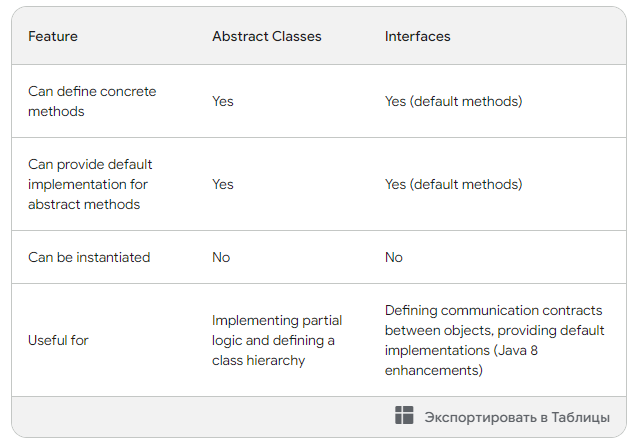
Even though both abstract classes and interfaces can now define methods with implementation (default methods in interfaces since Java 8), there are still key differences in how they function and their primary purpose:
1. Purpose:
Abstract classes: Designed to serve as base classes for other classes, providing partial code implementation and defining a class hierarchy. They can model "is-a" relationships (e.g., Mammal "is-a" Animal).
Interfaces: Designed to define a contract of behavior that classes must implement, promoting decoupling and abstraction. They can model "has-a" relationships (e.g., Dog "has-a" BehaviorEat).
2. Implementation:
Abstract classes: Can define abstract methods (without implementation) and concrete methods (with implementation). Derived classes must implement abstract methods and can override inherited concrete methods.
Interfaces: Can define only abstract methods (or default methods with implementation since Java 8). Classes implementing an interface must provide an implementation for all abstract methods. Default methods cannot be overridden.
3. Instantiation:
Abstract classes: Cannot be directly instantiated. Only derived classes can be instantiated.
Interfaces: Cannot be directly instantiated. They define a behavioral contract, not a concrete implementation.
4. Inheritance:
Abstract classes: Can inherit from a single abstract class or concrete class.
Interfaces: Can implement and inherit from multiple interfaces (multiple inheritance).
Analogy:
Abstract classes: Think of them like a blueprint for a house. The blueprint defines common structural elements (walls, windows, doors) but leaves room for customization in each room. Derived classes are like houses built based on that blueprint, with their own unique features (size, materials, colors).
Interfaces: Think of them like a set of controls for appliances. The interface defines common actions (on/off, temperature setting, program selection), but implementations vary. Each appliance adheres to the interface's rules with its own specific implementation (buttons, touchscreen, voice commands).
Conclusion:
Choosing between an abstract class and an interface depends on your specific design needs. Abstract classes are suitable for modeling class hierarchies and sharing common code, while interfaces are better for defining behavioral contracts and promoting loose coupling.
Guidelines:
Use abstract classes when you need an inheritance structure and want to share common code between related classes.
Use interfaces when you want to define a behavioral contract for unrelated classes to implement, achieving flexibility and decoupling.
Java 8 introduced more flexibility to interfaces with default methods, but use them judiciously to avoid excessive complexity.
I hope this detailed explanation helps you understand the subtle differences between abstract classes and interfaces!
#Java#OOP#JavaLearn#AbstractClassesvsInterfaces#programming