Philip Cardiff

143 posts

Philip Cardiff banner
Philip Cardiff

Philip Cardiff

@phiiliipc

Katılım Ağustos 2014
380 Takip Edilen242 Takipçiler
Philip Cardiff
Philip Cardiff@phiiliipc·
@chenna1985 I cycle by this bridge and plaque on the way to work. I really need to find a reason to use quaternions … maybe beam elements
English
1
0
1
36
Hiroaki Nishikawa
Hiroaki Nishikawa@HiroNishikawa·
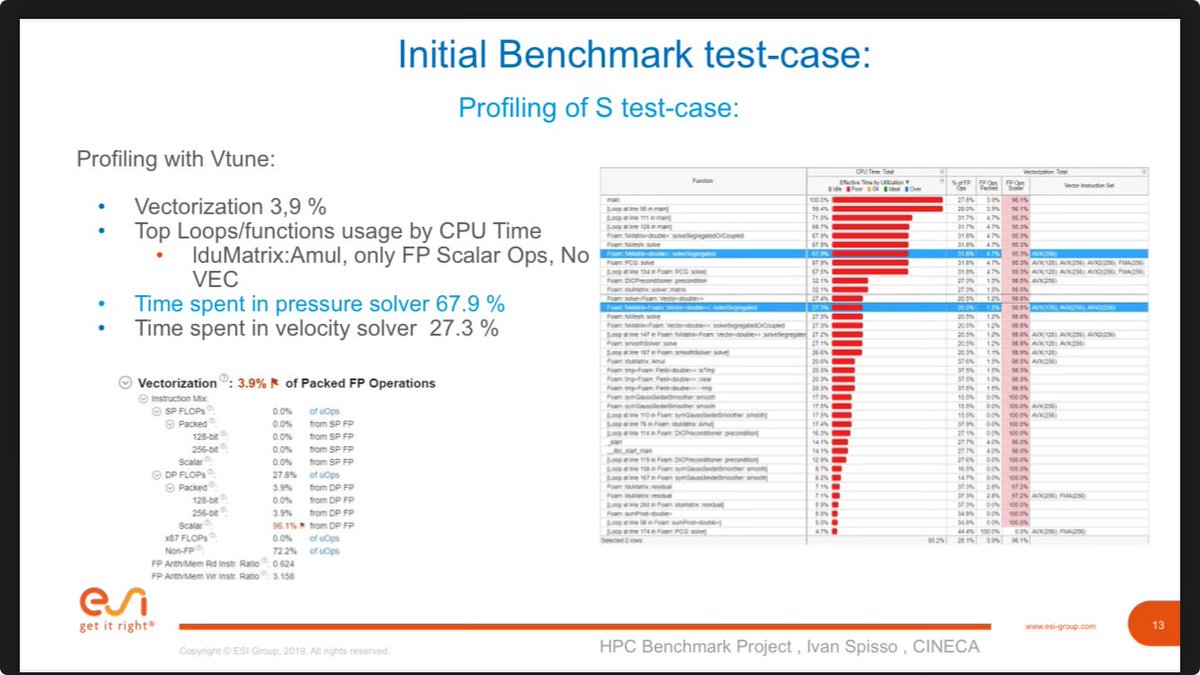
Some people told me that the Poisson solver for the pressure correction is the most time-consuming part of an incompressible NS solver while others told me that the Poisson solver is not so expensive and there's no strong need for improvement. I still don't understand it...
English
14
1
24
2.2K
Philip Cardiff
Philip Cardiff@phiiliipc·
@HiroNishikawa I beleive that in many complex geometry RANS cases like this, the outer residuals do not converge per se, but stagnate (with noise), and the user checks the quantities of interest for statistical convergence in some sense, e.g., meancalc.upstream-cfd.com is a tool for this
English
1
0
1
30
Philip Cardiff
Philip Cardiff@phiiliipc·
@HiroNishikawa As a concrete example, in the "motorbike" standard test case in OpenFOAM, which uses SIMPLE (+ kOmegaSST turbulence model), they perform 500 outer iterations (no outer convergence check), with relative tolerances of 0.1 for U/k/omega and 0.01 for p. e.g., develop.openfoam.com/committees/hpc…
English
2
0
2
84
Hiroaki Nishikawa
Hiroaki Nishikawa@HiroNishikawa·
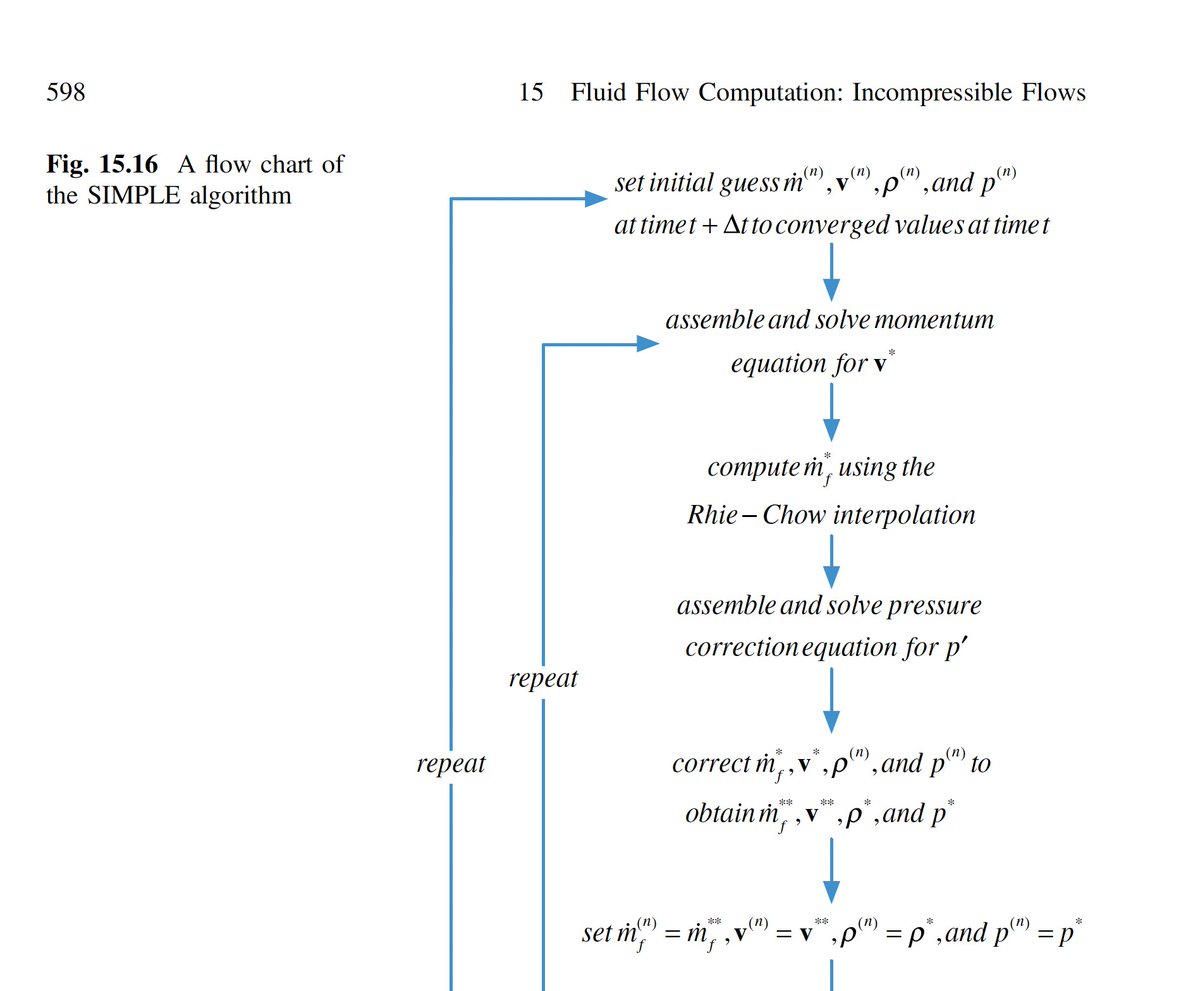
It says "solve momentum equations" and "solve pressure correction equation", but I want to know how well they are solved, for example, how many iterations are typically performed to solve these equations. I'm concerned with the details because I often hear that only one or two iterations are performed in practice. So, I wonder whether "solve" means just one or two iterations, or actually reducing the residuals of the discretized equations to a certain level (e.g., 2 or 3 orders of magnitude).
Hiroaki Nishikawa tweet media
English
6
3
35
2.1K
Philip Cardiff retweetledi
BioEngineering in Ireland 31
🎉 Registration is now OPEN for the 31st Annual BinI Conference 2026! 💡Early bird rates until Nov 21, 2025: PhD/Postdoc: €150 PI: €220 (Standard rates: €200 / €270) 🔗 Register via RAMI: rami.ie/bini-event-reg… #BinI2026
English
0
1
1
131
Hiroaki Nishikawa
Hiroaki Nishikawa@HiroNishikawa·
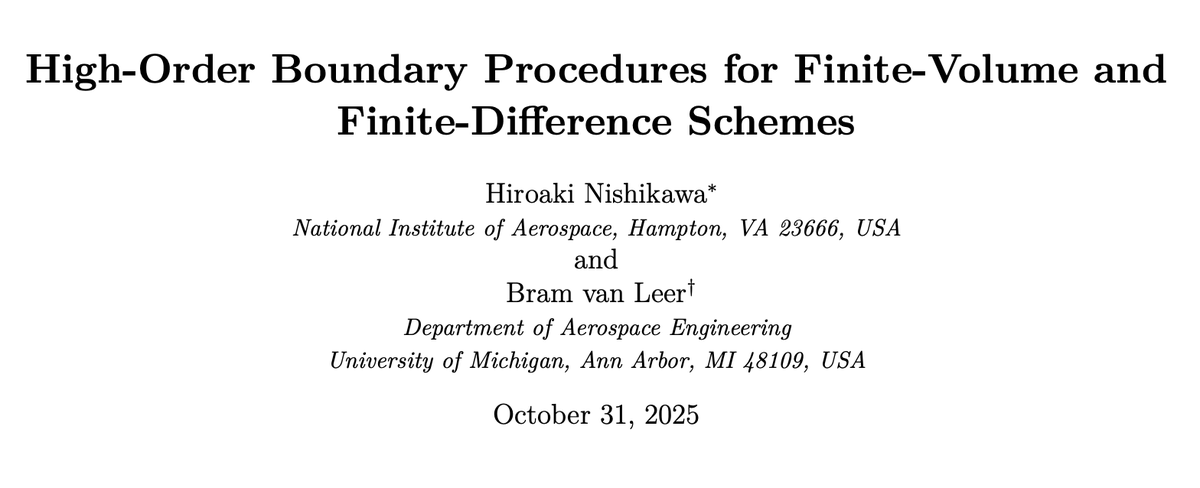
Finished a draft. It took about three years but I think we were able to improve the original algorithms and also derived new formulas for node-centered schemes. This paper is due May 2026, and so we still have time. Good.
Hiroaki Nishikawa tweet media
English
2
6
49
3.5K
Philip Cardiff
Philip Cardiff@phiiliipc·
@HiroNishikawa I wonder if there is a definition for “very high order” or “very very high order” in the same way high order is >2. >4 seems like very so maybe over 8 is very very 😜
English
0
0
3
81
Hiroaki Nishikawa
Hiroaki Nishikawa@HiroNishikawa·
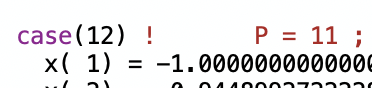
"p=11" indicates 12th-order accuracy. It's the first time I've seen a code with such a very very high-order scheme.
Hiroaki Nishikawa tweet media
English
2
2
26
1.7K
Philip Cardiff
Philip Cardiff@phiiliipc·
@HiroNishikawa MATLAB is nice but it will become slow for 2D and 3D (like other non compiled languages) unless you adopt or avoid certain code features eg nested for loops are not good for speed in script languages
English
0
0
2
193
Hiroaki Nishikawa
Hiroaki Nishikawa@HiroNishikawa·
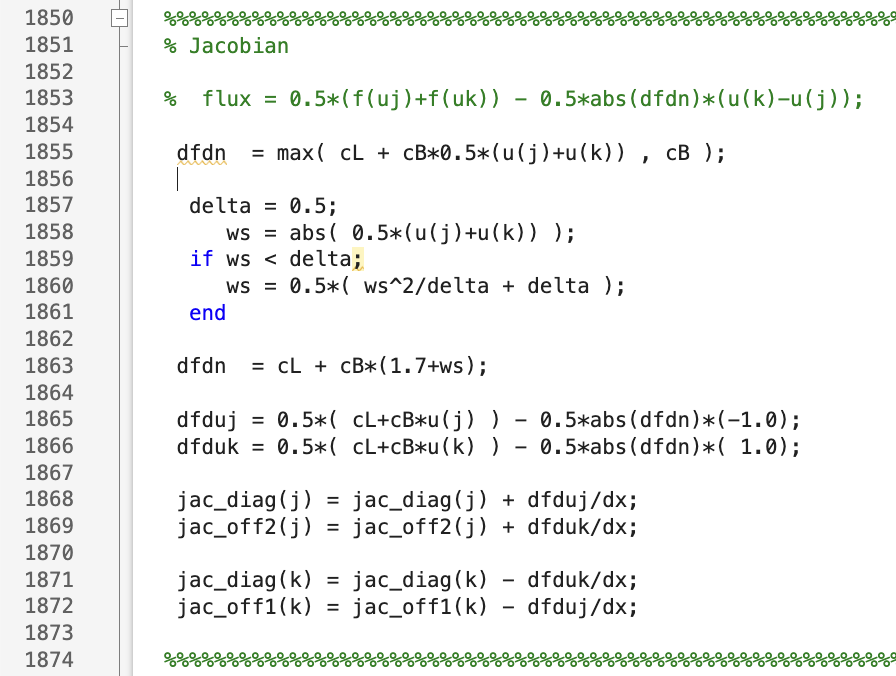
At some point, I started to use Matlab for 1D problems. It's very useful. Maybe I should use it also for 2D problems.
Hiroaki Nishikawa tweet media
English
7
4
105
5.2K
Philip Cardiff
Philip Cardiff@phiiliipc·
@HiroNishikawa What interesting features do spectral collocation method have relative to higher order finite volume or discontinuous Galerkin methods?
English
1
0
0
57
Hiroaki Nishikawa
Hiroaki Nishikawa@HiroNishikawa·
A postdoc position is available for CFD algorithm development at Old Dominion University, Norfolk, VA, USA hera.odurf.odu.edu/careers/Career… -- A new high-order positivity-preserving entropy-stable spectral-collocation schemes for 3D compressible Navier-Stokes equations.
Hiroaki Nishikawa tweet media
English
1
4
43
2.8K
Philip Cardiff
Philip Cardiff@phiiliipc·
@HiroNishikawa How do you calculate the weights? Inverse distance to some power or something else?
English
1
0
0
52
Hiroaki Nishikawa
Hiroaki Nishikawa@HiroNishikawa·
I'm nearing a breakthrough in extending an efficient fourth-order finite volume scheme, originally developed for tetrahedral grids, to mixed-element grids. This is something I thought about and could not figure out for a long time. So, I started to write down the algorithm. An exciting moment in CFD algorithm research.
Hiroaki Nishikawa tweet media
English
1
6
44
4.1K
Hiroaki Nishikawa
Hiroaki Nishikawa@HiroNishikawa·
Interesting database for finite elements
Hiroaki Nishikawa tweet media
English
1
8
75
4.2K
Philip Cardiff retweetledi
OpenFOAM Workshop
OpenFOAM Workshop@of_ws·
Better late than never. The official group picture from the #ofw20
OpenFOAM Workshop tweet media
English
0
3
18
834
Philip Cardiff
Philip Cardiff@phiiliipc·
@HiroNishikawa If you drop these cross derivative terms, will the order of accuracy be affected? 🤔
English
1
0
1
1.2K
Hiroaki Nishikawa
Hiroaki Nishikawa@HiroNishikawa·
This stencil fails because there is no way to determine c4, which is directly related to the cross derivative Pxy, on this stencil. Adding one more point, not on the coordinate axes, will make it work.
Hiroaki Nishikawa@HiroNishikawa

Here's a stencil for which a quadratic least-squares fit fails: cannot determine the coefficients (c0,c1,c2,c3,c4,c5) of a quadratic polynomial, P(x,y) = c0+c1*x+c2*y+c3*x^2+c4*x*y+c5*y^2 by minimizing sum_k | P(xk,yk) - f(xk,yk) |^2, here f(x,y) is a given function.


English
2
0
8
1.3K
Rúaidhrí O'Connor
Rúaidhrí O'Connor@RuaidhriOC·
Been trying to firm this up for a few hours, but here's a bolt from the blue All Black great Carlos Spencer is the new head coach of Terenure College RFC
Rúaidhrí O'Connor tweet media
English
23
10
322
69.9K
Philip Cardiff
Philip Cardiff@phiiliipc·
@HiroNishikawa Using a LSQ fit is interesting; I guess it becomes important for randomly perturbed grids
English
1
0
2
211
Hiroaki Nishikawa
Hiroaki Nishikawa@HiroNishikawa·
Yes, if you mean the order of truncation error. It's possible to determine it numerically. Not sure if I can explain this well enough here on X, but I can try once: (1) Write a code that computes your target discrete approximation (residual) at each node/cell in a grid over the domain x=[0,1], e.g., Res_j = ( f_{j+1/2} - f_{j-1/2} )/dx, which approximates df/dx=0 at a node/cell j, where f=f(u), and u is the solution, (2) Choose a smooth function for u, e.g., u(x)=exp(0.5*x), and store it at nodes/cells, u_j=u(x_j) if you define your numerical solution as a point value at x_j, a node or a cell center, (or compute cell averages if you define your numerical solution as a cell average), (3) Compute the residual, Res_j, at each node/cell with the smooth function values that you stored, u_j, j=1,2,3,..., (4) Subtract the value of df/dx at x_j from Res_j, e.g., if f=a*u with a=constant, Res_j = Res_j - a*0.5*exp(0.5*x_j), which should be the truncation error at x=x_j, (5) Compute a norm of Res_j: e.g., L1(Res) = sum_j | Res_j | / N, where N is the total number of nodes/cells, (6) Repeat the process over a series of refined grids, e.g., N=8, 16, 32, etc., and then plot log10( L1(Res) ) versus log10( 1/N ). (7) Slope of the line passing through the data points (or LSQ fit) would be the order of truncation error.
スバル@taikodrumer

@HiroNishikawa Is it possible to figure out the order of the error without computing the exact formulas? (I know little about CFD)
English
2
2
12
1.5K
Hiroaki Nishikawa
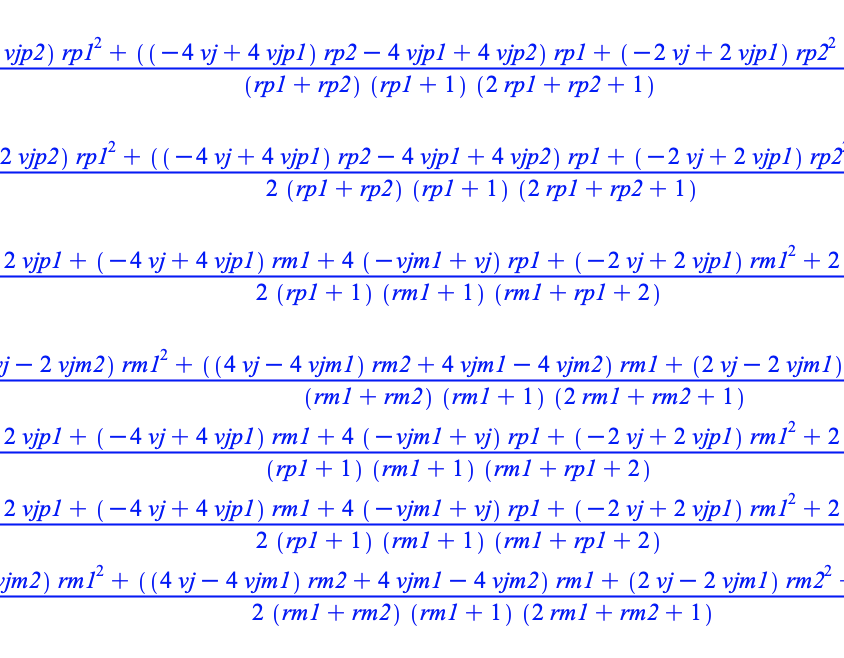
Hiroaki Nishikawa@HiroNishikawa·
Deriving a truncation error of a high-order scheme on a irregular grid. It's very complicated...
Hiroaki Nishikawa tweet media
English
5
6
88
3.8K
Philip Cardiff retweetledi
OpenFOAM Workshop
OpenFOAM Workshop@of_ws·
Don't miss out on the OpenFoam Workshop submission deadline: 30th of April! This is your chance to showcase your latest results, learn from industry experts, and connect with fellow colleagues. Make sure to submit on time to be part of this event, in beautiful Vienna, Austria
OpenFOAM Workshop tweet media
English
0
2
4
1K