

phra
2.6K posts



phra retweetledi


phra retweetledi

The IDF raided the home of a family that requested accommodation to evacuate their child with cerebral palsy—grenading the kitchen, schrapnel piercing the kid’s eye and brain; they executed the parents; then berated the 2 other kids about tunnels, before sending them out on foot.
Saul Staniforth@SaulStaniforth
"It was lunchtime. We were sitting down. They raided our house. They shot our mum and dad. Then they started shooting at us" Part of a detailed Sky News report on how Israeli soldiers murdered a mother and father in front of their 3 children (1/2)
English
phra retweetledi




phra retweetledi





phra retweetledi

The archaeological site at Lajiazhen in central China, located along the banks of the Yellow River, unveiled a poignant glimpse into the past. In this remarkable discovery, skeletons dating back 4,000 years depicted a mother's valiant efforts to protect her child during an earthquake that shook the village to its core in 2015.
The excavation process unearthed a total of 20 skeletons, each bearing the physical marks of distress caused by external forces. The ruined buildings strewn with debris served as a backdrop, allowing archaeologists to piece together a tragic tale. It became evident that the villagers residing along the Yellow River were defenseless against the immense power of Mother Nature.
Two main theories emerged from the scientific analysis of the site. The first theory suggested that the village was struck by a devastating earthquake. The seismic activity also triggered the formation of a natural dam upstream on the Yellow River, resulting in the accumulation of water. Several months later, the dam collapsed, unleashing a catastrophic flood that engulfed the village. The presence of sediment and the concurrent damage from the earthquake indicated that these events likely occurred in the same year.
The second theory pointed to flash floods and mudslides as the culprits behind the villagers' demise, as these natural phenomena have been recurrent in the region throughout history.
The village of Lajiazhen offered valuable insights into the lives of ancient Chinese peasants, revealing their agricultural practices and their keeping of animals for sustenance and religious purposes. Moreover, this site also unveiled an extraordinary find in 2005—an overturned pot containing the world's oldest noodles.
Due to its significance, the site has gained widespread renown and is often referred to as "China's Pompeii."

English
phra retweetledi
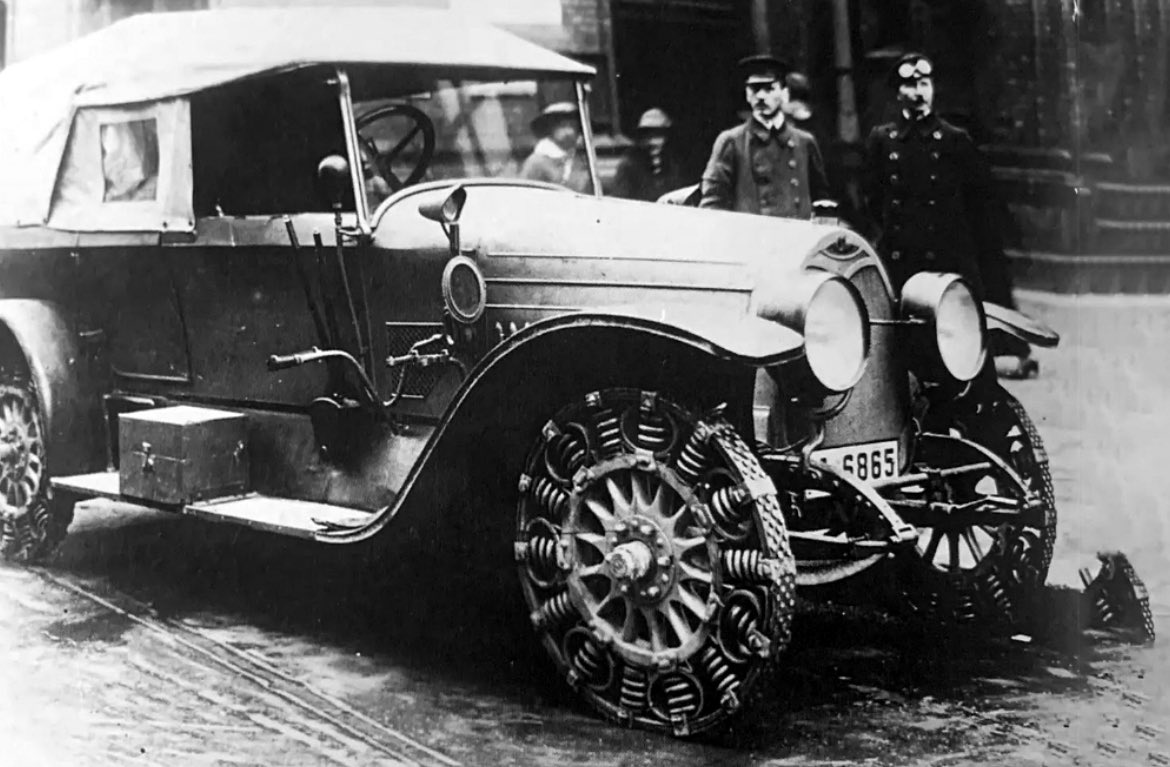
In the early 1900s, the shortage of rubber and the challenges associated with filling tires with air during the First World War led to a significant need for alternative solutions. In response to this problem, German engineers devised a groundbreaking invention in 1916—a steel spring tire.
The tire was specifically designed by the Germans to address the scarcity of rubber and the unreliable nature of traditional rubber tires. Their goal was to create a tire that not only offered a viable alternative to rubber but also provided enhanced reliability, particularly for military vehicles that required robust and durable tire solutions.
The innovative steel spring tire was first implemented on a Protos vehicle, showcasing its potential for military applications. The tire design incorporated a series of steel springs arranged in a circular pattern, which replaced the conventional rubber construction. These springs were strategically placed to provide both support and flexibility, allowing the tire to withstand the rigorous demands of military operations while offering improved traction on various terrains.
One of the key advantages of the steel spring tire was its resistance to punctures and damage, which significantly reduced the need for constant maintenance and tire replacements. This attribute made it particularly attractive for military vehicles operating in challenging environments, such as battlefields or rough terrain.
Furthermore, the German engineers believed that the steel spring tire's performance would not be affected by adverse weather conditions, a common issue with traditional rubber tires. The tire's unique design was expected to maintain its reliability and functionality even in extreme temperatures, making it well-suited for military campaigns in diverse climates.
While the steel spring tire initially gained attention due to its potential military applications, there was also significant interest in its civilian use. The tire's durability and puncture resistance made it an attractive option for commercial vehicles, especially those that frequently traveled on rough roads or encountered sharp debris.
Although the steel spring tire demonstrated promise, the end of the First World War and subsequent developments in rubber technology led to a shift back towards traditional rubber tires. Rubber became more accessible again, and advancements in tire manufacturing techniques and materials improved the reliability and performance of rubber tires. As a result, the steel spring tire gradually faded from use, becoming a fascinating but short-lived chapter in the evolution of tire technology.
Nonetheless, the German engineers' ingenuity in developing the steel spring tire during a time of resource scarcity and technological challenges remains a testament to human innovation and adaptability in the face of adversity.

English
phra retweetledi

3/26/23: A cop helicopter flying too low got its tail tangled in a tree top and crashed, killing 2 Baton Rouge cops. The man they had been hunting, Deandre Dwayne Bessye, was accused only of refusing traffic stop. Cops caused their own crash. Bessye got charged with murder x2.

English
phra retweetledi

One of these kids complained that her childhood was stolen. Guess who?

English
phra retweetledi

A rarely seen video filmed by the Japanese coast guard shows the massive tsunami waves swelling in the sea off the coast of northern Japan, after the M9.0 Tōhoku earthquake which struck offshore #Today in 2011
[video: buff.ly/428GEgC]
twitter.com/blabla112345/s…
English
phra retweetledi

Drone footage recorded in a New Brunswick woodland shows a moose losing both of its antlers.
Credit: Derek Burgoyne
English
phra retweetledi

All the evils of pervasive surveillance, and none of the possible benefits. You owe it to yourself to read @doctorow this horrific account doctorow.medium.com/vw-wouldnt-loc…
English




@malcolmkenyatta Why don't you make police insure themselves instead of letting the taxpayer pick up the tab when they get sued !
English

I’m not sharing or watching the video of Tyre Nichols having his life stolen. This is how we should remember him — as someone who was loved and who mattered.
He should be alive and the work must never stop to ensure more lives aren’t brutally taken.
Highspire, PA 🇺🇸 English
phra retweetledi

today, after i narrowly missed my subway, a woman came up to me and ask if i spoke spanish. i said yes and she asked me how to get to east harlem. i told her that we would be transferring at the same stop, so she should just stick with me. we sat down and started talking
English