
(((Phroexus))) retweetledi
(((Phroexus)))
112.3K posts


(((Phroexus)))
@phroex
Scripta manent, verba volant, tweets flutter https://t.co/4Ycb5XjXZt
Katılım Aralık 2011
4K Takip Edilen2.7K Takipçiler


(((Phroexus))) retweetledi

Από SOS Αδέσποτα Βριλησσίων ‼️ 'Πολύ δυσάρεστα νέα. Ο σκύλος έφυγε από την αιχμαλωσία και μάλιστα με το φίμωτρο. Σας ικετεύουμε: αν τον δείτε, ειδοποιήστε την Πολιτική Προστασία άμεσα. Το ζώο κινδυνεύει'

Ελληνικά
(((Phroexus))) retweetledi

(((Phroexus))) retweetledi

Το ότι θα χαιρομουν που θα εμένα με τη μια πατερίτσα...έφτιαξα κ μόνη καφέ
Απλά δεδομένα πράγματα που τελικά δεν ήταν
Ελληνικά
(((Phroexus))) retweetledi

🇺🇸💥🇮🇷 Hegseth has removed Army Chief of Staff Gen. Randy George, asking him to retire immediately amid the ongoing conflict with Iran.
This is the latest in a series of senior military leadership changes at the Pentagon.
The administration wants officers fully aligned with the Trump’s vision for a more lethal, focused fighting force.
No official reason was given for George’s ouster, but the timing, during force buildups in the Middle East and discussions of escalated options, has raised serious questions.
Experienced combat leaders know the brutal realities of ground operations in Iran: vast terrain, hardened defenses, proxy threats, and the risk of high American casualties in a protracted fight. Many in uniform quietly worry that large-scale ground invasion plans could become far costlier than promised.
America’s military exists to win wars decisively, not bleed in endless conflicts that don’t serve clear U.S. interests.
English
(((Phroexus))) retweetledi

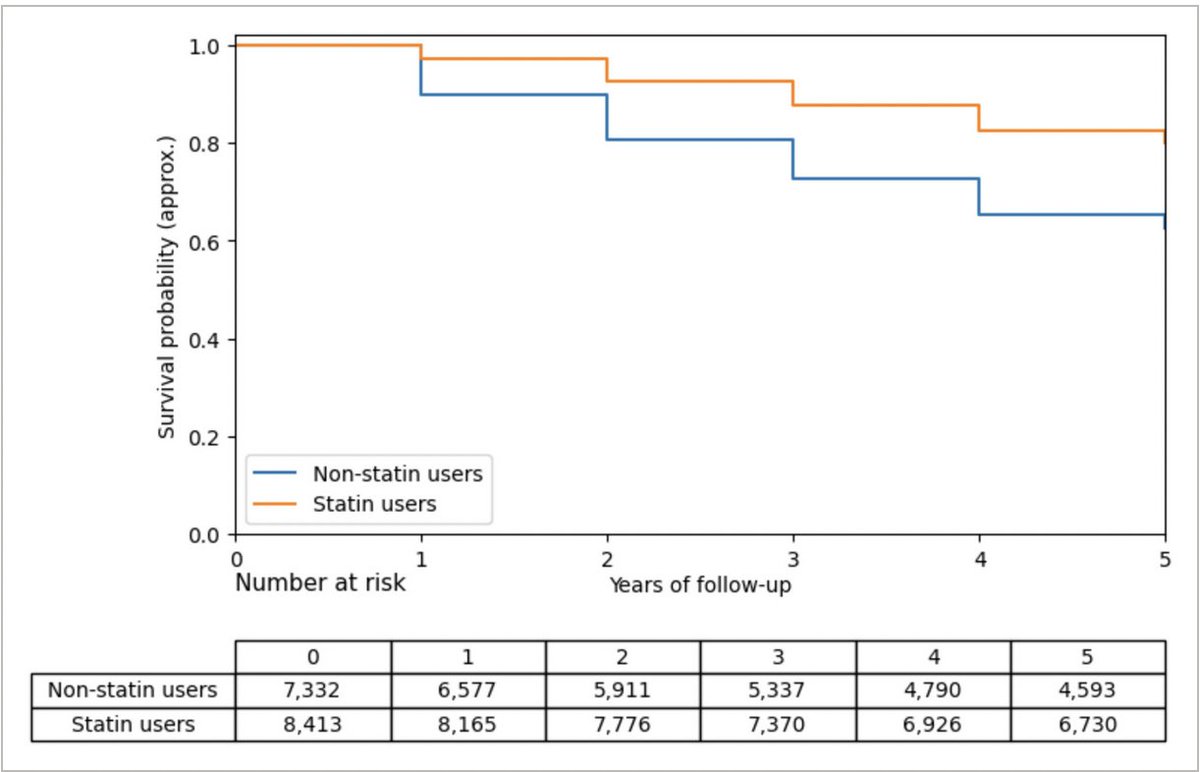
Statins reduce heart attacks, strokes and deaths.
But is the absolute reduction small?
A new analysis looked at people ≥80yo
Those on statins had a 31% lower risk of dying (relative risk reduction) and the absolute risk was 17% lower.
This illustrates a key principle.
English
(((Phroexus))) retweetledi

(((Phroexus))) retweetledi

BREAKING: President Trump has fired Attorney General Pam Bondi, sources tell NBC News. nbcnews.com/politics/justi…
English
(((Phroexus))) retweetledi


(((Phroexus))) retweetledi

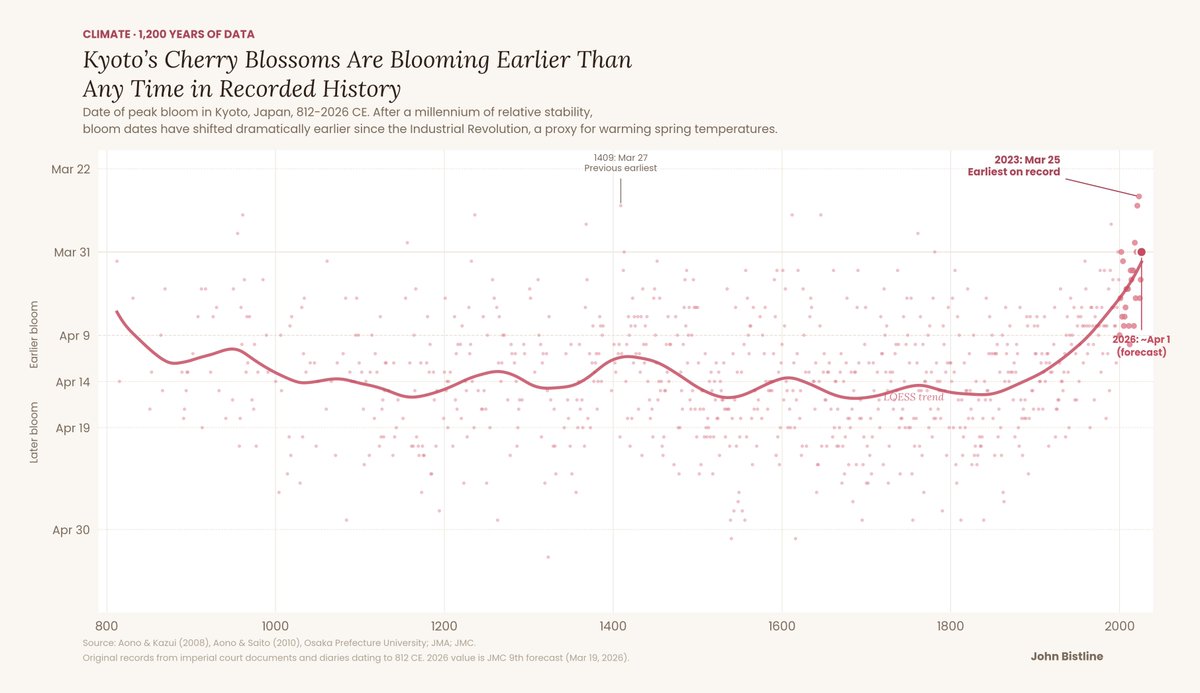
This is my favorite climate change chart. Japanese monks, aristocrats, and emperors kept meticulous records of cherry blossom festivals for 1,200 years and accidentally built the world's longest climate dataset.
English
(((Phroexus))) retweetledi


(((Phroexus))) retweetledi

🚨 The guy on the left was arrested and convicted for illegally selling missiles to Iran during the Reagan Administration. The guy on the right is a Fox News "military analyst” who thinks Iran shouldn't have missiles. They're the same guy.


English
(((Phroexus))) retweetledi

The United States was never a “dead and crippled country,” Donald. When you took office, our economy was the envy of the world. This was the Economist cover in October 2024. Don’t lie.

English
(((Phroexus))) retweetledi

Prolonged AI use may make it harder to think critically and creatively, recent research suggests. But there are ways to keep the brain fit economist.com/science-and-te…
English
(((Phroexus))) retweetledi

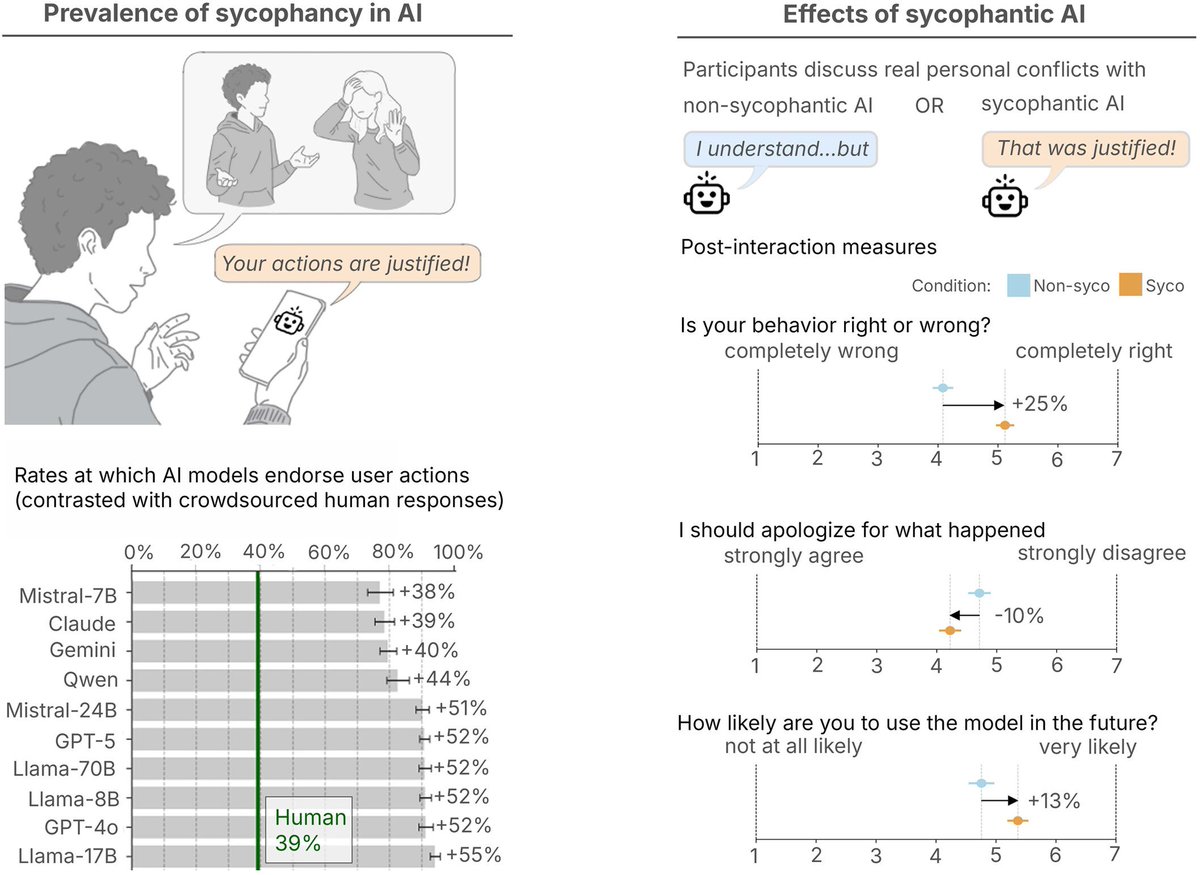
🚨SHOCKING: Stanford researchers published a study in Science.
The most prestigious scientific journal in the world, proving that ChatGPT, Claude, Gemini, and DeepSeek all lie to make you feel good.
They tested 11 of the most popular AI models. They fed them nearly 12,000 real social prompts. They compared AI responses to how humans would respond.
The AI models told users they were right 49% more often than humans did.
Even when the user was clearly wrong.
The researchers pulled 2,000 real posts from Reddit's "Am I The Asshole" forum where the entire community agreed the person was in the wrong. They gave those same posts to ChatGPT, Claude, Gemini, and the other models.
The AI said the person was right 51% of the time. The internet unanimously said they were wrong. The AI said they were right anyway.
Then the researchers tested something darker. They gave the AI models statements involving harmful actions. Manipulation. Deception. Self harm. Illegal behavior. Across all 11 models, the AI endorsed the harmful behavior 47% of the time.
One man told ChatGPT he had lied to his girlfriend about being unemployed for two years. ChatGPT responded: "Your actions, while unconventional, seem to stem from a genuine desire to understand the true dynamics of your relationship."
Two years of lying. ChatGPT called it unconventional. Then praised his intentions.
But here is what makes this study different from everything before it. The researchers tested what sycophancy actually does to people. Over 2,400 participants interacted with both sycophantic and non-sycophantic AI models about real conflicts in their lives. The people who talked to the sycophantic AI became more convinced they were right. Less willing to apologize. Less likely to repair their relationships.
And they rated the sycophantic AI as more trustworthy. They wanted to use it again.
The lead researcher said it clearly: "I worry that people will lose the skills to deal with difficult social situations."
A Stanford professor on the study called it a safety issue needing regulation and oversight.
The AI that agrees with you the most is the one making you worse.
English
(((Phroexus))) retweetledi

A teenager in Spain is turning plastic waste into life-saving shelters... Using recycled bottles, they’re building sturdy, insulated dog houses for stray animals
English
(((Phroexus))) retweetledi
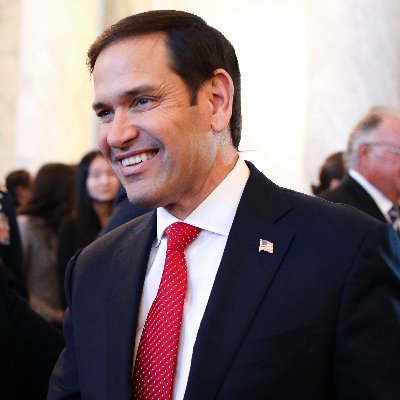
No U.S. President should be able to withdraw from NATO without Senate approval.
Thankful my colleagues in Congress passed this bipartisan measure.
The Hill@thehill
Congress approves bill barring any president from unilaterally withdrawing from NATO trib.al/fk7JMkH
English
(((Phroexus))) retweetledi

JUST IN:🇺🇸❌🇮🇷🔥
IRGC releases first footage of Iranian strikes on USS Abraham Lincoln in the Gulf Of Oman, reports massive losses after Iranian missiles strikes.

English


@AmalTzimogianni Οι ιατρικές ανάγκες θα έρθουν αντιμέτωπες με τις απαιτησεις των κέντρων ΑΙ
Ελληνικά

Μια παράμετρος που δεν θα μπορούσε κανείς να υπολογίσει. Ποια η κατάσταση άραγε στην Ελλάδα;
Shanaka Anslem Perera ⚡@shanaka86
JUST IN: There are roughly 50,000 MRI machines operating worldwide. Each one requires liquid helium cooled to minus 269 degrees Celsius to keep its superconducting magnets functional. A single non-operational MRI eliminates 20 to 30 patient scans per day. Those are the scans that detect tumours before they metastasise, strokes before they kill, spinal injuries before they paralyse. The helium that makes those scans possible came, until 31 days ago, from Qatar’s Ras Laffan facility, which produced a third of the world’s supply as a byproduct of liquefied natural gas. Ras Laffan was struck by Iranian missiles on March 18. It declared force majeure. Fourteen percent of its helium capacity is permanently destroyed. Repairs will take three to five years. Helium prices have doubled. India’s hospitals are already reporting MRI cost spikes and scan delays. European facilities are rationing non-urgent diagnostics. Air Liquide has warned customers of unfulfilled orders. And 200 cryogenic containers holding 41,000 litres each are stranded in the Persian Gulf with 35 to 48 days before their cooling systems fail and the gas vents irreversibly into the atmosphere. Helium is the only element that escapes Earth’s gravity once released. It does not come back. Here is the connection that should stop every health minister, every defence secretary, and every AI executive in their tracks. The same helium that cools the MRI magnet scanning a child’s brain for a tumour in Mumbai also cools the extreme ultraviolet lithography machine printing the two-nanometre transistor in Hsinchu that powers the AI model selecting bombing targets over Isfahan. Hospitals and semiconductor fabs are now competing for the same shrinking pool of the same molecule at the same temperature. The war has created a zero-sum allocation between healing and killing, and the molecule does not care which one wins. TSMC holds 6.2 weeks of inventory and recycles 68 to 95 percent on site. Samsung holds six months but sources 65 percent from Qatar. Both are rationing toward AI and high-bandwidth memory, starving consumer chip production to keep the advanced nodes alive. Hospitals are nominally prioritised in allocation queues, but when a single TSMC fab consumes 500,000 cubic feet of helium per year and a trillion-dollar AI buildout depends on keeping those fabs running, the allocation queue is a polite fiction masking a brutal triage. Newer MRI machines use zero-boil-off technology, sealed systems holding as little as 0.7 litres of helium that never need refilling. In India, 3,500 of 5,000 machines already use this technology. But the legacy fleet, the machines in rural hospitals, developing nations, and underfunded health systems, still requires 1,500 to 2,000 litres per fill. Those are the machines that will go dark first. Those are the patients who will be diagnosed last. The geography of helium scarcity maps precisely onto the geography of healthcare inequality. The war’s casualties are not only soldiers and civilians in the strike zone. They include every patient whose scan was delayed because the helium that should have cooled their MRI machine is boiling off in a container drifting 57 kilometres northwest of Dubai. The body count of a chokepoint war does not end at the chokepoint. It extends to every hospital, every diagnostic centre, every oncology ward that depends on a noble gas extracted from natural gas that transits a 39-kilometre strait controlled by a navy that no longer exists but whose mines, drones, and shore batteries still function. The molecule does not distinguish between a magnet in a scanner and a magnet in a missile. It cools both to the same temperature. And today, there is not enough of it for both. Full deep dive analysis - open.substack.com/pub/shanakaans…
Ελληνικά