

Pixel ZenZ
38.2K posts

Pixel ZenZ
@pixelzenz
Pixel World with Zen Comiing ~
Katılım Ekim 2023
2.8K Takip Edilen1.2K Takipçiler


"The era of isolated machines is over."
Meet our CEO, @JOllwerther .
Business leader with 15+ years in robotics, drone-tech, and media. Jon led commercial teams at Measure (Drone as a Service) and Aerobo/Vermeer.
Now, he’s creating TCP/IP for Motion.
Get ready to experience Konnex.
English
SIGN – Nền tảng chủ quyền số đang thay đổi cục diện Trung Đông!
Khi các quốc gia vùng Vịnh đang lao vào cuộc đua kinh tế số, @Sign mang đến SIGN như một “siêu hạ tầng” thực thụ: Sovereign Infrastructure for Global Nations. Từ CBDC quốc gia, token hóa tài sản thực (RWA), đến hệ thống danh tính số tự chủ – tất cả đều được xây dựng trên Sign Protocol với zero-knowledge privacy, hybrid blockchain (public L2 + Hyperledger Fabric private chain) và TokenTable phân phối quy mô hàng triệu người.
Dubai muốn blockchain hub số 1? Riyadh Vision 2030 cần dòng vốn RWA khổng lồ? SIGN chính là lớp hạ tầng giúp họ giữ chủ quyền dữ liệu, kiểm soát dòng vốn, đồng thời kết nối liền mạch với thanh khoản toàn cầu. Không còn phụ thuộc, không còn rủi ro – chỉ có tăng trưởng bùng nổ dưới quyền kiểm soát của chính họ!
Đây không phải token hype, đây là công nghệ quốc gia thực chiến. Trung Đông đang thức tỉnh với $SIGN – và bạn thì sao?
#SignDigitalSovereignInfra

Tiếng Việt
How Do Concrete Vaults Actually Work?
You open a DeFi app.
You deposit funds into a vault.
Moments later, you receive vault shares.
Then you notice new numbers appear: eRate, NAV, maybe even changing balances over time.
And the question hits:
“What is actually happening to my money?”
Let’s break down Concrete vaults in a way that feels intuitive — not technical.
1. From Your Perspective: What You Actually Did
Think of this like joining a shared investment pool.
You deposit assets into a Concrete vault
The system gives you vault shares
Your shares represent your ownership
Over time, your balance increases
But here’s the key:
👉 You don’t earn yield because your tokens sit still
👉 You earn because your capital is actively working onchain
This is what makes managed DeFi different.
2. Vault Shares & eRate — The Simple Truth
Let’s simplify this with a mental model:
🫙 The Jar Analogy
The vault = a jar filled with assets
Your deposit = adding water into the jar
Vault shares = how much of the jar you own
Now introduce:
📈 eRate (Exchange Rate)
eRate = value of each share
At the beginning: 1 share ≈ 1 unit of value
Over time: 1 share becomes worth more
👉 You don’t get more shares
👉 Your shares become more valuable
This is automated compounding in action.
3. NAV — The Whole Picture
Let’s remove the jargon.
NAV (Net Asset Value) simply means:
The total value of everything inside the vault
So:
NAV = total pool of capital
Vault shares = slices of that pool
If the vault grows from $1M → $1.2M:
NAV increases
Your share of the pool is worth more
eRate goes up
👉 You didn’t do anything
👉 The system made your capital more efficient
4. Why Time Matters (More Than You Think)
This is where most people misunderstand DeFi vaults.
Vaults are not designed for quick in-and-out moves.
Think of it like planting a tree 🌱
Day 1: You plant it
Day 2: Nothing happens
Weeks later: Growth starts
Months later: You see real results
Why?
Because:
Strategies need time to generate yield
Onchain execution has costs (gas, fees)
Capital needs to be deployed efficiently
Markets fluctuate in the short term
👉 If you leave too early, you miss the compounding phase
👉 If you stay longer, you benefit from exponential growth
Time is not just a factor — it’s the engine.
5. Not Passive: The Power of Active Management
A common misconception:
“Vaults just hold assets.”
That’s wrong.
Concrete vaults are actively managed systems.
🍳 Think of It Like a Chef
The vault = a kitchen
Your capital = ingredients
The system = the chef
The chef doesn’t just store food.
They:
Deploy capital across strategies
Rebalance positions
Adapt to market conditions
Optimize for yield and risk
This is onchain capital deployment at work.
6. What This Means for You
Now connect everything:
Your vault shares represent ownership
NAV tracks the total system value
eRate reflects how much each share is worth
Strategies generate yield
Management optimizes performance
Time unlocks compounding
The Result:
👉 Your capital doesn’t just grow
👉 It grows smarter over time
This is the core of managed DeFi.
7. The Mental Model You Should Remember
Let’s simplify everything into one clean framework:
Concrete vaults = pooled capital system
Vault shares = your ownership
NAV = total value of the pool
eRate = value per share
Time = growth driver
Active management = optimization layer
Put simply:
You’re not just depositing into a vault
you’re plugging into an engine designed for automated compounding and intelligent capital allocation.
Final Thought
Most people focus on returns.
Few understand how those returns are generated.
But once you understand the mechanics:
You stop thinking like a trader…
and start thinking like an allocator.
🚀 Explore Concrete at app.concrete.xyz @ConcreteXYZ
English
🚨 SIGN is one of the most overlooked infrastructure plays in Web3 right now
While most of the market is chasing short-term narratives,
Sign Protocol is building something far more fundamental:
👉 A trust layer for the digital economy.
@Sign transforms real-world data into verifiable, on-chain attestations powering use cases like:
Digital identity
Compliance (KYC/AML)
CBDCs
Real-world assets (RWA)
With multi-chain support + Zero-Knowledge privacy,
it enables systems to verify truth without exposing sensitive data.
📊 Why this matters:
The next phase of crypto won’t be driven by hype alone
it will require:
Regulation
Real users
Institutional adoption
And all of that depends on trusted, standardized data.
🌍 From government infrastructure to global markets,
Sign is positioning itself at the center of this shift.
⚡ $SIGN isn’t just another narrative it’s the foundation layer most people haven’t priced in yet.
#SignDigitalSovereignInfra

English

🔐 Sign Protocol ( $SIGN ): The Trust Layer of Web3
@Sign is building an omni-chain attestation layer that turns real-world data into verifiable, cryptographically signed records.
Instead of just moving assets, Sign enables trust to become programmable.
⚙️ Core Idea
Schemas → standardized data templates
Attestations → signed proofs of real-world claims
This allows systems to verify things like identity, compliance, or transactions in a consistent and scalable way.
🔒 Key Strengths
Multi-chain + off-chain flexibility
Privacy-first (Zero-Knowledge proofs)
Selective disclosure & lifecycle management
🌍 Why It Matters
From digital identity to CBDCs and RWA verification, Sign Protocol provides the infrastructure for trusted data at national scale.
✨ Takeaway
If blockchains secure value,
Sign Protocol secures truth.
#SignDigitalSovereignInfra

English
Sign Protocol (@Sign / $SIGN )
Sign Protocol is the cryptographic evidence and attestation layer powering the full S.I.G.N. (Sovereign Infrastructure for Global Nations) architecture. It is an omni-chain attestation protocol that lets governments, institutions, and developers define standardized templates (Schemas) and issue cryptographically signed, verifiable records (Attestations) that prove real-world claims all while remaining fully interoperable, privacy-first, and auditable at national scale. #SignDigitalSovereignInfra
English
The Middle East is on the cusp of an economic renaissance powered by true digital sovereignty! @Sign is leading the charge with $SIGN, building the essential infrastructure that lets nations control their data, secure cross-border trade, and unlock unprecedented growth.
From Dubai’s blockchain hubs to Riyadh’s Vision 2030, $SIGN delivers the sovereign layer every forward-thinking economy needs decentralized, tamper-proof, and built for real-world impact. This isn’t just another token; it’s the foundation for self-reliant digital nations thriving in the 21st century. Who’s ready to see $SIGN fuel the next wave of Middle Eastern prosperity?
#SignDigitalSovereignInfra

English
Gần đây nhất, vào ngày 16/3/2026, @konnex_world đã mở mint cho bộ sưu tập NFT "Konnex Autonomous Units" trên
@opensea
(chuỗi
@ethereum
, giá 0.0004 $ETH). Đây là các đơn vị robot đầu tiên tham gia mạng lưới, được thiết kế để vận hành và phát triển, mở ra cánh cửa vào hệ sinh thái Konnex. Dự án thường tổ chức các buổi thảo luận trên X Spaces, như cuộc trò chuyện với Acurast và FolksFinance về chuyển đổi sang nền kinh tế máy móc.
Tiếng Việt
The End of Manual Labor: Why the Future of DeFi is Built on Infrastructure, Not Apps
If you’ve spent more than a week in DeFi, you’ve likely realized that "being your own bank" often feels like a grueling full-time job.
To keep your capital even remotely productive, you have to navigate a fragmented nightmare: hundreds of protocols across dozens of chains, each with shifting yields and opaque risks. You aren't just an investor; you’re a part-time researcher, a gas-fee accountant, and a 24/7 risk monitor.
The current landscape is built for hobbyists with infinite time. But for institutional DeFi to truly scale, we need to stop "playing" with apps and start deploying through systems. We need DeFi vaults.
The Fragmentation Problem: Abundance vs. Exhaustion
The problem isn't a lack of opportunity; it’s the sheer weight of managing it. Today, the DeFi map is a mess of silos. New strategies pop up on Layer 2s every hour, yields on Aave or Compound shift by the minute, and liquidity is scattered across a dozen DEXs.
For the average user, keeping capital productive requires constant attention. If you aren't staring at a dashboard, you’re likely losing money to "human latency" the time it takes for you to notice a yield has dropped and move your money somewhere else.
The Hidden Cost of Manual Finance
Managing positions manually isn't just annoying; it’s inefficient. The operational burden is staggering:
Gas Leaks: Moving $1,000 to chase a 2% higher yield often costs more in gas than the profit you’ll make.
Idle Capital: Because rebalancing is a chore, capital often sits in outdated strategies, missing out on better, safer opportunities.
Fragmentation Risk: Tracking risk across ten different tabs is a recipe for disaster. One missed liquidation alert, and your "yield" vanishes.
In short, manual DeFi doesn't scale. It creates a "tax" on your time and your returns.
Enter the Vault: From Manual Strategy to Automated Systems
In mature financial systems, capital doesn’t move because a human clicked a button; it flows through infrastructure. Concrete vaults represent this evolutionary leap. Instead of you chasing the yield, the vault acts as a sophisticated engine for onchain capital deployment.
By moving from "apps" to managed DeFi infrastructure, we unlock a level of capital efficiency that was previously impossible for individual users. A vault doesn't sleep, it doesn't get bored, and it doesn't forget to compound.
How Concrete Engineers Capital
Concrete isn't just a place to "park" your crypto; it’s a structured system designed to handle the complexity of the market for you. It relies on a three-pillar architecture:
The Allocator: This is the brain of the operation, handling active capital deployment to ensure your assets are always where they are most productive.
The Strategy Manager: This defines the "universe" of where capital can go, ensuring your money stays within high-quality, vetted strategies.
The Hook Manager: Think of this as the "Onchain Compliance Officer." It enforces risk parameters in real-time, ensuring that the vault never strays into toxic or illiquid territory.
This combination allows for automated compounding and rebalancing that is deterministic meaning it happens exactly when it should, every single time.
Real-World Efficiency: The Concrete DeFi USDT Vault
To see this in action, look at the Concrete DeFi USDT vault. In a market where people are still manually hopping between "inflation-heavy" farms, this vault offers a stable ~8.5% yield.
The secret isn't a magic trick; it’s infrastructure. The vault automates the management of debt and credit states, ensuring capital is never idle. While a manual user is busy calculating gas costs to move their stables, the Concrete vault has already rebalanced, compounded, and secured the position. It turns a "boring" stablecoin into a high-performance financial tool.
The Big Shift: Systems Over Hype
The future of DeFi won't be defined by who finds the next "1,000% APY" gem. It will be defined by who builds the best systems to manage capital.
As the ecosystem grows more complex, manual management will become obsolete. We are moving toward a world where Concrete vaults are the default interface a world where you allocate your capital to a trusted system and let the infrastructure handle the rest.
The era of manual labor is ending. The era of onchain systems is here.
Explore Concrete at app.concrete.xyz

English
Konnex đã chứng minh khả năng của mình qua các thử nghiệm kéo dài 6 tháng, đạt tỷ lệ thành công 99.5% trong việc AI điều khiển robot, được xác thực độc lập. Họ đang phát triển các giai đoạn như Ingest (đã ra mắt vào cuối tháng 1/2026), cho phép người dùng nộp mô hình Vision-Language-Action và đánh giá hành vi robot trong thời gian thực. Dự án cũng thu thập dữ liệu robot phi tập trung, với hơn 1.5 triệu lượt nộp RLHF (Reinforcement Learning from Human Feedback) và hơn 382.000 ví duy nhất tham gia testnet.
@konnex_world with : hub.konnex.world/points?referra…
Pixel ZenZ@pixelzenz
Konnex, với tài khoản X @konnex_world, là một dự án tiên phong trong lĩnh vực công nghệ tự động hóa và blockchain. Với khẩu hiệu "Building the GDP of autonomous systems. Turning robot labor into on-chain liquidity. $KNX", Konnex tập trung vào việc xây dựng nền kinh tế máy móc, nơi lao động của robot được chuyển hóa thành tài sản thanh khoản trên chuỗi khối. Dự án kết hợp trí tuệ nhân tạo (AI), robot học và công nghệ phi tập trung để tạo ra hệ sinh thái nơi các agent AI có thể kiểm soát robot một cách tự động. Konnex đã chứng minh khả năng của mình qua các thử nghiệm kéo dài 6 tháng, đạt tỷ lệ thành công 99.5% trong việc AI điều khiển robot, được xác thực độc lập. Họ đang phát triển các giai đoạn như Ingest (đã ra mắt vào cuối tháng 1/2026), cho phép người dùng nộp mô hình Vision-Language-Action và đánh giá hành vi robot trong thời gian thực. Dự án cũng thu thập dữ liệu robot phi tập trung, với hơn 1.5 triệu lượt nộp RLHF (Reinforcement Learning from Human Feedback) và hơn 382.000 ví duy nhất tham gia testnet. Gần đây nhất, vào ngày 16/3/2026, Konnex đã mở mint cho bộ sưu tập NFT "Konnex Autonomous Units" trên @opensea (chuỗi @ethereum, giá 0.0004 $ETH). Đây là các đơn vị robot đầu tiên tham gia mạng lưới, được thiết kế để vận hành và phát triển, mở ra cánh cửa vào hệ sinh thái Konnex. Dự án thường tổ chức các buổi thảo luận trên X Spaces, như cuộc trò chuyện với Acurast và FolksFinance về chuyển đổi sang nền kinh tế máy móc.
Tiếng Việt
Konnex, với tài khoản X @konnex_world, là một dự án tiên phong trong lĩnh vực công nghệ tự động hóa và blockchain. Với khẩu hiệu "Building the GDP of autonomous systems. Turning robot labor into on-chain liquidity. $KNX", Konnex tập trung vào việc xây dựng nền kinh tế máy móc, nơi lao động của robot được chuyển hóa thành tài sản thanh khoản trên chuỗi khối. Dự án kết hợp trí tuệ nhân tạo (AI), robot học và công nghệ phi tập trung để tạo ra hệ sinh thái nơi các agent AI có thể kiểm soát robot một cách tự động.
Konnex đã chứng minh khả năng của mình qua các thử nghiệm kéo dài 6 tháng, đạt tỷ lệ thành công 99.5% trong việc AI điều khiển robot, được xác thực độc lập. Họ đang phát triển các giai đoạn như Ingest (đã ra mắt vào cuối tháng 1/2026), cho phép người dùng nộp mô hình Vision-Language-Action và đánh giá hành vi robot trong thời gian thực. Dự án cũng thu thập dữ liệu robot phi tập trung, với hơn 1.5 triệu lượt nộp RLHF (Reinforcement Learning from Human Feedback) và hơn 382.000 ví duy nhất tham gia testnet.
Gần đây nhất, vào ngày 16/3/2026, Konnex đã mở mint cho bộ sưu tập NFT "Konnex Autonomous Units" trên @opensea (chuỗi @ethereum, giá 0.0004 $ETH). Đây là các đơn vị robot đầu tiên tham gia mạng lưới, được thiết kế để vận hành và phát triển, mở ra cánh cửa vào hệ sinh thái Konnex. Dự án thường tổ chức các buổi thảo luận trên X Spaces, như cuộc trò chuyện với Acurast và FolksFinance về chuyển đổi sang nền kinh tế máy móc.
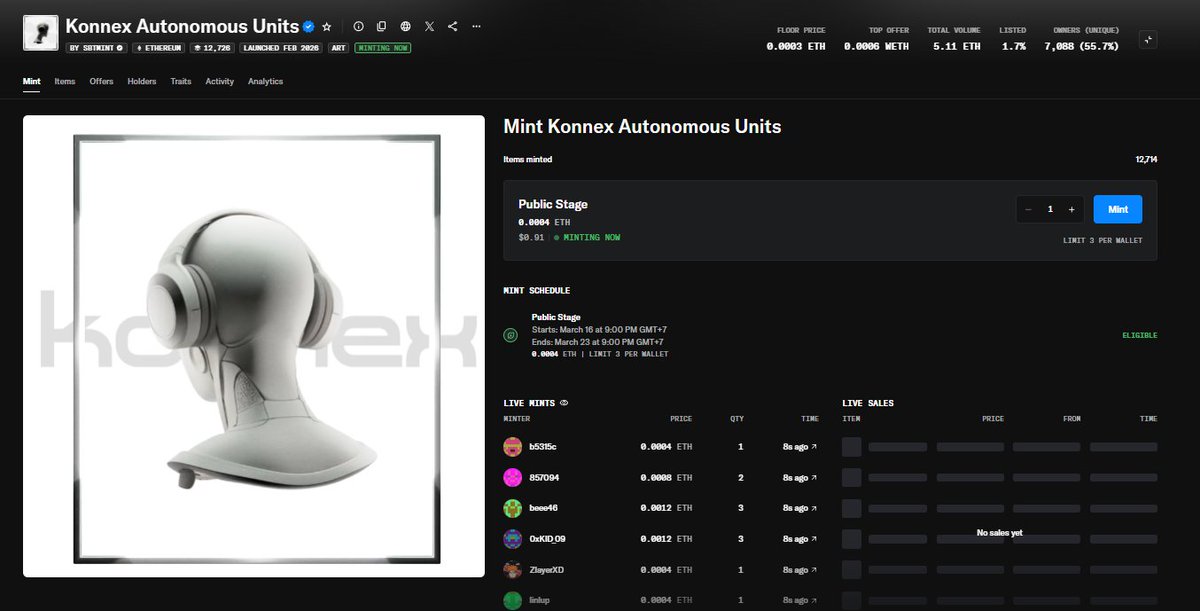
Konnex@konnex_world
Konnex Autonomous Units mint is now LIVE. Exclusively on @opensea Chain: Ethereum Price: 0.0004 ETH Your gateway into Konnex awaits. opensea.io/collection/kon…
Tiếng Việt
The Sharpe Ratio Comes to DeFi: Why 8% is Often Better Than 80%
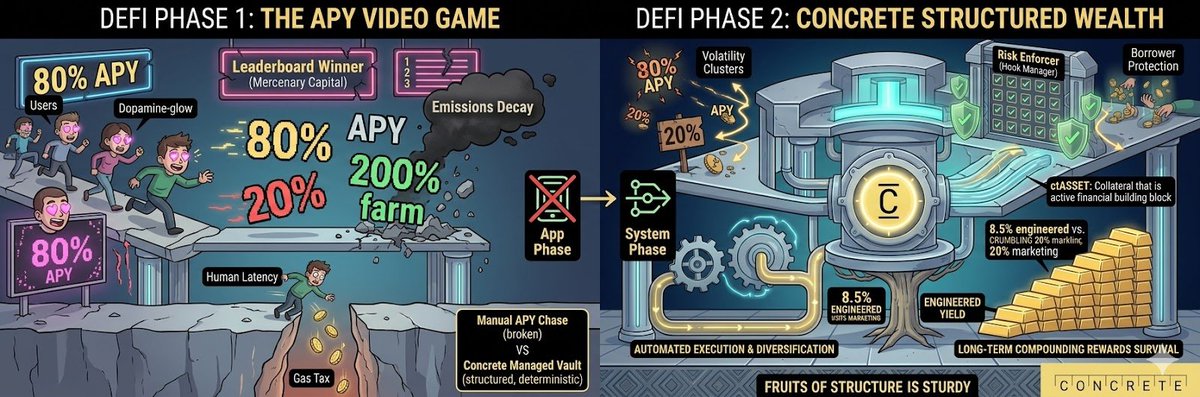
For most of DeFi’s history, we’ve treated yield like a video game leaderboard.
You open a dashboard, sort by "Highest APY," and the protocol at the top wins the liquidity. It’s a simple, dopamine-driven race where capital flows toward the biggest number. But as anyone who has been through a few market cycles knows, the "biggest number" usually comes with a catch.
In traditional finance, no one looks at a return in a vacuum. They look at risk-adjusted yield. It’s time DeFi grew up and did the same.
The APY Illusion: All Yield is Not Created Equal
The problem with comparing two strategies based solely on headline APY is that it’s like comparing a lottery ticket to a savings account just because the lottery ticket could pay out more.
In DeFi, that "100% APY" usually hides a cocktail of invisible risks:
Emissions-Driven Inflation: The yield is paid in a "farm token" that loses 10% of its value every week.
Liquidity Thinning: You’re earning great returns, but there isn't enough depth in the pool for you to exit without 5% slippage.
Volatility Clustering: The strategy works perfectly until the market dips, at which point a liquidation cascade wipes out six months of gains in six minutes.
When you factor in these hidden costs, that 100% APY often has a "net" return that is negative.
Re-thinking the Goal: Capital Preservation vs. Yield Chasing
Serious investors the kind representing institutional DeFi don’t ask "How much can I make?" They ask "How much risk am I taking to make this?"
This is the core of risk-adjusted thinking. It’s about the consistency of returns and the resilience of the strategy during a market downturn. A strategy that delivers a steady, predictable return is infinitely more valuable for building wealth than one that swings between +200% and -90%.
The future isn't about chasing the highest peak; it's about building the most durable foundation.
How @ConcreteXYZ Vaults Change the Math
This is where managed DeFi enters the chat. Most users can’t spend 24 hours a day monitoring liquidation thresholds or rebalancing pools. That’s why Concrete vaults aren't designed to just "find yield" they are designed to allocate capital based on risk parameters.
Instead of passive farming, Concrete focuses on onchain capital allocation. The vault infrastructure acts as a disciplined manager that:
Enforces Risk Guardrails: Using "Hook Managers" to ensure capital doesn't stay in strategies that become too risky.
Automates Execution: Handles the automated compounding and rebalancing so you don't lose your gains to gas fees or human error.
Diversifies Exposure: Spreads capital across different debt and credit states to ensure that one bad event doesn't break the whole vault.
Case Study: The "Boring" Power of 8.5%
Take the Concrete DeFi USDT vault as an example. In a world where people still hunt for 20% stablecoin yields, Concrete’s ~8.5% might seem modest.
But look at the "risk-adjusted" reality. While the 20% farm is likely relying on volatile incentives or high-leverage loops that could snap at any moment, the Concrete vault is delivering a sustainable return backed by institutional-grade infrastructure.
Over a year, the 8.5% strategy often outperforms the 20% strategy because it doesn't have the "downside spikes" that kill the compounding effect. It’s the difference between a sprinter who trips halfway and a marathon runner who never stops.
The Bigger Picture: From Apps to Systems
DeFi is moving away from the "App Phase" where we manually jump between high-yield pools and into the "System Phase."
In this new era, DeFi vaults will become the default interface. We won't be "yield chasers" anymore; we will be "capital allocators." The winner won't be the protocol with the flashiest marketing or the highest temporary APY. The winner will be the one that delivers the most reliable, risk-aware returns regardless of what the market is doing.
The leaderboard is changing. It’s time to stop looking at the top of the chart and start looking at the strength of the vault.
Explore Concrete at app.concrete.xyz
English
The APY Illusion: Why High Yield Is the Most Expensive Lie in DeFi
For years, DeFi has been a game of "biggest number wins."
We’ve all done it: open a dashboard, sort by APY, and chase the triple-digit figure like it’s a golden ticket. Protocols advertise these numbers in bold fonts, and capital flows toward them with reckless abandon. But here is the hard truth that the industry is finally waking up to: The highest APY is almost always the least sustainable yield.
In the next phase of onchain finance, we need to stop talking about yield as a marketing tool and start talking about it as an engineered outcome.
The Hidden Taxes of Headline Yield
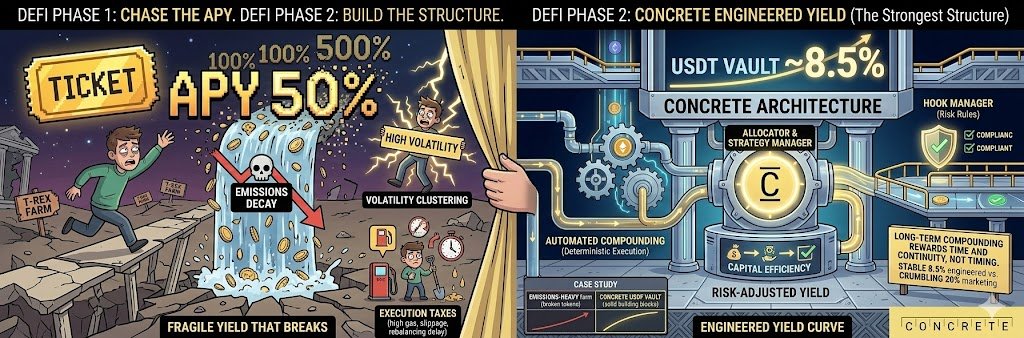
The problem with APY is that it’s usually a "gross" figure, not a "net" reality. A 50% yield looks great on a website, but once you pull back the curtain, the numbers start to bleed.
Think about what that headline figure doesn't show you:
Emissions Decay: Most high APYs are paid in "farm tokens" that are being printed into oblivion. As the token price drops, your real return vanishes.
Volatility Clustering: High yield often correlates with high risk. When market volatility spikes, the "extra" yield you earned is wiped out by a single liquidation event or price crash.
The Execution Tax: Between gas costs, slippage during rebalancing, and the "human latency" of forgetting to claim rewards, that 50% often shrinks to 10% in practice.
In short, chasing headline APY is a race to the bottom. It’s built for speculation, not for institutional DeFi.
Reframing the Goal: Risk-Adjusted Return
Sophisticated capital doesn't ask "How much can I make?" It asks "How much can I make relative to the risk I am taking?"
This is the shift from "passive farming" to onchain capital allocation. A mature financial system doesn't just throw money at a wall; it deploys it into managed DeFi structures that are built to survive different market regimes.
This is where risk-adjusted yield becomes the only metric that matters. It’s the difference between a fragile yield that breaks during a market cascade and an engineered yield that holds firm.
Concrete: Engineering the Yield Curve
Concrete vaults aren't just yield wrappers; they are structured capital allocators. While most protocols focus on the "marketing" of the number, Concrete focuses on the "architecture" of the return.
Instead of leaving users to manage their own risk, Concrete uses a disciplined framework:
The Allocator & Strategy Manager: These roles act as the brain of the vault, ensuring capital is moved to the most efficient debt and credit markets without human error.
The Hook Manager: Think of this as the "Onchain Compliance Officer." It enforces risk rules in real-time, ensuring that the vault never strays into high-risk, low-liquidity traps just to pump a headline number.
Automated Compounding: By removing the need for manual claiming and redeploying, Concrete eliminates the "leakage" that usually kills DeFi returns.
Case Study: The 8.5% vs. The 20%
Look at the Concrete DeFi USDT vault. In a world of 20% "emissions-heavy" stablecoin farms, Concrete’s ~8.5% might look modest to a beginner.
But look closer.
That 8.5% is engineered yield. It’s built on capital efficiency, not token printing. It is designed to be durable across volatility regimes, backed by governance enforcement and deterministic execution. For a serious builder or institution, a stable 8.5% that survives a crash is infinitely more valuable than a 20% that vanishes when the market turns red.
The Bottom Line: Infrastructure Beats Marketing
The first phase of DeFi was about the "Sugar Rush"high APY, high adrenaline, and high fragility.
Phase 2 is about Concrete vaults. It’s about moving toward a system where onchain capital allocation is handled by robust code rather than manual guesswork. We are moving from a world of "apps" that we play with, to "systems" that we trust to grow our wealth.
Stop chasing the biggest number. Start looking for the strongest structure.
Explore Concrete at app.concrete.xyz
English
Pixel ZenZ retweetledi

gm ct
gmcrete everyone!🗿
Check your profile 400 bags points has been distributed for last week’s article submission on @ConcreteXYZ
Now we anticipate the next one!
Always remember your actions = your bags.

English
The "Tamagotchi" Era of DeFi is Over: Why the Future is Concrete
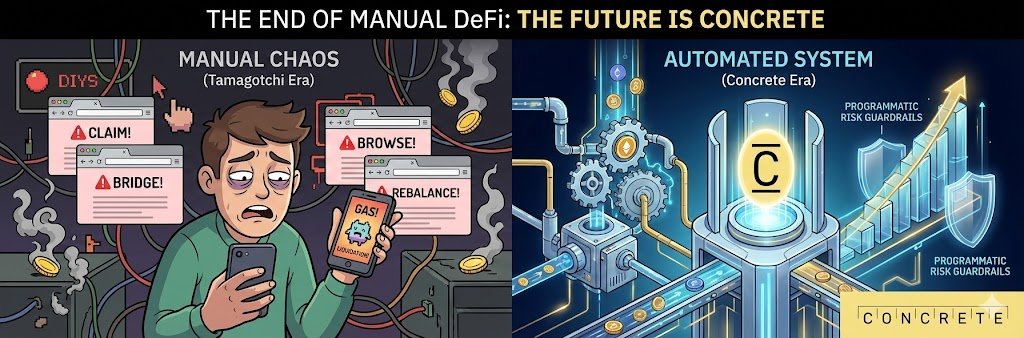
If you’ve spent any time in DeFi over the last few years, you’ve realized a frustrating truth: your portfolio is essentially a digital pet. You have to feed it (gas fees), watch it constantly so it doesn’t die (liquidation risk), and manually move it from one "playground" to another to keep it happy (yield farming).
We were promised the future of finance, but what we got was a second full-time job as a manual risk manager.
Today, Concrete is launching a new website and a tagline that signals the end of this era: The Future of Onchain Finance. But this isn't just a marketing pivot. It’s a fundamental bet that the "App Phase" of crypto is dying, and the "System Phase" is beginning.
The Problem: We’re Building Apps, Not Infrastructure
The current DeFi landscape is a sea of fragmented dashboards. To be a "power user," you’re expected to claim rewards, bridge assets, rebalance vaults, and monitor health factors across five different tabs.
This isn't finance; it’s an endurance test.
Most protocols today are built for speculation—short-term spikes in APY that attract mercenary capital. But speculation doesn't scale. To move toward a truly global financial system, we need to stop building "apps" that require constant human attention and start building onchain systems that run themselves.
The Shift: From "Active Management" to "Capital Allocation"
The future of onchain finance is invisible. It’s the shift from you managing a strategy to you allocating to a system.
In this future, "compounding" isn't a button you click every Sunday morning to save on gas. It’s a native, background process. This is where Concrete enters the frame. By focusing on Concrete Vaults as infrastructure rather than just "another product," the protocol is creating a world where:
Risk is Programmatic: Instead of relying on manual oversight, Concrete uses institutional-grade architecture to enforce safety guardrails.
ctASSETs are the New Primitives: We’re moving beyond static tokens. With ctASSETs, your positions remain liquid and productive, turning what used to be "dead" collateral into active financial building blocks.
Automation is the Default: The system handles the "human latency" - the delays, the mistakes, and the missed opportunities -leaving the user with the only thing that actually matters: long-term compounding.
Why This Changes the Game
When finance moves from manual "App-hopping" to automated "Onchain Systems," the barrier to entry for both retail users and institutions vanishes.
Institutions don't want to hire a team of 20 people to manually claim rewards on a DEX; they want a vault that adheres to ERC-4626 standards, manages credit risk algorithmically, and provides a structured yield. Retail users don't want to lose their shirts in a flash crash; they want a protocol that has "Borrower Protection" baked into its DNA.
Concrete is building that foundation. It’s moving us toward a version of DeFi that looks less like a chaotic casino and more like a high-performance engine - one that’s always on, always optimizing, and entirely permissionless.
The Bottom Line
Wealth isn't built by catching a 10,000% APY spike for three days. It’s built through the relentless, boring, and automated math of compound interest.
The "Future of Onchain Finance" means you can finally stop babysitting your portfolio and start letting the infrastructure do the work. The era of manual finance is ending. The era of @ConcreteXYZ is here.
See the vision for yourself at concrete.xyz
English