Sabitlenmiş Tweet

Simon Pepin Lehalleur
16.9K posts

@plain_simon
Mathematician (algebraic geometry, motives & friends, singularities in statistics and ML). 'Geometry is successful magic' (R. Thom) University of Essen.


Rumored lawyers caught making out in Central Park goes viral and divides the internet trib.al/FWTTAUH
Every single review I have handled at NeurIPS as an AC is **much worse** than a well executed AI review. By "much worse" I do not mean 20% or 50%. I mean a factor of about 10-100. At least - 10x more mathematical issues are caught, - 10x more missing key citations are caught, - 10x more novelty claims are invalidated with evidence, - 10x more issues with the experiments are observed, - 10x more typos and grammatical issues are fixed, - 10x more inconsistencies are found, and so on. In many cases I have handled over the last 10 years, the human reviews are so bad in comparison that the improvement factor is closer to 100. (The best human reviews I received over the years are worse than an AI review I can generate today, but still entirely good enough to make the correct decision. On the other hand, an AI review is often an almost comprehensive summary of all key issues --- something a human almost never has time to deliver --- and such feedback is immensely useful to the authors) At this point, we would be much better to just 1) give one very thorough ChatGPT review to all submitted papers (I am mainly talking about my fields - optimization, AI, machine learning), automatically, and 2) keep asking for a revision or two (to keep the duration of the process within some bounds) until the number of issues decreases to an extent when the AI reviewer is satisfied, in a given time-frame (eg, 1 month). 3) At that point, a human AC can make a decision (to keep an eye on this all should anything go wrong). The role of the AC would be merely to observe and manage the process, and make a final decision, based on the trajectory of the revisions. I can't believe I am saying this -- AI reviews were a nonsense idea even a year ago. The current AI reviews are super-human.

I’m releasing my Pokémon equivalent of The Odyssey today… it’s our biggest video ever. We’ve spent 6 months & millions of dollars making this movie, hope you enjoy

You can find the writing here: ulam.ai/research/algeb… I did multiple readings and re-readings, but I'm not an expert in motivic homotopy theory. I've run also multiple adversial LLM checks with GPT-5.6 Pro to both smooth the exposition and catch any errors. The core is probably 4-5 pages and you can see a summary of the argument in the beginning. Overall, this is by far the most impressive piece of work I've got with AI. It's still about finding a counterexample, but once found, there's some work to be done on theory building to check it. Historically, this question was approached by Rees, who constructed bundles, that were later shown to be motivic and expected to be non-algebraizable. This was the initial path we took here with GPT to prove Rees construction works. But that led to nothing, and then GPT came up with this new construction, and potential motivic approach. It's also impressive because it touches active areas of current research. Contrary to Erdos problems, you can't argue here that these problems did not receive enough attention or are not relevant. Any homotopy theory expert's opinion highly appreciated. I plan to go with a standard route of journal submission and peer-review for this result as not only it is beautiful, but might be quite hard to autoformalize currently (no motives in mathlib).
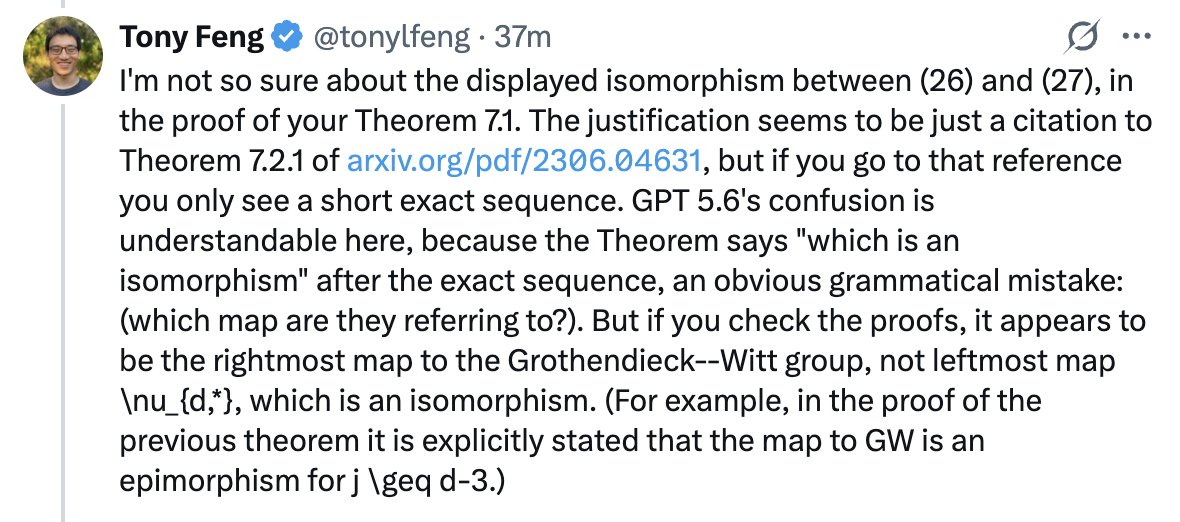
Conjecture that every complex topological vector bundle on CP^n is algebraic is false. GPT-5.6 Pro found me an example on CP^5 that is not only non-algebraizable, but also with no motivic lift. This also disproves a more recent conjecture by Asok-Fasel-Hopkin.



The Jacobian conjecture problem and solution, presented visually. For people like me who don't read math jargon.