puja kaura

2.6K posts

puja kaura banner
puja kaura

puja kaura

@pmkaura

High School educator (ESL)|Omnivorous reader|Word person|Movie buff| Aspiring towards #equanimity| #merit16 alumnus

mumbai, india Katılım Ocak 2012
308 Takip Edilen474 Takipçiler
puja kaura
puja kaura@pmkaura·
I am old enough to remember this case. No accountability, not then, not now. In India, every woman is for herself.
Sann@san_x_m

Her name was Ruchika Girhotra. She was 14 years old. A tennis player from Panchkula, Haryana. On August 12 1990, she went to meet S.P.S. Rathore at his office. He was the Inspector General of Police and head of the Haryana Lawn Tennis Association. He had promised her father he would arrange special coaching for her. When her friend stepped out of the room, he molested her. Her family filed a complaint three days later. Rathore had her expelled from school. Her father was suspended from his bank job on false charges. Six cases were filed against her brother Ashu. The family's house was forcibly sold. They fled to the outskirts of Shimla and took up earth filling work to survive. On December 28 1993, days after Ashu was paraded in handcuffs through their neighbourhood, Ruchika consumed poison. She died the next day. She was 17. Rathore threw a party that night. He then refused to release her body to her father unless he signed blank papers. Those papers were later used to forge documents accepting a false autopsy report. Despite a police inquiry recommending an FIR against him, Rathore kept getting promoted. He became the Director General of Police of Haryana in 1999. The case went through 40 adjournments and more than 400 hearings over 19 years. In December 2009 a court convicted him of molestation. He was sentenced to six months' imprisonment and fined Rs 1,000. The sentence was later enhanced to 18 months. The Supreme Court upheld his conviction in 2016 but reduced it to the time already served. He walked free. The judge who tried to add abetment to suicide charges against him was forced into premature retirement. The judge who dismissed those charges was a neighbour of Ruchika's family involved in a property dispute with them. S.P.S. Rathore was later invited as a VIP guest to a Republic Day event in Panchkula. Ruchika Girhotra was 14 when he molested. She was 17 when she died. Follow for stories India deserves to remember.

English
0
1
1
163
puja kaura
puja kaura@pmkaura·
Kudos for articulating what so many of us have been thinking. To be kind in this cold world and let it drive your moral compass is an act of revolution today.
Pratim D Gupta@peedeegee

There was a time when stardom was a fortress. In the 90s, Ruby Bhatia wasn't just a VJ; she was the electric pulse of a new, liberalised India, reportedly commanding Rs 1 lakh per show. Rahul Roy wasn't just an actor; he was the face of a generation’s collective heartbreak, the Aashiqui boy whose silhouette defined romance and whose haircut was the bestseller in every saloon. Govinda? He was—and is—the undisputed king of the masses, a comic genius who could make a cinema hall shake with a single pelvic thrust. Fast forward three decades, and the fortress has been dismantled by the relentless, voyeuristic machinery of social media. Today, these icons find themselves under the harsh, unforgiving glare of a "content-hungry" digital mob that mistakes struggle for failure and evolution for desperation. Recent headlines have taken a perverse pleasure in dissecting Ruby Bhatia’s career shift. Yes, the woman who once defined "cool" is now a life coach charging Rs 3,000 for a six-month program. To the keyboard warriors, this is a "fall from grace." To any sane mind, it is a woman finding meaning after a nervous breakdown, choosing to make mental health accessible to the masses rather than gatekeeping it for the elite. Similarly, Rahul Roy has been subjected to the "cringe" treatment for appearing in social media reels with unknown creators. The internet, in its infinite cruelty, ignores the fact that this man is a brain stroke survivor. He is fighting aphasia, paying off legal debts that predated his illness, and trying to "stay active" and work for as long as he is alive. When he asks his trolls to find him "decent work" instead of mocking his reels, he isn't showing desperation; he is showing a spine of steel that most "influencers" couldn't dream of possessing. Then there is Govinda, the man who once gave the Khans a run for their money, now frequently seen performing at school annual days and weddings. The "dark shadow" of social media brands these "small shows," as if the size of the stage dictates the stature of the legend. Govinda’s response is a masterclass in humility: "I never let my ego influence my work." Whether it’s a Chief Minister’s event or a local school function, the man dances because he is a performer. There is more dignity in one of his "wedding steps" than in the entire collective output of a thousand anonymous trolls. Social media has birthed a generation of spectators who believe that unless you are at the absolute zenith of your power, you should vanish into the shadows. We have become a culture that feeds on the "tragedy" of the legacy act. But here is the truth: There is nothing sad about a veteran getting up and going to work. There is nothing "cringe" about an icon refusing to be defeated by a health crisis or a shifting industry. The desperation doesn't belong to Ruby, Rahul, or Govinda. The desperation belongs to the social media ecosystem that needs to tear down giants just to feel tall.

English
1
0
1
56
puja kaura retweetledi
Matthew LaBosco
Matthew LaBosco@matthew_labosco·
Robert Sapolsky is a Stanford neuroscientist who proved chronic stress is the silent killer doctors ignore. On Chris Williamson's podcast, he revealed 10 "normal" habits you do every day that wreck your sleep, mood, and nervous system: 1) Replay conversations in your head
English
158
2.2K
18K
3.8M
puja kaura retweetledi
In Libro Veritas
In Libro Veritas@InlibroV·
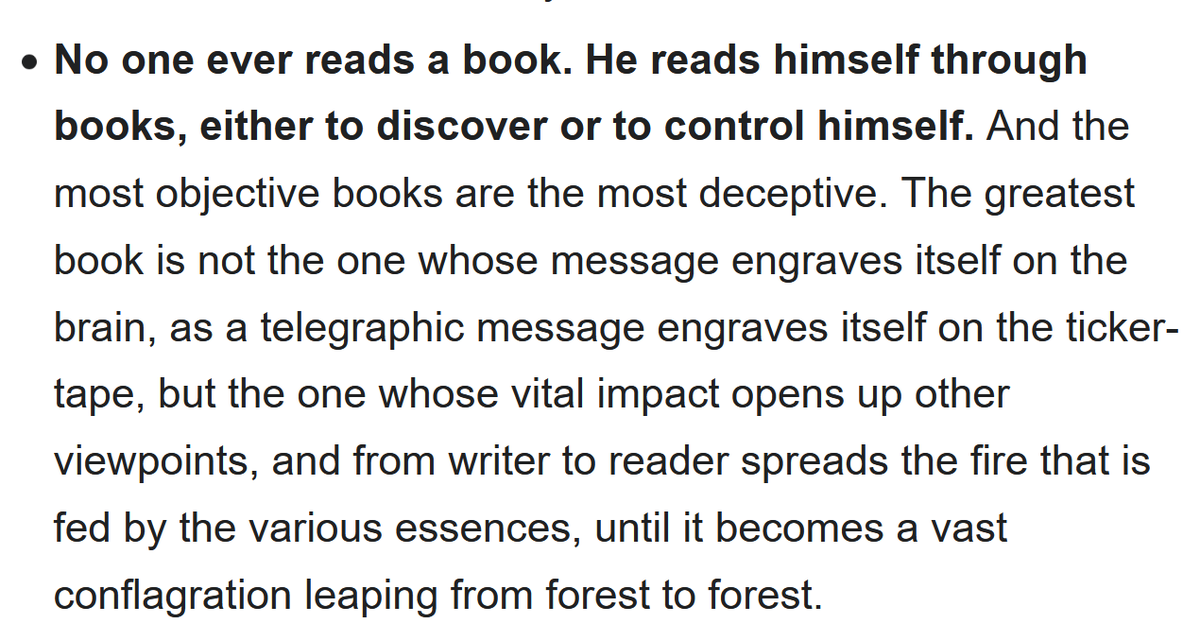
"No one ever reads a book. He reads himself through books..." Romain Rolland
In Libro Veritas tweet media
English
8
88
588
25K
puja kaura
puja kaura@pmkaura·
@KiranManral Hang in there. It might not be a triumph but I managed to flow till the end. Also, it's poised for a 2nd season.
English
0
0
0
53
Kiran Manral
Kiran Manral@KiranManral·
Started Big Mistakes with such anticipation because you know, Dan Levy and Schitt's Creek but it is just a scream fest and not one single laugh out moment two episodes down. Does it get better, do I abandon it? If so, what outrageously funny new series can I watch? Thank you.
English
4
0
0
773
Kiran Bir Sethi
Kiran Bir Sethi@kiranbirsethi·
Turned 60 today… still curious, still questioning, still laughing at myself. My wishes: A generous (slightly shameless) heart ❤️ Eyes that see the good The joy of not knowing, and asking anyway ✨ And yes… yoga at 95 (no excuses!) I’m making a list of 60 things to do- ideas?
Kiran Bir Sethi tweet media
English
2
0
10
242
Parminder Singh
Parminder Singh@parrysingh·
Is there a word you like so much that you look for reasons to use it - even tweaking a sentence just to slip it in? I’ll start: epiphany.
English
98
5
78
21.3K
puja kaura
puja kaura@pmkaura·
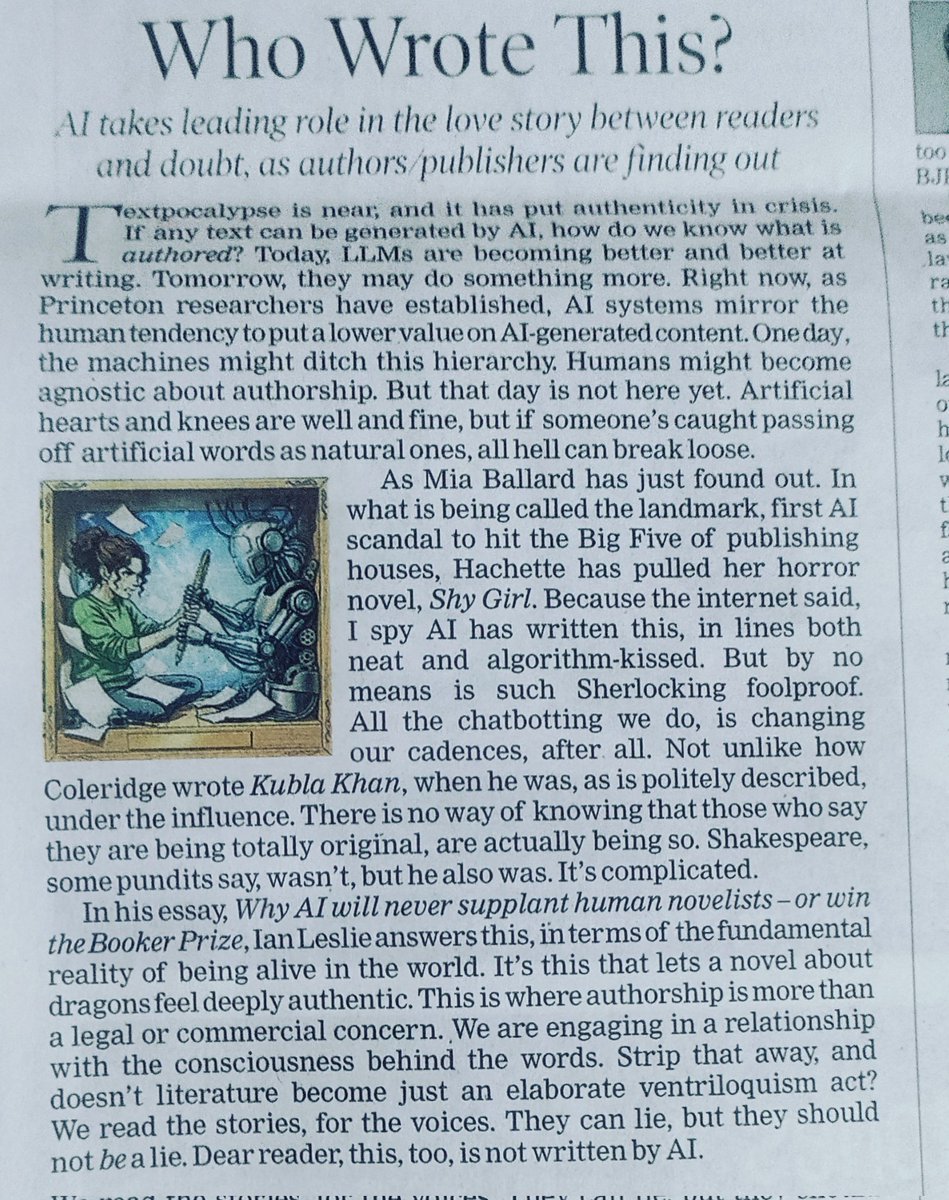
Textpocalyspe is truly here...
puja kaura tweet media
English
0
0
0
14
puja kaura retweetledi
Dr Tariq Tramboo
Dr Tariq Tramboo@tariqtramboo·
A message from Iranian women to the west, U.S. and Israel.
English
176
3.5K
8.8K
251.1K
puja kaura retweetledi
Anish Moonka
Anish Moonka@anishmoonka·
Went down the rabbit hole on this. Your brain treats a physical book like a landscape. It builds a spatial map of the text, the same way it maps trails, rooms, and city blocks. When you scroll on a phone, that map breaks apart. Seven large-scale research reviews and direct brain scans confirm what you already feel. A 2023 study in PLOS ONE attached brain-activity sensors to children’s heads while they read the same text on paper and on screen. Paper reading produced fast brain waves, the pattern linked to focused attention. Screen reading shifted the brain into slow waves, the pattern linked to mind wandering and daydreaming. Same kids. Same words. Measurably different brain states. A separate 2022 study from Showa University in Japan scanned the front of the brain, the area that manages focus and comprehension, during phone versus paper reading. Smartphones sent that region into overdrive, meaning the brain was straining just to keep up with basic processing. Paper reading produced a moderate load that triggered natural deep breathing, which helped regulate brain function and sustain focus. The phone suppressed that breathing pattern entirely. Since 2017, researchers have published seven major reviews combining hundreds of individual studies. Six of seven reached the same conclusion: people understand less on screens. A 2018 review of 54 studies and 170,000+ participants, literally titled “Don’t throw away your printed books,” found paper outperformed screens across the board for non-fiction. A 2024 follow-up with 49 more studies confirmed it. The gap has grown steadily every year since 2001. Being a “digital native” doesn’t help. The best explanation is how your brain tracks where you are. Your short-term memory can only juggle about 7 things at once. A physical book gives you constant location cues: the weight shifting from right hand to left, where a paragraph sits on the page, how thick the remaining pages feel. Your brain hands off the “where am I in this text?” job to those physical signals, leaving more room for actually understanding what you’re reading. On a phone, every screen looks identical. Your brain has to track position and process meaning at the same time, and something gives. A Norwegian eye-tracking study analyzing 25,000+ individual eye movements found screen readers processed text more shallowly. The students had no idea they were reading differently. In 2019, nearly 200 reading scientists from 30+ countries signed an open letter warning that screen reading was degrading deep comprehension. Since then, Scandinavian countries, among the most digitized school systems on Earth, have started putting physical books back in classrooms.
shree🪄@Goldensky0

reading books on a phone and reading paperback books are two different things

English
144
2.1K
9.5K
1.5M
puja kaura retweetledi
Ifenimi
Ifenimi@Ifenimiii·
This will always be my favourite poem of all time. The language was specifically sculpted to fit the grooves of my soul.
Ifenimi tweet media
English
4
196
804
16.4K
puja kaura retweetledi
Mental Health Support Foundation
‘Story of an Attention Seeker’ And our youthful facilitator is~ @Mewondermi Milana Prakash, 27, is a published author of three works of fiction, a musician, a songwriter and a painter. She did her MBA from IIM Ahmedabad and lives with bipolar disorder. #WorldBipolarDay #Mumbai
Mental Health Support Foundation tweet media
English
1
5
7
414
puja kaura retweetledi
𝖆𝖓𝖓𝖆
𝖆𝖓𝖓𝖆@___adorn·
i don’t need to ever hear anything about literary fiction again. this is where danielle steel lives
𝖆𝖓𝖓𝖆 tweet media
English
30
186
7K
217.4K
puja kaura retweetledi
Umesh
Umesh@umesh_ai·
Letterforms!
Umesh tweet mediaUmesh tweet mediaUmesh tweet mediaUmesh tweet media
English
44
375
2.6K
160.3K