Prajwal Ajay

608 posts

Prajwal Ajay

Prajwal Ajay

@praajwall

Previously, https://t.co/hrBdR8zGG7

Bengaluru, India Katılım Temmuz 2014
135 Takip Edilen123 Takipçiler
Prajwal Ajay
Prajwal Ajay@praajwall·
Workflow for any modifications to the websites - Find a reference image on Dribble/Pinterest for the changes >> use chatgpt to create a prompt based on the memory of what the business/app does >> nano-banana creates a mockup >> Claude code writes code/debugs and tests
English
0
0
1
96
Prajwal Ajay
Prajwal Ajay@praajwall·
AI context window might get solved, but the human context window will be the only limiting factor going forward - and the only fix is large cups of coffee and apparently there's an upper limit on that
English
0
0
1
38
Prajwal Ajay
Prajwal Ajay@praajwall·
It's wild that Claude cowork bled the Indian stock market - If only markets adjusted for everything claude code is capable of instead - there would be a massacre
English
0
0
0
106
Prajwal Ajay
Prajwal Ajay@praajwall·
We don't need a different model architecture for AI to be dangerous. Without guardrails, humans can take advantage, yes, but a bigger risk is misinterpreted tasks and the tools to execute them already exist This decade is going to be wild
Peter Steinberger 🦞@steipete

moltbook.com is art.

English
0
0
0
43
Prajwal Ajay
Prajwal Ajay@praajwall·
In a world where being performative is what brings attention to what you have to say, the what you have to say gets diluted behind the theatrics. Raw, original thoughts not orchestrated around being viral are left to notes that maybe ai consumes to again share performative shit
English
0
0
0
38
Prajwal Ajay
Prajwal Ajay@praajwall·
@mattbrinkley @openclaw Ready to be tested - will be running it on a fresh Mac today! Happy to send it to you if you'd like to test it out.
Prajwal Ajay tweet media
English
1
0
1
61
Prajwal Ajay
Prajwal Ajay@praajwall·
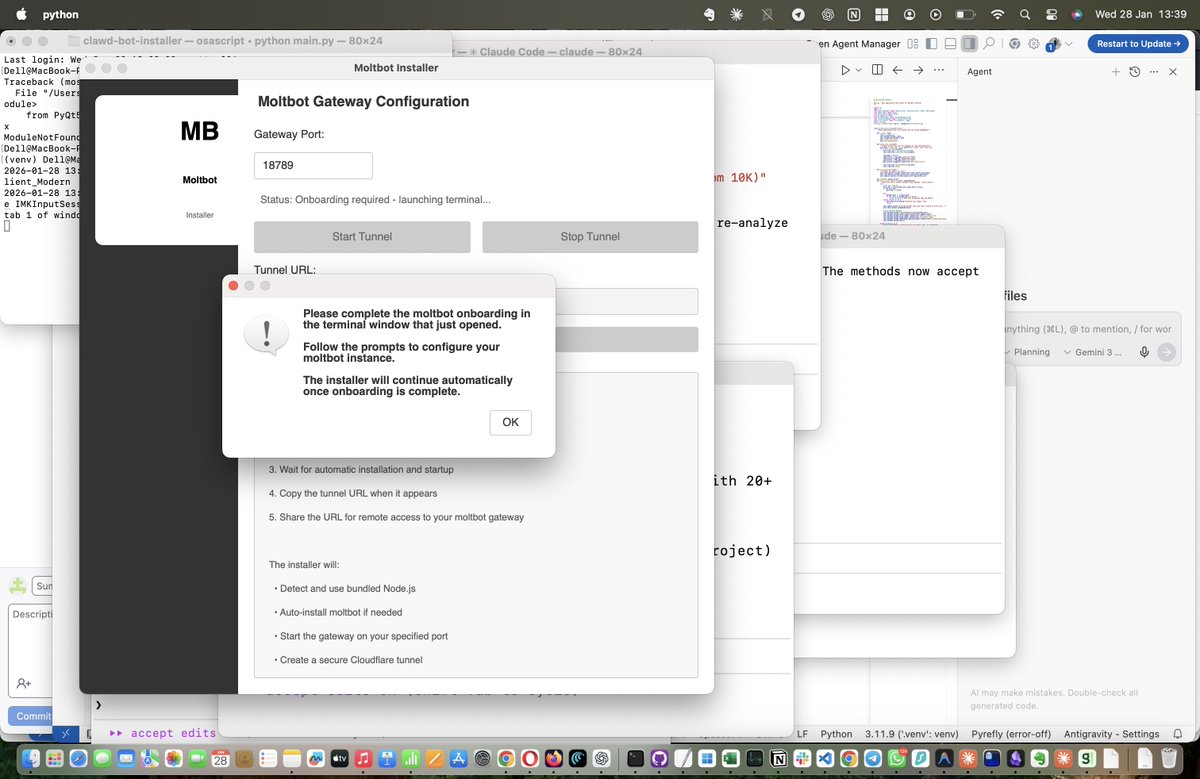
UGLY AF UI, but it gets the job done. No setup required. Just one click, get a link, use it anywhere. Clawdbot/@openclaw - the simplest way to use it - the application keeps the window open Kinda wild that the non-technical world gets access to everything weeks/months later. Testing it, will let y'll know
Prajwal Ajay tweet media
English
1
0
0
279
Peter Yang
Peter Yang@petergyang·
Does Claude(dot)ai take forever to load for anyone else?
English
10
0
9
8.2K
Prajwal Ajay
Prajwal Ajay@praajwall·
Working on making Clawd-bot(Molt-bot) easily accessible to anyone by just installing a macOS app!! All dependencies, including bundled Node packages, Clawd bot libraries, and access via a Cloudflared tunnel, so someone can just install the application and run everything!! [IF this paragraph seemed irrelevant to you, ignore, idea is for it to be irrelevant] Repurposing the sendfiles.org repo for this and trying out multiple Claude agents on different tasks as well!! Comment below and I will notify you!
Prajwal Ajay tweet media
English
0
0
0
304
Prajwal Ajay
Prajwal Ajay@praajwall·
@pbteja1998 Am I the only one who uses GitHub desktop instead of the editor when I need to verify the changes 😅
English
0
0
1
47
Prajwal Ajay
Prajwal Ajay@praajwall·
As long as original thinking is reserved by humans - we can survive in that off chance there is a Samaritan equivalent
English
0
0
0
37
Prajwal Ajay
Prajwal Ajay@praajwall·
I’ve been wondering, mostly after spending time with Claude Code running directly in the terminal for months now - what makes Claude Code so powerful/different compared to using the app or using any other app and why it feels so futuristic What struck me wasn’t just that it’s “powerful” or “fast.” It’s that it doesn’t feel like an application in the traditional sense at all In a normal app, everything is locked behind predefined workflows. You have to open a folder. You have to select a file. You have to click upload. Not because that’s the best way to do things, but because the app needs those steps to know what you want. That entire existing world exists because intent had to be translated through hard-coded paths. Features were basically frozen interpretations of what someone thought users might want to do. With Claude sitting on the terminal, that layer disappears. Once it has access, you’re not choosing features anymore. You’re stating intent, and the system is figuring out the real commands in real time. No “this button does that.” No “this workflow supports that use case.” Just: here’s what I want, go do it. And that made me zoom out. If an intelligence layer can convert human language directly into executable actions - bash commands, file ops, edits - then what exactly is the role of the OS UI anymore? What if the OS is just a dumb box? By dumb box, I don’t mean useless. I mean it doesn’t impose workflows. It doesn’t force you into menus, apps, or screens. It just securely exposes the system, and the intelligence layer handles everything else. You talk. It responds. It brings up whatever data, files, or tools are needed in that moment. Not because someone pre-built a “feature” for it, but because the system can figure it out on the fly. I keep coming back to this: most applications exist the way they do because computers couldn’t understand intent. So we built interfaces to compensate. If that constraint starts disappearing, the entire mental model of “open app → perform steps → close app” starts feeling… optional. Maybe apps still exist. Maybe they’re still there in the background. But for a large chunk of everyday computer use, the interface might just collapse into a conversation. And watching Claude operate directly on the terminal made that shift feel very real, very fast. Feels like the future is going to be here faster than we could have imagined!!
English
0
0
1
56
Prajwal Ajay
Prajwal Ajay@praajwall·
Building businesses in India, at least from what I’ve seen, fundamentally comes down to understanding willingness to pay, and that willingness is extremely low when you’re optimizing for cost savings for SMEs, individuals, freelancers, or small businesses unless you either help them save direct money in an obvious way or you manage to form a habit that becomes hard to break, because people don’t pay easily for abstract value here, they pay when they can clearly see money saved or money made. If you can help someone procure something cheaper, access resources affordably, or get necessities at a lower cost, those businesses tend to work, and similarly, businesses that directly help other businesses make more money have a much clearer willingness to pay. Most consumer startups in India that scaled managed to establish buying behavior only after burning significant capital by offering the best service at the cheapest price or even free for a long time, and only once habits were formed did pricing get tested, at which point many companies failed because the willingness to pay simply wasn’t there anymore. When that willingness drops, investor appetite drops too, and what usually follows is an equilibrium where service quality deteriorates, not because founders want it to, but because economics force it. What starts as two-minute pickups or premium service slowly becomes five minutes, slower service, fewer riders, less availability, because earlier you were subsidizing excess capacity, and over time that subsidy disappears. This is also where second movers often succeed, because they wait for behavior to stabilize, expectations to normalize, and then enter with a less premium but economically viable service and survive or even thrive. Across services, especially in India, quality degradation is almost inevitable because as long as the core need is met, users tolerate deterioration, whether it’s housing, transport, logistics, or delivery. The service landscape itself splits into services that anyone can provide and services that only a defined set of people can provide, and even within the latter, there’s a distinction between services that merely serve the purpose of a business versus services that elevate or grow the business. If a website doesn’t generate orders, willingness to pay for it is low, but if a website drives business, willingness to pay is high, and the same applies to marketing where generic poster-making agencies struggle while those that crack distribution or sales can charge significantly more. Many businesses only want a digital presence as a trust layer, not as a decision-making layer, especially traditional professions like CAs, lawyers, or local services who still acquire clients through referrals and community, so their spend remains low, unlike e-commerce or Shopify businesses where the website is the business. A lot of Indian business behavior is cohort-driven rather than curiosity-driven, where people follow what has worked for others in their community and avoid what burned someone before, which is why early adopters are rare and fragile, and one bad experience can poison an entire category for years. This cohort thinking also explains why traditional people invest in culturally familiar assets like PGs, marriage halls, housing, or rentals rather than experimenting with newer models unless they see someone close to them succeed first. Across all of this, stripping unnecessary features that users don’t value is often more important than chasing maximum quality, because India is price sensitive in a very specific way: necessities are scrutinized heavily, but status-signaling or visibly aspirational products see irrational spending, which is why people won’t flex on better rice at home but will spend disproportionately on phones, cars, weddings, houses, and other visible markers of success, and this tension underpins almost every pricing and product decision in the Indian market. Other thoughts: Investing behavior in India is deeply cultural, past losses permanently shape risk appetite, quality deterioration is tolerated as long as basic needs are met, and startups often overbuild for quality when survival actually depends on ruthless simplification and aligning with how people already think and behave rather than how we want them to.
English
0
0
0
44
Prajwal Ajay
Prajwal Ajay@praajwall·
I think there can potentially be a large market for AI freelance managers(or whatever we end up calling them) who oversee multiple instances of Claude Code or equivalent tools, just by instructing them on what to do with a specific project context. You can be working on something and assign a task to someone else to look at a more technical issue that requires some oversight, but doesn’t require their full-time work. For example, I was working on setting up workers for some cron jobs and ad-hoc jobs triggered manually or through an API. I had to set up a queue management system with appropriate priorities for internal jobs and API jobs, and needed to decide whether to use Redis or just add a collection in Mongo for state management. It felt like I was complicating it. I asked Claude to frame the question and then sent it to a senior dev I had worked with at Gordian, and sent Claude the response and the implementation was done. Soon (if not already), easy transfer of a session to someone else or tagging someone else on maybe Slack(?) to look at it can happen. The whole process can be streamlined, where someone can charge for oversight, and you can have tens of Claude Code instances or equivalents running. You only hire freelancers who are experts to oversee or validate, and they charge by task or hour when their time is required. Not limited to coding only - but the same logic applies across any industry/role, etc
English
0
0
0
81
Prajwal Ajay
Prajwal Ajay@praajwall·
Just that application fee seems like a massive red flag - apart from the obvious 75:25 split(if it's true) - couldn't find obvious references Also two thousand or 5000? What is it? 😂
Prajwal Ajay tweet media
English
0
0
0
72
Prajwal Ajay
Prajwal Ajay@praajwall·
Service businesses are outcome-based, but that’s still too high-level. Every service actually has multiple layers, and if you don’t break it down that way, you’ll miss where willingness to pay actually exists. Take something simple like GST or tax filing. On paper, the outcome is “GST filed” or “tax filed.” But that’s not what people are really paying for. They’re paying for the assurance that it’s filed correctly, that nothing will come back later, and that there won’t be penalties or notices. The filing itself is a thin layer. The trust layer is the real product. That’s where the willingness to pay is. Same with bookkeeping. You can say, “Give me your bank statements and I’ll generate a P&L and balance sheet.” That’s execution. But the bare minimum to close the client is not the P&L. It’s the confidence that the numbers are right, defensible, and won’t create trouble later. If that layer isn’t solved, automation doesn’t matter. A useful way to think about this is the land-buying analogy. A property can be perfect, great location, high demand, tons of leads. But if the legal papers aren’t clean, nothing else matters. Legal clarity is the bare minimum layer. In services, that bare minimum layer changes by category, but it always exists. For CAs, lawyers, doctors, and consultants, the client doesn’t understand the work. So they’re outsourcing judgment, not execution. Anyone can file forms, prescribe tablets, or make slides. The question is whether it’s the right filing, the right medicine, or the right advice, and whether it’ll cause damage later. That’s pure trust. Where AI fits cleanly is in replacing expensive, repetitive cost-center layers, at least in the short term. Things like invoice extraction, document classification, or even AI models doing virtual try-ons or clothing previews are not new outcomes, they’re cheaper substitutes for existing manual or tool-heavy workflows. The willingness to pay here doesn’t come from delight or strategy, it comes from immediate cost savings and speed. These services can be sold as temporary or transitional replacements for existing cost centers, where businesses are willing to experiment because the downside risk is low and the upside is measurable. Competition will be high and defensibility weak, but there might be still value to be captured in that short window by undercutting traditional setups and by leveraging the low-cost centres for a task that can be completely AI-fied. Social media and marketing sit in a messy middle. Follower count is an objective metric, but the quality of followers, engagement, and monetization potential are not. You can promise five or ten reels a month, AI-generated or human-generated, but people don’t pay for content volume. They pay for momentum, signal, and bias to action. Again, different layers, different willingness to pay. This is where AI-first service businesses often get it wrong. They try to automate the entire service instead of identifying which layers can be automated and which layers must remain human. Decision-making, trust, and accountability layers still command a premium. Monotonous, repeatable, low-risk layers don’t. On the revenue side, consultants who impact the highest line items get paid more because they’re operating almost entirely in the decision-making layer. That layer is subjective, person-dependent, and very hard to automate horizontally. Vertical specialization might work, but only if you deeply understand all the decision variables for that specific context. So the real opportunity is not “AI services” broadly. It’s identifying: What are the layers of this service? What is the bare minimum layer required to close? Where does trust sit? Which layers have real willingness to pay? And which layers can be automated without eroding the core outcome? If you can strip out humans from the layers people don’t actually value, while preserving the layers they do pay for, you can build profitable, outcome-driven, AI-first service businesses in India. That’s the whole game. (I guess)
English
0
0
0
68
Prajwal Ajay
Prajwal Ajay@praajwall·
@whoshaheer Did you have to submit dpiit certificate or some other document for "verification" that you're a startup?
English
1
0
3
1.5K
Shaheer Ahmed
Shaheer Ahmed@whoshaheer·
So from Nov 1, govt. introduced rule 14A to fast-track gst registrations for startups We had to apply for a new GSTIN, so applied under this scheme today at 9 PM & left office I kid you not, haven't even reached home yet and my new gst is here 🕺 @ govt, tysm, please make everything this easy
Shaheer Ahmed tweet media
English
26
120
1.3K
112.9K
Christian
Christian@coldemailchris·
This A-Z cold email system cheatsheet covers everything you need to know to send 10,000+ cold emails/day with 98% deliverability in 2025. It covers in-depth walkthroughs on everything from: > AI prompts for deep market research, TAM mapping, and ICP validation > Best-in-market cold email infrastructure and deliverability protocols > 3-step account sourcing to contact enrichment list building process > 3 useful data scraping & enrichment workflows to build out in Clay > Top 46 GTM tools to leverage in your cold email technology stack > 10 validated cold email script frameworks + 10 core messaging principles > Campaign testing frameworks for hitting KPIs as efficiently as possible > Optimal campaign metrics to monitor and how to action on each one Want this A-Z cold email system cheatsheet for yourself? 👉 Like + Comment "Email" and I'll DM you the downloadable PDF. [ Must be following to receive ]
Christian tweet media
English
1.2K
167
2.2K
226.4K