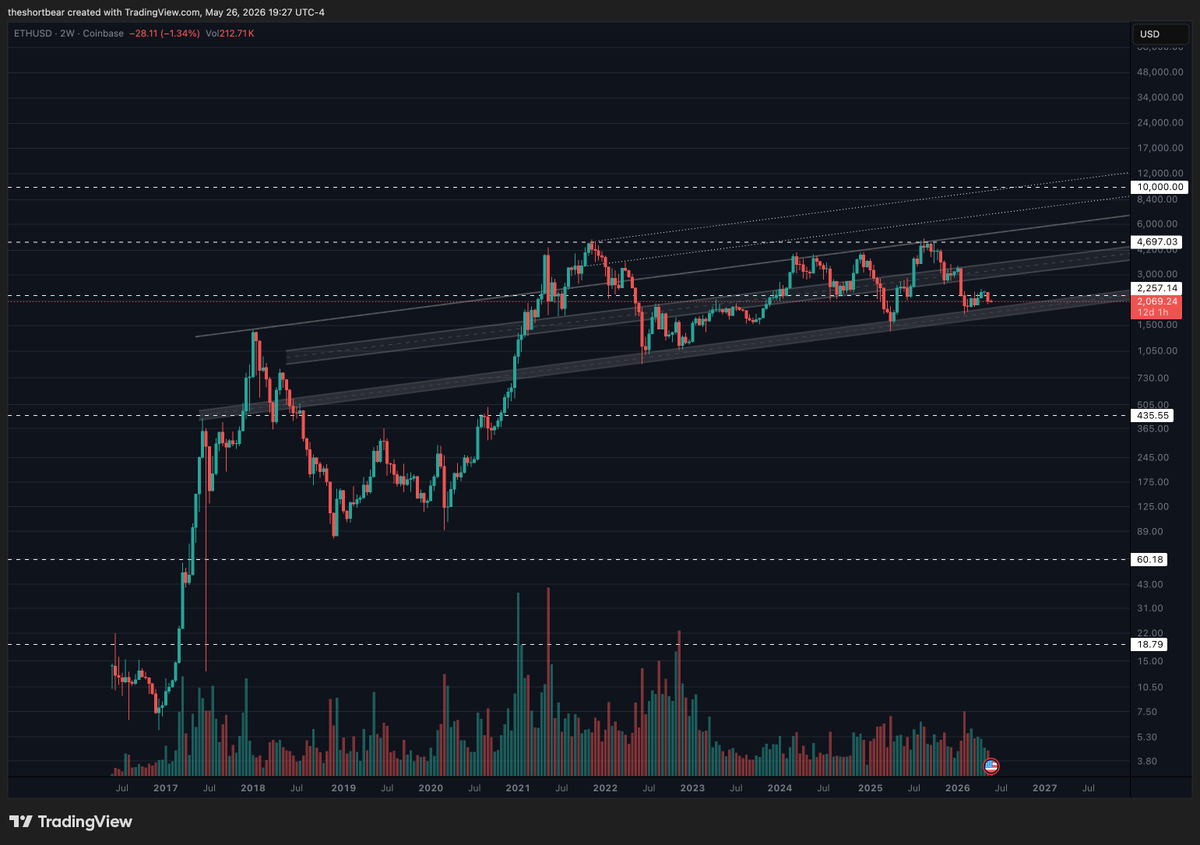
I have never seen so many people capitulating out of $ETH or crypto.
Some are writing blogs and essays explaining why it failed, mainly naming how other chains won the race, measured by fees taken in.
Some of my thoughts, in these hard times:
Time will tell, but I think many people are mistaken in treating $ETH like an end-stage $AMZN, as if the main question is already about mature margins, fees, and cash flows.
In reality, Ethereum is still very much earlier in its economies-of-scale phase, with nearly all metrics in the top right corner and growing at mid double digits to tripple.
Furthermore, most of the market is focused on the wrong battle: who can become the fastest and cheapest payment processor.
Lower fees, higher throughput, faster settlement. But that is likely a race to commoditization, similar to the payment processors crash over the last years.
If the only value proposition is speed and cost, then the moat gets thinner over time, easy disruptable. Someone can always be faster. Someone can always subsidize fees lower. Someone can always optimize one narrow use case.
The real value may not be in the transaction fee itself.
The real value is likely in the amount of economic activity secured by the network, the credibility of that security, the neutrality of the base layer, and the difficulty of replacing it once enough assets, applications, institutions, and users depend on it.
That is where Ethereum seems different to me and why so many institutions are choosing $ETH.
Most other projects still feel replaceable. They may have better performance in one area, better UX in another, or lower fees in the short term. But if their advantage is mainly technical efficiency, that advantage can be copied, competed away, or made irrelevant.
The newest hottest thing today is replacing the hottest thing from last quarter.
Ethereum’s bet appears to be much larger: become the most secure, decentralized, credibly neutral settlement layer for the internet economy.
Not the cheapest rail.
The hardest rail to replace.
In the end, the most valuable network may not be the one with the lowest transaction costs. It may be the one people trust most to secure the highest-value assets and applications over the longest period of time.
If $ETH can retain its market share while continuing to scale through upgrades that improve speed, throughput, and fees, its potential remains significant, especially if AI agents become truly crypto-native.
If it combines all of the above and earn the crown as the leading value-secured network, then $ETH could eventually be viewed as something like a truly decentralized, inflation-adjusting global bond: securing the world’s assets, free from political meddling, and deserving of a premium market cap because of the value it protects on top of the deflationary pressures create incentives to stake, get yield and trust the equivalent of buybacks and griwth in value secured to provide additional value.
Keep in mind over 1/3 of $ETH is now staked!
In that scenario, $ETH would not just be another asset to hold. It could become one of the only truly neutral and secure bonds for the digital economy.
... But sure, lets compare it to $SOL with 6% inflation, no moat, no security, massive outages, decreasing validator nodes and alike.
it just all feels like people are getting lost in short term fees and the easiest valuation attempt rather than what $ETH is actually built for, all while its testing its bottom range and players go full portfolio into AI.
@AuclairsDad When you say energy, I’m assuming you don’t mean just long CL. How best to invest in that? Thank you for sharing not just your thoughts but the rationale behind them. And by the way, you would be top Substack author if you started.
@AuclairsDad The folks at SemiAnalysis talk about Samsung being in a much stronger position for memory versus MU. Do you think memory usage will be so much that even with whatever weakness will rise in value?
@AuclairsDad I asked Claude the odds of a 1000 cases of Hantavirus in this US over the next 12 months. It said less than one in a million. ChatGPT confirmed.
@AuclairsDad I like how you can hold on during a trend as it’s developing and also exit without a meaningful drop. What got you from being quite bullish a week ago to now being bearish? You see things often that seem obvious later.
@AuclairsDad I know you kid around about Substack. You should absolutely be on there. And whether you want to charge a fee or do it for free is up to you. You are extraordinary in balancing fundamentals and market dynamics.
I said dozens and hundreds of times in last 2 years …
80% of the move will come in 20% of the days.
These stocks that I have gave avgo lam and half dozen others have rallied 30-50% off lows . Exact lows . Within days .
They want action every day. Don’t wanna wait !
Anthropic ran their entire marketing operation with one person.
$380 billion company.
Paid search. Paid social. SEO. Email. App stores.
One non-technical hire doing all of it — for 10 months.
I pulled it apart.
Compared it to every system we've built across the clients we've worked with.
Then asked myself one question:
If I had to reverse engineer this from scratch — what would it actually look like?
Turns out the architecture isn't that complicated.
I mapped the whole thing into a 47-page PDF you can upload directly to any LLM.
It coaches you through building your own version step by step.
Comment "marketing" and I'll send it over.