Prem N Ramkumar MD MBA

1.7K posts

Prem N Ramkumar MD MBA banner
Prem N Ramkumar MD MBA

Prem N Ramkumar MD MBA

@prem_ramkumar

Orthopaedic Surgeon: Hip & Knee Sports Medicine + Adult Reconstruction | P.I. - Orthopaedic Intelligence Lab | Team Physician, D1 NCAA and X-Games

Los Angeles, CA Katılım Haziran 2009
257 Takip Edilen5.9K Takipçiler
Prem N Ramkumar MD MBA retweetledi

Dudes Posting Their W’s
Dudes Posting Their W’s@DudespostingWs·
Every man can relate to this scenario
English
237
937
11K
1.3M
Prem N Ramkumar MD MBA retweetledi
ESPN
ESPN@espn·
LUKA STEPS BACK. BANG 🔥🔥🔥
Indonesia
236
3K
20.6K
911.1K
Prem N Ramkumar MD MBA retweetledi
Luka Doncic Performances
Luka Doncic Performances@LukaDoncicFilms·
Rookie Luka Doncic Downhill Scoring Reel
English
28
199
2.1K
223.1K
Prem N Ramkumar MD MBA retweetledi
LakeShowYo
LakeShowYo@LakeShowYo·
THIS ANGLE OF LUKA’S GAMEWINNER 🤩🪄
English
22
586
8K
228.4K
Daman Rangoola
Daman Rangoola@damanr·
Respectfully ABC we don't need the Sacramento Kings/Clippers score on screen
English
19
72
2.4K
48.2K
Prem N Ramkumar MD MBA retweetledi
Howard Luks MD
Howard Luks MD@hjluks·
I’ve been an orthopedic surgeon for nearly 30 years, and a few patterns have become impossible to ignore. One is that many musculoskeletal problems in adults aren’t sudden injuries. They’re the moment when declining capacity and awful metabolic health finally reveals itself. Over the decades your strength fades, muscle mass declines, as your aerobic capacity tanks. Tendons and connective tissues lose substance, stiffness, and resilience. For years the body compensated... quietly. Then one day a knee hurts during a run to get the train, or shoulder aches reaching overhead, or a back tightens lifting something simple. At that point the story usually becomes more about structural damage. An MRI gets ordered. Welcome to high-tech, low-medicine. And the MRI almost always finds something. A meniscus tear. A rotator cuff tear. A disc bulge. Why? Because by midlife these findings are extremely common — even in people with no pain at all. If you have a tear in one shoulder, image the other shoulder... you probably have the same tear there. But I digress. Once the scan appears, the narrative changes. The image becomes the diagnosis. Now the patient believes something is broken, and the focus often shifts to fixing what the MRI shows. What often gets lost in this is the reason the symptoms appeared in the first place. Many so-called “atraumatic” orthopedic complaints are not purely mechanical failures. They are the moment when reduced strength, declining tissue capacity, and sometimes broader metabolic health issues finally reach a tipping point. Our tissues change over the decades... get over it. In other words, the MRI didn’t create the problem. Well... it sort of did in this scenario. But all the MRI showed was something that was already there.... because of your age, lifestyle, health and so on. The real driver of symptoms is often loss of physiologic reserve. Less muscle. Less tendon or aerobic resilience. Less tolerance for load, etc. Once the MRI enters the picture, the risk becomes overtreatment. This is probably the number one reason people have surgery. When in many cases the most powerful intervention was never the scan or the procedure. It was rebuilding capacity. Strong muscles stabilize joints. Aerobic fitness improves metabolic health and tissue perfusion. Gradual loading restores tolerance. But people often don't take PT seriously prior to surgery. They often take PT very seriously afterwards. Therefore, PT is probably the reason you feel better, despite the surgery. The irony is that the treatment many people ultimately need is the same thing that might have prevented the problem in the first place. Staying strong. Staying active. Maintaining the reserve that protects our joints/tendons/muscles/abilities as we age.
English
103
279
1.8K
246.7K
Prem N Ramkumar MD MBA
Prem N Ramkumar MD MBA@prem_ramkumar·
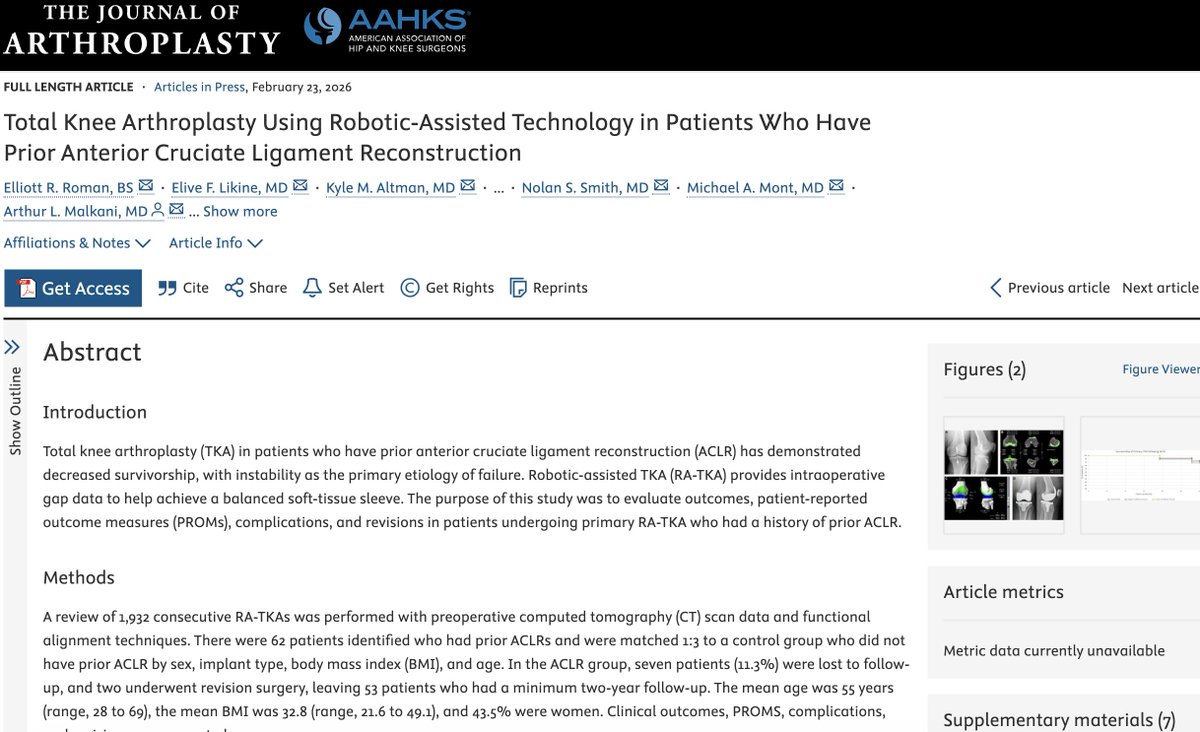
New research by Dr. Ramkumar and his colleagues shows that hip anatomy can significantly influence rotational variability in arthritic knees. Recognizing this before total knee arthroplasty may lead to better alignment and patient outcomes. ochipandknee.com/rotational-var… #medtwitter
Prem N Ramkumar MD MBA tweet media
English
0
0
0
94
Prem N Ramkumar MD MBA retweetledi
LakeShowYo
LakeShowYo@LakeShowYo·
REAVES BEHIND-THE-BACK PASS AND AYTON SLAMS IT DOWN 🔥
English
11
80
1.7K
55.3K
Prem N Ramkumar MD MBA retweetledi
Paul Bronks
Paul Bronks@SlenderSherbet·
When your wife asks you to do one little thing while she's out and you haven't done it.
English
210
799
6K
404.1K
Prem N Ramkumar MD MBA
Prem N Ramkumar MD MBA@prem_ramkumar·
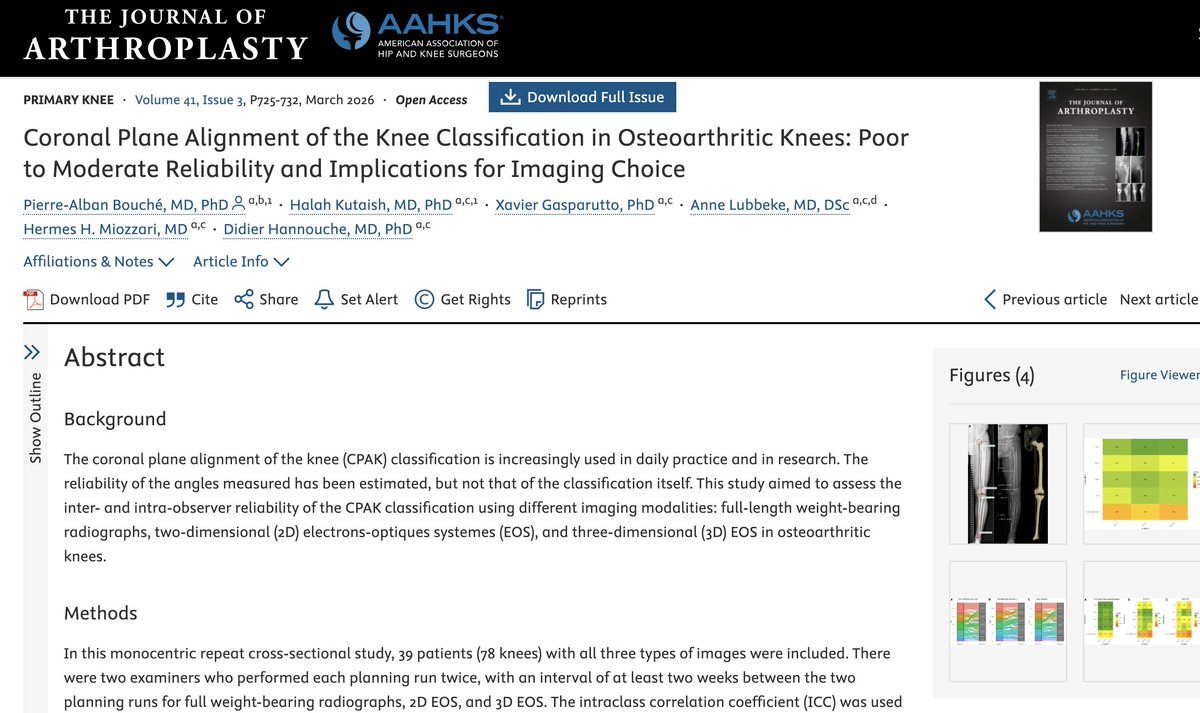
This study evaluated inter- and intra-observer reliability of the CPAK classification in osteoarthritic knees. Full-length weight-bearing radiographs, 2D EOS, and 3D EOS were compared for consistency and reproducibility. medilink.us/1gnw @JArthroplasty #medtwitter
Prem N Ramkumar MD MBA tweet media
English
0
0
0
146
Prem N Ramkumar MD MBA retweetledi
Hoops
Hoops@Hoopss·
Kids today don’t even know about this version of CP3. 🥶
English
64
870
4K
139.1K
Dave McMenamin
Dave McMenamin@mcten·
LeBron will actually pass Kareem on his first made field goal tonight. He had 10 FGM in a December 2023 game that the league refuses to count towards regular season stats since it was the in-season tournament championship (even though all other IST games stats count for reg szn)
Dave McMenamin tweet media
NBA@NBA

MILESTONE KING: LeBron James is on the verge of becoming the NBA’s all-time leader in career field goals made. Entering the Los Angeles Lakers’ matchup against the New Orleans Pelicans tonight (10:30 p.m. ET, NBA League Pass), he needs 11 field goals to break Kareem Abdul-Jabbar’s record of 15,837. James already holds the NBA record for career points, ranks second in free throws made and is sixth in three-pointers made.

English
40
67
1K
230.1K
Prem N Ramkumar MD MBA retweetledi
Nature Unedited
Nature Unedited@NatureUnedited·
A leopard watches the sunset while perched high in a tree in the Masai Mara, Kenya 🐆🌴
English
238
3.6K
33.5K
1.2M
Prem N Ramkumar MD MBA
Prem N Ramkumar MD MBA@prem_ramkumar·
Dr. Ramkumar and colleagues published findings on a tool-enabled language model agent for conversational analysis of clinical datasets. The study evaluates performance, reliability, and real-world applications in clinical data use. medilink.us/6jb8 #medtwitter
Prem N Ramkumar MD MBA tweet media
English
0
0
3
132
Prem N Ramkumar MD MBA retweetledi
Hoops
Hoops@Hoopss·
2012 Blake Griffin dunk reel
English
77
961
5.2K
463.4K
Prem N Ramkumar MD MBA retweetledi
Hoops
Hoops@Hoopss·
Zach Randolph torture chamber ‘14-15
English
133
981
6.5K
1.7M
Prem N Ramkumar MD MBA retweetledi
Johan
Johan@Adityapandeydev·
POV: how x, y and z felt after leaving the alphabet and joining mathematics
English
1K
33.1K
275.2K
16.3M
Prem N Ramkumar MD MBA retweetledi
Aakash Gupta
Aakash Gupta@aakashgupta·
Most people will read this and think optimists live longer because they eat better and exercise more. The study says something wilder. Lee et al. controlled for smoking, diet, exercise, alcohol, depression, BMI, and socioeconomic status. The longevity effect still held. The most optimistic quartile lived 11 to 15% longer and had 1.5 to 1.7x odds of reaching 85 even after removing every behavioral difference. Which means something is happening at the level of biology, not just habits. Rozanski’s meta-analysis across 229,391 participants found optimists carry 35% lower cardiovascular event risk. Blackburn’s Nobel Prize-winning lab at UCSF found pessimistic attitudes are associated with accelerated telomere shortening. Cortisol suppresses telomerase, the enzyme that rebuilds the protective caps on your chromosomes. So chronic negative expectation literally erodes the structures that keep your cells from aging. The loop runs: pessimistic cognitive style → sustained HPA axis activation → elevated cortisol → telomere degradation → accelerated cellular senescence. Optimists interrupt that loop at the top. They show less emotional reactivity to stressors, faster recovery from acute stress, and they default to reframing threats as challenges rather than catastrophizing. The part nobody talks about from this paper: the authors explicitly state optimism is modifiable. This isn’t a personality trait you’re born with. Cognitive reappraisal training, morning sunlight for cortisol rhythm regulation, deliberate breathing protocols for vagal tone, structured gratitude practices. All of these shift the prefrontal cortex patterns that determine where you sit on the optimism spectrum. A 35% reduction in cardiac events from a trainable psychological variable is a bigger effect size than most supplements on the market. That’s the real story buried in this abstract.
Sahil Bloom@SahilBloom

Major life hack: Be optimistic. The way you choose to perceive the world impacts every single area of your life. Choose wisely.

English
119
893
6.5K
1M