
Prerna Raghav 🌞

2.9K posts

Prerna Raghav 🌞 banner
Prerna Raghav 🌞

Prerna Raghav 🌞

@prernaraghav

Media Leader Storytelling Sustainability & Impact Live insights .Exe Creative Director @network18group Prev NdTv media, Times Network, Bbc wst & WatermarkFilms

India Katılım Haziran 2009
1.9K Takip Edilen690 Takipçiler
Prerna Raghav 🌞 retweetledi

Andrej Karpathy
Andrej Karpathy@karpathy·
Something I've been thinking about - I am bullish on people (empowered by AI) increasing the visibility, legibility and accountability of their governments. Historically, it is the governments that act to make society legible (e.g. "Seeing like a state" is the common reference), but with AI, society can dramatically improve its ability to do this in reverse. Government accountability has not been constrained by access (the various branches of government publish an enormous amount of data), it has been constrained by intelligence - the ability to process a lot of raw data, combine it with domain expertise and derive insights. As an example, the 4000-page omnibus bill is "transparent" in principle and in a legal sense, but certainly not in a practical sense for most people. There's a lot more like it: laws, spending bills, federal budgets, freedom of information act responses, lobbying disclosures... Only a few highly trained professionals (investigative journalists) could historically process this information. This bottleneck might dissolve - not only are the professionals further empowered, but a lot more people can participate. Some examples to be precise: Detailed accounting of spending and budgets, diff tracking of legislation, individual voting trends w.r.t. stated positions or speeches, lobbying and influence (e.g. graph of lobbyist -> firm -> client -> legislator -> committee -> vote -> regulation), procurement and contracting, regulatory capture warning lights, judicial and legal patterns, campaign finance... Local governments might be even more interesting because the governed population is smaller so there is less national coverage: city council meetings, decisions around zoning, policing, schools, utilities... Certainly, the same tools can easily cut the other way and it's worth being very mindful of that, but I lean optimistic overall that added participation, transparency and accountability will improve democratic, free societies. (the quoted tweet is half-ish related, but inspired me to post some recent thoughts)
Harry Rushworth@Hrushworth

The British Government is a complicated beast. Dozens of departments, hundreds of public bodies, more corporations than one can count... Such is its complexity that there isn't an org chart for it. Well, there wasn't... Introducing ⚙️Machinery of Government⚙️

English
386
690
5.7K
791.1K
Prerna Raghav 🌞
Prerna Raghav 🌞@prernaraghav·
@avikaul Privileged to witness this climb up close @avikaul .A remarkable journey built on people, purpose, and perspective. The next mountain is lucky to have you leading the ascent. Onward and upward. ⛰️✨
English
1
0
1
170
Avinash Kaul
Avinash Kaul@avikaul·
1/ A few days back was my last day at Network18. Almost 12 years. Before I say anything else — I want to talk about the people who actually made it all possible. Not the boardroom. The people outside it. 🧵
English
13
1
27
6.3K
Prerna Raghav 🌞
Prerna Raghav 🌞@prernaraghav·
Happy World Water Day 💧 Earth may be the blue planet, but the water humans can actually use is just a tiny fraction. And it’s the same pool the “cloud” depends on too. #WorldWaterDay #WaterConservation #Climate #AI #DataCenters
Aakash Gupta@aakashgupta

97% of the water on that map is saltwater. Data centers don't run on saltwater. The accessible freshwater humans can actually use, the rivers, lakes, and shallow aquifers that support 8 billion people, is 0.3% of Earth's total water supply. That tiny fraction is what data centers are pulling from. Google consumed 6.4 billion gallons across its data centers in 2023. Microsoft used 1.7 billion gallons, up 34% from the year before. Training GPT-4 alone consumed 13.4 million gallons in a single month at Microsoft's Iowa facility, equal to the monthly water usage of 130,000 Americans. Northern Virginia, the world's data center capital, used 2 billion gallons across its facilities in 2023, a 63% increase from 2019. Lawrence Berkeley National Lab projects U.S. data center water consumption will double or quadruple by 2028. The problem is where this water goes. Evaporative cooling doesn't return the water to the system. It's gone. And two-thirds of data centers built since 2022 are in regions already facing water stress. Arizona revoked new residential building permits in Maricopa County because groundwater was running out. Google's data center in the same county has a permit to draw 1.45 billion gallons per year. The state chose servers over homes. Posting a picture of the ocean to dismiss freshwater consumption is like pointing at the sun to argue a house fire isn't hot. Scale doesn't work when you're pulling from the wrong pool.

English
0
0
0
49
Prerna Raghav 🌞
Prerna Raghav 🌞@prernaraghav·
Big win for Indian deep-tech 🇮🇳 Trivandrum-based robotics startup Genrobotics has beaten 600+ global companies to secure a major contract with Singapore. Their robots will help clean and inspect sewer systems replacing dangerous manual work with technology. From solving India’s sanitation challenges to going global. 🌍 #StartupIndia #Robotics #DeepTech #Genrobotics #Sanitation (@GenroboticsOG
Runtime@RuntimeBRT

🚨 Trivandrum-based robotics company Genrobotics (@GenroboticsOG) has beat 600 other companies and secured a contract with Singapore.

English
0
1
1
72
Prerna Raghav 🌞 retweetledi
Aakash Gupta
Aakash Gupta@aakashgupta·
I worked at Epic Games for two years. This is real, and the strategy behind it is smarter than most people realize. Tim Sweeney has spent nearly two decades buying North Carolina forest land. 50,000+ acres across 15 counties. He’s now one of the largest private landowners in the state. The purchases started in 2008, right after the real estate collapse wiped out developers who had been planning golf resorts and luxury communities on biodiverse wilderness. Sweeney paid $15 million for Box Creek Wilderness, a 7,000-acre stretch in the Blue Ridge foothills containing 130+ rare and threatened species. Developers had owned 5,000 of those acres before the crash. He bought them for conservation prices when nobody else was bidding. He runs the acquisitions through an LLC called “130 of Chatham.” He buys the land, holds it for years, then either donates it to the U.S. Fish and Wildlife Service, sells it at a discount to state parks, or hands it to land trusts. In 2021, he donated 7,500 acres in the Roan Highlands to the Southern Appalachian Highlands Conservancy. Largest private land donation in North Carolina history. The part people miss: he told the News & Observer that since 2021, land got too expensive to keep buying. So he shifted focus to converting his existing 50,000 acres into permanent conservation status. He’s locking the land into legal structures that make development impossible regardless of who owns it in the future. A billionaire worth roughly $6 billion is spending tens of millions acquiring wilderness specifically during economic downturns, then giving it away or placing it under permanent legal protection. The land will outlast him, Epic Games, and Fortnite. That’s the part that separates Sweeney from billionaires who write checks to get their name on a building. The building depreciates. The forest compounds.
Dudes Posting Their W’s@DudespostingWs

Huge W

English
1.2K
19K
178.5K
10.5M
Prerna Raghav 🌞 retweetledi
Aakash Gupta
Aakash Gupta@aakashgupta·
A tech consultant in Sydney spent $3,000 and two months to do what Moderna has spent billions trying to scale. Paul Conyngham adopted Rosie, a staffy-Shar Pei cross, from a shelter in 2019. In 2024, tumors started growing on her back leg. Mast cell cancer, the most common skin cancer in dogs. He tried surgery, chemo, immunotherapy. Nothing shrank the tumors. Just slowed them down while the bills stacked into the tens of thousands. So he opened ChatGPT and asked it how to cure his dog’s cancer. The AI didn’t cure anything. What it did was compress months of literature review into hours. It suggested genomic sequencing, walked him through neoantigen identification, helped him build a research pipeline that would normally require a postdoc and a lab budget. He paid $3,000 to sequence Rosie’s tumor DNA at UNSW’s Ramaciotti Centre, then ran the mutations through AlphaFold to model the protein structures. A computational biology professor at UNSW saw his analysis and was, in his own words, gobsmacked that someone with zero biology training had assembled the whole thing. Then came the part nobody expects. The science was the easy half. Australian ethics approval to run a drug trial on your own pet took three months. Two hours every night after work, filling out a 100-page application. The red tape was harder than designing the vaccine. Once he cleared that, Páll Thordarson at the UNSW RNA Institute built a custom mRNA vaccine from Conyngham’s data. Sequencing to finished vaccine: less than two months. Conyngham drove 10 hours to deliver Rosie for her first injection in December. One month later, the tennis-ball-sized tumor on her leg had shrunk 75%. Here’s where the numbers get interesting. Moderna and Merck just reported five-year data on their personalized mRNA cancer vaccine for melanoma. It encodes up to 34 neoantigens per patient. The Phase III trial is fully enrolled. Projected cost per patient: $100,000 to $300,000. Their pipeline is worth an estimated $2.3 billion in annual sales by 2031. Conyngham did a version of the same workflow for his dog. Sequenced the tumor. Identified the neoantigens. Built a custom mRNA construct. Total cost: $3,000 for sequencing plus university lab time. The gap between those two numbers is where AI is about to rearrange the entire cost structure of precision medicine. The regulatory moat is real. Conyngham could do this because veterinary experimental treatments face lighter scrutiny than human medicine. There’s no FDA Phase I-III gauntlet for a one-off compassionate use case on a dog. But the technical workflow, tumor sequencing to neoantigen prediction to mRNA synthesis, is converging toward something a motivated person with the right AI tools can orchestrate in weeks instead of years. One guy, a rescue dog, and a $20/month ChatGPT subscription just produced a proof of concept that the pharmaceutical industry has spent a decade and billions of dollars building toward. The vaccine worked. The tumor shrank. And the only reason it happened is because a dog owner loved his dog enough to spend three months fighting paperwork.
Aakash Gupta tweet media
Séb Krier@sebkrier

This is wild. theaustralian.com.au/business/techn…

English
79
779
3K
344.5K
Prerna Raghav 🌞 retweetledi
Oxford Mathematics
Oxford Mathematics@OxUniMaths·
So who discovered the Fibonacci sequence? Fibonacci? No, afraid not (no disrespect Leonardo Bonacci, aka Fibonacci). Another scientist? Nope. Who then? Here's @MarcusduSautoy (it wasn't him either in case you're wondering).
English
57
476
1.5K
87.5K
Prerna Raghav 🌞 retweetledi
NotebookLM
NotebookLM@NotebookLM·
Introducing Cinematic Video Overviews, the next evolution of the NotebookLM Studio. Unlike standard templates, these are powered by a novel combination of our most advanced models to create bespoke, immersive videos from your sources. Rolling out now for Ultra users in English!
English
495
1.7K
14.9K
3.5M
Prerna Raghav 🌞 retweetledi
Pratyush Kumar
Pratyush Kumar@pratykumar·
📢 Open-sourcing the Sarvam 30B and 105B models! Trained from scratch with all data, model research and inference optimisation done in-house, these models punch above their weight in most global benchmarks plus excel in Indian languages. Get the weights at Hugging Face and AIKosh. Thanks to the good folks at SGLang for day 0 support, vLLM support coming soon. Links, benchmark scores, examples, and more in our blog - sarvam.ai/blogs/sarvam-3…
English
209
1.3K
6.9K
736.2K
Prerna Raghav 🌞 retweetledi
CNBC-TV18
CNBC-TV18@CNBCTV18News·
Thank You, Viewers! CNBC-TV18 tops the charts as India’s No.1 English Business News Channel with 85.9% market share! #CNBCTV18
CNBC-TV18 tweet media
English
5
5
20
9.4K
Prerna Raghav 🌞 retweetledi
Shereen Bhan
Shereen Bhan@ShereenBhan·
Ministry of Information and Broadcasting suspends TV ratings for 4 weeks or till further notice to curb “sensationalism” being displayed by “certain news TV channels” @CNBCTV18Live @CNBCTV18News #IranWar #TRP #News
Shereen Bhan tweet media
English
60
89
268
49.6K
Prerna Raghav 🌞
Prerna Raghav 🌞@prernaraghav·
Newsrooms are strange places. So much noise outside and yet you remember people in very small moments. Between policy conversations, sustainability debates and later the long days around the Global AI Lens sprint I think we will remember the calm you brought to mad production days. Thank you for making work feel lighter than it usually is. Wishing you a peaceful break and a fantastic next adventure. I’m certain bigger things await you. You will be missed here. All the best & Stay in touch.
English
1
0
0
331
Parikshit Luthra
Parikshit Luthra@Parikshitl·
28th of February, 2026 was my last day at CNBC-TV18. I have spent close to two decades at Network18 out of which 8 years were with CNBC-TV18. I anchored & reported heavily on the criminal justice system, terrorism, politics, parliament, conflict & foreign affairs while I was at CNN-IBN, which later became CNN-News18. My time at St Stephen’s College & Faculty of Law equipped me with the strong academic grounding that I needed while starting my career. At CNBC-TV18 as Chief of Bureau I was fortunate to meet & interview top business leaders & union ministers across sectors. I anchored & reported on the biggest economic policy, business, auto & financial sector stories impacting the country. I was responsible for curating new IPs like Newscentre, Global Eye & Global Lens on politics & foreign policy through an economic lens. In my last few weeks at the channel, I was lucky to be a part of our coverage of the Union Budget, the India AI Summit & our company’s flagship event, the Rising Bharat Summit 2026. For now I plan to take a break before I begin my next assignment!
Parikshit Luthra tweet mediaParikshit Luthra tweet mediaParikshit Luthra tweet mediaParikshit Luthra tweet media
English
90
6
270
51.2K
Prerna Raghav 🌞
Prerna Raghav 🌞@prernaraghav·
Two AI economies are forming in real time. App Store rankings are a mood n procurement pipelines are a system. One moves in days, the other in years. The real winner won’t be whoever trends it’ll be whoever gets embedded into everyday workflows. #Anthropic
Aakash Gupta@aakashgupta

Claude was #6 on the App Store on Wednesday. The Pentagon demanded Anthropic remove its restrictions on autonomous weapons and mass surveillance. Anthropic said no. Trump threatened criminal consequences. Hegseth asked to classify them as a national security supply-chain risk. Three days later, Claude is #1 in America for the first time ever, ahead of ChatGPT. The supply-chain designation is legally non-binding. Defense contractors can still technically use Claude. None of them will. When the Pentagon is publicly labeling a vendor a national security risk, no Raytheon or Lockheed procurement officer is signing that purchase order. Anthropic’s direct government revenue is around $200M, but the enterprise ripple effect through the defense industrial base is multiples of that, gone without a single law changing. Which makes what’s happening on the consumer side the most important strategic shift in AI right now. Anthropic doesn’t just want the consumer market anymore. They need it. Free users up 60% since January. Daily signups tripling, breaking all-time records every day this week. Katy Perry posting hearts around the $20/month Pro plan. ChatGPT’s own subreddit becoming a cancellation support group. OpenAI chose the Pentagon. Anthropic got chosen by the internet. And the users switching on values churn slower than users switching on benchmarks. At $380B, Anthropic just discovered that consumer AI might be worth more than every defense contract combined.

English
0
0
0
47
Prerna Raghav 🌞
Prerna Raghav 🌞@prernaraghav·
Fascinating times. Time will tell.
Aakash Gupta@aakashgupta

Dario Amodei just raised $30 billion at a $380 billion valuation three weeks before going on camera to say his own technology terrifies him. Nobody is asking the obvious question: why does the CEO of the fastest-growing enterprise AI company on earth keep doing press tours about how dangerous his product is? Anthropic went from $1 billion in annualized revenue in December 2024 to $14 billion by February 2026. That is 14x growth in 14 months. Claude Code alone is doing $2.5 billion annualized. Eight of the Fortune 10 are paying customers. The company is preparing for an IPO that could be one of the largest tech listings in history. This is a man who has figured out that the fear IS the product. Every time Amodei goes on 60 Minutes and compares AI to a tsunami, three things happen simultaneously. Enterprise buyers hear "this technology is so powerful that even its creator thinks you need to take it seriously." Regulators hear "we're the responsible lab, write the rules around our safety standards." And investors hear "the market for AI safety infrastructure is so large that even the people building it can't see the ceiling." Anthropic's entire competitive moat is that it's the AI company that worries out loud. OpenAI plays offense, Google plays distribution, and Anthropic plays conscience. That positioning just attracted Sequoia, Microsoft, Nvidia, GIC, and Coatue into the same cap table. Sequoia is backing Anthropic AND OpenAI AND xAI simultaneously because the bet isn't on which lab wins. The bet is that the market is so large that backing all three still returns 10x. The post says "nobody voted for this." Correct. But $30 billion in new capital voted for it last month. The same man who published a 38-page warning about existential risk in January closed the second-largest private funding round in venture history in February. Those two events are not in tension. They are the same strategy. Watch what he does, not what he says. Anthropic committed $50 billion to US data centers. They signed a $30 billion compute deal with Microsoft Azure running on Nvidia chips. They tripled international hiring. They are sprinting, not braking. The "tsunami on the horizon" framing does real work. It makes the urgency feel external, like weather. Meanwhile, the company is growing at 14x annually because the product works and customers can't stop buying it. Amodei genuinely believes the technology is dangerous AND he's building it as fast as humanly possible AND that contradiction is the most bankable brand position in enterprise software right now. The part that should stop you cold: he said it, raised $30 billion the same month, and nobody found that strange.

English
0
0
0
15
Prerna Raghav 🌞 retweetledi
CNN
CNN@CNN·
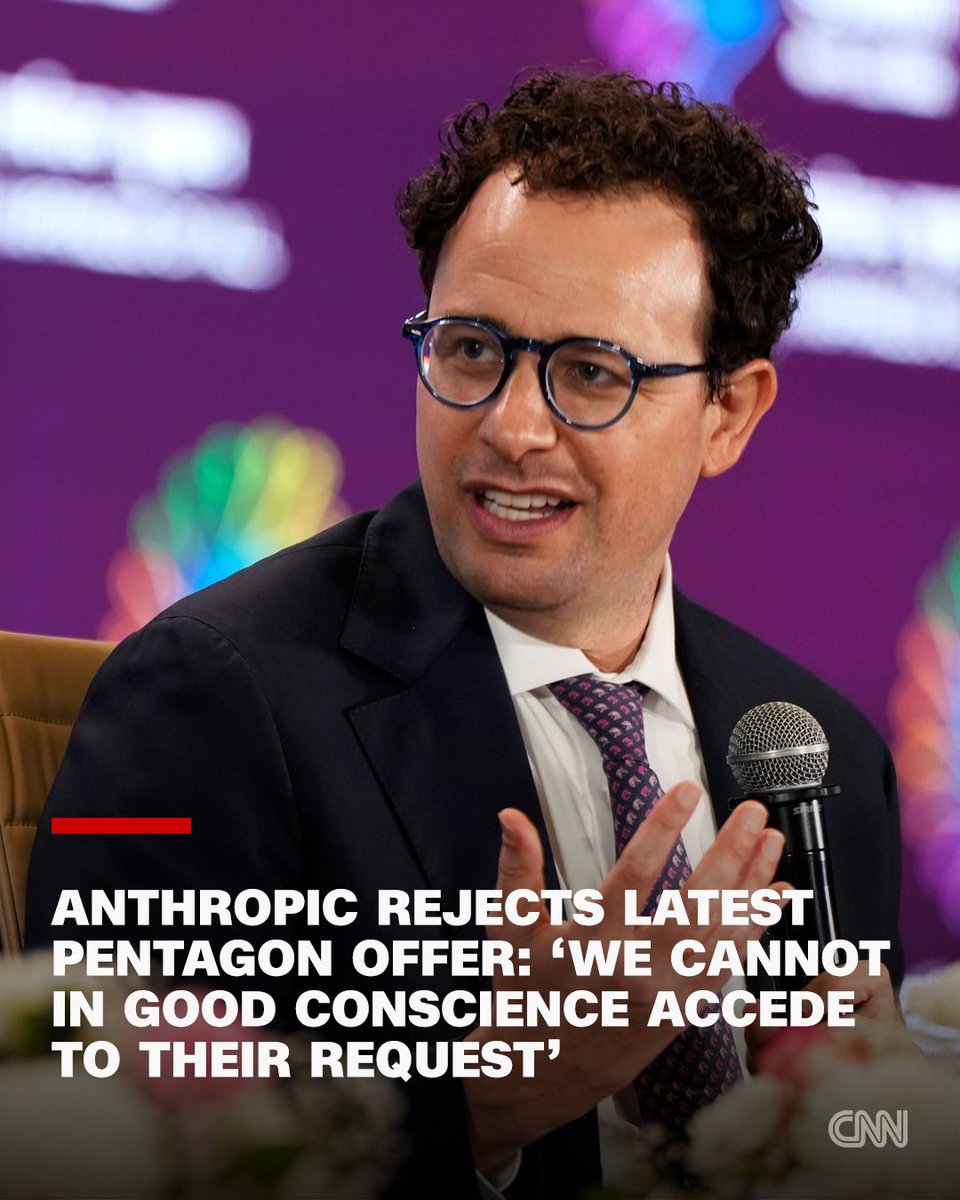
Anthropic is rejecting the Pentagon’s latest offer to change their contract, saying the changes do not satisfy the company’s concerns that AI could be used for mass surveillance or in fully autonomous weapons. cnn.it/4aEJhgh
CNN tweet media
English
167
408
1.9K
144.4K
Prerna Raghav 🌞
Prerna Raghav 🌞@prernaraghav·
The AI health divide isn’t really about models. It’s about governance and system design. China: super-app approach assistants like #Afu deploy broadly, regulate as they scale. US: institutional approach tools like #ChatGPTHealth validate first and integrate through hospitals. India: public-infrastructure approach a national health stack where many AI services can plug in. One maximizes access. One minimizes liability. One could balance both. India’s opportunity: population-scale AI healthcare with safeguards from day one. The real race isn’t who launches first it’s which system actually improves patient outcomes. AI in medicine won’t be judged by demos or benchmarks, only by whether people receive better care. #AI #HealthAI #HealthPolicy #DigitalHealth #HealthCare #esanjeevini #AarogyaSetu
Poe Zhao@poezhao0605

When ChatGPT Health launched in January, Chinese social media had one dominant reaction: “So this is the American version of Afu.” Afu is Ant Group’s AI health assistant. It was already serving 15 million monthly active users when ChatGPT Health went live. Within days, that number doubled to 30 million. The usual narrative — Silicon Valley innovates, China follows — didn’t apply here. But the “American Afu” framing also misses something deeper. Both countries are experiencing the same AI healthcare explosion. They are having entirely different conversations about it. My new piece explains why: hellochinatech.com/p/when-chatgpt…

English
0
0
0
20
Prerna Raghav 🌞
Prerna Raghav 🌞@prernaraghav·
The next zillion dollar startups won’t be apps.They’ll be companies where the “employees” are AI. A big shift in AI is starting We’re moving from software you use to Ai that does the job. Sales outreach, support, research, coding, operations agents are beginning to run real workflows. #EricSchmidt has been highlighting task-performing AI agents as a major opportunity area. The next wave of startups may not just assist work. They may operate it. #AI #AgenticAI #FutureOfWork #Startups #Automation
Big Brain AI@realBigBrainAI

Eric Schmidt's advice for making money in AI right now: "Found an agentic AI company. Not one designing agents, build an agent to do something."

English
0
0
0
26
Prerna Raghav 🌞
Prerna Raghav 🌞@prernaraghav·
A distinguished officer and respected defence analyst in the news media. He served the nation both in uniform and through his informed voice. A gentleman of honour and integrity, he will be remembered with deep respect 🇮🇳 Heartfelt condolences to his family. May his soul rest in peace. 🙏
English
0
0
2
69
Khushboo Mattoo
Khushboo Mattoo@MattLaemon·
Travel well Maroof. I hope someone from the crop today takes the legacy forward..
Khushboo Mattoo tweet media
English
7
10
96
2.6K