

Prakāśa
756 posts
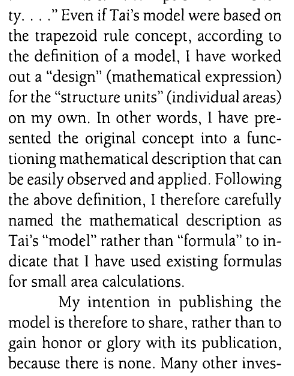

@Sprocket0479 @prksh2411 @oxcrowx maybe she is contrasting the "original" concept (trapezoid sum) with her novel concept (a specific presentation of the trapezoid sum)
English

Once a doctor re-invented integration by trapezoidal rule because she did not learn it in school.
She received 75 citations for her novel work.
She even named it after herself. lol.

Valentin Ignatev@valigo
I desperately need to learn more math. Recently I invented "lerp" from first principles. Would have saved some time if I knew its industry-standard name :/
English

@oxcrowx Her response (source 10 on the wiki page) is more graceful than one might expect but it still indicates she doesn't quite get it.
She simultaneously claims that the method is common sense and also that her presentation is original which seems innately contradictory.
English
More proof that we are living in Akhand Maharashtra (which is actually just Akhand Thanjavur)
Śaśā́ṅkaḥ श॒शाङ्कः॑@Konkanist
Different "historical" styles of the #Devanagari script
English

@prksh2411 Not directly related, but is पश्चिम the only दिक् without सर्वनाम notion? I only found पश्चिमायां in declension tables
Pūrvottara is not a new thing that Hindi made up. It is a type of samāsa that Pāṇini described.
2.2.26: दिङ्नामान्यन्तराले [traditional examples include pūrvottara]
TeaChaiLa टीचायला ಟೀಚಾಯ್ಲಾ ٹیچائےلا ટીચાઇલા@TeaChaiLa
Marathi still uses traditional words for sub directions. Ishaanya, Nairutya, Aagneya, Vaayavya. Hindi sadly has given up. Eg. North East in India in Marathi is called Ishaanya Bhaarat. In Hindi, they have changed it to Poorvottar Bhaarat. Poorvottar is a made up word.
@prksh2411 I mean Āraṇyak has to be older than sūtra literature no?
Latviešu
@Ugrashravas Not sure how old this part is, given the aberrant accent. But both uttarapūrva and pūrvottara seem to be freely used in Śrautasūtras. Even Hindi freely mixes these words (hi.wikipedia.org/wiki/%E0%A4%AA…).
English
@TeaChaiLa In that sense, all words are created. They are not eternal artefacts of the natural world. ईशान्य is a taddhita word rather than a samāsa word. And taddhita is a way to create new words out of old preexisting words.
English

@prksh2411 Samaasa, even if 10000 years old, is still a way to create words. It is an easy way out to create a non existent word. It is like saying Antidisestablishmentarianism is longest English word without acknowledging that there are four different words in it.
English
@ganeshkrishna Not recent. The "vector" sense is expressed by Pāṇini using antarāle (NE is in the antarāla of N and E, etc). None of the words you claim is absent is actually absent in Sanskrit. x.com/prksh2411/stat…
Prakāśa@prksh2411
Pūrvottara is not a new thing that Hindi made up. It is a type of samāsa that Pāṇini described. 2.2.26: दिङ्नामान्यन्तराले [traditional examples include pūrvottara]
English
😄, while poorvottara is literally correct as east-north, the popular meaning (prasiddha artha) of poorva is before and uttara is after in this compound.
So poorvottara is used (almost always) to mean "before and after" and only recently (after English) for the direction.
And I can't think of the right samāsa to combine poorva +vibkati and sense +uttara to create the vector math to get a direction. This can be seen in the absence of words pashchimōttara paschimadakshina poorvadakshina etc.
TeaChaiLa टीचायला ಟೀಚಾಯ್ಲಾ ٹیچائےلا ટીચાઇલા@TeaChaiLa
Marathi still uses traditional words for sub directions. Ishaanya, Nairutya, Aagneya, Vaayavya. Hindi sadly has given up. Eg. North East in India in Marathi is called Ishaanya Bhaarat. In Hindi, they have changed it to Poorvottar Bhaarat. Poorvottar is a made up word.
English

@prksh2411 @Akjarati Are these hindi speakers? Never heard ṇ from em
English

@Saatvata @cobbaltt @chrisinthebooks So even with all the Keralamian exceptionalism, 1121 is mostly due to male migration.
English
@Saatvata @cobbaltt @chrisinthebooks Yeah, a differential of ~4 years in life expectancy would lead to a delta of ~60 between population ratio and at birth ratio.
English
This reminds me, there was a reddit post a few weeks ago about abortion in India on a non-India-centric sub. Cue Americans that "India is very progressive". The frontlines of our culture wars are different, lol.
Vefa T.@GM_Finnegan
Kültür şoku sayılır mı bilmiyorum ama Amerikalı bir arkadaşım İran’da çok eşliliğin yasal olduğunu görünce “bu kadar progressive olduklarını bilmiyordum” demişti
English
@Saatvata @cobbaltt @chrisinthebooks National-level data shows the ratio improving marginally from 919 to 929.

English
@Saatvata @cobbaltt @chrisinthebooks Also at least some numbers in that map are wrong. See the data here: mohfw.gov.in/sites/default/…
English