
produmanni
88.8K posts

@produmanniXBT
a trader without a million but with an impressive win rate short positions on $btc until nov 2026. waiting for low prices on eth nft co-founder: @pingopond


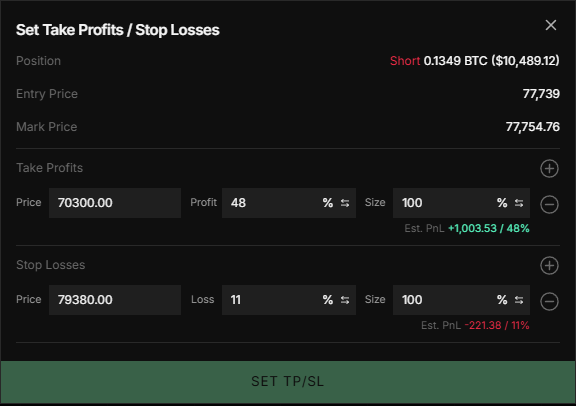
99% IGNORE THIS, AND THEY’RE DUMB! HOW TO GET $10,000 IN OPERATING CAPITAL IN ONE TRADE. Prop‑challenges on @VestExchange demand 10% profit on the provided deposit. The loss threshold is 6%, daily drawdown 4%. With a risk‑to‑reward (RR) of 2.8–3, you can close the challenge in a single trade within the rules of Vest Market. Promo code MANNI20 gives you 20% off any challenge. A $10,000 prop‑account costs $88. So here’s the drill: 1. Sign up on Vest Market [trade.vestmarkets.com/join/XATVE]. 2. Buy the challenge for $88 (less than the typical stop‑loss on many people’s orders). 3. Open a short from any level above $77,000. Stop‑loss at $79,380, take‑profit at $70,300. 4. Leave it alone. Let the market (or Trump) do the talking. If it hits the target, you instantly get $10,000 to trade, keeping 90% of the profits. 1% of that is $100, which fully covers the initial risk. If it stops out, you just take a normal loss. The kind you already accept when you pay fees. *Vest Market is an RWA perp DEX, top‑30 by volume, with a proper funding round backed by people from BlackRock. Fine, I won’t keep selling it. You’ll ignore it anyway, right? If this isn’t a solid RR, I don’t know what fucking RR is → @VestExchange.


99% IGNORE THIS, AND THEY’RE DUMB! HOW TO GET $10,000 IN OPERATING CAPITAL IN ONE TRADE. Prop‑challenges on @VestExchange demand 10% profit on the provided deposit. The loss threshold is 6%, daily drawdown 4%. With a risk‑to‑reward (RR) of 2.8–3, you can close the challenge in a single trade within the rules of Vest Market. Promo code MANNI20 gives you 20% off any challenge. A $10,000 prop‑account costs $88. So here’s the drill: 1. Sign up on Vest Market [trade.vestmarkets.com/join/XATVE]. 2. Buy the challenge for $88 (less than the typical stop‑loss on many people’s orders). 3. Open a short from any level above $77,000. Stop‑loss at $79,380, take‑profit at $70,300. 4. Leave it alone. Let the market (or Trump) do the talking. If it hits the target, you instantly get $10,000 to trade, keeping 90% of the profits. 1% of that is $100, which fully covers the initial risk. If it stops out, you just take a normal loss. The kind you already accept when you pay fees. *Vest Market is an RWA perp DEX, top‑30 by volume, with a proper funding round backed by people from BlackRock. Fine, I won’t keep selling it. You’ll ignore it anyway, right? If this isn’t a solid RR, I don’t know what fucking RR is → @VestExchange.


99% IGNORE THIS, AND THEY’RE DUMB! HOW TO GET $10,000 IN OPERATING CAPITAL IN ONE TRADE. Prop‑challenges on @VestExchange demand 10% profit on the provided deposit. The loss threshold is 6%, daily drawdown 4%. With a risk‑to‑reward (RR) of 2.8–3, you can close the challenge in a single trade within the rules of Vest Market. Promo code MANNI20 gives you 20% off any challenge. A $10,000 prop‑account costs $88. So here’s the drill: 1. Sign up on Vest Market [trade.vestmarkets.com/join/XATVE]. 2. Buy the challenge for $88 (less than the typical stop‑loss on many people’s orders). 3. Open a short from any level above $77,000. Stop‑loss at $79,380, take‑profit at $70,300. 4. Leave it alone. Let the market (or Trump) do the talking. If it hits the target, you instantly get $10,000 to trade, keeping 90% of the profits. 1% of that is $100, which fully covers the initial risk. If it stops out, you just take a normal loss. The kind you already accept when you pay fees. *Vest Market is an RWA perp DEX, top‑30 by volume, with a proper funding round backed by people from BlackRock. Fine, I won’t keep selling it. You’ll ignore it anyway, right? If this isn’t a solid RR, I don’t know what fucking RR is → @VestExchange.


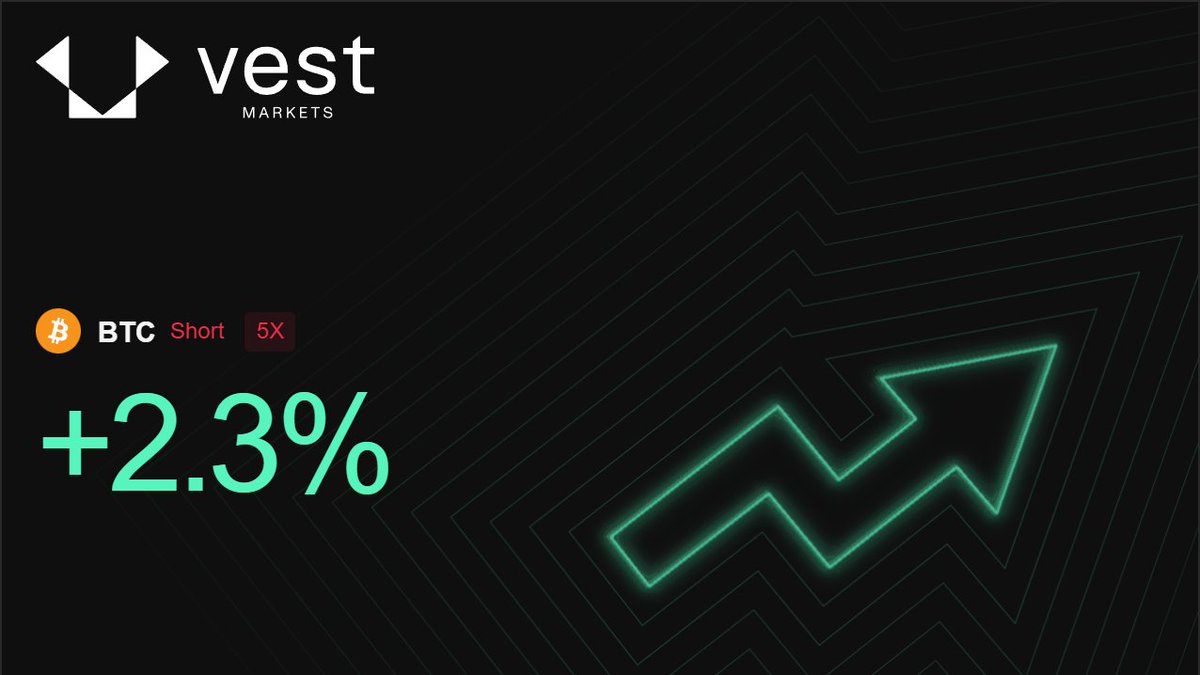
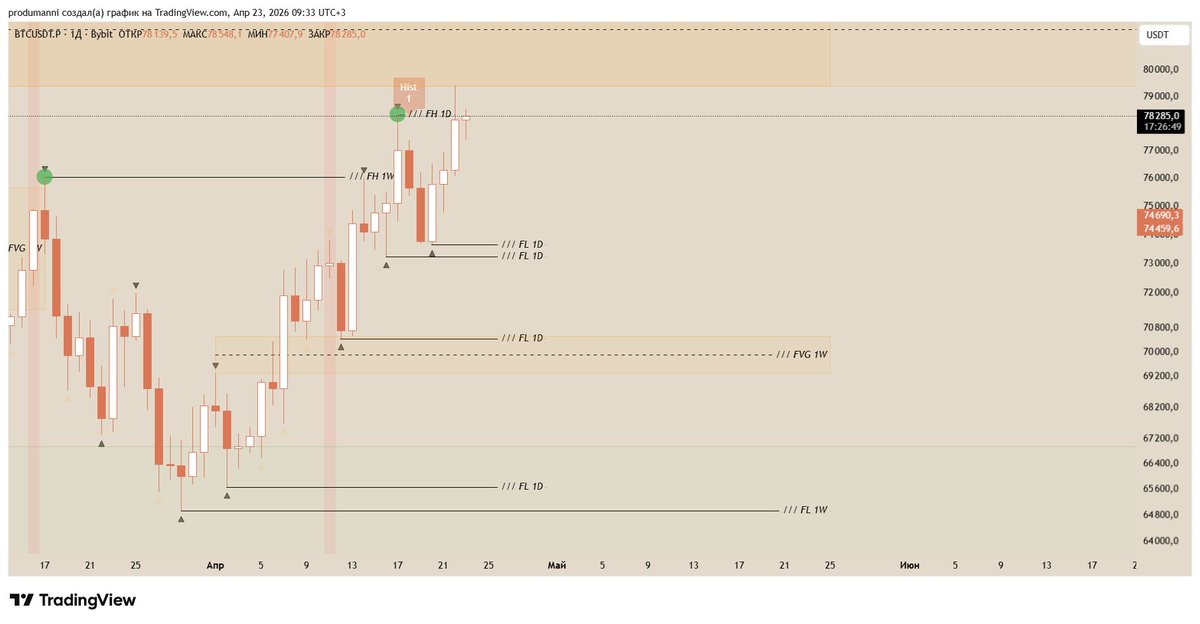
IMPORTANT: WHY SHORTING BTC RIGHT NOW TAKES YOUR MONEY INSTEAD OF MAKING IT, BUT... Earlier, in the post about VC, I pointed out that the key is the combo of two timeframes - X (the main TF) and X-1 (one level lower). Simple version. X is always your POI. X-1 is where you validate incoming volume. That’s your answer to two basic questions: where did the volume come from, and where is it likely going. But two more things matter just as much - narrative (trend) and order flow. They’re tied together. When you map where volume came from and where it’s headed, you’re building the narrative from point A to point B. Price doesn’t move in clean 1-2 candle impulses. Volatility is built through local refuels and distribution. And the market is fractal. Every move is just a piece of a bigger structure. So X is always X-1 for a higher formation. That’s how the narrative stacks. If you don’t want to piss into the wind, figure out which way it’s blowing. That’s where the third timeframe comes in - X+1. The narrative is defined by the last VC on the higher timeframe relative to your POI. Example. Price taps a 4H FVG, buyers step in with a 1H VC. That sets the upside target at the first 4H element. Now check the last VC on 1D. If it came from buyers, your 4H move is trend-aligned. If not, you’re trading against the flow. ⤿ THIS IS THE PROBLEM WITH THE CURRENT $BTC SHORT We’ve got a 1W FVG from buyers at $69,300 - $70,520. That acts as a VC coming out of a monthly element. That flips the narrative to the buy side. The valid VC TF here is 1D. Which means shorts taken off a 4H VC are countertrend. I factored that risk in when opening positions. Still, volume confirmation isn’t limited to FVG or SNR. There are other layers - cycle timing, broader trend, all of it matters. In a cleaner setup, you’d just trade with buyers. That’s what the system says. But with the current fundamentals, it’s either stay out, or take the trade and accept you’re standing in the wind, wearing brand new shoes.


PingoPond operations have been suspended, and resumption remains uncertain. It was a long journey spanning over 18 months. We scaled from zero to one of the most active projects in the @Aptos ecosystem, relying solely on our own efforts and resources. Along the way, we faced numerous obstacles and outright setbacks. We committed to the Aptos Foundation Accelerator program and were the sole project to receive not only attention but support. In the end, we were denied everything. We survived that blow, shifted our strategy, and moved to a white-label model. We achieved our goals — the partner project became almost entirely dependent on PingoPond for community engagement infrastructure. The white-label model has its advantages, but carries certain risks. Internal issues within the partner project left us without the necessary resources to continue. Therefore, @PingoPond is suspending operations. We're proud of what we've built. We're open to any commercial proposals, including the sale of our solutions.