
Przemek Maciolek

467 posts

Przemek Maciolek banner
Przemek Maciolek

Przemek Maciolek

@przemur

I like solving riddles 🇵🇱🇪🇺🚴🏼‍♂️

Kraków, Poland Katılım Ekim 2009
549 Takip Edilen229 Takipçiler
Przemek Maciolek retweetledi
Paul Graham
Paul Graham@paulg·
Hamming's talk is so important that I reproduced it on my site. It's one of the only things on my site written by someone else. paulgraham.com/hamming.html
Ihtesham Ali@ihtesham2005

A mathematician who shared an office with Claude Shannon at Bell Labs gave one lecture in 1986 that explains why some people win Nobel Prizes and other equally smart people spend their whole lives doing forgettable work. His name was Richard Hamming. He won the Turing Award. He invented error-correcting codes that made modern computing possible. And he spent 30 years at Bell Labs sitting in a cafeteria at lunch watching which scientists became legendary and which ones faded into nothing. In March 1986, he walked into a Bellcore auditorium in front of 200 researchers and told them exactly what he had seen. Here's the framework that has been quoted by every serious scientist for the last 40 years. His opening line landed like a punch. He said most scientists he worked with at Bell Labs were just as smart as the Nobel Prize winners. Just as hardworking. Just as credentialed. And yet at the end of a 40-year career, one group had changed entire fields and the other group was forgotten by the time they retired. He wanted to know what the difference actually was. And he said it wasn't luck. It wasn't IQ. It was a specific set of habits that almost nobody is willing to follow. The first habit was the one that hurts the most to hear. He said most scientists deliberately avoid the most important problem in their field because the odds of failure are too high. They pick a safe adjacent problem, solve it cleanly, publish it, and move on. And because they never swing at the hard problem, they never hit it. He said if you do not work on an important problem, it is unlikely you will do important work. That is not a motivational line. That is a logical one. The second habit was about doors. Literal doors. He noticed that the scientists at Bell Labs who kept their office doors closed got more done in the short term because they had no interruptions. But the scientists who kept their doors open got more done over a career. The open-door scientists were interrupted constantly. They also absorbed every new idea passing through the hallway. Ten years in, they were working on problems the closed-door scientists did not even know existed. The third habit was inversion. When Bell Labs refused to give him the team of programmers he wanted, Hamming sat with the rejection for weeks. Then he flipped the question. Instead of asking for programmers to write the programs, he asked why machines could not write the programs themselves. That single inversion pushed him into the frontier of computer science. He said the pattern repeats everywhere. What looks like a defect, if you flip it correctly, becomes the exact thing that pushes you ahead of everyone else. The fourth habit was the one that hit me the hardest. He said knowledge and productivity compound like interest. Someone who works 10 percent harder than you does not produce 10 percent more over a career. They produce twice as much. The gap doesn't add. It multiplies. And it compounds silently for years before anyone notices. He finished the lecture with a line I have never been able to shake. He said Pasteur's famous quote is right. Luck favors the prepared mind. But he meant it literally. You don't hope for luck. You engineer the conditions where luck can land on you. Open doors. Important problems. Inverted questions. Compounded hours. Those are not traits. Those are choices you make every single day. The transcript has been sitting on the University of Virginia's computer science website for almost 30 years. The video is free on YouTube. Stripe Press reprinted the full lectures as a book in 2020 and Bret Victor wrote the foreword. Hamming died in 1998. He gave his final lecture a few weeks before. He was 82. The lecture that explains why some careers become legendary and others disappear is still free. Most people who could benefit from it will never open it.

English
82
435
3.7K
772K
Przemek Maciolek
Przemek Maciolek@przemur·
@marcinbunsch Tell me more about the cats. The two that live in my house are half-wild, half-psychopath monsters ;)
English
0
0
1
17
Marcin Bunsch
Marcin Bunsch@marcinbunsch·
@przemur And I’ve never been punched by a dog. Of course it’s simplistic, all twitter hot takes are. One thing I will bever understand is why people have such a problem with dogs. It’s cats that are assholes! ;)
English
1
0
1
27
Marcin Bunsch
Marcin Bunsch@marcinbunsch·
One of the best metrics of humanity is how someone treats animals. No, dogs are not people, but they are family members. You want a hot take? Dogs are better than people. They are loyal, loving and support you through thick and thin. They can actually teach you about being in the moment in your life. So yeah, dogs are not children but loving dogs makes you a better human.
English
1
0
0
428
Przemek Maciolek retweetledi
Anish Moonka
Anish Moonka@anishmoonka·
A newborn sperm whale can’t swim. It starts sinking the second it’s born. If nobody pushes it to the surface, it drowns in mile-deep water. On July 8, 2023, a sperm whale named Rounder went into labor off the coast of Dominica. Researchers from Project CETI, a $33 million AI initiative out of MIT, Harvard, and Northeastern that’s trying to decode whale language, happened to be there doing routine fieldwork. They had drones in the air and underwater microphones running. What they captured over the next six hours just got published in two papers, one in Science and one in Scientific Reports. Eleven whales gathered at the surface before Rounder even started delivering. Her mother, Lady Oracle, was there. So was her daughter Accra. Three generations in the water. But the wild part: half those whales belonged to a completely separate bloodline that normally keeps its distance from Rounder’s family. On a typical day, these two family lines split off to hunt in different areas and rarely cluster together. For the birth, they all converged before labor started. The unrelated family somehow knew it was coming. The delivery took 34 minutes. Sperm whale calves come out tail-first with their flukes still folded from the womb. They haven’t developed the oil-filled organ in their heads that helps adult whales float, so the moment they’re born, they’re dead weight in the ocean. Every adult whale in the group, related and unrelated, started taking turns pushing the calf up to breathe. They kept this rotation going for three hours. When a pod of pilot whales (known to be aggressive toward sperm whales) and a large group of Fraser’s dolphins showed up during delivery, the adults formed a wall around the newborn until the threat passed. The underwater audio is where it gets interesting. CETI’s microphones picked up the whales changing their vocal patterns during the birth. The click-based sounds they use to talk to each other shifted at specific moments, and vowel-like structures appeared in the recordings. This builds on what CETI found in 2024 when they ran machine learning on over 8,700 recorded whale calls and discovered sperm whale communication isn’t a basic 21-sound code. It’s a system of about 300 distinct sound combinations, with the whales adjusting rhythm and timing in real time, speeding up and slowing down the way a musician does mid-performance. A 2025 follow-up from UC Berkeley found these clicks also contain vowel patterns, something scientists had assumed only humans could produce. Sperm whales carry the largest brain of any animal on the planet. About 9 kg. Roughly six times heavier than yours. The evolutionary analysis in the new Science paper suggests this kind of cooperative birthing goes back over 36 million years, to the common ancestor of all toothed whales. The calf was spotted a year later, swimming with its family.
The Associated Press@AP

Rare footage of a sperm whale giving birth has offered scientists a window into the behavior of these large, elusive mammals.

English
99
3K
18.9K
1.7M
Przemek Maciolek
Przemek Maciolek@przemur·
I predict a lot of new tools will emerge solving this. Eventually, it might end up having the most AI <-> human surface area
English
0
0
0
10
Przemek Maciolek
Przemek Maciolek@przemur·
A fascinating (and well researched) look into the emerging bottleneck of the human verification bandwidth. As we start operating on higher and higher abstractions, it's challenging to understand what (and why) was built by AI
Christian Catalini@ccatalini

1/ Some Simple Economics of AGI—🔥🧵 Right now, there is a low-grade panic running through the economy. Everyone is asking the same anxious question: what exactly is AI going to automate, and what will be left for us?

English
1
0
1
49
Przemek Maciolek retweetledi
Seungwook Han
Seungwook Han@seungwookh·
Can language models learn useful priors without ever seeing language? We pre-pre-train transformers on neural cellular automata — fully synthetic, zero language. This improves language modeling by up to 6%, speeds up convergence by 40%, and strengthens downstream reasoning. Surprisingly, it even beats pre-pre-training on natural text! Blog: hanseungwook.github.io/blog/nca-pre-p… (1/n)
Seungwook Han tweet media
English
47
261
1.7K
251.3K
Przemek Maciolek
Przemek Maciolek@przemur·
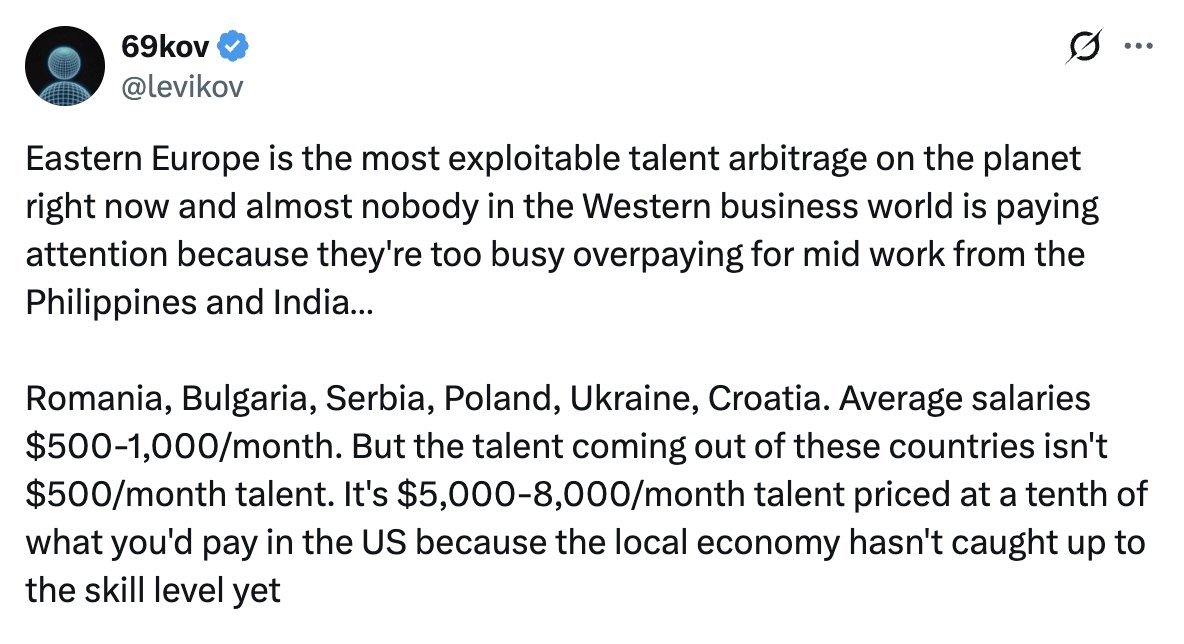
@marcinbunsch I'm old enough to remember. Such numbers might have been true >25 years ago for mid-tier talent. After joining the EU, PLN got much stronger. $500 in 2006 equated to around 1500 PLN, which would give roughly half of the average salary (all industries combined)
English
0
0
1
23
Marcin Bunsch
Marcin Bunsch@marcinbunsch·
"Average salaries $500-1,000/month" I'm not even gonna quote-tweet this ragebait slop. You can stop reading after this line. Poland has one of the best software engineers in the world. You will not get them for $1k/mo. These numbers are off by ~15 years.
Marcin Bunsch tweet media
English
2
0
8
331
Przemek Maciolek
Przemek Maciolek@przemur·
@marcinbunsch After comparing it by side by side, I am impressed. I think it did better job than Claude for my toy exercise. And it took similar amount of time. One interesting observation is that it generated almost no comments in output code (though it was very clear)
English
1
0
0
28
Marcin Bunsch
Marcin Bunsch@marcinbunsch·
Is a Mac Mini with 32GB of RAM a valid local llm machine? It looks like it can run Qwen 3.5 35GB reasonably well. Although an RTX 3090 can possibly perform better.
English
1
0
1
268
Przemek Maciolek
Przemek Maciolek@przemur·
@marcinbunsch UD-Q4_K-XL and UD-Q4_K_M yielded only 12 t/s for generation (didn't investigate further why so little). While UD-UQ2_XXS was quite meh, UD-Q2_K_XL was pretty good in my limited tests. Gonna plug it to opencode now and see how does it feel
English
2
0
0
49
Marcin Bunsch
Marcin Bunsch@marcinbunsch·
@przemur Nice, so q4 might be a great middle point. 24gb? I ran it on 4060 16gb but had to offload to ram so got 10-15 t/s
English
1
0
0
51
Przemek Maciolek retweetledi
Qiguang Chen
Qiguang Chen@QiguangChen·
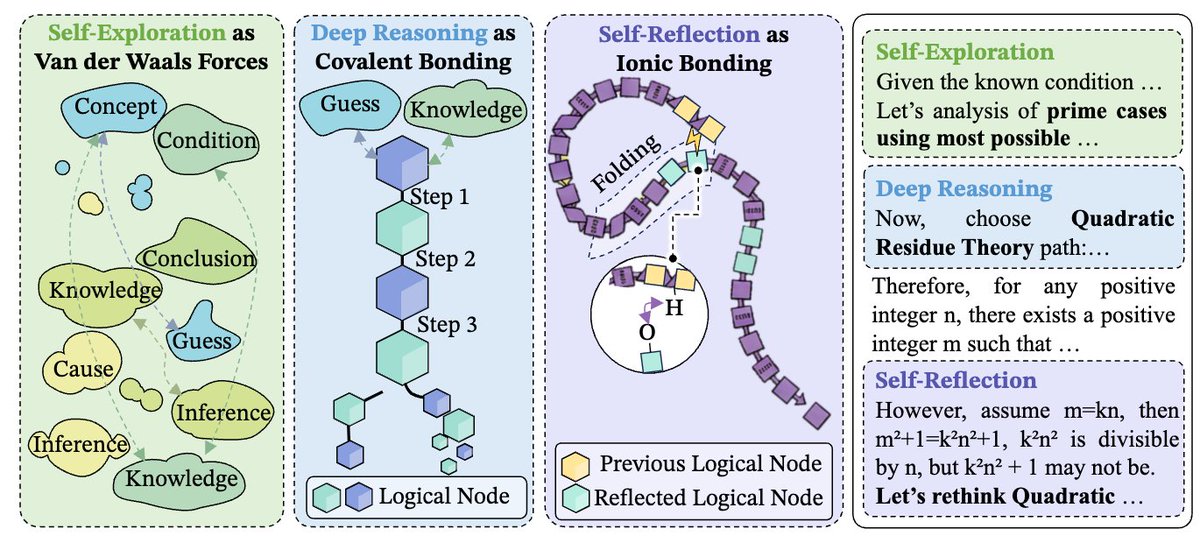
🧪 The Molecular Structure of Thought: Mapping the Topology of Long Chain-of-Thought Reasoning 🌐 arXiv:arxiv.org/pdf/2601.06002 Happy to share our work😊 Stop chasing longer CoT. Build a better molecular structure—reliable reasoning bonds that keep the logic from falling apart.
Qiguang Chen tweet media
English
8
38
159
46.6K
Kamil Stanuch
Kamil Stanuch@KamilStanuch·
Few thoughts from yesterday Cafe Cursor Kraków. tl;dr beyond expectations ◾ 90+ builders packed into a 40-person cafe in the heart of Kazimierz (because when launching we didn't expect such interest) ◾  Gallons of coffee consumed and hundreds of new connections made ◾ Overheard: "I came here just to code, but the conversations with other devs turned out to be the best part!" ◾ We had engineers and execs with 30+ years of experience at public companies mixing with high schoolers working for YC startups or building their own local RAGs. (Yup, instant imposter syndrome) Yes, after hitting 200% capacity on Luma in 48h, we are definitely planning the next Cursor event in Krakow ASAP. Meanwhile: this event wouldn't have happened without Justyna's support on the ground (🙏), attendence of all other A-players! and of course @benln, @nickwm and @ftnabeelah from @cursor_ai Team. @iggyexperience not only recorded the event but pieced the video together while it was still happening. (Kraków founders are truly built different 🔥 ). See you soon!
English
20
5
124
9.4K