Peter Schulam

609 posts

Peter Schulam

Peter Schulam

@pschulam

Scientist at Amazon Alexa AI. I’m interested in applied machine learning and building software systems. Views are my own.


El Segundo, CA Katılım Mayıs 2011
93 Takip Edilen350 Takipçiler
Peter Schulam
Peter Schulam@pschulam·
In fact, ML can be especially impactful in situations like this. The heuristics make excellent features for a linear model. The result is often good enough (or is a strong baseline). Keeping this in mind gives me a nice “playbook” for kicking off work on a new project.
English
0
0
1
0
Peter Schulam
Peter Schulam@pschulam·
For some classification problems, a first analysis usually uncovers several heuristics that would work ~50-75% of the time. My gut reaction to this is often: “Do we really need to use machine learning here?” After all, I don’t want to be the fool with a hammer looking for nails.
English
1
0
1
0
Peter Schulam
Peter Schulam@pschulam·
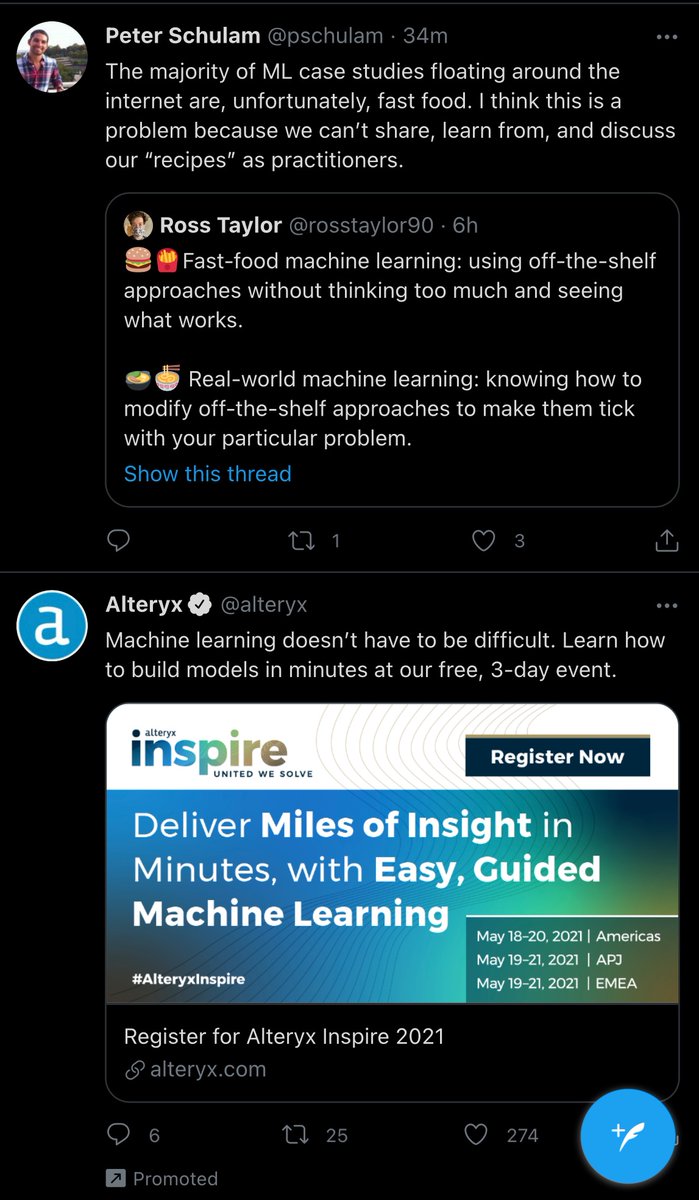
The majority of ML case studies floating around the internet are, unfortunately, fast food. I think this is a problem because we can’t share, learn from, and discuss our “recipes” as practitioners.
English
1
0
3
0
Peter Schulam
Peter Schulam@pschulam·
When we talk about covariate shift, the support of the train and test distributions may be the same but the frequency of seeing a given input may have changed. This is important when we use low-capacity models, but maybe less so with the richer classes we use today.
English
1
0
3
0
Peter Schulam
Peter Schulam@pschulam·
There are lots of recent papers in the ML literature that look at how to detect when we can’t make reliable predictions. I often see this described as detecting “out of distribution” samples. This is unusual to me, though. The same value can come from two different distributions.
English
2
0
13
0
Peter Schulam
Peter Schulam@pschulam·
@IAmSamFin Great write-up on this (unfortunately?) evergreen debate; thanks for sharing! I liked your point about avoiding the “who owns regression” question. The same tool can be used to accomplish different things.
English
0
0
1
0
Sam Finlayson
Sam Finlayson@IAmSamFin·
@pschulam Well put, and I think it makes a lot of sense in historical context of the fields. ML is about building computers that do stuff, stats is about understanding things (and sometimes the things are even computers that do stuff) sgfin.github.io/2020/01/31/Com…
English
1
0
0
0
Peter Schulam
Peter Schulam@pschulam·
@TimRadtke Thanks for the link! This looks interesting; I’ll check it out.
English
0
0
0
0
Tim Radtke
Tim Radtke@TimRadtke·
@pschulam KDD's Applied Data Science track comes to mind: #ads-papers" target="_blank" rel="nofollow noopener">kdd.org/kdd2020/accept…
English
1
0
0
0
Peter Schulam
Peter Schulam@pschulam·
Stats journals often have a separate “applications” track. Does something like this exist for machine learning? I’m looking for good write ups of the nitty gritty details behind successful ML applications.
English
2
1
8
0