QANplatform

1.3K posts

QANplatform banner
QANplatform

QANplatform

@QANplatform

Quantum-resistant Layer 1 hybrid #blockchain platform. 👨‍💻Code smart contracts in any language. 🆕 QAN TestNet is LIVE! #QANplatform

Katılım Temmuz 2019
29 Takip Edilen47.1K Takipçiler
QANplatform
QANplatform@QANplatform·
Q-Day will not be announced with a headline. There will just be wallets draining. Here is how it actually plays out for the people holding assets when it happens. It is a Tuesday morning in 2029. A security researcher in Geneva, let us call her Laura, is running a routine audit on a post-quantum migration report for a mid-sized European bank. The bank did the work. They migrated their internal comms two years ago. Updated their certificate infrastructure. Rotated keys. They went through the checklist and signed off. Their CISO presented it to the board as done. But buried in Laura's audit is a single line item she almost skips, Legacy transaction signatures, 2019 to 2023. Not re-signed under PQC. Archived, not active. She pauses. Those transactions are not active. The bank is not using them. They are just sitting in the archive, like old files in a folder nobody opens. Except this is not a folder on a hard drive in a server room the bank controls. This is a blockchain. Archived does not mean gone. Archived means permanently stored, publicly accessible, readable by anyone with an internet connection, forever. A quantum computer powerful enough to run Shor's algorithm does not care that those transactions are old. It does not need permission to access them. It does not need to break into anything. The public keys are right there on-chain. As they always were. As they were designed to be. And a public key, to a sufficiently advanced quantum computer, is just the beginning of the calculation. The exposure did not happen in 2029. It happened the day each transaction was broadcast. The quantum computer just has to show up. Laura types slowly now. Because the question she is adding to her report is not "could this happen." It is "how many other ledgers have this same line item and do not know it yet."
English
16
34
88
1.9K
QANplatform
QANplatform@QANplatform·
March Milestones: New QAN XLINK Release, TestNet Fixes, and Status Page This month's update highlights the release of a refined QAN XLINK Beta version with a smoother user experience, alongside essential TestNet fixes. We've also taken steps to increase transparency with our new public Status Page and addressed documentation gaps to make integration easier for developers. Read the full recap on our blog, link in the comments 🔗👇
QANplatform tweet media
English
13
37
116
2.2K
QANplatform
QANplatform@QANplatform·
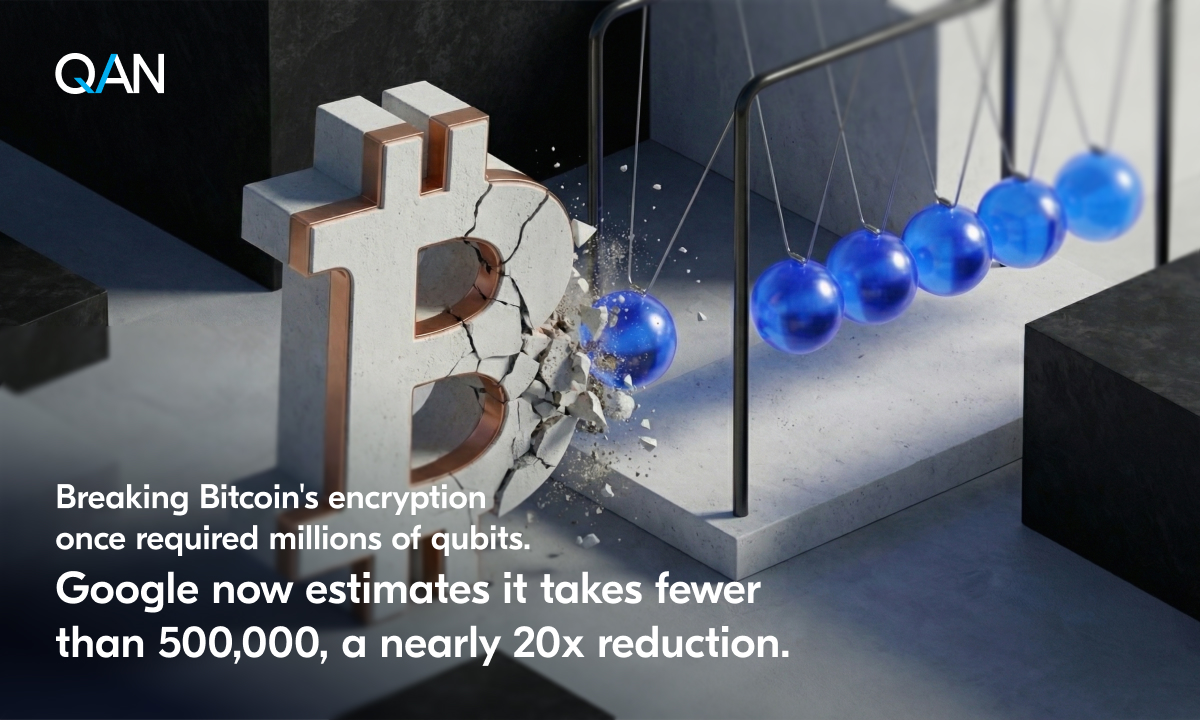
4/🧵 Google's conclusion is unambiguous: "We urge all vulnerable cryptocurrency communities to join the migration to PQC without delay." This is exactly why we're building quantum-safe infrastructure from the ground up.
English
1
2
43
910
QANplatform
QANplatform@QANplatform·
3/🧵 It's not just Bitcoin. Ethereum's Proof-of-Stake validators, smart contracts, and tokenized real-world assets all introduce new attack surfaces that go far beyond Bitcoin's exposure. And 2.3M+ BTC in dormant wallets? Exposed with no easy path to migrate without coordinated protocol intervention.
English
1
2
36
1K
QANplatform
QANplatform@QANplatform·
Google Quantum AI just published a landmark paper on quantum threats to cryptocurrency and the numbers are sobering. Here's what every blockchain builder needs to know 🧵
QANplatform tweet media
English
16
37
122
2.9K
QANplatform
QANplatform@QANplatform·
Our public status page is now live and available to everyone. Here's what you get: - real-time status monitoring: see the live operational state of all core QAN system components at a glance - 44-day uptime history: nearly six weeks of historical performance info Check it out! Link in the comments 👇
English
14
40
125
4K
QANplatform
QANplatform@QANplatform·
We've shipped a new version of the QAN XLINK desktop app. Download it from our website! 💻 Here's what we updated based on your feedback: - refined the UX with targeted improvements for a smoother, more intuitive experience - resolved a bug affecting account visibility within the app - expanded the user guide with greater detail and clearer step-by-step guidance Test it and let us know what you think. Link to the download page in the comments 👇
English
10
37
113
2.9K
QANplatform
QANplatform@QANplatform·
27 million developers globally. Fewer than 25,000 actively building on-chain. That is not a skills problem. It is an industry design problem. There is a bottleneck at the centre of one of the fastest-growing industries in the world and almost nobody talks about it seriously. 27 million active software developers globally. Roughly ONLY 25,000 of them actively building on-chain. That is not a skills gap. That is a design choice that became a wall and then became invisible because everyone got used to it. When Ethereum launched, Solidity made sense. Purpose-specific language, controlled execution environment, reduced attack surface for a novel paradigm. A reasonable call in 2015 for a team figuring out something nobody had built before. But then something happened that nobody planned for, the rest of the industry copied the constraint, not the reasoning behind it. New chain launches. New language requirement. Learn ours first, then build. So now a Java developer who has shipped production systems for a decade has to start from zero to put a smart contract on-chain. A Python developer who can build a trading algorithm in an afternoon cannot natively express that logic in a deployed contract without learning Solidity or hiring someone who knows it. Think about what that actually means. You are running an industry that says it wants to rebuild financial infrastructure, supply chains, identity systems, and the internet. And you have structured it so that only the developers who went out of their way to learn a niche language can participate. The best engineers in the world are not in Web3. Most of them looked at the onboarding wall and went back to building something else. This is the bottleneck nobody names. And it is entirely self-inflicted.
English
24
44
113
3.3K
QANplatform
QANplatform@QANplatform·
ECDSA in plain language. Your private key generates a public key. One-way math. Easy forward, nearly impossible to reverse. That is what secures every wallet on most major chains. A quantum computer running Shor's algorithm reverses it. That is the threat.
English
10
38
111
2.9K
QANplatform
QANplatform@QANplatform·
The math protecting every crypto wallet has never been solved. But it is about to be. What quantum computing actually does to blockchain security, explained fully. In 2030, a quantum computer will do something that changes everything. Not because it is smarter than your laptop. Because it is different in a way that breaks a very specific assumption the entire internet is built on. Here is what most people get wrong about quantum computing It is not that quantum computers are fast. They are not faster at most things. Your laptop still wins at spreadsheets, video games, running your code. Quantum computers are not general-purpose speed machines. The problem is that a quantum computer is extraordinarily good at one thing, finding the mathematical shortcut hidden inside the problems that modern encryption is built on. RSA. ECDSA. Diffie-Hellman. These are not just names. They are the actual locks on every crypto wallet, every HTTPS connection, every signed transaction on every blockchain ever built. They work because the math problem inside them is hard. Specifically, "takes longer than the age of the universe to brute force" hard. Quantum computing does not brute force that problem. It solves it differently. Using a fundamentally different approach to computation that humans have never had access to before. And here is the part that should make you pause The infrastructure we built on top of that assumption has a combined market cap in the tens of trillions. And almost none of it has a serious plan for what comes next. This is not fear. This is not speculation. NIST published its post-quantum cryptographic standards in August 2024. Governments are running Q-Day scenario planning right now. The question is not whether this is coming. The question is who is building for it.
English
23
34
114
2.6K
QANplatform
QANplatform@QANplatform·
7/🧵Three things just aligned: NIST has finalized the post-quantum standards (since August 2024) The White House has made PQC migration an explicit federal policy directive (March 2026) The quantum timeline is compressing, not expanding Chains built quantum-safe from the start don't face a migration problem. They're already where policy is going.
English
0
4
37
1.4K
QANplatform
QANplatform@QANplatform·
6/🧵Here's the actual threat model: Most blockchains run on elliptic curve cryptography (ECC). Quantum computers could crack ECC using Shor's algorithm which means digital signatures, the mechanism that proves you own your wallet, become forgeable. At that point, "not your keys, not your coins" stops being a mantra and starts being a footnote in a post-mortem.
English
1
10
37
1.5K
QANplatform
QANplatform@QANplatform·
The White House just made post-quantum cryptography and blockchain security national policy. Not a proposal, not a talking point buried in a press release. Policy in a strategy signed by the President of the United States, dated March 2026. 🧵
English
22
48
132
4.6K