

Rachel Rapp
385 posts

Rachel Rapp
@rachelrapp
Posts mainly about AI, tech, and food | AI edu @baseten | Recovering academic | Probably eating right now
Berlin Katılım Mayıs 2020
498 Takip Edilen311 Takipçiler

Rachel Rapp retweetledi

"But only frontier models are being used!"
No, it's a Cambrian explosion of models

English

The open source agent...
Not the family-owned French luxury design house
English

USA has ChatGPT
USA has Grok
USA has Claude
USA has Gemini
China has DeepSeek
China has Qwen
China has Kimi
China has MiniMax
Europe has?
Indonesia

As someone who’s lived the last 25 summers in the EU, this is 100% correct.
Also the most dull way to spend a summer.
Mads@europemaxxed
Real euro summer: - hotel with no AC - beach town you’ve never heard of - plastic chairs - €1 beers - lots of sitting around doing nothing - cigarettes
English

Real euro summer:
- hotel with no AC
- beach town you’ve never heard of
- plastic chairs
- €1 beers
- lots of sitting around doing nothing
- cigarettes
Gordon Gekko@GordonGekko420
Fake Euro summer: - 5 star resort - beach clubs - bottle service - planned events and reservations Real euro summer: - hotel with no AC - beach town you’ve never heard of - plastic chairs - €1 beers - lots of sitting around doing nothing - cigarettes
English
@gilad_only Finally caved and bought internet
After seeing I was 2 hours in with 8.5 hours to go 🥲
English

@rachelrapp Danke dir!
You have internet on the flight? That’s awesome
English


@itsolelehmann @grok if you extrapolate Germany's data center capacity to match US size geographically, would it exceed the US?
English

I'm German.
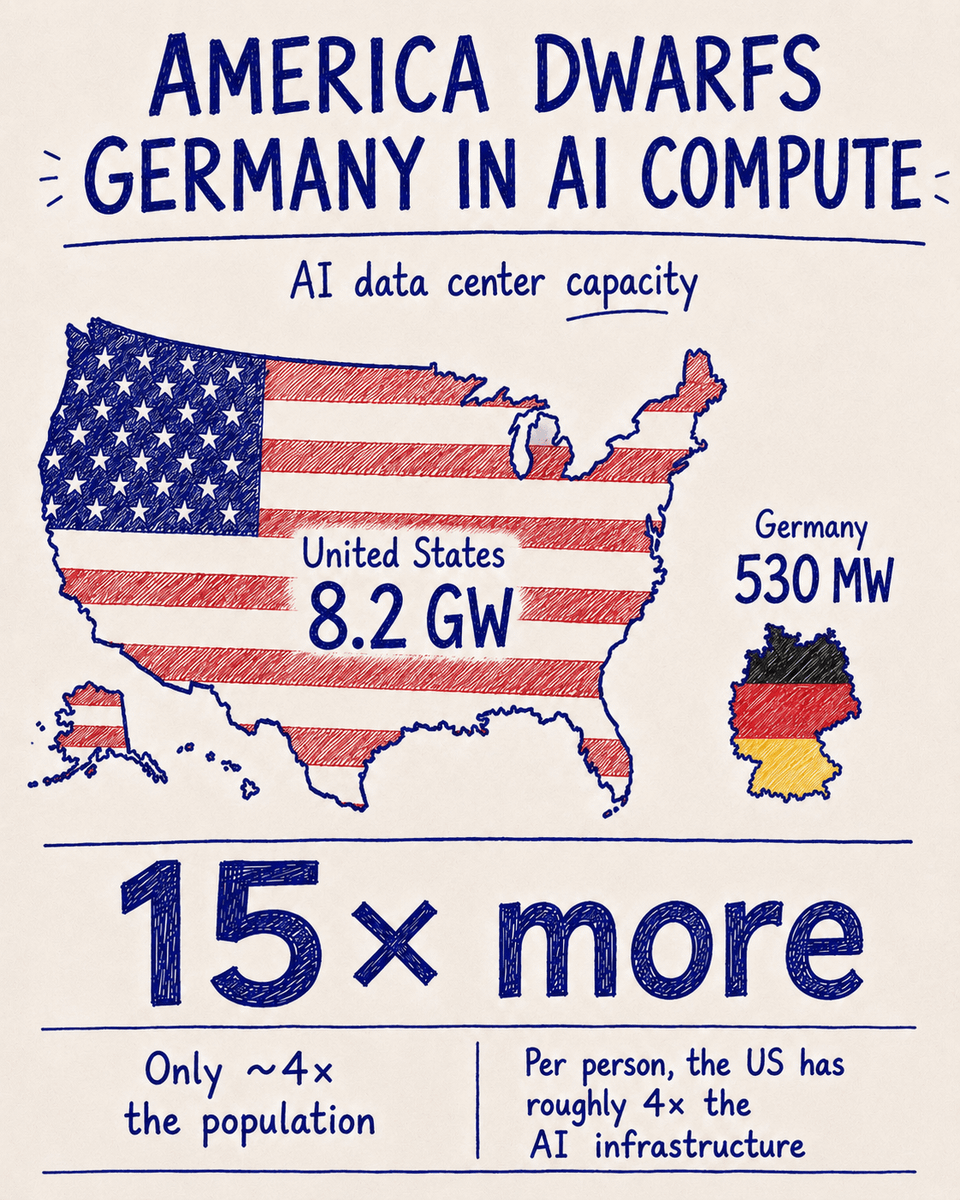
Germany's ENTIRE AI data center capacity is less than 1/2 of just one site being built in Texas.
We have 530 megawatts of AI data center capacity in the entire country.
The US has 8.2 gigawatts. That's 15x more compute on a country with only 4x the people.
Per German, the US has roughly 4x the AI infrastructure.
One university computer at MIT is 4x faster than Germany's most important commercial AI facility.
The obvious reaction here is "so what, German companies can just rent compute from AWS."
But that's the same logic Germany applied to Russian gas for two decades.
Roughly 70% of German enterprise AI today runs on American cloud providers like AWS, Microsoft, and Google. Which means it runs under American law.
Every AI tool running in German hospitals, courts, ministries, banks, and factories sits on a foreign platform.
Here's why this can actually become problematic. Imagine these scenarios:
> The next GPU generation launches and American companies get access first because they own the data centers. German firms wait 12 months and pay 2-3x more for what's left.
> A frontier AI model gets released and US export controls block it from being deployed in Germany. SAP and Siemens watch American competitors integrate it for a year before they can.
> And in the worst case, a US president decides to use AI access as leverage in a trade dispute. German companies get cut off from the models their American competitors are still running.
All of them are compounding problems that will negatively impact the German economy (and everyone's standard of living/jobs etc).
None of this is hypothetical.
> The US pulled Starlink as leverage with Ukraine in March 2025
> Chip exports to China have been throttled for three years
> And the CLOUD Act lets the US demand any data stored by American cloud providers (even when the customer is a German company and the servers are physically in Germany).
Germany doesn't have an answer for any of those scenarios today because the infrastructure that would make those answers possible isn't built yet.
Now look at why this is actually happening on the ground.
In the last 3 months Germany rejected 3 AI data center projects in a row:
> Groß-Gerau, February: Vantage Data Centers, €2.5 billion, 174 MW. Voted down 18-14 by the local council
> Maintal: EdgeConnex, €1 billion, 170 MW. Blocked over a backup gas generator the developer needed because grid connections in Germany take 7-10 years and a data center is built in 2
> Freyenstein, Brandenburg, April: 700 MW AI campus. Killed by protests before construction
€3.5 billion in AI infrastructure turned away in one quarter.
And the situation is more urgent than it looks because compute is getting harder to access, not easier.
NVIDIA's Blackwell GPUs are already allocated through the second half of 2027. The American hyperscalers locked in the bulk of new production with forward orders placed in 2025. TSMC's advanced packaging lines (the actual bottleneck) are sold out through 2026.
Germany has no hyperscaler of its own. That means German industry sits at the back of the queue, and the gap compounds every quarter that goes by.
Where Germany is falling short right now comes down to three things:
> Public backlash, because the case for what AI data centers actually do for a country has never been made to the people voting on them
> Industrial electricity at €0.16-0.18 per kWh vs about $0.08 in Texas. For a 1 GW campus that's $700-900 million extra per year just for power
> Grid connections taking 7-10 years for large facilities when the data center itself is built in 2. No serious operator runs on math where the wait is longer than the build
And the first one is the biggest. Electricity policy and grid timelines are fixable. Public consent isn't, until someone makes the case that this infrastructure isn't nice-to-have. It's the foundation everything else runs on.
The average person only feels the downside (noise, rising electricity cost, terror attack vector)
We have a big messaging and marketing problem around data centers and why they are critical for everyone's future.
Germany still has the foundation to win this if it moves now.
Germany adopted its first national data center strategy in March 2026. 28 concrete measures, annual progress reports, doubling overall capacity and quadrupling AI capacity by 2030. The plan exists.
The Industriestrompreis launched on January 1st of this year. It targets 5 cents per kWh for half of an industrial user's annual consumption. If data centers get cleanly pulled into that framework, the electricity cost gap with Texas gets significantly closer.
Deutsche Telekom turned on 10,000 NVIDIA Blackwell GPUs in Munich in Q1. One facility increased Germany's available AI compute by roughly 50% overnight.
And the demand is already domestic. SAP, Siemens, BMW, BASF. The German industrial anchors that benefit most from AI are German companies. The customers are at home, the infrastructure should be at home too.
And this is the thing that most people forget.
Germany won the second industrial revolution. By 1900 German chemical output had passed Britain's, Siemens was wiring the world, and BASF and Bayer were inventing industries that didn't exist before they built them.
The companies that came out of those decisions are still the largest employers in Germany 130 years later.
Germany sat out the third industrial revolution, the software one, and that was survivable because software didn't run factories.
But AI runs factories. It runs hospitals, logistics, courts, and financial markets. This one is infrastructure in the same category as railways and chemical plants.
The plan is written and the money is ready.
The only question left is whether the country will let it get built.
There's a lot of work left to do, but I'm staying optimistic.
English


@cb_doge @BrettRatner I know I shouldn’t be surprised considering how wealthy these two are, but…
That is the sickest plane I have ever seen
English

The most important thing in life is having true friends.

English

@rachelrapp Thank you Rachel, this is a huge help. It means I don’t have to worry about an issue I was really worried about having to deal with. 🔥
English
@rachelrapp Hi Rachel, I have 2 technical questions about tool call streaming on the platform I’m hoping you can answer for me.
This is critical to some features in implementing
I’ll add each as an attached tweet using the + gesture since they’ll never fit in one.
Thank you.🍺
English
@yosoymario91 @tricalt this somehow explains how you can respond to X, LI, WhatsApp, and GH at the same time
English

Average balkan diet is like
Breakfast: coffee and cigarette
Lunch: coffee and cigarette
Dinner: 2kg grilled meat, bread, baklava, 2 liters of rakija from a coca cola bottle with a sprite cap
Life expectancy: 90 years
English
@communicating Baseten's infrastructure is agnostic to whatever model framework you use; we don't intercept or do anything with the streamed responses!
English
For custom Truss deployments (vLLM), does your gateway support transparent SSE passthrough for tool_call_deltas? Specifically, does it handle subsequent parameter chunks where the id is null, or is there a middleware that buffers to ensure JSON integrity before forwarding?
English
Our competitors when they see we dropped a new blog on how we get our perf numbers
GIF
Ian Carrasco@ia_n_ai
English
@communicating Late here but -- yes, we do support incremental! 🍻
English
Using the Model APIs (OpenAI-compatible), do you support tool_call_deltas for incremental parameter streaming, or is the JSON object buffered on the server side until completion? I need to avoid 'bursty' tool calls if I can.
English