RadioNuclear Podcast

118 posts

RadioNuclear Podcast

RadioNuclear Podcast

@rad_pod

A brand new podcast coming out of the @ImagingCDT at King's and Imperial College London. Tune in to hear all about biomedical engineering and imaging sciences.

St Thomas' Hospital London Katılım Nisan 2020
74 Takip Edilen111 Takipçiler
RadioNuclear Podcast
RadioNuclear Podcast@rad_pod·
With the release of our latest episode - hosted by @Roykurtzbard and colleagues studying for Masters Degrees @KingsImaging, we have reached the milestone of 1500 downloads! spoti.fi/3KG6wab Thanks to everyone for supporting us so far! Hoping to get more episodes out soon!
RadioNuclear Podcast tweet media
English
1
2
5
0
RadioNuclear Podcast retweetledi
Roy Kurtzbard
Roy Kurtzbard@Roykurtzbard·
The conversation will include #datasafety, possible #biases and how to overcome #inequality in data representation in healthcare. The link to the episode to follow!
English
1
1
2
0
RadioNuclear Podcast retweetledi
Roy Kurtzbard
Roy Kurtzbard@Roykurtzbard·
We are a group of enthusiastic MEng/MSc students studying Healthcare Technologies at King’s College London. #RadioNuclearPodcast ☢️ has kindly agreed to host our episode featuring @AtoAndyKing about important ethical considerations in #ArtificialIntelligence
English
1
2
3
0
RadioNuclear Podcast
RadioNuclear Podcast@rad_pod·
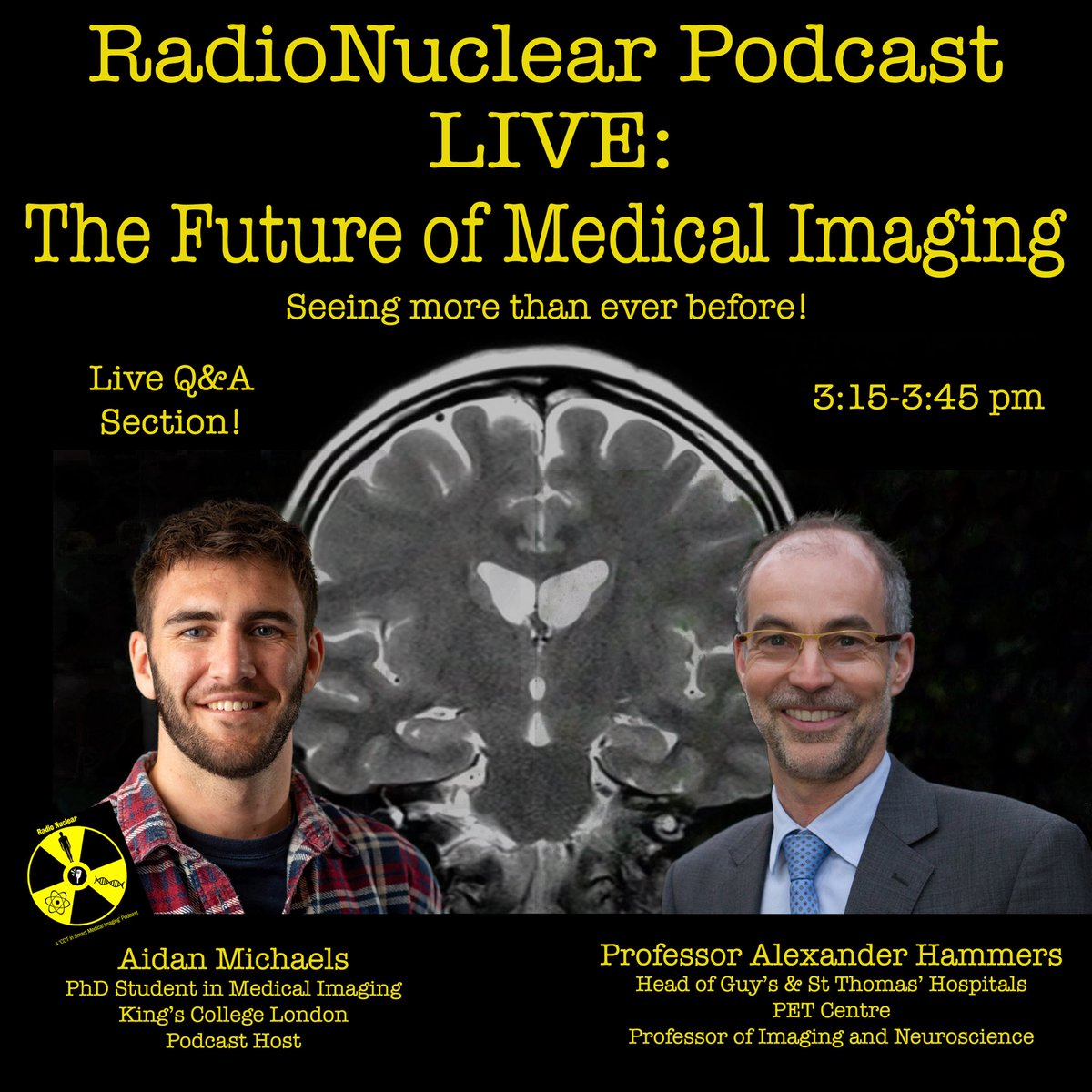
Here’s a little snippet from the latest episode with @Hammers_Alexand and @AMMichaels - here Prof Hammers describes how a targeted radiotracer is much like a key 🔑 with a torch 🔦 - very precise to a specific target/lock 🔒 and bright in a dark setting (our body)
English
1
3
7
0
RadioNuclear Podcast
RadioNuclear Podcast@rad_pod·
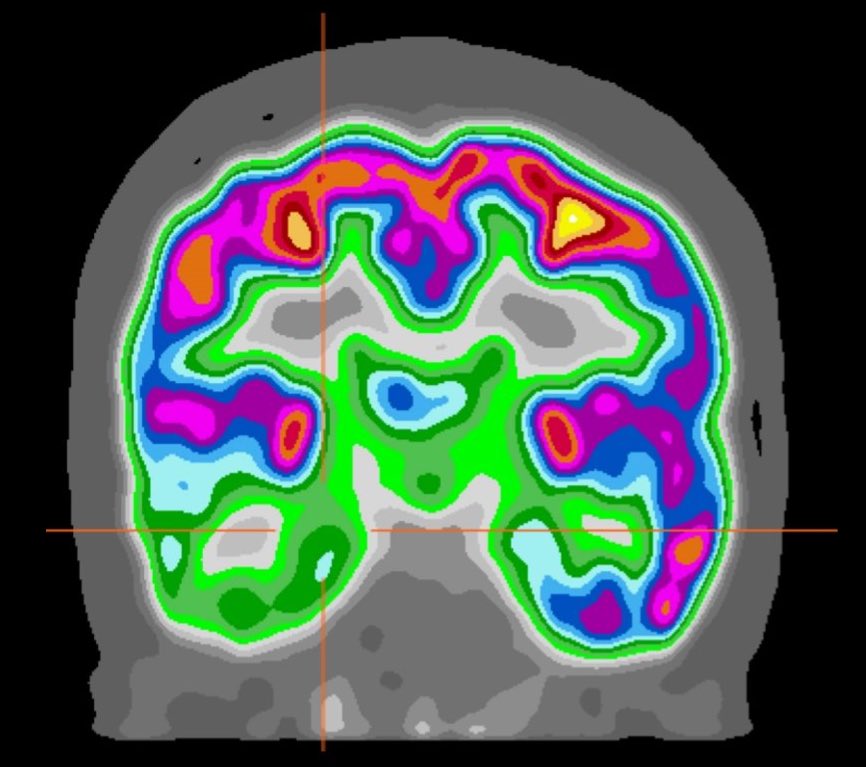
We then reference the resolution differences between magnetic resonance imaging (MRI, 1st image) at roughly 7:7000 and PET imaging (2nd image) at 7:7,000,000,000 (that’s 7 billion!!) - nanomolar sensitivity
RadioNuclear Podcast tweet mediaRadioNuclear Podcast tweet media
English
0
1
2
0
RadioNuclear Podcast
RadioNuclear Podcast@rad_pod·
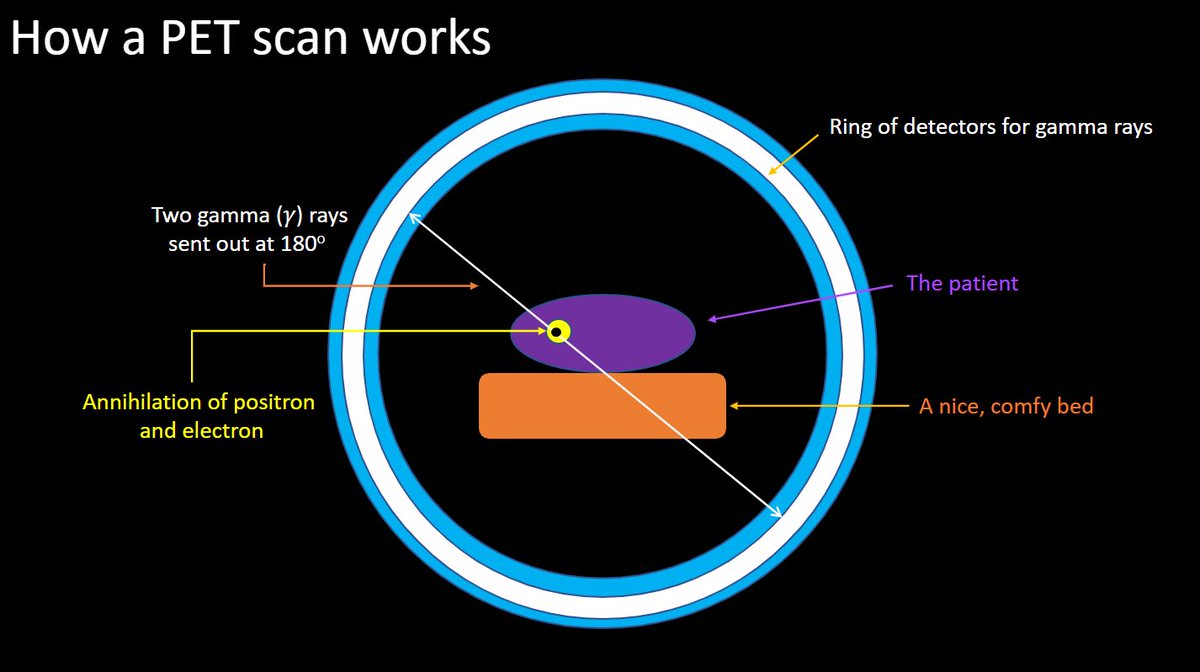
The first slide we refer to is this: how a PET scan works - note the annihilation of the positron and electron leads to the emission of two gamma rays sent out in directly opposite directions which is what is detected by the scanner ☢️
RadioNuclear Podcast tweet media
English
1
1
2
0
RadioNuclear Podcast
RadioNuclear Podcast@rad_pod·
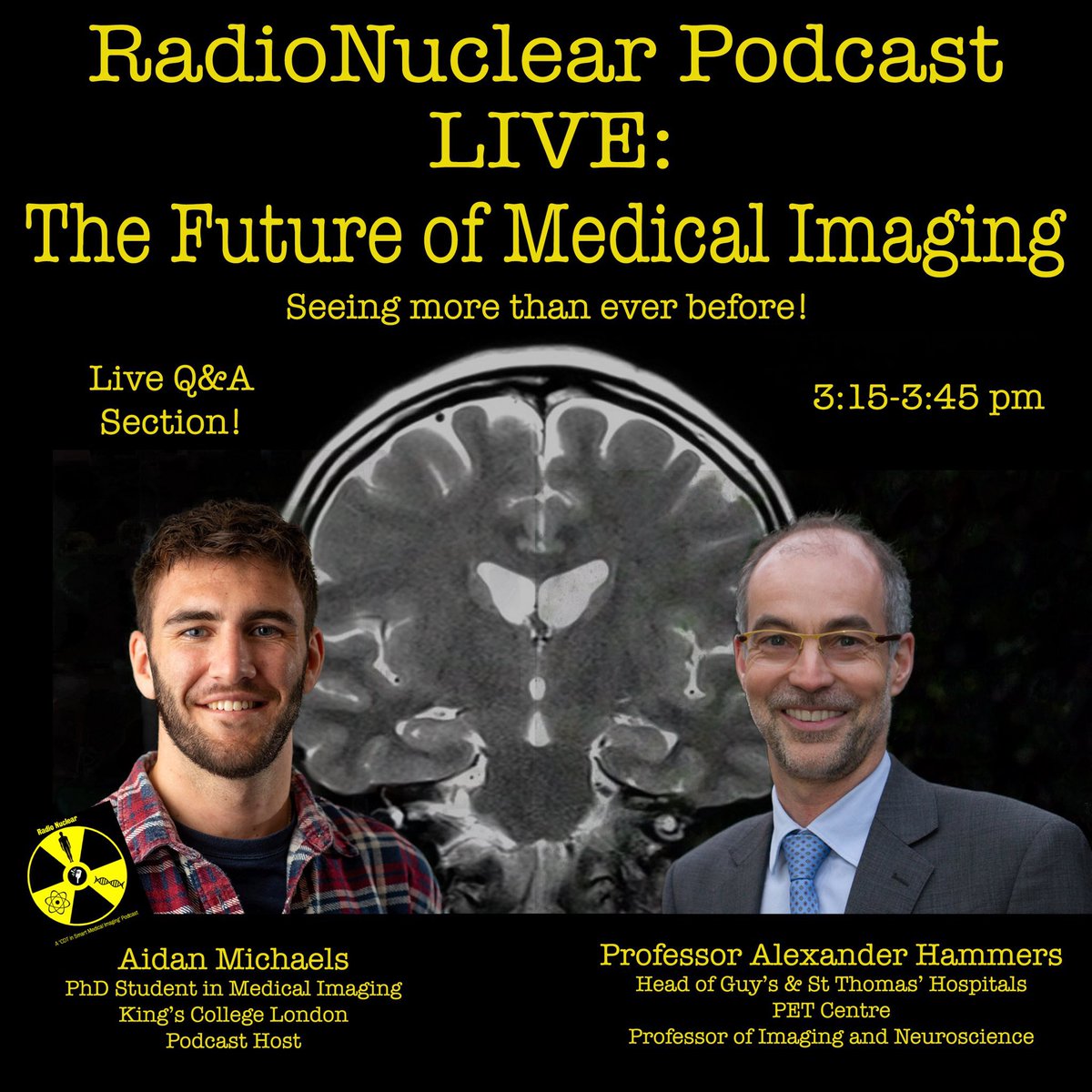
Our episode with Prof Alexander Hammers @Hammers_Alexand is out now! Please go and give it a listen! It was a fantastic chat about positron emission tomography (PET), how it’s used in medicine and what the future looks like for PET in healthcare
RadioNuclear Podcast tweet media
English
1
3
18
0
RadioNuclear Podcast
RadioNuclear Podcast@rad_pod·
Prof Hammers questions @AMMichaels about what’s interesting in this brain scan - can you see it? 👀 (hint: the cross hairs help!)
RadioNuclear Podcast tweet media
English
0
0
1
0
RadioNuclear Podcast
RadioNuclear Podcast@rad_pod·
Yes. It does use ionising radiation which can be harmful. A typical brain PET scan will give you a radiation dose of about 2-5mSv. That is about as much as the background radiation (from rocks, space etc) in 1-2 years in the UK.
English
4
0
2
0
RadioNuclear Podcast
RadioNuclear Podcast@rad_pod·
So, we would never do a PET without good justification - but when justified, the information gain / patient benefit vastly outweighs the risk.
English
0
0
2
0
RadioNuclear Podcast
RadioNuclear Podcast@rad_pod·
It is estimated that the risk of developing cancer over one’s lifetime from such a dose is up to about 0.03%. This has to be compared to the standard (background) risk of developing any cancer during one’s lifetime which is ~50%.
English
0
0
2
0