Sabitlenmiş Tweet

One simple trick that will make creating anything easy.
A quick thread with four videos that give you the single most powerful hack for copywriting, Spaces, podcasts, and everything else.
English
Dave - Radio Copywriter
3.5K posts
@radiocopywriter
Know how your customers think before they do | Actionable Advice | Hot Tips | Malarky

If Mixtape was a movie I wouldn't have been able to have so much fun doing this.

TV ads don't work nearly as well as believed | Shannon Roddel, University of Notre Dame Traditional TV ads are far less effective than believed, according to real-time viewership data. Even with all the hype around streaming, traditional TV still dominates ad spend. Advertisers are putting $139 billion into linear ads this year, compared to just $33 billion for ads on streaming/connected TV. “We show TV ads are only about half as effective as we thought.” With no way to track individual behavior among traditional TV viewers, it’s difficult to determine whether all that spending gets results. New research from the University of Notre Dame helps determine the return on investment for TV ads, ironically by using digital data. By combining massive datasets that track exactly what households watch and buy second by second, the study separates the real impact of TV ads from other factors. Traditional methods of measurement, which rely mostly on ratings and aggregate market data, appear to overestimate ad effectiveness by 55% in a study of advertising for food delivery services, according to Shijie Lu, an associate professor of marketing at Notre Dame’s Mendoza College of Business. Lu’s research appears in Marketing Science. Imagine that a household watches only part of a live game. If a food delivery ad airs during the portion they watched, they may see it; if it airs earlier or later, they may miss it. That timing difference creates a kind of natural experiment, helping the researchers isolate the ad’s true effect from other factors, such as which households were already more likely to order food. Researchers could not easily do this before with traditional TV measurement. Smart TV tracking now provides second-by-second household viewing data, making this kind of measurement possible at a much finer level. Using LG smart TV data, Lu and coauthors Tsung-Yiou Hsieh from Oklahoma State University and Rex Yuxing Du from the University of Texas at Austin analyzed the viewing habits of millions of people who opted in to sharing their viewing data, letting the researchers see exactly what was on peoples’ screens—broadcast networks such as NBC and ABC, specifically—over a four-month period. The study didn’t track streaming apps like Hulu or Amazon. LG watched what viewers watched and connected that data to people’s food delivery app usage to measure ad impact. “This is a game-changer,” Lu says, “because we can now link precise TV viewing data with real purchase history to measure TV ad effectiveness more credibly. “Brands are overestimating their campaigns and wasting money on ineffective placements,” he says. “We show TV ads are only about half as effective as we thought. When corrected, the real sales impact is much lower, which has important implications for how advertisers evaluate performance and allocate spending.” In addition to showing that traditional measures greatly overstated the effects of TV ads, the new measurement method revealed additional insights that could help companies better target their ads. Data show that promotions for first-time buyers increase retention. Viewers’ responsiveness to ads peaks within two days of purchasing food on a delivery app, with the highest engagement rate found among customers who have ordered two to four times previously. Young, tech-savvy sports fans are better prospects than older news viewers. “The old ways of measuring TV ads are missing an important part of the picture, because they do not fully account for who is more likely to see ads and who is more likely to buy,” Lu says. Traditional TV ad tracking confuses ad effectiveness with pre-existing habits (like who is already likely to buy or who watches a lot of TV), leading to inflated results. This research fixes that by isolating the random timing of ad slots within shows, allowing the team to accurately measure the true sales lift of TV ads and determine how that impact varies based on a customer’s history. The study provides a powerful tool for more precisely measuring the return on investment of TV advertising. By targeting ads based on what viewers actually buy—not just demographics like age or gender—this approach brings digital-level precision to TV. futurity.org/traditional-tv…



@BowTiedTrance 👍🏻 She’s being vague enough so that people fill in the blank to satisfy the narrative of their newly acquired political identities.
Humans bring gender bias to their interactions with AI, finds study | Trinity College Dublin Humans bring gender biases to their interactions with Artificial Intelligence (AI), according to new research from Trinity College Dublin and Ludwig-Maximilians Universität (LMU) Munich. The study involving 402 participants found that people exploited female-labeled AI and distrusted male-labeled AI to a comparable extent as they do human partners bearing the same gender labels. Notably, in the case of female-labeled AI, the study found that exploitation in the Human-AI setting was even more prevalent than in the case of human partners with the same gender labels. This is the first study to examine the role of machine gender in human-AI collaboration using a systematic, empirical approach. The findings show that gendered expectations from human-human settings extend to human-AI cooperation. This has significant implications for how organizations design, deploy, and regulate interactive AI systems, according to the authors. The study, led by sociologists in Trinity's School of Social Sciences and Philosophy, has just been published in the journal iScience. Key findings include: - Patterns of exploitation and distrust toward AI agents mirrored those seen with human partners carrying the same gender labels. - Participants were more likely to exploit AI agents labeled female and more likely to distrust AI agents labeled male. - Assigning gender to AI agents can shape cooperation, trust, and misuse implications for product design, workplace deployment, and governance. Sepideh Bazazi, first author of the study and Visiting Research Fellow at the School of Social Sciences and Philosophy, Trinity, explained, "As AI becomes part of everyday life our findings that gendered expectations spill into human-AI cooperation underscore the importance of carefully considering gender representation in AI design, for example, to maximize people's engagement and build trust in their interactions with automated systems. "Designers of interactive AI agents should recognize and mitigate biases in human interactions to prevent reinforcing harmful gender discrimination and to create trustworthy, fair, and socially responsible AI systems." Taha Yasseri, co-author of the study and Director of the Centre for Sociology of Humans and Machines (SOHAM) at Trinity, said, "Our results show that simply assigning a gender label to an AI can change how people treat it. If organizations give AI agents human-like cues, including gender, they should anticipate downstream effects on trust and cooperation." Jurgis Karpus, co-author of the study and Postdoctoral Researcher at Ludwig-Maximilians-Universität (LMU) Munich, added, "This study raises an important dilemma. Giving AI agents human-like features can foster cooperation between people and AI, but it also risks transferring and reinforcing unwelcome existing gender biases from people's interactions with fellow humans." More about the study In this experimental study, participants played repeated rounds of the social science experiment Prisoner's Dilemma—a classic experiment in behavioral game theory and economics to study human cooperation and defection. Partners were labeled human or AI. Each partner was further labeled male, female, non-binary, or gender-neutral. The team analyzed motives for cooperation and defection, distinguishing exploitation (taking advantage of a cooperative partner) from distrust (defecting pre-emptively). Findings show that gender labeling can reproduce gendered patterns of cooperation with AI. The participants were recruited in the UK and the experiment was conducted online. The sample size was 402 participants. Read more: phys.org/news/2025-11-h…
Here’s the pattern I see. The Left calls out obstruction instructions for their agitprop playmakers. The Right responds, Rhetorically! The Lunatic flock of seagulls stand on their soapbox & scream WE’RE ALL GONNA DIE Holy hyperbole Batman root these loons in reality

Now that we have AI, writing doesn't signal proof of work like it used to. There's long been a genre of book that's really just a glorified business card. The authors would hand out these books, and people politely accepted them, and nobody expected a single page to be read. In exchange, those authors received steep speaking and consulting fees. I can't tell you how many writers have told me how their fees skyrocketed after they published their book. Most of them were hired simply because they published a book, and not necessarily because that book was any good. This game still exists, but everybody's a little more skeptical of it now because it's so much easier to hack the system.

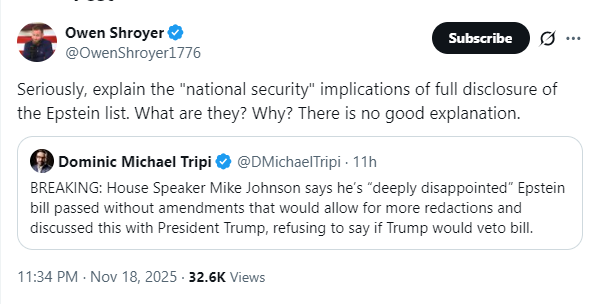
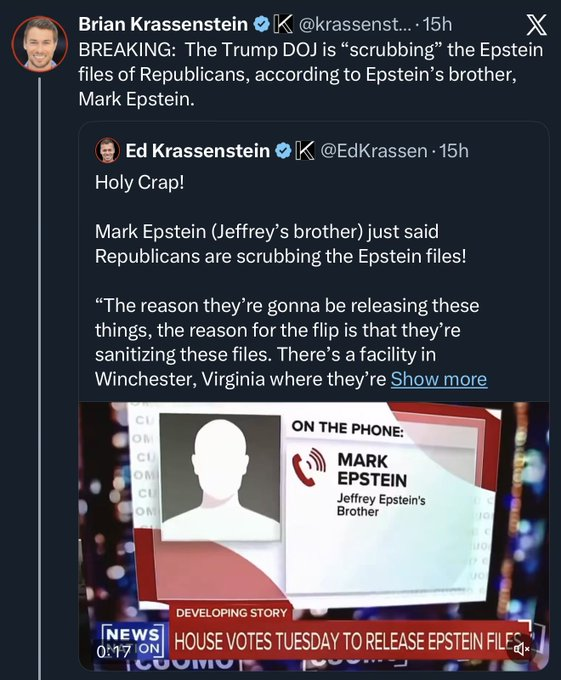
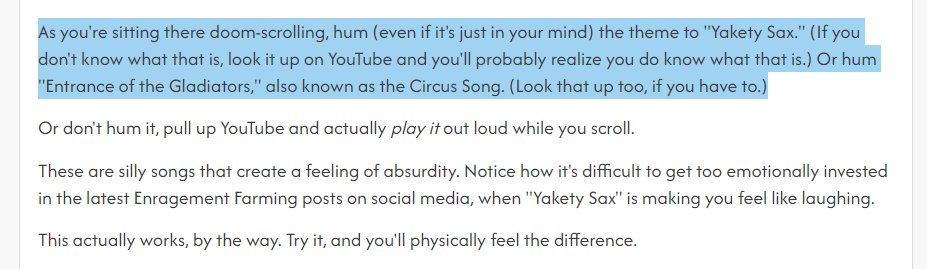
I've been in broadcast radio since 1982. (That beard isn't dyed white; I earned every grey hair) The average person doesn't realize why the news cycle, both online and in the media, seems designed to keep you mad, afraid, or both. When you're angry and/or afraid, you're easier to control and steer; specifically, you're easier to KEEP mad and scared, which leads to the addictive doomscrolling that generates a metric ton of cash for the people who angered and frightened you to begin with. Easy hack to address this: Every thing you see that makes you mad or scared, force yourself to laugh out loud at it. It doesn't have to be a sincere laugh; that's irrelevant. The physical act of laughing affects your attitude and changes the impact it has on you. I would go into the time-honored broadcasting advice I've given people I've trained over the years to plaster a big, fake smile on their face when going on the air, but I'm already dangerously close to writing an entire chapter for you. lol


What???
A simple writing exercise shows promise for reducing anxiety | Karina Petrova, PsyPost A new study suggests that the vividness of a person’s fears about their future may be linked to anxiety through its effect on their self-esteem. The research, published in the journal Psychological Reports, indicates that having a very clear mental picture of a feared future self is associated with lower self-worth, which in turn is connected to higher anxiety. The work also explored a writing exercise that showed potential for reducing anxiety in the moment. Our conceptions of who we might one day become, known as “possible selves,” shape our present motivations and emotions. These mental projections include both our hopes for the future, like becoming a successful artist, and our fears, such as failing in a career or being alone. The clarity of these future images can vary greatly from person to person, and this variation has captured the attention of psychologists studying mental health. Researchers have observed that individuals with higher anxiety often report more detailed and intense mental images of negative future events. A team of researchers at York St John University in the United Kingdom sought to better understand this connection. The group, led by Jennifer Shevchenko, was interested in the mechanism behind the link between clear feared selves and anxiety. A common explanation, based on what is known as Attentional Control Theory, suggests that anxiety biases a person’s attention toward threats. This prolonged focus could naturally make threatening mental images, including feared future selves, seem more vivid. This perspective treats the clear images as a consequence of anxiety. The researchers proposed an additional possibility: that the clarity of these feared selves could also actively contribute to anxiety. They hypothesized that self-esteem might be a key factor in this process. Self-esteem, which refers to a person’s overall sense of self-worth, is known to have a reciprocal relationship with anxiety; low self-esteem can be both a predictor and a consequence of anxiety symptoms. The team wondered if experiencing a highly detailed vision of a feared future could feel so psychologically real that it damages a person’s current self-esteem, thereby feeding into their anxiety. To investigate this, the researchers designed a two-part study involving 68 university students who participated online. For the first part of the study, they employed a correlational design, which examines relationships between different variables as they naturally occur. Participants completed several questionnaires. One was a standard assessment for generalized anxiety, and another measured self-esteem. They also completed a task where they described their “feared possible selves” and then rated how clear the mental images associated with these fears were. The analysis of this data revealed several expected connections. Higher levels of anxiety were associated with lower levels of self-esteem. In addition, higher anxiety was associated with greater clarity of feared possible selves, meaning people with more anxiety tended to see their fears more vividly. A new connection was also identified: lower self-esteem was associated with having clearer images of a feared future. The team then used a statistical method called mediation analysis to test their central hypothesis about the role of self-esteem. The results supported their prediction. The analysis showed that self-esteem accounted for the relationship between the clarity of feared selves and anxiety. In simpler terms, the connection between having a vivid fear for the future and experiencing anxiety appeared to be channeled through a person’s sense of self-worth. Having a highly detailed mental picture of a feared future was linked to lower self-esteem, and this lower self-esteem was, in turn, associated with greater anxiety. The second part of the study explored a potential intervention. Using a repeated-measures design, the researchers assessed participants’ anxiety levels at three different points. They measured anxiety at the beginning of the study, then again after the task where participants described their feared future, and a final time after they completed a writing exercise known as the Best Possible Self technique. This technique instructed participants to write in detail about a future in which everything had gone as well as it possibly could and they had achieved their goals. After collecting the data, the researchers divided the participants into two groups based on their initial anxiety scores: a “probable anxiety” group and a “non-probable anxiety” group. The results showed that after writing about their feared selves, participants in the probable anxiety group reported a slight increase in their anxiety. By contrast, after completing the Best Possible Self writing exercise, participants in both groups reported a significant decrease in their anxiety levels compared to their baseline measurements. The researchers acknowledge certain limitations to their work. The study was conducted with a sample of university students, so the findings may not apply to the broader population or to individuals with a clinical diagnosis of an anxiety disorder. Because the first part of the study was correlational, it identifies associations but cannot definitively prove that one factor causes another. The observed reduction in anxiety from the writing exercise was also measured immediately afterward, so it is unclear how long this effect might last. Future research could build upon these findings by studying different populations, including those receiving treatment for anxiety. Longitudinal studies that follow participants over time would be useful for establishing the long-term effects of interventions like the Best Possible Self technique. The researchers also suggest that future experiments could directly measure whether the writing exercise works by improving self-esteem or by increasing the clarity of positive future selves. Such work could help refine simple, low-cost tools for managing anxiety. Read more: psypost.org/a-simple-writi…