Rafael Laguna de la Vera

9.4K posts

Rafael Laguna de la Vera banner
Rafael Laguna de la Vera

Rafael Laguna de la Vera

@rafbuff

Founding Director @SPRIND - Find me nowadays @rafbuff.mastadon.social

Cologne, Germany Katılım Haziran 2007
1.4K Takip Edilen4.5K Takipçiler
Sabitlenmiş Tweet
Rafael Laguna de la Vera
Rafael Laguna de la Vera@rafbuff·
I'm off to @rafbuff.mastadon.social folks, follow me there (and yeah, it takes some time getting used to it, but well worth it)
English
2
1
4
976
Ole Lehmann
Ole Lehmann@itsolelehmann·
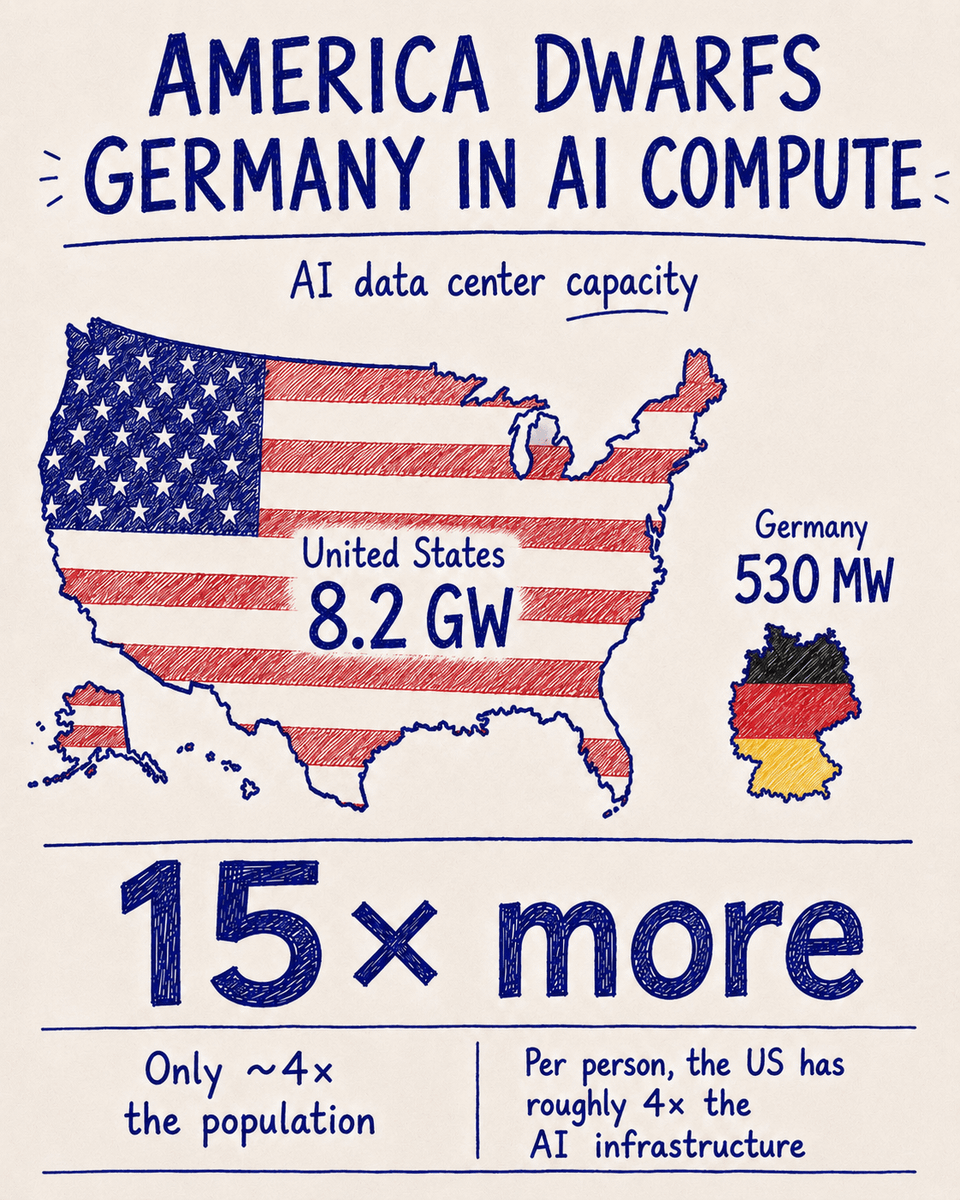
I'm German. Germany's ENTIRE AI data center capacity is less than 1/2 of just one site being built in Texas. We have 530 megawatts of AI data center capacity in the entire country. The US has 8.2 gigawatts. That's 15x more compute on a country with only 4x the people. Per German, the US has roughly 4x the AI infrastructure. One university computer at MIT is 4x faster than Germany's most important commercial AI facility. The obvious reaction here is "so what, German companies can just rent compute from AWS." But that's the same logic Germany applied to Russian gas for two decades. Roughly 70% of German enterprise AI today runs on American cloud providers like AWS, Microsoft, and Google. Which means it runs under American law. Every AI tool running in German hospitals, courts, ministries, banks, and factories sits on a foreign platform. Here's why this can actually become problematic. Imagine these scenarios: > The next GPU generation launches and American companies get access first because they own the data centers. German firms wait 12 months and pay 2-3x more for what's left. > A frontier AI model gets released and US export controls block it from being deployed in Germany. SAP and Siemens watch American competitors integrate it for a year before they can. > And in the worst case, a US president decides to use AI access as leverage in a trade dispute. German companies get cut off from the models their American competitors are still running. All of them are compounding problems that will negatively impact the German economy (and everyone's standard of living/jobs etc). None of this is hypothetical. > The US pulled Starlink as leverage with Ukraine in March 2025 > Chip exports to China have been throttled for three years > And the CLOUD Act lets the US demand any data stored by American cloud providers (even when the customer is a German company and the servers are physically in Germany). Germany doesn't have an answer for any of those scenarios today because the infrastructure that would make those answers possible isn't built yet. Now look at why this is actually happening on the ground. In the last 3 months Germany rejected 3 AI data center projects in a row: > Groß-Gerau, February: Vantage Data Centers, €2.5 billion, 174 MW. Voted down 18-14 by the local council > Maintal: EdgeConnex, €1 billion, 170 MW. Blocked over a backup gas generator the developer needed because grid connections in Germany take 7-10 years and a data center is built in 2 > Freyenstein, Brandenburg, April: 700 MW AI campus. Killed by protests before construction €3.5 billion in AI infrastructure turned away in one quarter. And the situation is more urgent than it looks because compute is getting harder to access, not easier. NVIDIA's Blackwell GPUs are already allocated through the second half of 2027. The American hyperscalers locked in the bulk of new production with forward orders placed in 2025. TSMC's advanced packaging lines (the actual bottleneck) are sold out through 2026. Germany has no hyperscaler of its own. That means German industry sits at the back of the queue, and the gap compounds every quarter that goes by. Where Germany is falling short right now comes down to three things: > Public backlash, because the case for what AI data centers actually do for a country has never been made to the people voting on them > Industrial electricity at €0.16-0.18 per kWh vs about $0.08 in Texas. For a 1 GW campus that's $700-900 million extra per year just for power > Grid connections taking 7-10 years for large facilities when the data center itself is built in 2. No serious operator runs on math where the wait is longer than the build And the first one is the biggest. Electricity policy and grid timelines are fixable. Public consent isn't, until someone makes the case that this infrastructure isn't nice-to-have. It's the foundation everything else runs on. The average person only feels the downside (noise, rising electricity cost, terror attack vector) We have a big messaging and marketing problem around data centers and why they are critical for everyone's future. Germany still has the foundation to win this if it moves now. Germany adopted its first national data center strategy in March 2026. 28 concrete measures, annual progress reports, doubling overall capacity and quadrupling AI capacity by 2030. The plan exists. The Industriestrompreis launched on January 1st of this year. It targets 5 cents per kWh for half of an industrial user's annual consumption. If data centers get cleanly pulled into that framework, the electricity cost gap with Texas gets significantly closer. Deutsche Telekom turned on 10,000 NVIDIA Blackwell GPUs in Munich in Q1. One facility increased Germany's available AI compute by roughly 50% overnight. And the demand is already domestic. SAP, Siemens, BMW, BASF. The German industrial anchors that benefit most from AI are German companies. The customers are at home, the infrastructure should be at home too. And this is the thing that most people forget. Germany won the second industrial revolution. By 1900 German chemical output had passed Britain's, Siemens was wiring the world, and BASF and Bayer were inventing industries that didn't exist before they built them. The companies that came out of those decisions are still the largest employers in Germany 130 years later. Germany sat out the third industrial revolution, the software one, and that was survivable because software didn't run factories. But AI runs factories. It runs hospitals, logistics, courts, and financial markets. This one is infrastructure in the same category as railways and chemical plants. The plan is written and the money is ready. The only question left is whether the country will let it get built. There's a lot of work left to do, but I'm staying optimistic.
Ole Lehmann tweet media
English
201
297
1.3K
91.8K
Rafael Laguna de la Vera
Rafael Laguna de la Vera@rafbuff·
I'm off to @rafbuff.mastadon.social folks, follow me there (and yeah, it takes some time getting used to it, but well worth it)
English
2
1
4
976
Rafael Laguna de la Vera
Rafael Laguna de la Vera@rafbuff·
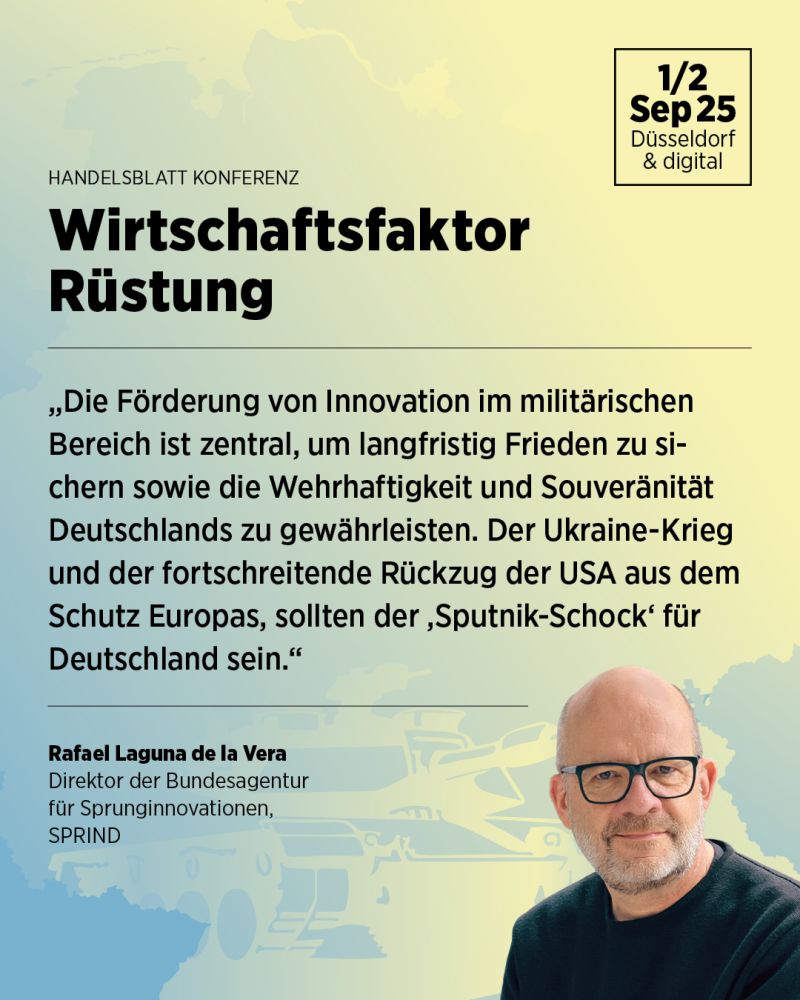
Zeitenwende 2.0 = Gründerzeit 2.0? Wie gelingt der nachhaltige militärisch-zivile Innovationstransfer? Wo sind die größten Bottlenecks? Freue mich auf die Diskussion zu diesem Thema mit Rafaela Kraus, Paul Höller und Larissa Holzki am Dienstag, dem 2. September. live.handelsblatt.com/event/handelsb…
Rafael Laguna de la Vera tweet media
Deutsch
1
3
9
795
Rafael Laguna de la Vera
Rafael Laguna de la Vera@rafbuff·
Es gibt viel Grund zu Technikoptimismus, denn einige Folgeinnovationen werden uns in den nächsten Jahrzehnten helfen, die großen Herausforderungen zu meistern, die uns heute oft als bedrückend, gefährlich und unlösbar erscheinen. linkedin.com/pulse/wie-wir-…
Rafael Laguna de la Vera tweet media
Deutsch
1
2
4
318
Rafael Laguna de la Vera retweetledi
Florian Herrmann
Florian Herrmann@fwhfreising·
Gespräch mit Transmutex, RWE & SPRIND: Transmutex plant in Bayern eine neuartige Anlage zur Transmutation – ein Prozess, der Atommüll reduzieren, Energie erzeugen und wertvolle Isotope für die Medizin gewinnen kann. Der Freistaat begleitet die Idee offen. #Innovation #Transmutation #Kerntechnik #Bayern #Forschung
Florian Herrmann tweet mediaFlorian Herrmann tweet mediaFlorian Herrmann tweet mediaFlorian Herrmann tweet media
Deutsch
6
13
59
50.2K
Rafael Laguna de la Vera
We are getting closer and closer to the WALL-E world friends. Is this a future we want? I agree with @karpathy that pure #Tiktok is already more than we need. Let's do something useful, something that is good for all people with this...
Andrej Karpathy@karpathy

Very impressed with Veo 3 and all the things people are finding on r/aivideo etc. Makes a big difference qualitatively when you add audio. There are a few macro aspects to video generation that may not be fully appreciated: 1. Video is the highest bandwidth input to brain. Not just for entertainment but also for work/learning - think diagrams, charts, animations, etc. 2. Video is the most easy/fun. The average person doesn't like reading/writing, it's very effortful. Anyone can (and wants to) engage with video. 3. The barrier to creating videos is -> 0. 4. For the first time, video is directly optimizable. I have to emphasize/explain the gravity of (4) a bit more. Until now, video has been all about indexing, ranking and serving a finite set of candidates that are (expensively) created by humans. If you are TikTok and you want to keep the attention of a person, the name of the game is to get creators to make videos, and then figure out which video to serve to which person. Collectively, the system of "human creators learning what people like and then ranking algorithms learning how to best show a video to a person" is a very, very poor optimizer. Ok, people are already addicted to TikTok so clearly it's pretty decent, but it's imo nowhere near what is possible in principle. The videos coming from Veo 3 and friends are the output of a neural network. This is a differentiable process. So you can now take arbitrary objectives, and crush them with gradient descent. I expect that this optimizer will turn out to be significantly, significantly more powerful than what we've seen so far. Even just the iterative, discrete process of optimizing prompts alone via both humans or AIs (and leaving parameters unchanged) may be a strong enough optimizer. So now we can take e.g. engagement (or pupil dilations or etc.) and optimize generated videos directly against that. Or we take ad click conversion and directly optimize against that. Why index a finite set of videos when you can generate them infinitely and optimize them directly. I think video has the potential to be an incredible surface for AI -> human communication, future AI GUIs etc. Think about how much easier it is to grok something from a really great diagram or an animation instead of a wall of text. And an incredible medium for human creativity. But this native, high bandwidth medium is also becoming directly optimizable. Imo, TikTok is nothing compared to what is possible. And I'm not so sure that we will like what "optimal" looks like.
English
0
1
3
402
Rafael Laguna de la Vera
Autonomous drones have the power to dramatically improve the way we live: delivering goods to remote areas, saving lives in extreme conditions, and performing tasks that are dangerous or even impossible for humans. To unlock this potential, we need breakthrough innovation.
SPRIND, Federal Agency for Breakthrough Innovation@SPRIND

The dream of fully autonomous flight is not yet a reality. What is missing are robust systems that can safely navigate complex environments without GNSS or human intervention. We are tackling this challenge with our SPRIND Funke Fully Autonomous Flight 2.0 sprind.org/en/actions/cha…

English
0
1
5
424
Rafael Laguna de la Vera retweetledi
SPRIND, Federal Agency for Breakthrough Innovation
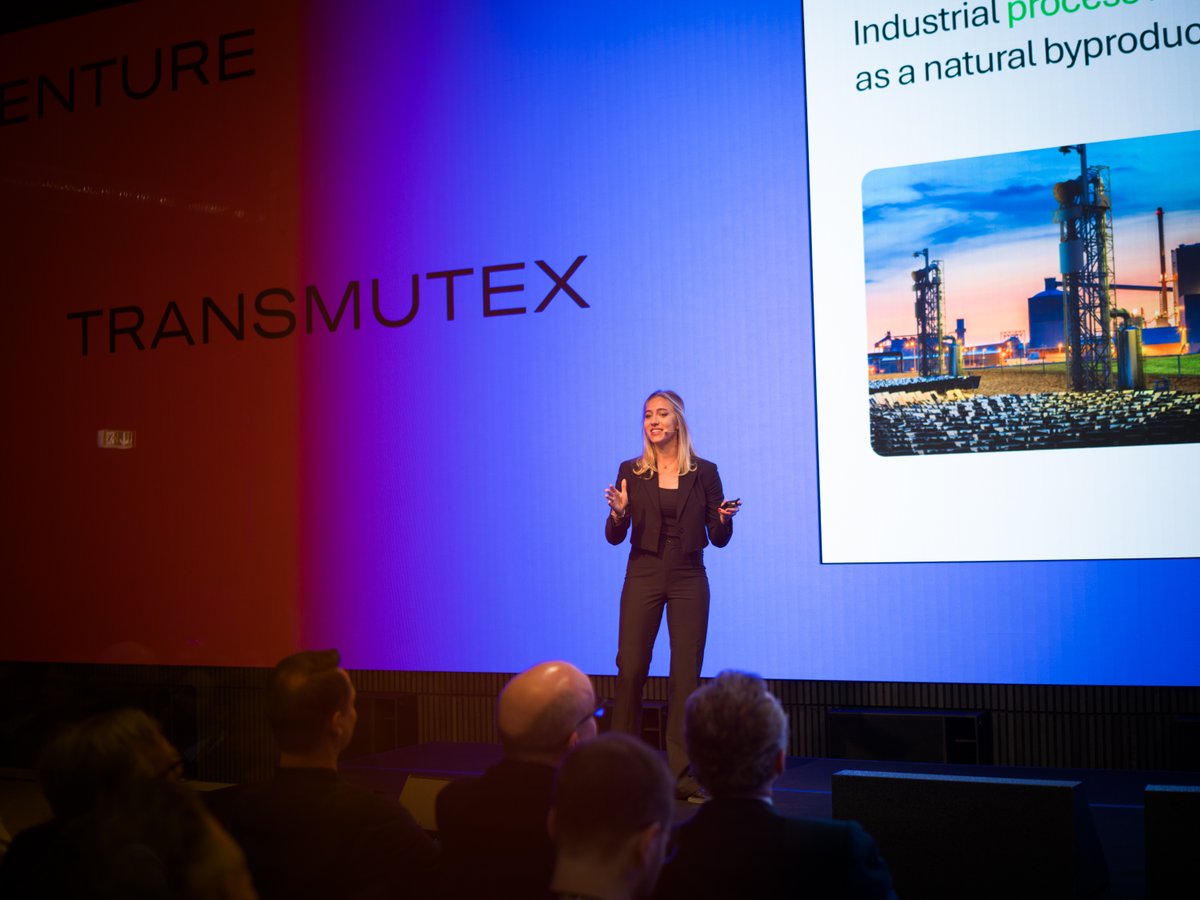
At VENTURE SPRIND, 50+ teams from the SPRIND portfolio from the fields of DeepTech, Computing and Quantum, Life Science, Energy Storage, Climate, Biomanufacturing, AI and Robotics and Advanced Materials pitched in front of 250+ international investors sprind.org/en/words/magaz…
SPRIND, Federal Agency for Breakthrough Innovation tweet media
English
0
1
4
473
Kumar Garg
Kumar Garg@KumarAGarg·
1/ UPDATE: I'm so excited to announce our newest program: the Big if True Science Accelerator (BiTS). The goal is help more scientists design the type of ambitious research programs that were critical to advancements such as the Internet or mRNA vaccines. A few items to note:
Kumar Garg tweet media
English
11
39
176
31.6K