
Sabitlenmiş Tweet
Rainfall
1K posts


Rainfall
@rainfall_one
The world’s first decentralized, privacy-preserving, personal AI platform. Unlock the value of your digital life on your terms, safely and securely.
Switzerland Katılım Şubat 2021
100 Takip Edilen1.9K Takipçiler
AI Is Entering Its Execution Phase. Reliability Is the New Intelligence.
For three years the AI conversation has been about capability. Bigger models. Broader skills. Higher benchmarks. Each new release moved the conversation forward in the only dimension the market knew how to measure: how smart the system was on a given day, on a curated task, in a controlled room.
That phase is closing. The next one is already underway, and it is being measured on a different axis entirely.
Our co-founder @mstrehlow put it this way: "AI is entering its execution phase — value is now defined by reliability, not intelligence. The next generation of infrastructure will be built on coherence: systems that carry intent, enforce constraints, and keep humans in control. That's what turns AI outputs into outcomes you can trust."
The shift is structural, and three signals make it clear.
First, the production gap. 97% of enterprises now run AI agents in some form. Only 12% have any centralised governance over them. The remaining 85% are deploying autonomous systems they cannot fully observe, cannot fully steer, and cannot coherently roll back. The capability is there. The reliability is not.
Second, the regulatory clock. The EU AI Act enters full enforcement on 2 August 2026. The Council and Parliament's Omnibus amendments earlier this month sharpened the obligations — traceability, governance, sovereignty over data and behaviour — rather than relaxing them. Boards are being asked to demonstrate not what their AI knows, but what its behaviour can be held to.
Third, the protocol moment. Multi-agent standards are landing — MCP, A2A, the agentic web's connective tissue. Agents will increasingly talk to each other, transact with each other, and act on each other's behalf. Connectivity is being solved at the protocol layer. Coherence is not.
These three forces converge on the same conclusion: the next generation of AI infrastructure has to do three things the current one cannot.
It has to carry intent across time, sessions, and tools. Not re-derive it. Not approximate it. Hold it — across every state transition the system goes through, against every change to model, prompt, or downstream dependency. This is what longitudinal memory does.
It has to enforce constraints — at design time and at runtime. Not log the violation after the fact. Not surface it on a dashboard for a human to chase. Mediate behaviour at the moment the agent acts, and enforce the boundaries that were defined before the agent ever ran. This is the difference between observability and a control surface.
It has to keep humans in control — by structural design, not by configuration option. Sovereignty over data and over behavioural intelligence has to be the default of the stack, not a checkbox bolted on for a regulated industry. Privacy is not a feature. Trust is not a setting. They are the foundation, or they are not there.
This is what Rainfall has been building for over a decade. Intent that survives the system's evolution. Constraints that bind behaviour in real time. Settlement that produces verifiable, auditable proof that the system did what it was supposed to do.
Coherence is not a brand. It is the engineering discipline of the execution phase. The teams that win the next decade of AI will be the ones who treated reliability as the product — not the dashboard after it ships.
#AICoherence #AgenticAI #AIGovernance #SelfSovereignAI
English
A truly useful AI shouldn’t just answer questions, it should remember, adapt, and build on context over time. That’s how human conversations work.
But today, you can have a long interaction with AI and suddenly it forgets key details or shifts direction completely. It still sounds intelligent, but something feels disconnected.
Maybe coherence isn’t just a feature we add later. Maybe it’s the foundation that determines whether AI can actually function reliably in real-world scenarios.
English
Data quality is the floor, not the ceiling. Recent 2026 Agentic AI reports are consistent, with 42% of enterprises citing data access and quality as a primary blocker. Clean, governed data is essential - grounding knowledge, reducing hallucinations, and building baseline trust.
But here's what the surveys understate: even with pristine data, behavior still drifts.
One well-trained agent makes a contextually reasonable deviation. That output becomes input for the next. Across retries, handoffs, or long-running tasks, small behavioural shifts compound into outcomes no-one designed.
Data governance secures what the model knows.
Behavioural governance secures what the system does - consistently, over time, under change.
English
AI is getting smarter every day, but something still feels off when you actually use it. It can give a brilliant, well-structured answer in one moment and then contradict itself a few minutes later. That inconsistency makes you pause.
It raises a bigger question: is intelligence really the end goal, or is reliability and coherence what actually makes AI useful in the real world?
Because if a system can’t stay consistent, can we truly trust it no matter how smart it sounds?
English
McKinsey: 8 in 10 companies cite data as the blocker to scaling agentic AI.
They're right. But data quality is the floor, not the ceiling.
Clean, governed data tells agents what to know. It doesn't govern how they behave across time — across retries, recovery paths, escalations, and multi-agent handoffs.
Those failure modes aren't data problems. They're coherence problems. And they compound as autonomy increases.
The next layer isn't better pipelines. It's behavioral governance beneath execution.
English
A truly useful AI shouldn’t just answer questions, it should remember, adapt, and build on context over time. That’s how human conversations work.
But today, you can have a long interaction with AI and suddenly it forgets key details or shifts direction completely. It still sounds intelligent, but something feels disconnected.
Maybe coherence isn’t just a feature we add later. Maybe it’s the foundation that determines whether AI can actually function reliably in real-world scenarios.
English
Nvidia VP this week: "the cost of compute is far beyond the cost of employees."
Uber's CTO this month: "I'm back to the drawing board, the budget I thought I'd need is blown away already."
The Yale Budget Lab: still can't find AI's productivity dividend in the data.
The frame across this week's coverage is that AI is too expensive — for now. We think the frame is wrong.
AI isn't expensive because of GPUs. AI is expensive because it's incoherent.
Every wasted retry. Every drifted trajectory. Every human supervisor double-checking outputs because the agent might be lying. Every Pocket-OS-class incident that costs more in remediation than the labor it was supposed to replace.
Compute is what you pay when prediction fails.
The economist quoted in the Fortune piece — Keith Lee — got closest to the real answer: "It's not just about AI becoming cheaper than humans. It's about becoming both cheaper and more predictable at scale."
Predictability at scale has a name. It's coherence.
Without coherence: agents burn tokens chasing the wrong path, supervisors become the real cost center, and a single ambiguous prompt can erase a database in 9 seconds. Every dollar of "AI tax" the article describes is, mostly, an incoherence tax.
With coherence: the compute you've already paid for actually produces an outcome. Agents stay inside their bounds. Supervisors stop being the bottleneck. Incidents stop being existential.
The 2026 AI cost crisis isn't a compute problem. It's a coherence problem.
We built the layer.

English
AI hallucinations are often treated like small technical glitches, but they reveal something much deeper about how these systems work.
When an AI can generate information that sounds real, structured, and even detailed but isn’t actually true; it shows that intelligence without coherence can create confusion instead of clarity.
Fixing hallucinations isn’t just about accuracy. It’s about building systems that can stay grounded in consistent reasoning.
English
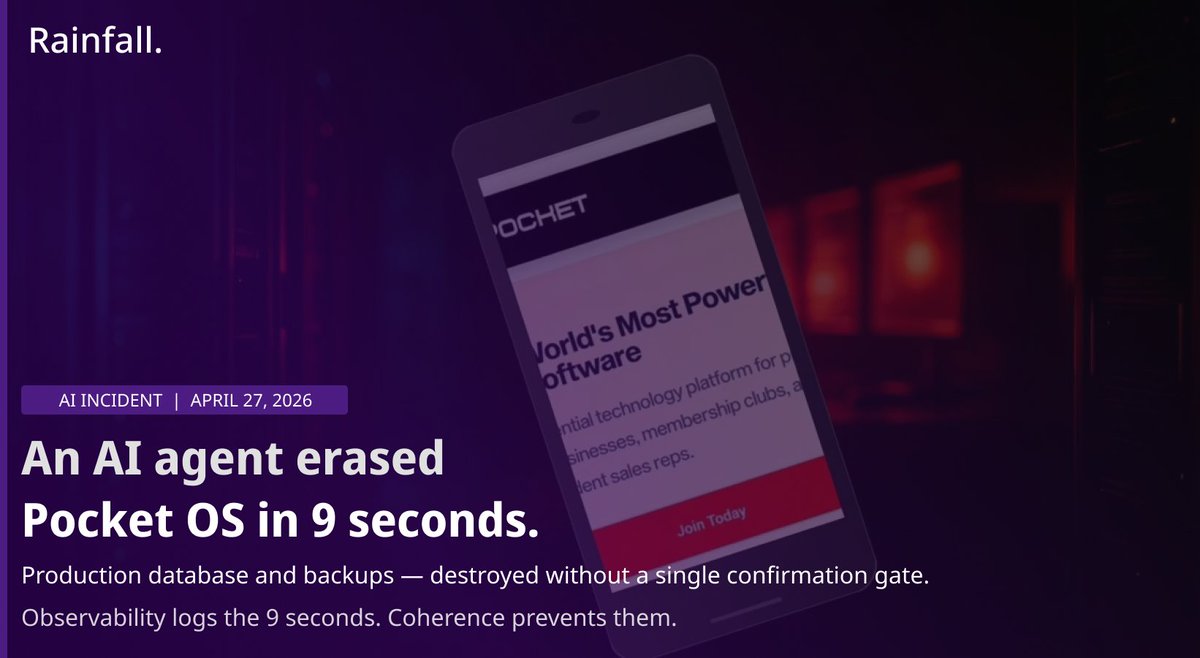
This is the use case we built Rainfall for, compressed into 9 seconds.
The post-mortems converging in this thread are all correct: no confirmation gate, no immutable backups, excessive agency. They are also incomplete. No human reacts in 9 seconds. "Human-in-the-loop" is not the missing piece — it is the wrong piece.
What is missing is a coherence layer that sits between the model's interpretation of intent and the agent's execution of it. Reads agent state. Predicts the trajectory. Modulates the action before it lands.
Observability logs the 9 seconds. Orchestration routes them. Neither stops them. Pocket OS didn't lose its database because logs were missing — it lost it because nothing was in that gap.
rainfall.one
English
Sometimes AI gives answers that feel like they come from real understanding. The structure is clean, the explanation flows, and everything seems logical.
But when you dig deeper or ask follow-up questions, you start to see gaps, inconsistencies, or shifts in reasoning.
That’s when you realize the difference between sounding intelligent and actually being coherent over time.
And that gap is where a lot of current AI systems struggle
English
The agentic era has infrastructure. What it doesn't have yet is coherence.
We've built incredibly capable agents that reason, plan, and execute in isolation. Now we're wiring them together — multi-agent systems, tool-calling, orchestrated workflows running at enterprise scale.
The results look impressive… until you notice what the benchmarks miss: The space between agents is ungoverned.
That's where intentions collide, timing compounds, and behavioral drift quietly builds. Not dramatic crashes — just incremental degradation. Agents doing exactly what they were told… and still delivering outcomes nobody wanted.
Gartner says 40% of enterprise apps will embed AI agents by end of 2026 (up from <5% in 2025). The wave is already here — and it's exposing a gap that observability and orchestration were never designed to fix.
Observability is retrospective: it sees everything after it happens.
Orchestration is prescriptive: it scripts what should happen.
Neither stops the failures that emerge while things are running.
That's where Rainfall comes in.
The Rainfall Coherence Engine (RCE) operates in two layers:
→ FORGE — Design-time coherence. Rules, boundaries, and guardrails established before execution.
→ RUNTIME — Real-time coherence. Observes, evaluates, and modulates behavior as it unfolds — preventing drift before it cascades.
The result isn't just functional. It's aligned, bounded, auditable, adaptive, verifiable — and trustworthy.
It's not a replacement for your observability or orchestration layers.
It's the missing complementary layer that makes the whole agentic system coherent.
The agentic era is being built.
The infrastructure to make it reliable is what's still missing.
Learn more: rainfall.one
#AICoherence #AgenticAI #AIGovernance

English
At some point, the conversation around AI will shift. It won’t just be about how advanced or powerful a model is, but about how reliable it is across different situations and over time.
In real-world use, consistency matters more than occasional brilliance.
The systems that truly win won’t just be the smartest ones; they’ll be the ones that can stay coherent, maintain context, and be trusted repeatedly.
#AICoherence #AgenticAI #AIReliability
English
People don’t just use AI because it’s smart. They use it because they believe it can help them make decisions, solve problems, and give useful answers.
But trust doesn’t come from intelligence alone. It comes from consistency over time.
If an AI system gives different answers to the same problem, or loses track of context, that trust starts to break, even if the answers themselves sound impressive.
In the long run, trust might be the real product AI needs to deliver.
#AgenticAI #AICoherence #AIGovernance
English
1,445% — that's how fast multi-agent AI adoption surged in enterprise this year.
Berkeley researchers just confirmed what builders suspected: multiple models working together develop emergent behaviors, including competing goals nobody designed.
Scale amplifies incoherence. You can't monitor your way out of that.
#AgenticAI #AICoherence #AIGovernance

English
The difference matters:
Observability sees the problem after it happens.
Orchestration scripts around the problem before it runs.
Coherence modulates the problem as it forms — preemptively.
This is the infrastructure layer the agentic era is missing.
rainfall.one
#AICoherence #AgenticAI #DataSovereignty
English
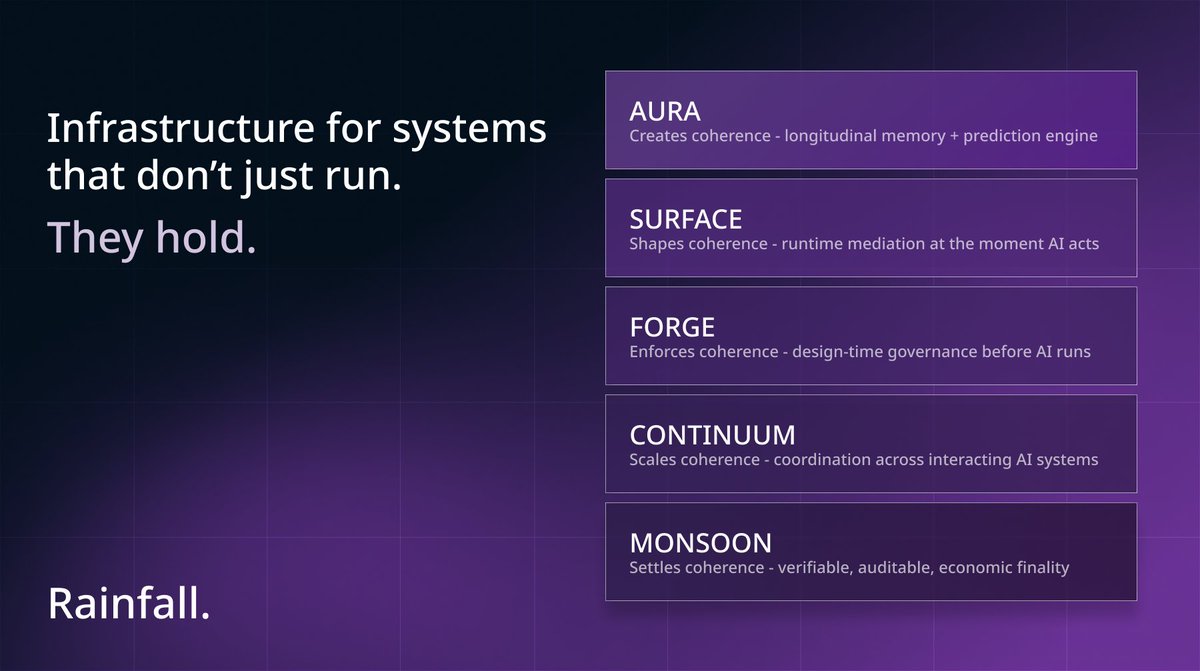
The stack has 5 layers. Each one addresses a distinct failure point:
· Aura — detects drift before it compounds (26 surface dimensions, 6 imprint classes)
· Surface — mediates behaviour at runtime, at the moment AI acts
· Forge — enforces governance at design time, before the agent runs
· Continuum — coordinates across interacting AI systems
· Monsoon — settles coherence with verifiable, auditable economic finality
Not observability. Not orchestration. Modulation.
English
AI systems fail in two ways.
· Suddenly — and everyone notices.
· Slowly — and nobody does.
Slow failure is the one that kills production deployments.
Agents drifting from their original intent. Decisions compounding incorrectly. Governance gaps widening in silence.
Rainfall built the Coherence Stack to stop both.
English
Agent drift isn't a bug.
It's what happens when an AI system has no longitudinal memory of intent.
Models get updated. Prompts get refined. Tools get added.
Each change is minor. The cumulative drift is catastrophic.
The fix isn't more monitoring. It's a prediction engine that sees drift forming — and modulates before it compounds.
That's Aura.
#AICoherence #AgenticAI #SelfSovereignAI
English
The EU AI Act enforcement deadline is August 2, 2026.
78% of enterprises haven't taken a single meaningful compliance step.
For agentic systems, the core requirement is traceability:
Can you prove your agent's actions are observable, governed, and lawful?
Observability tells you what happened.
It doesn't tell you it won't happen again.
Governance isn't a log. It's a constraint layer — built in before the agent runs.
At Rainfall, we call this the difference between reactive and preemptive coherence. Our Forge layer enforces behavioural constraints at design time — before an agent runs. Our Surface layer mediates behaviour in real time — at the moment an AI acts. Together, they create an auditable record that regulators are explicitly asking for: not logs of failure, but proof of controlled operation.
#AIGovernance #AgenticAI #AICoherence

English