TruthCapital

154 posts

TruthCapital banner
TruthCapital

TruthCapital

@ramesh_vd

Business Analysis using core concepts All information and insights shared for learning . Not to be seen as recommendations. Not SEBI registered.

Katılım Ağustos 2010
167 Takip Edilen1.2K Takipçiler
TruthCapital
TruthCapital@ramesh_vd·
#Beezaasan Update on Beezaasan: Keep a tab on potential defense pivot emerging. The strategic acquisition linked to the Asawara Earthtech project involves an exact 34.84% equity stake, and it is not just a random related-party asset—it might be the actual structural vehicle for high-energy defense chemistry lines. Asawara Earthtech Limited, holds critical regulatory assets, most notably the defense explosive licenses filed with the Gujarat Pollution Control Board (GPCB) for high-energy manufacturing lines like RDX, HMX, TNT, and PETN Management stopped at 34.84% because of a strict legal wall, not a lack of interest. Funding the deal via a promoter share swap pushed their holding right up against the 75% Minimum Public Shareholding (MPS) limit. So two points to keep track of - 1. The GPCB Final EC Amendment, PESO Manufacturing Licenses, Consent to operate, Commissioning disclosures 2. The promoters still hold the remaining 65% of Asawara, so the key trigger to watch next is a QIP or cash buyout to bring the rest of the defense business into the listed entity. If this plays out, and you're tracking it closely, it could be a massive opportunity to catch a potential re-rating trend early. [Not investment advice, DYOR] [Credit to X handle who shared information regarding this]
TruthCapital@ramesh_vd

#Beezaasan 🧨 Beezaasan Explotech (SME)— Solar Industries and Premier Explosives are the sector benchmarks. Can Beezaasan ever trade at those multiples? Solar dominates scale. Premier dominates defence. Beezaasan is neither — so what exactly is it, and is the market pricing it right? Let's break it down 👇 🏭 What does it actually do? Beezaasan is a Gujarat-based commercial explosives company serving India's mining and infrastructure sector — coal mines, cement quarries, highway tunnels, and stone-crushing belts across 20+ states. Four business lines: packaged slurry explosives (legacy, low margin), bulk emulsion site services (pump trucks that mix chemicals directly in the borehole — safer, stickier), detonating fuses, and cast boosters & initiators. The new Bhantala plant is purpose-built for the last two. The real model shift: they stopped selling boxes of explosive sticks and started delivering clean rock fragmentation as a service — mobile mixing trucks, on-site blasting engineers, zero live explosive storage at the mine. Coal India doesn't want a supplier; it wants a blasting partner. That's the wedge. Does it have a moat? Narrow, but real. PESO licensing takes 2–3 yrs just to get started. Once their pump trucks are embedded in a mine site, switching suppliers means halting operations. Their new Bhantala plant (fuses + boosters) earns ~22–28% EBITDA vs 8–10% for basic slurry. Moat is widening — slowly. 📊 FY28E projections — the operating leverage story New plant + product mix shift = margin expansion on a growing revenue base. The margin driver: basic slurry earns 8–10% EBITDA. Bulk emulsions 12–14%. Detonating fuses and cast boosters from Bhantala earn 22–28%. Every rupee that shifts toward the Bhantala product mix improves consolidated margins structurally — that's the operating leverage. Finance costs nearly gone — from ₹3.7 Cr in FY25 to ~₹1.0 Cr in FY28E after IPO debt prepayment. Flows straight to PAT. EPS CAGR FY26–FY28E: ~33%. One more trigger: ₹19.94 Cr of IPO cash is still parked in FDRs. The moment final PESO clearances under the Explosives Rules 2008 come through, that cash unlocks the next Bhantala capacity block. 💰 Valuation — what is the market actually pricing in? At 32x trailing, the stock looks expensive on today's earnings. On FY28E EPS of ₹22.8, the forward P/E compresses to ~12 x. For an SME commercial explosives utility with ~33% EPS CAGR through FY28E, 12–15x forward is not expensive. The market is asking you to believe in the Bhantala ramp and the mix shift. If you do — reasonably priced. If execution slips — there's limited margin of safety at 32x TTM. Summary: fairly priced if Bhantala executes. No margin of safety if it doesn't. Management quality — trust but verify The Somani family runs the show — MD Navneet Somani (25+ yrs explosives ops). Domain-deep, operationally hands-on. That counts in a high-compliance, dangerous-logistics business. Redflags: Related party cross-holding — ₹52.6 Cr Management deployed a share swap to acquire a 34.84% stake in Asawara Earthtech Limited — an associate company in earthmoving & civil ops. Done via non-cash swap (not IPO proceeds), but complex group structures obscure true cash realities. Investors will discount until AEL contributes real, traceable earnings. This is the single biggest governance concern. Pending litigation — ₹98.3 Lakh tax disputes Standard for industrial/chemical companies in India. Immaterial at <0.5% of revenue. But worth tracking as the company scales into new states — regulatory surface area grows with geography. These are SME transition friction flags, not structural fraud signals. Can it ever re-rate like Premier Explosives (~80x P/E)? Premier commands 80x because defence & aerospace is 76%+ of revenue — solid propellants for Akash/Astra missiles, ISRO pyrogen igniters, countermeasure Chaffs & Flares, and a record ₹1,569 Cr order book (4x annual revenue). Irreplaceable supplier relationships built over years of MoD qualification cycles. Beezaasan is 100% commercial mining. No missile contracts. No ISRO lines. No export pipeline. Management has explicitly confirmed no defence pivot — every IPO rupee is going into emulsion plant expansion and commercial bulk trucks, not cleanroom propellant facilities. For a re-rating, the business model itself must change. Entering defence requires years of R&D, MoD qualification cycles, and entirely new infrastructure. Zero signal from management today. 📌 Final take Beezaasan is a clean, well-run, narrowly moated commercial explosives company with a credible earnings ramp. Disciplined promoters — 75% stake, zero pledge. Real operating leverage as Bhantala scales. Governance flags are manageable, not structural — but they are real and need watching. At 32x TTM, you are paying for FY28E delivery. The ~33% EPS CAGR and 12x FY28E P/E make it reasonable if execution holds — but there's limited downside buffer if the Bhantala ramp or PESO clearances disappoint. Re-rating story? Doesn't exist yet. Without a mix shift toward defence — which management has not signalled — this trades as a mining infrastructure utility, not a defence-tech compounder. Everything seems fairly priced at current levels. 📌 The one thing to watch: any strategic pivot toward defence/aerospace. That's the single catalyst that changes the valuation conversation entirely. Until then — priced to perfection on the existing plan. [Not investment Advice, DYOR] [Any contrarian views or missing information , please do share in comments]

English
0
3
23
3.6K
TruthCapital
TruthCapital@ramesh_vd·
@maitymit Yes agree .. intentionally conservative here.. 25% to 30% growth playout might be there.
English
0
0
0
52
MMM
MMM@maitymit·
@ramesh_vd FY27E projection is very conservative
English
1
0
0
61
TruthCapital
TruthCapital@ramesh_vd·
#Divgi #DivgiTTS Divgi-TTS is a structural play on three converging tailwinds in Indian auto — the SUV boom, EV transition, and "China+1" export reshoring. High-Precision Mechanics is the foundation across all three, while Embedded Hardware & Software is the extra weapon that specifically unlocks the EV opportunity and Divgi's move toward electronic Shift-on-the-Fly (ESOF) transfer cases for premium SUV trims. That combination is why an old-school gear company from the 1960s is now both India's dominant 4WD supplier and Tata's transmission partner for EVs. What does it do In the early 1960s, the Divgi family started out doing high-precision gear engineering. Nothing flashy. Just gears. Then in 1995, they entered a 20-year joint venture with BorgWarner — one of the biggest drivetrain companies in the world. For two decades, Divgi sat inside BorgWarner's engineering playbook: friction material bonding, electron-beam welding, synchronizer design. The kind of manufacturing know-how that takes most companies generations to build organically. When the JV ended in 2016, most companies would've gone back to being a contract manufacturer. Divgi did something different — they became a co-development partner. Here's what that means: when Mahindra designs a Thar, or Tata builds a new EV, they don't go shopping for an off-the-shelf gearbox. Divgi's engineers are in the room at the concept stage — customizing, prototyping, testing the mechanism that gets power from the engine (or battery) to the wheels. That's "co-architect," not "vendor." Moat Divgi controls roughly 70-75% of India's 4WD/AWD transfer case market — currently the highest-margin, fastest-growing of its three segments (35-38% category CAGR). They're the only homegrown maker of interactive torque couplers. Gross margins run 60-63% — versus ~56% for Sona BLW and ~45-50% for traditional forging companies. Why such fat margins for an "auto parts" company? Because the real product isn't the metal — it's the 3-5 year OEM qualification process baked into every platform. Once Divgi is validated on a vehicle program, switching suppliers costs the OEM ₹50-100 crore and 12-18 months of line shutdown. Nobody does that lightly. The margin gap over Sona BLW likely comes down to product mix: Divgi sells fully integrated, software-calibrated systems where it's often the only qualified domestic source, while Sona's portfolio leans more toward individual EV components in a more competitive field. Underneath that lock-in sits a genuine technological edge. The 20-year BorgWarner JV left Divgi with proprietary process trade secrets and patents — not just product designs, but the manufacturing know-how and electronic software calibration needed to build integrated Shift-on-the-Fly transfer cases. That IP protects the process, which is far harder to reverse-engineer than a part. This is also why the barrier to entry is so high — and it's not about money. Setting up a high-precision drivetrain plant costs ₹250-500 crore, which plenty of players can raise. The real wall is the 3-5 year, non-transferable OEM qualification cycle per platform. A great example: Ramkrishna Forgings has successfully scaled into component exports, but has never managed to break into the system-level 4WD transfer case market — they lack the ECU calibration capability and the multi-year co-development track record that OEMs like Mahindra demand. Capital alone can't buy that; only time and trust can. The honest segment picture: synchronizer systems (the legacy, ICE-linked manual gearbox business) remains Divgi's largest revenue base today, but it's the structurally narrowing piece — BEVs use single-speed gearboxes, eliminating synchronizers entirely. EV/E-Gear is still small in absolute revenue but is where current RFQ momentum and future growth concentrate. Divgi is already a certified E-Gear supplier to Tata Motors, with a 120-kW EV transmission program hitting Start of Production. Narrow moat, but widening, not shrinking. Valuation FY26: revenue jumped 61% to ₹352.89 crore, profit grew 92% to ₹46.93 crore. They're sitting on a ₹380cr order book plus a freshly-won ₹800cr, 7-year global export contract for transfer cases — split between Mahindra's Scorpio pickup and Tata's Yodha platform, shipping out through Southeast Asia. FY28E (20% CAGR model): revenue ₹508cr, EBITDA margin 27.6%, EPS ₹25.81, ROIC scaling from 14% to 19.4%. The upside case — four catalysts that could compound together: 1. Export contract front-loads. Base case assumes slow ramp from H2FY27. Faster overseas platform adoption could mean skipping the "sample batch" phase and going straight to full-line shipments, filling Shirwal's spare capacity sooner. 2. Mix shifts toward "smart" hardware. Faster adoption of ESOF transfer cases and 120-kW EV modules (mechanics + Divgi-owned software) carries >65% gross margins vs standard parts — a structural margin lift, not just cyclical. 3. The 150,000-unit domestic RFQ converts. Tooling for these manual components is already fully depreciated at Sirsi/Shivare — near-zero incremental cost, almost pure profit if won. 4. Temporary input-cost windfall. Raw material pass-through clauses lag 3-6 months; softer steel/aluminum prices would let Divgi pocket the spread temporarily. Stack all four: FY28E revenue could stretch toward ₹600-650cr (vs ₹508cr base), margins toward 29-30%, EPS toward ₹34-36 (vs ₹25.81 base) — a 35-40% EPS upside layered on an already-doubling earnings base. Management Run by the Divgi brothers — Jitendra (MD, UCSD-trained mechanical engineer, 30+ years in transmission design) and Hirendra (manufacturing, vendor development, shop floor automation). Promoter family holds ~60.5%, zero pledge. Through facility buildouts at Shirwal, EV ramp-ups, and export wins, they've stayed virtually debt-free. Engineers running the show — clean governance, no RPT red flags, board 50%+ independent. Execution credibility check: management's export turnaround guidance (₹80-90cr annual run-rate) has played out as promised through FY26. Watch items: Top customer = 50%+ of revenue, top 5 = 90%+. Management's biggest job is diversification. ₹800cr export contract's H2FY27 SOP is management's own guidance — any client-side delay leaves Shirwal capacity underutilized. IPO fund deployment for Shirwal extended into FY27 (Feb 2026) — framed as prudent validation-first, but worth watching for repeat pattern. Closing The biggest swing factor isn't the export contract or RFQ — it's drivetrain architecture. If single-motor EVs dominate (Divgi's mechanical transfer case carries over via E-Gear), Divgi's leadership extends into the EV era. If dual/quad-motor setups win (software coordinates independent axle motors, no physical transfer case needed), Divgi's core mechanical segment gets bypassed. Worth contrasting with pure-play automotive software names like KPIT — KPIT posted FY26 revenue of $724.8 million with a 20.8% EBITDA margin, but FY26 was volatile for them, with PAT margins compressing from ~14% to ~11% YoY in Q3 as OEMs delayed software-defined-vehicle programs. KPIT owns the calibration/software layer but no hardware — if architecture shifts toward software-coordinated multi-motor EVs, KPIT-type players are direct beneficiaries, while Divgi's hardware-heavy model would need its software arm to carry more weight. Autocar ProfessionalMarkets Mojo For now: a small gear shop absorbed two decades of BorgWarner's drivetrain DNA, built India's dominant 4WD systems business, and rides three tailwinds — SUVs for volume today, China+1 for exports today, EV for relevance tomorrow. The KPIT contrast is a useful lens for the one risk that matters most: whether Divgi's hardware-first model keeps pace if the industry's center of gravity shifts further toward software. [Not investment advice, DYOR]
TruthCapital tweet media
English
3
9
39
2.6K
TruthCapital
TruthCapital@ramesh_vd·
#moreopenlaboratories #moreopenlabs Morepen Laboratories — generic API manufacturer grinding out a living, or a business undergoing a structural shift the market hasn't fully priced yet? Two new engines are coming online — CDMO and Medical Devices. One has an ₹825 Cr order book. The other is being carved into a separate subsidiary. Together they could fundamentally change the quality of earnings story. Or not. Let's dig in 👇 🏭 What they do — and what is actually changing Morepen started in 1984 as a bulk API manufacturer — mastering process chemistry on off-patent molecules. Today if someone in the US or Europe takes a Loratadine allergy pill or a Montelukast asthma tablet, there's a real chance it came from Morepen's USFDA-approved plants. They hold 64% of India's Loratadine export share and 38.6% of Montelukast exports. Dominant — but in a low-margin commodity game. Then came Chapter 2 — Home Diagnostics. Launched Dr. Morepen glucometers and BP monitors with a classic razor-and-blade model. Sell the machine cheap. Lock the consumer into buying proprietary testing strips forever. 17M+ device users, 1.5 billion+ strips sold. Strips earn 35–45% EBITDA vs 15–20% for APIs. Sticky, recurring, and high-margin. Now Chapter 3 — the structural shift that matters: 🔹 CDMO pivot (late FY26): First-ever large-scale CDMO mandate — an ₹825 Cr multi-year global manufacturing contract with an international innovator. Not a spot API sale. A 4-year rolling commitment — ₹150 Cr in FY27, ₹250 Cr in FY28. First time in 40-year company history they've moved from transactional API vendor to strategic long-term manufacturing partner. 🔹 Medical Devices subsidiary (ongoing): Home Health diagnostics is being reorganised into a separate subsidiary — separating a high-margin recurring consumer business from the low-margin API business. When it stands alone, the market applies a consumer health/med-tech multiple, not a blended pharma multiple. That is where re-rating optionality sits. 🏰 Moat — narrow, but the structural shifts are widening it Regulatory barriers (Strong): USFDA DMF filings take 2–4 years, cost ₹150–250 Cr, and are site-specific. Morepen has zero Form 483 observations across consecutive USFDA audits — a trust advantage that can't be bought overnight. Customer lock-in (Moderate): Switching API suppliers requires a post-approval regulatory amendment — months of compliance review, drug shortage risk. On the consumer side, owning a Dr. Morepen glucometer mechanically locks you into their strips. CDMO shifts the moat durability: A 4-year exclusive manufacturing relationship means a global innovator can't exit without triggering costly regulatory re-filings. That's fundamentally stickier than spot API sales — and earns 22–28% EBITDA vs 15–20% for standard APIs. Risk: Medium-term CGM substitution threat — wearable patches that eliminate finger-prick strips. Premium-priced today, but cost deflation over 5–7 years could disrupt the strip ecosystem. 📊 Valuation — the operating leverage case for FY28 A new ₹200 Cr OSD formulations plant (QIP-funded) is coming online — scaling max revenue capacity from ₹2,200 Cr to ₹3,400 Cr, utilisation ramping 55% in FY27 to 75% in FY28. Capex cycle is largely done. Operating leverage is about to play. Revenue grows 10–15% annually per management guidance. EPS nearly doubles. That's the operating leverage story — fixed-cost base already built, incremental revenue flows disproportionately to the bottom line. At ~14x FY28E, in line with mid-cap pharma peers. If CDMO ramps and medical devices re-rates as a separate entity, the multiple could expand too — not just the earnings. 👔 Management quality — experienced but carry baggage Sushil Suri (CMD) has run Morepen since inception in 1984 — 40+ years of process chemistry and global regulatory navigation Walk the talk verdict: Capital allocation has been disciplined — balance sheet cleaned, debt eliminated, QIP done cleanly, SMT capex delivered on schedule. But near-term margin execution missed — EBITDA compressed when management had guided double-digit margins 2003 GDR governance scar In 2003, Morepen's promoters essentially faked investor demand for their overseas fundraise — borrowed money through offshore shell companies to subscribe to their own shares, making it look like genuine outside interest. SEBI caught it and banned them from capital markets. It's two decades old and the balance sheet is clean today — but it's the same promoter family still in charge. 61%+ retail float — structural volatility risk FIIs hold just 1.58%, mutual funds ~1.25%. With over 61% of the float held by retail investors, there is no institutional price-discovery anchor. The real deal-breakers 🔹 CDMO order book — first ever, and recent: ₹825 Cr mandate in late FY26. First in 40-year company history. Market hasn't fully priced the quality-of-earnings shift from volatile spot API pricing to predictable scheduled CDMO revenue. 🔹 Medical Devices subsidiary — value unlock option: 35–45% strip margins buried inside 9.6% blended EBITDA. Demerger forces the market to apply the right multiple to the right business. Demerger execution timeline is the critical variable. 📌 Closing Capex done. Plant built and ramping. CDMO order book real and recent — first in company history. Medical devices demerger could unlock a re-rating of the most profitable unit. EPS potentially doubles FY26→FY28 on 10–15% revenue growth. That asymmetry is the investment case. Bull case: CDMO ramps to ₹250 Cr+ by FY28, devices demerger executed cleanly, market re-rates both businesses at appropriate multiples. ₹3.99 EPS at 20–22x = material re-rate. Bear case: CDMO execution slips, CGM deflation accelerates, margins stay compressed, market keeps applying 12–14x generic API multiple. Fairly priced at best. This isn't a story about what Morepen has been. It's a bet on whether two new engines — CDMO and a standalone medical devices business — can fundamentally change the quality and multiple of earnings over the next 24 months. Capex is done. Now it's entirely an execution story.
TruthCapital tweet media
English
2
5
26
2.8K
TruthCapital
TruthCapital@ramesh_vd·
#Beezaasan 🧨 Beezaasan Explotech (SME)— Solar Industries and Premier Explosives are the sector benchmarks. Can Beezaasan ever trade at those multiples? Solar dominates scale. Premier dominates defence. Beezaasan is neither — so what exactly is it, and is the market pricing it right? Let's break it down 👇 🏭 What does it actually do? Beezaasan is a Gujarat-based commercial explosives company serving India's mining and infrastructure sector — coal mines, cement quarries, highway tunnels, and stone-crushing belts across 20+ states. Four business lines: packaged slurry explosives (legacy, low margin), bulk emulsion site services (pump trucks that mix chemicals directly in the borehole — safer, stickier), detonating fuses, and cast boosters & initiators. The new Bhantala plant is purpose-built for the last two. The real model shift: they stopped selling boxes of explosive sticks and started delivering clean rock fragmentation as a service — mobile mixing trucks, on-site blasting engineers, zero live explosive storage at the mine. Coal India doesn't want a supplier; it wants a blasting partner. That's the wedge. Does it have a moat? Narrow, but real. PESO licensing takes 2–3 yrs just to get started. Once their pump trucks are embedded in a mine site, switching suppliers means halting operations. Their new Bhantala plant (fuses + boosters) earns ~22–28% EBITDA vs 8–10% for basic slurry. Moat is widening — slowly. 📊 FY28E projections — the operating leverage story New plant + product mix shift = margin expansion on a growing revenue base. The margin driver: basic slurry earns 8–10% EBITDA. Bulk emulsions 12–14%. Detonating fuses and cast boosters from Bhantala earn 22–28%. Every rupee that shifts toward the Bhantala product mix improves consolidated margins structurally — that's the operating leverage. Finance costs nearly gone — from ₹3.7 Cr in FY25 to ~₹1.0 Cr in FY28E after IPO debt prepayment. Flows straight to PAT. EPS CAGR FY26–FY28E: ~33%. One more trigger: ₹19.94 Cr of IPO cash is still parked in FDRs. The moment final PESO clearances under the Explosives Rules 2008 come through, that cash unlocks the next Bhantala capacity block. 💰 Valuation — what is the market actually pricing in? At 32x trailing, the stock looks expensive on today's earnings. On FY28E EPS of ₹22.8, the forward P/E compresses to ~12 x. For an SME commercial explosives utility with ~33% EPS CAGR through FY28E, 12–15x forward is not expensive. The market is asking you to believe in the Bhantala ramp and the mix shift. If you do — reasonably priced. If execution slips — there's limited margin of safety at 32x TTM. Summary: fairly priced if Bhantala executes. No margin of safety if it doesn't. Management quality — trust but verify The Somani family runs the show — MD Navneet Somani (25+ yrs explosives ops). Domain-deep, operationally hands-on. That counts in a high-compliance, dangerous-logistics business. Redflags: Related party cross-holding — ₹52.6 Cr Management deployed a share swap to acquire a 34.84% stake in Asawara Earthtech Limited — an associate company in earthmoving & civil ops. Done via non-cash swap (not IPO proceeds), but complex group structures obscure true cash realities. Investors will discount until AEL contributes real, traceable earnings. This is the single biggest governance concern. Pending litigation — ₹98.3 Lakh tax disputes Standard for industrial/chemical companies in India. Immaterial at <0.5% of revenue. But worth tracking as the company scales into new states — regulatory surface area grows with geography. These are SME transition friction flags, not structural fraud signals. Can it ever re-rate like Premier Explosives (~80x P/E)? Premier commands 80x because defence & aerospace is 76%+ of revenue — solid propellants for Akash/Astra missiles, ISRO pyrogen igniters, countermeasure Chaffs & Flares, and a record ₹1,569 Cr order book (4x annual revenue). Irreplaceable supplier relationships built over years of MoD qualification cycles. Beezaasan is 100% commercial mining. No missile contracts. No ISRO lines. No export pipeline. Management has explicitly confirmed no defence pivot — every IPO rupee is going into emulsion plant expansion and commercial bulk trucks, not cleanroom propellant facilities. For a re-rating, the business model itself must change. Entering defence requires years of R&D, MoD qualification cycles, and entirely new infrastructure. Zero signal from management today. 📌 Final take Beezaasan is a clean, well-run, narrowly moated commercial explosives company with a credible earnings ramp. Disciplined promoters — 75% stake, zero pledge. Real operating leverage as Bhantala scales. Governance flags are manageable, not structural — but they are real and need watching. At 32x TTM, you are paying for FY28E delivery. The ~33% EPS CAGR and 12x FY28E P/E make it reasonable if execution holds — but there's limited downside buffer if the Bhantala ramp or PESO clearances disappoint. Re-rating story? Doesn't exist yet. Without a mix shift toward defence — which management has not signalled — this trades as a mining infrastructure utility, not a defence-tech compounder. Everything seems fairly priced at current levels. 📌 The one thing to watch: any strategic pivot toward defence/aerospace. That's the single catalyst that changes the valuation conversation entirely. Until then — priced to perfection on the existing plan. [Not investment Advice, DYOR] [Any contrarian views or missing information , please do share in comments]
TruthCapital tweet media
English
0
5
29
6.7K
TruthCapital
TruthCapital@ramesh_vd·
@jhawararun Totally agree. Thanks for highlighting a very important missing point.
English
0
0
1
118
arun jhawar
arun jhawar@jhawararun·
@ramesh_vd No.1 management .why always looking at no.s these company bastards sold major shares without informing share holders only to tell that they will reinvest back into company.The primary objective for any analysis should be management quality , not business ..it only comes later
English
1
0
1
168
TruthCapital
TruthCapital@ramesh_vd·
#Stallion #StallionIndia #StallionIndiaFluorochemicals 🧵 Stallion India Fluorochemicals India's AC boom is real. The supply chain risk is real too. This company is quietly solving both. India imports most of its refrigerant gas from China. China gluts the market → margins get crushed. China restricts exports → India faces a shortage. Stallion's answer: make the molecule yourself. This is the story of a company riding India's cooling boom — and quietly building a semiconductor bet What it does: Stallion doesn't make ACs. It makes them run. For 20 years, they've imported giant ISO tanks of refrigerant gas, blended them to each OEM's exact specification, and delivered filled cylinders to Voltas, Daikin, and BlueStar before every summer. Asset-light. Reliable. But fully dependent on China for every molecule they sold. That dependence is the original sin of this business — and it cuts both ways. When China floods the global market with cheap R-32, Stallion's inventory gets written down overnight. They've lived through this before. It will happen again. The Capex: The new plants — a 10,000 MT R-32 facility in Bhilwara (Oct 2026) and a ₹200 Cr HFO plant in 2027 — are not the asymmetric bet. They are the compounder leg. Management has already broadcast this story. Sophisticated investors have already priced it. COGS drops from 78% to 73%. EBITDA expands from 13% to 18–22%. Strong, linear, predictable growth — but that's exactly what 22x FY28E is paying for. Here's the catch though: CARE has already flagged capex project delays and ₹7.71 Cr of excess IPO fund utilisation. The Bhilwara plant has been re-anchored to October 2026 once already. If it slips again, the FY28 earnings story slips with it — and at 22x, there's no valuation cushion for a miss. Valuation: The numbers bear this out. FY26 came in at ₹434 Cr revenue and ₹44 Cr PAT. By FY28, the estimates point to ₹750 Cr revenue, ₹95 Cr PAT, and EPS of ₹8.22. At CMP ₹183, that's roughly 22x forward earnings for a company guiding 30–35% revenue CAGR with margin expansion baked in. That's a fair price for the compounder. But it's not where the asymmetry lives. It's also worth noting that CFO has been negative for two consecutive years as working capital gets consumed by the cylinder fleet and safety stock buildup. The business only turns cash flow positive in FY27, and that assumption depends entirely on the Bhilwara plant running on schedule. Key Challenge: There's another risk hiding in plain sight. China is not standing still. Chinese refrigerant manufacturers are structurally overbuilt, politically supported, and have repeatedly dumped R-32 and R-410A into global markets at prices that make domestic manufacturing look unviable. The moment Bhilwara goes live, Stallion enters into direct competition with the same Chinese players they currently buy from. If China decides to flood the market again in 2027 — as they have historically done during periods of global demand softness — Stallion's shiny new plant could face margin compression before it even hits full utilisation. This is the single biggest structural risk to the thesis and it doesn't get talked about enough. But here's where it gets interesting. India imposed anti-dumping duties of $1,171 to $1,519 per tonne on Chinese R-32 in 2021. Those duties expire in December 2026 — exactly when Bhilwara commissions. A DGTR sunset review is already underway, renewal looks likely, and if it goes through, Stallion gets a tariff wall the moment it enters manufacturing. If it doesn't, the margin thesis faces pressure from day one. One regulatory event. Worth tracking closely. Asymmetric Bet: The real asymmetric bet is sitting quietly in Khalapur, Maharashtra and Mumbattu, Andhra Pradesh. Stallion has built 300-bar high-pressure cylinder infrastructure for electronic-grade specialty gases. This is not for ACs. This is for chip fabs. And almost nobody is talking about it. Here is why it's truly asymmetric. Semiconductor fabs don't buy gas off the shelf. It takes 2 to 3 years just to qualify a single supplier. One purity defect ruins an entire chip batch worth crores. But once a fab approves you, the revenue becomes sticky, high-margin, and virtually impossible for a standard competitor to replicate. The downside is limited to the initial capex already spent. The upside is a complete multiple re-rating of the business. The flip side of this is also true though — if India's fab buildout takes longer than the government timelines suggest, this optionality simply sits idle. Capital locked in infrastructure that isn't generating returns is a drag, not a free option, until the demand actually shows up. The macro makes this even more interesting. India has committed ₹76,000 Cr to its semiconductor push and domestic fabs are coming online. If chip manufacturing in India scales as planned, Stallion already has the infrastructure ready, no competitor can qualify overnight, and this quietly becomes a de facto monopoly supply position. And if the timeline slips? The core refrigerant business fully protects the downside. It is a free call option on India's chip future — but only if you believe the government's semiconductor ambitions are real and on schedule, which is itself a bet worth thinking about carefully. Risk: One more thing worth flagging. Top 10 clients represent 74 to 89% of Stallion's revenue. This is the dark side of being the most reliable supplier in the room — deep relationships that have also become deep dependencies. If any one of those OEMs decides to vertically integrate, qualify a second supplier, or shift to a competitor during a supply disruption, the revenue concentration becomes a very uncomfortable conversation very quickly. So is it a structural compounder or an asymmetric bet? The honest answer is both — but in different parts of the same business. The R-32 and HFO plants are the bread and butter that secure the floor and fund the journey, provided they commission on time and China doesn't undercut the margin story. The semiconductor gas qualification is the lottery ticket — low downside because the infra is built, massive upside because one fab approval re-rates everything. At 22x FY28E, you are buying the compounder. The asymmetry comes free. But the risks are real, and they aren't priced in either. India needs to cool down and build chips. Stallion is quietly building the molecules for both. The cooling story compounds at 30–35%. The chip story is the free option nobody has priced in. Family-run, debt-free, 0% pledged — capable operators still earning listed-company trust. The thesis works if management executes, China doesn't dump, and India's fabs show up. Two of those three are in their control. One isn't. [Not investment advice, DYOR]
TruthCapital tweet media
English
0
13
77
6.8K
TruthCapital
TruthCapital@ramesh_vd·
@aditya_sh96 Hey ..its written for the effect :) literally it doesnot mean only 1 patent. It implies a broader set of patents for various flow chemistry.
English
1
0
0
56
Aditya Sharma
Aditya Sharma@aditya_sh96·
@ramesh_vd Can you please share the patent number? Or the application number?
English
1
0
0
65
TruthCapital
TruthCapital@ramesh_vd·
#Acutaas #Acutaaschemicals Acutaas Chemicals — The Flow Chemistry Patent Nobody Is Talking About Most Indian chemical stocks compete on cost. Acutaas competes on who can even copy them. One patent. Two industries. Zero substitutes. Flow chemistry — the moat that serves both Big Pharma and the EV+Semiconductor revolution 🧵👇 What They Do (Business Verticals) 🔵 Pharma Intermediates — 610+ complex molecules for global drug makers 🔵 CDMO — Exclusive chemist for innovators like Fermion (Bayer's cancer drug Darolutamide) 🔵 EV + Semicon — First outside China to make EV electrolyte additives; India's only semiconductor photoresist maker 🔵 Specialty Chemicals — Parabens, salicylic acid, niche consumer materials The pivot: from generic pharma supplier → deep-tech critical infrastructure. The Real Moat: Flow Chemistry Here's what most miss. Acutaas doesn't just make chemicals. They make them via proprietary continuous flow chemistry processes that competitors simply cannot replicate. Production-side moat:→ Multi-stage synthesis requires ₹150-200Cr+ capex + 4 years for regulatory clearance → 90%+ of intermediates made fully in-house → USFDA + PMDA approvals are non-transferable — new entrant = full re-audit Demand-side customer stickiness:→ Their molecules get written INTO client drug patent filings → Switching supplier = $1-3M refiling + 2-3 years of comparative stability testing → Customer retention: 90-95% within CDMO/innovator contracts Barriers to entry:→ You need the chemistry and the compliance and the regulatory trust — all simultaneously → In FY24, unorganized generic players were wiped out by Chinese dumping. Acutaas survived because they were already unreplicable. This isn't a patent on a product. It's a patent on the process. You can't reverse-engineer a process you can't observe. Tweet 4 — Financial Projection + Asymmetric Bet Numbers back the thesis: OPM went from 11.2% in FY24 → 42.4% in Q4FY26 as the mix shifted. The asymmetric bet? Semiconductor photoresists. Today Acutaas is India's sole manufacturer. Global market = $4.8B → $7.1B by 2030. Their target: 5% global share + 60% domestic share. The capex is already deployed. The validation cycles are running. If even 1-2 Indian fabs (backed by India Semiconductor Mission) lock them in — the revenue step-change is non-linear. PAT CAGR guided at ~38% through FY28. At 73x trailing P/E, it's not cheap — but at 40x forward FY28 earnings, it's a different conversation. FCF is currently negative (-₹12 Cr) — that's the CapEx phase. It flips positive post-FY26. Watch that inflection. Closing Acutaas is rare: a company where the supply chain IS the product. Promoters hold ~40%, zero pledge. Debt-free. ROCE at 31.6%. The flow chemistry patents don't just protect margins — they determine whether customers can even leave. [Not investment advice, DYOR]
TruthCapital tweet media
English
4
10
88
6.3K
TruthCapital
TruthCapital@ramesh_vd·
#sigmaadvancedsystems #sigmaadvanced Sigma Advanced Systems — Could be India's Most Underrated Dual-Engine Defence Play? What if one company was simultaneously: 🔵 Writing the firmware for India's next-gen missiles 🔴 Machining jet engine parts for Rolls-Royce in the UK Same balance sheet. Same team. The Business = two engines running in parallel Engine 1: Defence Electronics→ Missile & avionics sub-systems → Multi-domain radars & counter-UAS (anti-drone shields) → Naval & submarine ruggedized electronics → CEMILAC + AS 9100 Rev D flight-certified — mandatory for the Indian MoD Engine 2: Precision Engineering (Aerostructures)→ 5-axis & 8-axis CNC machining of aero-engine housing parts → NADCAP-certified chemical surface treatment — rare globally → Fuelled by the acquisition of UK's Nasmyth Group Revenue split: Electronics: sovereign Indian MoD orders Precision Eng: £300M Rolls-Royce contract (₹3,800 Cr over 7 years) Q4FY26 revenue: ₹323 Cr (+469% YoY). This is no longer a small-cap experiment. The Real Moat This isn't a story about who has the best product. It's about who can even get certified to make it. Supply-side lock:→ AS 9100 Rev D + NADCAP + CEMILAC + DGQA = 4 separate certifications → Each takes 2–4 years of zero-defect audits → ₹130–190 Cr minimum capex just to set up a competing facility → Certifications are facility-specific and non-transferable Demand-side lock:→ Sigma's sub-systems are written into OEM master airframe blueprints→ Switching supplier = $2–5M re-validation + 24 months FAA/EASA recertification → Customer retention: >95% on mature platforms The Nasmyth arbitrage (uncopiable):→ UK front-end for NADCAP finishing + Western OEM relationships → Hyderabad back-end for low-cost 5-axis CNC machining → Sigma takes a Rolls-Royce order. Nasmyth handles the front-end design and NADCAP finishing. Hyderabad handles the bulk CNC carving at 35–40% lower cost. The customer sees a UK-certified supplier. The P&L sees Indian manufacturing costs. → The two nodes are only valuable together — which is precisely what makes the combination hard to replicate. That window has already closed. The Numbers (Stripped of the Noise) Before anything else — a flag that separates serious investors from the rest. FY26 reported PAT is ₹268 Cr. Screener shows EPS of ₹15.21. Both numbers are technically correct and completely misleading. Strip out the ₹262 Cr one-time land and asset sale gains and the actual defence manufacturing business earned ₹16 Cr in core PAT in FY26. Core EPS: ₹2.28. That's the real starting line. Here's what the core operational business actually looks like: Revenue is real and scaling — ₹474 Cr in FY26 to a projected ₹938 Cr by FY28. The Rolls-Royce contract alone runs at ₹543 Cr per year. Current installed capacity is ₹600 Cr. A ₹95 Cr capex program in FY27 takes that ceiling to ₹1,250 Cr. The FY28 projection assumes only 75% utilisation — there's 33% upside if execution holds. Margins today are honest and modest. Core EBITDA is 10.4% in FY26 -- The path to 19% by FY28 is entirely a Nasmyth story. Every machining job that migrates from high-cost UK workshops to Hyderabad flows directly into margin. By FY28, core PAT reaches ₹108 Cr and fully diluted EPS hits ₹12.67 — on a post-placement share base of 8.50 Cr shares that already prices in the June 2026 preferential allotment. The working capital discount is real and you need to price it in. Debtor days sit at 270. Net cash cycle is 310 days. Sigma is essentially pre-financing ~₹350 Cr of working capital for the Ministry of Defence at any given time. The fix is the revenue mix shifting toward Rolls-Royce, which pays on commercial terms. As that happens, debtor days compress to 210 by FY28 and CFO reaches ₹114 Cr. ROIC climbs from 7.1% to 13.4%. Management & Governance Promoters hold 71.22%, pledged shares are zero — completely cleared, zero forced liquidation risk, zero overhang — and they chose a ₹460 Cr equity raise over bank debt to fund growth, with India Ratings independently monitoring every rupee of deployment. The walk-the-talk record is clean: margin pivot promised and delivered, Nasmyth integration promised and delivered, ₹3,800 Cr Rolls-Royce contract signed — founders are fully in, unencumbered, and building with their own skin in the game. Closing - know the past to forecast the future This company has a complicated past worth understanding before you size a position. Megasoft Limited was a Hyderabad-based telecom software company that for years sat dormant on the BSE — negligible revenue, no meaningful business, a shell in all but name. The transformation into a defence engineering company happened through a reverse merger with the unlisted private entity Sigma Advanced Systems, sanctioned by NCLT only in December 2025. The listed vehicle that retail investors are buying today is legally the same entity that was filing near-zero revenue returns as a telecom software company twelve months ago. Layer on top of that: a ₹262 Cr gain from selling land and assets that inflated FY26 reported profits to ₹268 Cr — numbers that led many investors to build models on ₹15.21 EPS when the actual defence business earned ₹16 Cr in core PAT. And a UK acquisition — Nasmyth Group — executed in November 2025, consolidated for only five months in FY26, carrying its own one-time transaction costs of ₹9.13 Cr, and still in early integration. These are not small footnotes. They are the entire context behind every headline number this company has reported so far. So the question is whether the overhang from that messy past has been genuinely wiped clean — and the evidence is starting to point that way. The shell is no longer a shell. The NCLT merger is sanctioned, the name is changed, the promoter structure is consolidated at 71.22% with zero pledged shares. The asset sales that distorted FY26 are one-time and done — they won't repeat, which means FY27 reported numbers will finally reflect only what the factories produce. The ₹460 Cr equity raise retires the debt that the transition period accumulated. And Nasmyth, whatever its integration complexities, just unlocked a £300 Million seven-year contract with Rolls-Royce — one of the most demanding aerospace customers on the planet. You do not win that contract without genuine engineering credibility. The order book now has a different character entirely. ₹3,800 Cr from Rolls-Royce. ₹208 Cr in artillery shell exports. ₹107 Cr from North American defence customers. A ₹450 Cr electronic warfare contract from the Indian MoD. These are not prototype orders or one-off government allocations — these are series production commitments from customers who spent years validating the supplier before signing. The past was messy. The transition was opaque to anyone relying on screening platforms. The FY26 numbers require significant stripping before they tell you anything useful. All of that is fair and should be priced into your risk assessment. But the overhang is structural, not permanent. A dormant shell has been replaced by a live operating entity. A real estate windfall has been replaced by aerospace contracts. And a telecom software footnote in Hyderabad is now a certified Rolls-Royce supply partner with seven years of revenue visibility. Whether the bright future the order book promises actually converts into cash depends entirely on one thing: Nasmyth workload migrating to Hyderabad fast enough to show up in margins before the market loses patience. Watch the FY27 quarterly filings. When debtor days compress and normalised EBITDA crosses 15%, the transformation story stops being a thesis and starts being a fact. [Not investment Advice, DYOR]
TruthCapital tweet media
English
3
30
117
8.8K
Sou Ban
Sou Ban@soubanyoyahooc1·
@ramesh_vd Sir ur posts r so elaborate and detailed ,it amazes me for the fact that the amt of work ur putting in to generate this content,pls continue to post like this,thanks 🙏.
English
1
0
1
45
TruthCapital
TruthCapital@ramesh_vd·
#kwalitypharma No blockbuster patent like Venus Remedies. No USFDA exclusivity windows like Senores. Kwality Pharma grows on something quieter — 200+ process dossiers filed across 40 countries, each one locking a global distributor into KPL's factory for the next 3–5 years. Is that enough to double EPS by FY28? Here is the case. 🧵 What it does KPL manufactures complex sterile injectables across three verticals — general injectables (the cash base), cytotoxic oncology vials via Unit 5 (the growth engine), and hormones and peptides via the newly built Unit 6 (the future inflection, commissioning H2 FY27). Instead of selling directly, KPL develops a process dossier — years of formulation work, bioequivalence studies, and stability data — and hands it to MNC distributors in Europe and Latin America. The distributor files for local regulatory approval naming KPL's plant as the exclusive manufacturer. KPL earns three ways: a technology transfer fee for the development work it already did, a batch supply margin on every vial shipped, and a profit share from the partner's sales. The moat — and its honest limits A patent gives a legal monopoly on a molecule. KPL does not have that — all its molecules are off-patent. The technology transfer fee is not an IP fee either. The partner pays for the ready-made technical package that saves them 2–3 years of work, not for exclusive rights to the molecule. The real lock-in comes after the dossier is filed. Once the partner's local approval names KPL's specific plant as the manufacturer, replacing KPL means pulling the registration, sourcing a new manufacturer, running fresh bioequivalence studies, and refiling — a 24–36 month penalty per product per market. Time-based switching cost, not legal exclusion. Every new filing adds another layer. The FY28 numbers — and what drives them FY26 EPS was ₹64.5. FY28E is projected at ₹136.5 — more than double in two years on a 45% CAGR. At CMP the stock trades at 18.5× FY28E. FY26A — Sales / EPS / EBITDA₹503 Cr  /  ₹64.5  /  24.1%base FY28E — Sales / EPS / EBITDA₹830 Cr  /  ₹136.5  /  28.0%+65% sales · EPS ×2.1 Revenue drivers: ↑Unit 6 hormones and peptides — commissions H2 FY27, unlocks ₹150 Cr incremental ceiling at the highest margin in the business; zero in revenue today ↑EU and LatAm corridor deepens — Mexico, Colombia, Brazil filings converting to commercial supply at 2.5× price realisation per unit versus legacy RoW markets Margin levers: ↑Mix shift to oncology and peptides — Unit 5 and Unit 6 carry 32–40% EBITDA margins versus 18–21% for legacy injectables; as their share grows, blended margin lifts to 28% ↑Operating leverage on a fixed cost base — 80+ scientists already funded; employee cost drops 9% → 7.2% of sales; every incremental ₹100 revenue delivers ₹32+ to EBITDA The closing thought KPL is not Venus Remedies — it does not own patent-protected molecules that competitors cannot legally copy. It is not Senores — it does not get 180-day exclusivity windows that generate one-time earnings spikes. What it has is more patient and more durable: 200+ process dossiers across 40 countries, each one running a multi-year supply contract that a distributor cannot exit without a 2–3 year regulatory penalty. Add a new country, add a new product, lock in another partner — repeat. No arbitrage. No IP fortress. Just a quietly compounding technology transfer machine where the revenue engine runs on filings, not patents, and grows one locked-in distributor at a time. The only real question is whether the factory passes its next EU-GMP audit — because that is the gate that lets the next wave of filings convert into revenue [Not investment advice, DYOR]
TruthCapital tweet media
English
2
27
103
10.3K
TruthCapital
TruthCapital@ramesh_vd·
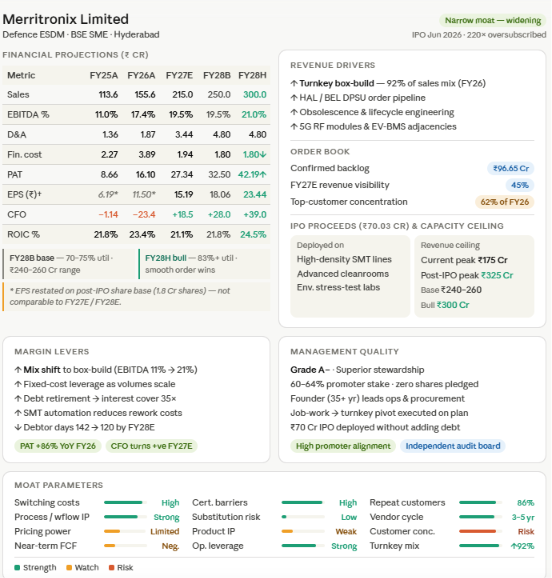
#Merritronix #MerritronixLtd Merritronix Ltd — a defence electronics IPO worth understanding. A thread. What it does Merritronix builds mission-critical electronics — radar sub-assemblies, avionics modules, flight control systems — for India's defence and aerospace programs. Not a generic PCB assembler. A certified, turnkey box-build manufacturer that HAL and BEL trust with the electronics inside fighter jets and radar networks. 97.8% of revenues come from Aerospace & Defence. The moat You can't just walk in. IPC Class 3 + EN 9100 certifications take years to earn. Vendor onboarding with defence PSUs runs 3–5 years. Once embedded, switching mid-program means full re-certification — so clients don't. 86% repeat customer rate proves it. The real edge isn't a patent. It's a compliance fortress that keeps competitors out and customers locked in. Management Founder-led. 35+ years in the industry. 60–64% promoter stake with zero shares pledged. They walked away from low-margin job-work, rebuilt around high-reliability turnkey systems, and now run EBITDA margins of 17%+ vs. the 5–8% typical for generic EMS. The ₹70 Cr IPO capital is being deployed into new SMT lines and cleanrooms — without touching debt. Skin firmly in the game. Revenue drivers & operating leverage Defence indigenisation ("Make in India") is a structural tailwind — HAL and BEL are mandated to source locally. Obsolescence engineering (reverse-engineering discontinued parts for ageing military fleets) is a high-margin niche with almost no competition. As revenues scale, fixed factory costs spread thinner. FY26 proved it: revenue +36.5%, net profit +85.9%. Operating leverage is real and kicking in. EPS & growth prospects EPS was ₹11.50 in FY26 (restated on post-IPO share base). FY27E: ₹15.19. FY28 range: ₹18 base case (70–75% utilisation, ₹250 Cr revenue) to ₹23.44 bull case (83%+ utilisation, ₹300 Cr). Post-IPO capacity ceiling rises to ₹325 Cr. The TAM for defence ESDM grows at ~18% CAGR to ₹28,000 Cr by 2030. Merritronix currently holds ~1% of it. The one watch item 62% of revenues come from a single customer. That's the thread you pull if you want to worry. A procurement delay or budget freeze at that one client hits the top line directly. Working capital is also negative today — defence billing cycles are long. Both are manageable but they are real risks, not footnotes. Closing Merritronix is not a story about growth at any cost. It's a story about a niche manufacturer that spent 20 years earning the right to be in the room — and is now using public capital to scale what's already working. Narrow moat, widening. Grade A− management. A business that gets harder to compete with every year it stays compliant. Worth watching closely. [Not investment advice, DYOR]
TruthCapital tweet media
English
2
14
52
5.4K
TruthCapital
TruthCapital@ramesh_vd·
#SenoresPharma #SENORES A pharma company with 42% EPS CAGR trades at just 17.9× FY28E. Is the market pricing a two-year earnings spike about to peak — or completely missing what this business actually is? Here is the full picture on Senores Pharmaceuticals. 🧵 What it does Most generic pharma companies make a drug and sell it once. Senores operates two distinct businesses out of the same factory — and that distinction is why the margins look nothing like a typical generics company. Business 1 — Own ANDA portfolio. Senores spends 2–3 years earning USFDA approval for complex drugs — controlled substances, oncology injectables, high-barrier specialty molecules. It owns the approved dossier. It manufactures every unit at its own plants in India and Atlanta. But instead of building a US sales force, it licenses distribution rights to large partners like Dr. Reddy's. Dr. Reddy's pays Senores three times: an upfront licensing fee for the right to sell, a per-batch supply price for every unit manufactured, and a back-end profit share from US sales. Dr. Reddy's earns only from selling. Senores earns from all three — with none of the sales overhead. Business 2 — CMO/CDMO manufacturing. Here a third party already owns the drug approval and simply pays Senores to manufacture it at their facility. Senores earns only the manufacturing margin — one revenue layer, not three. Lower margin than the ANDA business but steady, volume-driven, and it sweats the same factory assets that the ANDA business already paid for. The combination drives 29–33% EBITDA margins — high-margin ANDA licensing stacked on top of a contract manufacturing base that keeps the plants fully utilised between own-product batches. The moat Not a patent. It is time, compliance, and geography — three things money alone cannot shortcut. Each USFDA drug approval takes 2–3 years and is tied to a specific facility. Senores has 51 approved. A competitor starts from zero. The DEA licence in Atlanta is rarer still. Manufacturing controlled substances on US soil requires high-security infrastructure and compliance audits most Indian pharma companies have never attempted. It opens direct US government supply contracts that are simply unavailable to everyone else. For select approvals, the USFDA grants a 180-day exclusivity window — Senores is the only generic supplier before competitors can legally enter. 28 more filings in progress means this is a repeating cycle, not a one-time event. Once Dr. Reddy's integrates a Senores-supplied product, switching requires finding another USFDA-cleared manufacturer for the same molecule, passing fresh facility audits, and running full-scale batches — all while risking US pharmacy stock-outs. Nobody does that over a price difference. The FY28 numbers FY26A: Sales ₹679 Cr · EBITDA ₹199 Cr (29.4%) · PAT ₹121 Cr · EPS ₹30.85 · ROIC 23.5% FY28E: Sales ₹1,235 Cr · EBITDA ₹414 Cr (33.5%) · PAT ₹287 Cr · EPS ₹62.08 · ROIC 28.1% Two structural drivers power this — operating leverage on a fully staffed cost base (every incremental ₹100 revenue drops ₹34 to EBITDA) and a 51-approval launch calendar already on paper. One transient item: IPO proceeds permanently wiped ₹23 Cr of finance costs — that step-change is now in the base and does not repeat. FY27 and FY28 need no new catalyst. At 17.9× FY28E the market is pricing a 42% EPS CAGR as if it flatlines the moment FY28 closes. What could re-rate this significantly — and why ① 28 new filings confirm the launch engine keeps running. The market's single biggest concern is that FY26–28 was a one-time wave of exclusivity windows rather than a sustainable machine. Confirmation that a fresh wave is incoming transforms the narrative from cyclical earnings spike to structural compounder with a rolling launch calendar. ② US government mandates onshore controlled-substance supply. Government institutional contracts are annuity revenue — fixed volumes, predictable pricing, multi-year tenure, no sales effort required. This type of revenue is structurally different from product-by-product licensing deals and commands a higher earnings quality premium from the market ③ CDMO segment gets valued separately. The contract manufacturing business is guided at ₹210–250 Cr in FY27 alone — already large enough to stand on its own. - Because their revenue is contracted, visibility is high, and capital requirements are low. ④ Emerging markets inflects commercially. Senores has 285 registered products and 636 under registration across Latin America, Africa, and Asia. - Currently sub-scale in revenue contribution. Diversifying from US concentrated regulatory play. The closing thought Is the market pricing a two-year earnings spike that peaks at FY28 — or has it simply not looked closely enough at what a 28-molecule filing pipeline, a DEA licence nobody else in Indian pharma holds, and a CDMO base growing on the same assets can quietly compound into over the next five years? 🤔 [Not investment advice, DYOR]
TruthCapital tweet media
English
1
17
90
8.9K
TruthCapital
TruthCapital@ramesh_vd·
#venusremedies Is Venus Remedies a boring 15–20% compounder quietly doing hospital supply rounds — or a deeply misunderstood asymmetric bet hiding behind a pharma label nobody bothers to read? 🧵 The business Venus Remedies is not your typical pharma company grinding out generic tablets for retail chemists. It operates in a niche that most investors walk past: sterile injectable formulations for hospital ICUs — antibiotics that fight drug-resistant superbugs, chemotherapy injectables, and critical care drugs that can only be delivered intravenously in a controlled clinical setting. For nearly a decade the company struggled — good science, poor commercialisation, heavy debt. Then management made two pivots that changed everything: they stopped selling complex molecules directly, instead signing manufacturing alliances with Cipla, Zydus, and Intas who already owned hospital relationships. And they cleared every rupee of debt from operating cash flow. Today Venus runs a debt-free balance sheet with ₹250+ Cr in unencumbered cash — while its sterile lines run at near-full capacity. The moat — especially the IP layer Two-layer moat. The outer wall: 1,000+ global Marketing Authorisations(license to sell medicines) tied to specific plants, non-transferable, each taking 18–36 months to secure. Any competitor replicating Venus's export footprint needs a decade and hundreds of crores just for paperwork. The inner wall — the one the market keeps mispricing — lives inside the Venus Medicine Research Centre (VMRC). A DSIR-recognised in-house lab generating 135+ global patents across the US, EU, and India. The core breakthrough: proprietary Antibiotic Adjuvant Entities — molecules that don't just treat infections, they disarm the bacterial resistance mechanism itself. The flagship Elores shields antibiotics from the beta-lactamase and carbapenemase enzymes bacteria use to neutralise them. Management — why trust them Two reasons: tested under pressure, and kept their word. Dr Manu Chaudhary (Joint MD, PhD structural biology) personally anchors the 135+ patent portfolio — a promoter-scientist who built the core moat. Pawan Chaudhary (MD) architected the commercial pivot. Saransh Chaudhary (next-gen, CEO Venusiac) now drives global out-licensing of Elores. Promoters hold 41.76% equity with zero shares pledged. When debt was heavy and commercialisation was stalling, management did not dilute equity, did not diversify — they paid down every rupee from operations. FY26 net profit: ₹102.78 Cr, up 127% YoY. Under-promise, over-deliver. Current numbers and EPS trajectory FY26 actuals: Sales ₹769.6 Cr · EBITDA margin 18.5% · PAT ₹102.8 Cr · EPS ₹76.9 · ROIC 21.8% · CFO ₹155 Cr — cash conversion 1.5× reported profit. Base-case model at 15–18% guided revenue growth: FY27E EPS ₹91.7 · FY28E EPS ₹128.7. At CMP ₹1,610, that is 12.5× forward P/E on FY28E — priced as if it is still the debt-heavy generic manufacturer of five years ago. The asymmetric bet — four levers and why now Most estimates only capture revenue growth. The real asymmetry is what happens when product mix shifts toward high-margin, IP-protected molecules. 1. Mix shift: generic → proprietary IP drugs — the highest-probability lever and the most direct EPS driver. Venus sells a blend of commodity generics (gross margin ~28–30%) and proprietary patented formulations like Elores (gross margin ~45–50%+). As Elores scales deeper into hospital formularies, every 5% revenue mix shift adds ~150–200 bps EBITDA margin. On just 1.33 Cr shares, each 100 bps margin expansion = ~₹5–6 EPS uplift. If EBITDA exits at 26–28% instead of 22.5%, FY28E EPS reaches ₹155–170 — not ₹128. 2. Global Elores out-licensing milestones — Venus already received a ₹11 Cr milestone payment from one AMR licensing deal. Each EU or US agreement adds upfront fees plus multi-year royalties — zero incremental capex. Two or three deals could add ₹15–25 Cr PAT annually, translating to +₹11–19 EPS purely from licensing income. 3. AMR becomes a global policy emergency — WHO, G7, and EU have flagged antimicrobial resistance as a tier-1 crisis. Fast-track procurement frameworks for proven AMR therapies are being legislated now. Venus is one of the very few companies globally with commercially validated, patented, adjuvant-based AMR solutions already in 60+ countries — a potential strategic acquisition target for Big Pharma missing this platform entirely. 4. Plerixafor oncology inflection — entry into the $65B → $105B chemo injectable market via GCC and EU hospital formularies. EU-GMP manufacturing and regulatory filings are already in place. Adoption is a matter of when, not whether. ⚡ Why now — five reasons the window is open today → Balance sheet inflection just happened. The debt paydown that unlocks all future optionality was completed in FY26. You are evaluating this in the first year of a clean, self-funding capital structure → Capacity expansion is being commissioned now. The ₹65 Cr Baddi lyophilisation line — which raises the revenue ceiling from ₹850 Cr to ₹1,150 Cr — goes live in Q2 FY27. The earnings impact will show up in the next 2–3 quarters. → Mix shift is at its earliest visible stage. EBITDA expanded from 12% to 18.5% in a single year as patented molecules grew faster than generics. The inflection has started . At 22–28% EBITDA, this is a completely different earnings machine. → Global AMR policy is accelerating. The EU's AMR Action Plan and the US PASTEUR Act are moving from discussion to legislation in 2025–26. Governments are creating guaranteed procurement frameworks for validated AMR drugs — and Elores is one of the very few that qualifies today. → Valuation has not caught up (or has it ??). At 12.5× FY28E on a debt-free, 21%+ ROIC, IP-protected business with an expanding moat — the stock is priced for a generic compounder's destiny, not a specialty pharma platform's (it may be totally wrong to interpret this way). Venus Remedies is an IP-protected, debt-free, founder-scientist-run specialty pharma company at 12.5× FY28E earnings. The base case already works. The mix-shift toward proprietary molecules is already happening and unpriced. The licensing optionality, AMR tailwind, and oncology expansion sit on top as free options. The window is open because the balance sheet cleared last year and the capacity expansion fires next quarter. Is the market still seeing a debt-laden generic injectable manufacturer from five years ago — or has it simply not looked closely enough at what is quietly being built inside? [Not investment advice, DYOR]
TruthCapital tweet media
English
3
30
170
14.1K
rachit jain
rachit jain@rachit11995·
@ramesh_vd Where did you read this? Can you share the report link?
English
1
0
0
148
TruthCapital
TruthCapital@ramesh_vd·
#sedemac #sedemacmechatronics An IIT Bombay lab project is now the invisible brain inside millions of India's scooters, EVs & diesel generators — and nobody is talking about it. Here's the full picture on Sedemac Mechatronics 🧵 The setup Born from a question — why are Indian OEMs buying over-engineered Bosch ECUs for engines that run in completely different conditions? Sedemac was built to answer that. Not as a component maker, but as a software-IP firm that ships its code embedded inside hardware. Their sensorless control algorithms eliminated the starter motor, sensor hub, and wiring loom from two-wheelers entirely — one smart ECU does it all. Two bets. Both winning. EV power electronics — every electric scooter and e-rickshaw needs a motor controller. Sedemac ported its sensorless motor expertise into EV inverters. TAM grows from ₹3,100 Cr → ₹11,400 Cr by 2030 at 31% CAGR. Current share ~3.5%, targeting 20%. Industrial genset electronics — digital governors and AVRs for hospitals, telecom towers, data centres. 75%+ domestic market share already. Now expanding into US and European off-highway equipment. The moat is genuinely wide ECUs are designed-in at the vehicle blueprint stage — switching mid-lifecycle costs an OEM ₹15–30 Cr and 18 months of delays. ARAI certifications are non-transferable, platform-specific, and take 12–18 months to earn. Sensorless ISG + EFI patents run into the 2030s. Platform retention >90%. LTSAs lock volumes for 5–7 years per model cycle. ROIC spread of >3,000 bps over WACC. Competitive Advantage Period rated 10+ years. Capacity & capex Current plants (Chakan + Dhayari) — 5.7 Mn units/yr, revenue ceiling ₹1,100 Cr. Bhosari SMT complex comes online FY27 — adds 4.65 Mn units/yr, unlocking another ₹900 Cr. Combined ceiling: ₹2,000 Cr. Funded entirely from internal cash — FY26 FCF was ₹185 Cr on capex of just ~₹40 Cr. Zero balance sheet stress. Margin levers Gross margins 38–40% vs peers at 22–28% — the gap is code, not components. Employee costs fall from 9.3% → 7.5% of sales as volumes scale over a fixed R&D base. Finance cost collapses from ₹12 Cr → ₹3.8 Cr. Net debt-free. Interest cover heading to 35×. Result: EBITDA 18.4% → 22.7%, PAT 7.1% → 13.6%, ROIC 24.5% → 43.2% — all in four years. The numbers FY26A: Sales ₹1,058 Cr (+61% YoY) · EBITDA ₹217 Cr · PAT ₹104 Cr · EPS ₹23.7 · CFO ₹172 Cr. Management guided >30% revenue growth for next two years. At 30% CAGR: FY27E → ₹1,375 Cr sales · EPS ₹37.7  |  FY28E → ₹1,788 Cr · EPS ₹54.8 · CFO ₹312 Cr. Valuation At CMP ~₹2,587, trailing P/E is 109× — yes, expensive. But on FY28E at 30% CAGR, that compresses to ~47×. For a business with a 10+ year moat, 43% ROIC, widening competitive position, and management guiding >30% growth — 47× is the market pricing in flawless execution, not speculation. The Bhosari ramp and EV mix crossing 12% of revenue are the catalysts. Watch Q2 FY27. Risks Customer concentration — one large OEM carries outsized revenue weight. Any platform discontinuation is a cliff risk. Chinese entrants — BYD/Inovance tier-2 suppliers with subsidised hardware could target Indian 2W/3W price points. ARAI certifications buy time, not permanent protection. Verdict India's most uniquely protected play on EV electrification + industrial power digitisation, built on an IIT-born patent moat, funded by its own cash flows, run by founders with skin in the game. The moat is real. The valuation demands execution. The numbers say it can deliver. [Not investment advice, DYOR]
TruthCapital tweet media
English
7
32
161
13.9K
Gourav jain
Gourav jain@jaingourav31087·
@ramesh_vd Good info.. Whats the future guidance/plan ??
English
1
0
0
146
Ginger Investor
Ginger Investor@GingerInvest44·
@ramesh_vd Very well depth explanation Do you want to cover more in this arena?
English
1
0
2
311
TruthCapital
TruthCapital@ramesh_vd·
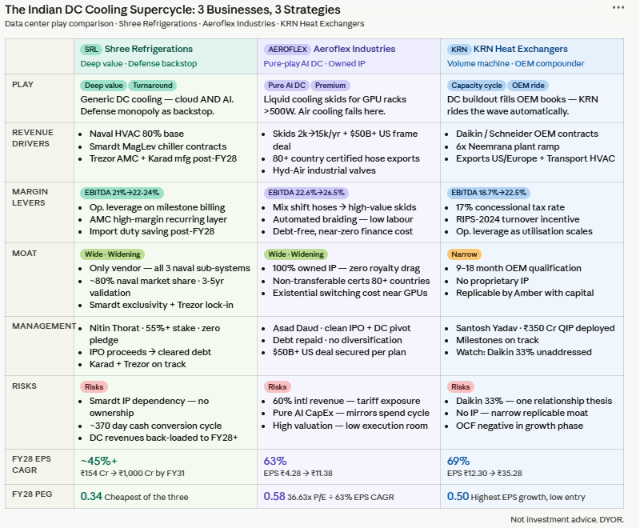
#shreerefrigerations #aeroflex #KRNheatexchanger The Indian DC Cooling Supercycle: 3 Stocks, 3 Strategies — Pick Your Risk/Reward India's AI infrastructure buildout is creating a thermal management supercycle. Three companies are positioned to capture it — but they play completely different games. Know which one fits your portfolio. 🧵 1/ Shree Refrigerations — Deep Value hiding behind a Defense Moat Most are chasing Aeroflex. The real alpha is hiding in plain sight. Modality: Central bulk water-chilling engines — the baseline cooling every data center needs. Cloud AND AI. Generic solution = wider TAM than any niche play. Defense is the backstop: Only Indian vendor certified for all 3 naval cooling sub-systems. 3-5 year shipyard validation. ~80% naval HVAC market share. Unreplicable. DC is the upside: Smardt MagLev oil-free tech cuts PUE by 20-50%. 70,000 sq ft Karad plant moves to localised manufacturing post-FY28. Trezor subsidiary stacking sticky multi-year AMC contracts quietly. Numbers: ₹154 Cr → ₹1,000 Cr by FY31 (45%+ CAGR). PEG 0.34. ROIC 22-25% vs 12% WACC. ✅ Defense monopoly as permanent backstop | Cloud + AI TAM = largest of the three | AMC recurring revenue compounding | Q4 FY26 net margin hit 19.3% on operating leverage ⚠️ Doesn't own Smardt IP — exclusivity risk | ~370 day cash cycle | DC revenues back-loaded to FY28 Verdict: Defense moat + oil-free tech + AMC stickiness + 0.34 PEG. DC exposure with structural armor underneath. 2/ Aeroflex — Pure-Play AI Infrastructure with Owned Technology Modality: Liquid Cooling Skids and Secondary Fluid Networks routing coolant directly to GPU chips at >500W. Air cooling fails here. Liquid is the only answer. IP is 100% owned. No licensing. No royalty drag. 30 years of proprietary SS corrugation process trade secrets. Switching cost is existential — one coolant leak destroys millions in active GPU arrays. Clients cannot afford to switch. Capacity: 2,000 → 15,000 skids/year. Frame deal with $50B+ US tech corp signed. TAM: $3B → $21B by 2030 at 33% CAGR. Numbers: 63% EPS CAGR to FY28. EBITDA targeting 24.5%. Debt-free. 60-day debtor cycle. FY28 P/E at 36.63x. ✅ 100% owned IP — zero partner risk | Near-infinite switching costs near GPU arrays | Only Indian hyperscaler-certified SS liquid cooling skid maker | Cleanest balance sheet of the three ⚠️ 60% international revenues = tariff exposure | Pure AI CapEx play — order pipeline mirrors hyperscaler spend | 36.63x FY28 P/E leaves zero execution room Verdict: Owned IP. Existential switching costs. $21B TAM. 63% EPS CAGR. Purest AI infra play in India. 3/ KRN Heat Exchangers — The Volume Machine Riding the OEM Wave Modality: Fin & tube coils built to OEM print. Daikin designs the chiller — KRN stamps the coil inside it. Industrially. At scale. No proprietary tech needed. No direct hyperscaler relationship needed. DC buildout fills OEM books — KRN rides the wave automatically. Scale is the story: ₹1,000 Cr Rajasthan facility targeting 50% of Indian hyperscale DC coil demand. 6x capacity. Only 20% utilized today — operating leverage ahead is enormous. Fully backward integrated. Cost pass-through shields margins. Numbers: ₹430 Cr → ₹1,350 Cr by FY28. 69% EPS CAGR. PEG 0.50. 17% concessional tax rate. ✅ 69% EPS CAGR at 0.50 PEG — cheapest earnings growth of the three | 6x plant at 20% utilization = massive leverage ahead | China-plus-one pulling OEM sourcing to India ⚠️ Daikin = 33% of revenue — one relationship defines the thesis | Narrow moat — replicable with capital | Builds to client print — EBITDA structurally capped ~19.5% | OCF negative during growth phase Verdict: Not a moat buy. A capacity cycle buy. Maximum operating leverage at the lowest valuation. [Not investment advice, DYOR]
TruthCapital tweet media
English
5
26
122
10.8K