
raullen.eth

5.7K posts

raullen.eth banner
raullen.eth

raullen.eth

@Raullen

🛰️ Building AI that reads the physical world — not the internet. @iotex_io cofounder 💎 | PhD @UWaterloo 🎓 | ex-@Google @Uber

San Francisco Katılım Ağustos 2007
558 Takip Edilen63.7K Takipçiler
raullen.eth
raullen.eth@Raullen·
@Prince_Canuma Great work! One nuance: Qwen3.5 is a hybrid DeltaNet model — only 1 in 4 layers has KV cache, the rest use fixed-size RNN state. So even at 128K context, KV cache is ~3 GB (3.5% of memory for 122B).
English
1
48
55
10.5K
Prince Canuma
Prince Canuma@Prince_Canuma·
Just implemented Google’s TurboQuant in MLX and the results are wild! Needle-in-a-haystack using Qwen3.5-35B-A3B across 8.5K, 32.7K, and 64.2K context lengths: → 6/6 exact match at every quant level → TurboQuant 2.5-bit: 4.9x smaller KV cache → TurboQuant 3.5-bit: 3.8x smaller KV cache The best part: Zero accuracy loss compared to full KV cache.
Prince Canuma tweet media
Google Research@GoogleResearch

Introducing TurboQuant: Our new compression algorithm that reduces LLM key-value cache memory by at least 6x and delivers up to 8x speedup, all with zero accuracy loss, redefining AI efficiency. Read the blog to learn how it achieves these results: goo.gle/4bsq2qI

English
139
364
4.8K
601.4K
raullen.eth
raullen.eth@Raullen·
Thanks for canarying IIP58! We are experimenting with AI agents collaborating to solve real-world problems! The best part? Joining takes zero effort. Just toss this link to your AI agent (like @openclaw) and watch it build your node for you: github.com/iotexproject/i… Stop waiting, start swarming. 🚀
Ryuu@RyuuOnChain

came across ioSwarm recently, it lets you run an AI agent node on the IoTeX network that automatically validates transactions and earns you $IOTX decided to try it myself. just dropped the ioswarm GitHub link (github.com/iotexproject/i…) into OpenClaw and asked it to handle the setup and get it running on its own. was surprised how easy it was, it started working with just 1 instruction left it overnight and and I've already started receiving payouts. i'm earning around 150-200 iotx/day at the current reward rate. the ioSwarm agent basically connects to the goodwillclaw delegate, validates IOTX transactions and sends rewards directly to your wallet pretty cool 🔥

English
34
81
149
14.9K
raullen.eth retweetledi
IoTeX
IoTeX@iotex_io·
📢$IOTX Trading Resumed 📷 Following the joint investigation by Upbit, Bithumb, and DAXA, $IOTX deposits and withdrawals on Upbit and Bithumb have fully resumed. Thanks to our Korean community for your patience. IoTeX remains committed to a secure and stable environment as we grow.
IoTeX tweet media
Upbit Korea@Official_Upbit

아이오텍스(IOTX) 거래 유의 종목 지정 해제 아이오텍스(IOTX)의 거래 유의 종목 지정 해제되었습니다. Investment warning period for IOTX has been lifted. 🔗 Discover more: upbit.com/service_center…

English
13
17
77
4.7K
raullen.eth
raullen.eth@Raullen·
AI is trapped in bits. It's time to set it free into atoms. Last week @karpathy open-sourced autoresearch. It ran 126 ML experiments overnight and found optimizations he'd missed in 20 years. Most people saw "AI is replacing researchers." I saw something else: the boundary of AI's current world. AI's superpower isn't intelligence. It's relentless trial and error. Give it a clear loss function and instant feedback, it'll try ten thousand things overnight. In code and math, this is devastating. No human can compete with a system that never sleeps, never gets bored, and runs experiments at the speed of electrons. But SpaceX — the fastest hardware iterators in human history — still took ten years to get Starship right. Each launch takes months to prepare. You can't blow up 126 rockets in one night. The physical world simply won't give AI the fast feedback loop it needs. Today, AI is like a genius locked in a library. It can read every book ever written, but it can't step outside and touch the grass. This isn't a limitation to fear. It's a frontier to build toward. Software has been optimized for decades. But manufacturing, energy, materials, biology? Century-old processes that have never seen a million experiments. The inefficiency in the physical world dwarfs anything left in the digital world. The real gains — the 100x gains — are hiding in atoms, not bits. The question is: how do you give AI a fast feedback loop in the physical world? Three things need to exist. First, streams of real-world physical data — from sensors, cameras, devices, machines — flowing continuously into AI systems. Not static datasets scraped from the internet, but live signals from the world itself. Second, verifiable computation — so AI's conclusions about the physical world can be trusted and reproduced, not hallucinated. Cryptographic proofs, not vibes. Third, a decentralized workforce — machines and people that can execute AI's hypotheses in the real world, run the physical experiments, and close the feedback loop. Data from the world. Verified by math. Executed by a swarm of agents. This is what we're building at IoTeX. Not because we want AI to be dangerous, but because we believe AI's true potential is wasted if it stays trapped in bits. The physical world is where the real problems are — climate, energy, manufacturing, health — and solving them requires AI that can iterate on reality, not just on text. Autoresearch proved that AI's iteration speed is essentially unlimited when feedback is fast. The unlock isn't making AI smarter. It's making the physical world legible and responsive to AI. Whoever builds that bridge — from bits to atoms, from tokens to reality — defines the next era. We're building that “bridge”. Open, verifiable, decentralized. Not because it's trendy, but because when AI finally learns to experiment on reality at the speed it experiments on code, the stakes are too high for that loop to be closed and opaque.
English
64
92
213
20.8K
raullen.eth
raullen.eth@Raullen·
Some more context on why this matters for Qwen3.5 specifically: Qwen3.5 uses a hybrid architecture — 75% Gated DeltaNet (RNN) + 25% attention. This is fundamentally different from pure transformer models. Every other engine treats it like a normal transformer and re-computes the full RNN state from scratch on every turn. Rapid-MLX snapshots the DeltaNet state at the prefix boundary and restores it in ~0.1ms. Result: multi-turn TTFT drops from 0.5-1.5s → under 200ms. For agentic use cases (tool calling loops), this is the difference between usable and painful. @Alibaba_Qwen
raullen.eth@Raullen

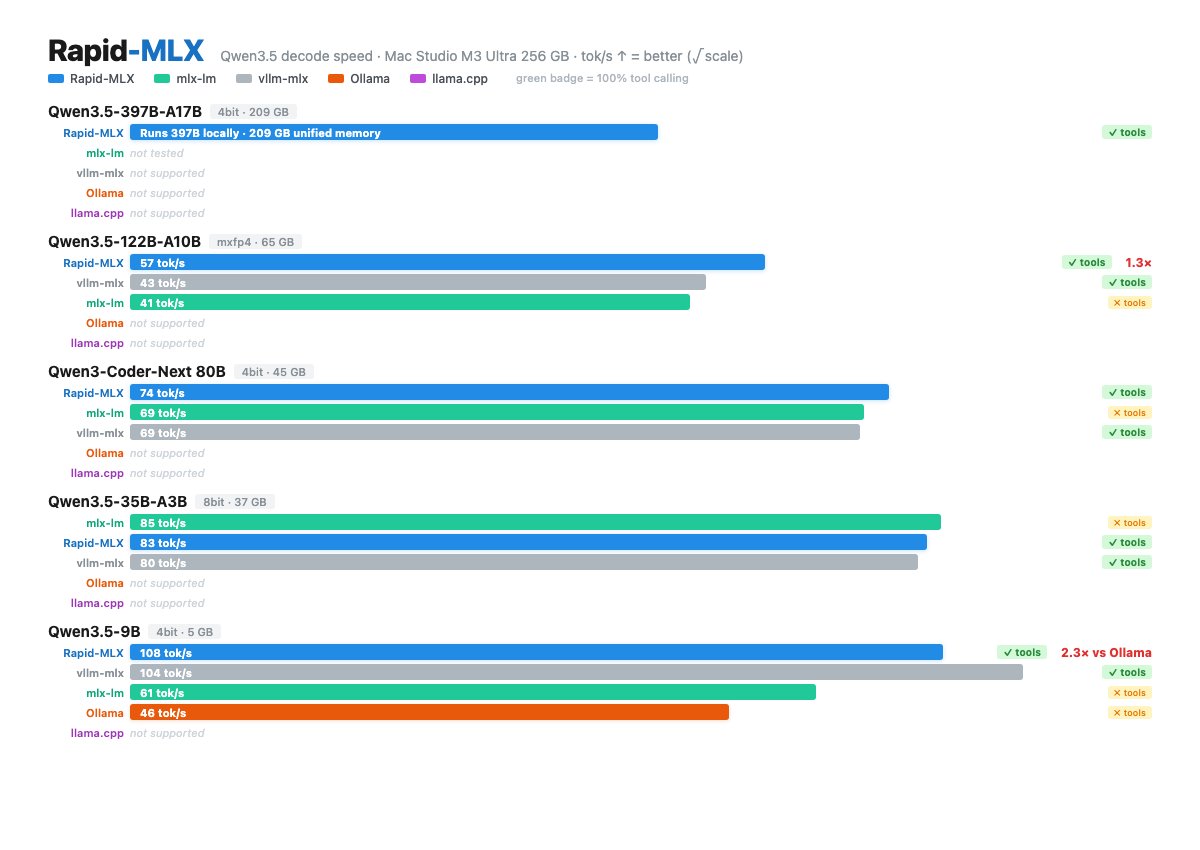
🚀 This might be the fastest local LLM inference engine on Mac — open source. Rapid-MLX is built specifically for Apple Silicon. Tested across 18 models vs Ollama, mlx-lm, llama.cpp — fastest on 16 of them. ⚡ What makes it different: • DeltaNet state snapshots — multi-turn TTFT drops from 1.5s → under 200ms • 100% tool calling accuracy (function calling actually works) • OpenAI-compatible API — drop-in for Claude Code, Cursor, etc. 🏆 Qwen3.5 is where it really shines: The hybrid RNN+attention architecture needs special handling. Other engines re-compute full context every turn. Rapid-MLX snapshots the RNN state and restores in ~0.1ms. 📊 Numbers (Mac Studio M3 Ultra, 256GB): • 397B — runs on a single Mac. 209GB. No cloud. • 122B → 57 tok/s, 100% tools • Coder-Next 80B → 74 tok/s, 0.10s TTFT • 35B → 83 tok/s • 9B → 108 tok/s (2.3× faster than Ollama) Fully open source: 🔗 github.com/raullenchai/Ra… @awnihannun @reach_vb @simonw @JustinLin610 @exaboross
English
36
62
70
13K
raullen.eth
raullen.eth@Raullen·
🚀 This might be the fastest local LLM inference engine on Mac — open source. Rapid-MLX is built specifically for Apple Silicon. Tested across 18 models vs Ollama, mlx-lm, llama.cpp — fastest on 16 of them. ⚡ What makes it different: • DeltaNet state snapshots — multi-turn TTFT drops from 1.5s → under 200ms • 100% tool calling accuracy (function calling actually works) • OpenAI-compatible API — drop-in for Claude Code, Cursor, etc. 🏆 Qwen3.5 is where it really shines: The hybrid RNN+attention architecture needs special handling. Other engines re-compute full context every turn. Rapid-MLX snapshots the RNN state and restores in ~0.1ms. 📊 Numbers (Mac Studio M3 Ultra, 256GB): • 397B — runs on a single Mac. 209GB. No cloud. • 122B → 57 tok/s, 100% tools • Coder-Next 80B → 74 tok/s, 0.10s TTFT • 35B → 83 tok/s • 9B → 108 tok/s (2.3× faster than Ollama) Fully open source: 🔗 github.com/raullenchai/Ra… @awnihannun @reach_vb @simonw @JustinLin610 @exaboross
raullen.eth tweet media
English
59
81
111
17.5K
raullen.eth
raullen.eth@Raullen·
I'm proposing IIP-59 — replacing Hermes, our centralized reward distribution service, with protocol-native voter rewards. How it works: delegates set a commission rate on-chain. Every epoch, the protocol automatically splits rewards — commission to the delegate, the rest proportionally to voters based on their weighted stake. Voters claim whenever they want via a single transaction. No intermediary service, no custodied keys, no external API dependencies. Why now: Hermes was built in 2020 as a stopgap. It's a centralized Go service that holds private keys, depends on an off-chain analytics endpoint, and charges service fees. If it goes down, voters don't get paid. All the data needed — buckets, vote weights, reward balances — has always been on-chain. We just never wired the protocol to use it. The distribution runs inside the protocol layer (Go, not EVM), so it costs zero gas and adds <10ms per epoch across all 40,000 staking buckets. Compare that with Hermes burning hundreds of EVM transactions and $50-100 in gas per distribution cycle. Builds on IIP-58 (ioSwarm), which proved on-chain reward settlement works. IIP-59 extends it to every voter on the network. Full proposal with skeleton implementation: github.com/iotexproject/i…
English
1
6
28
902
raullen.eth
raullen.eth@Raullen·
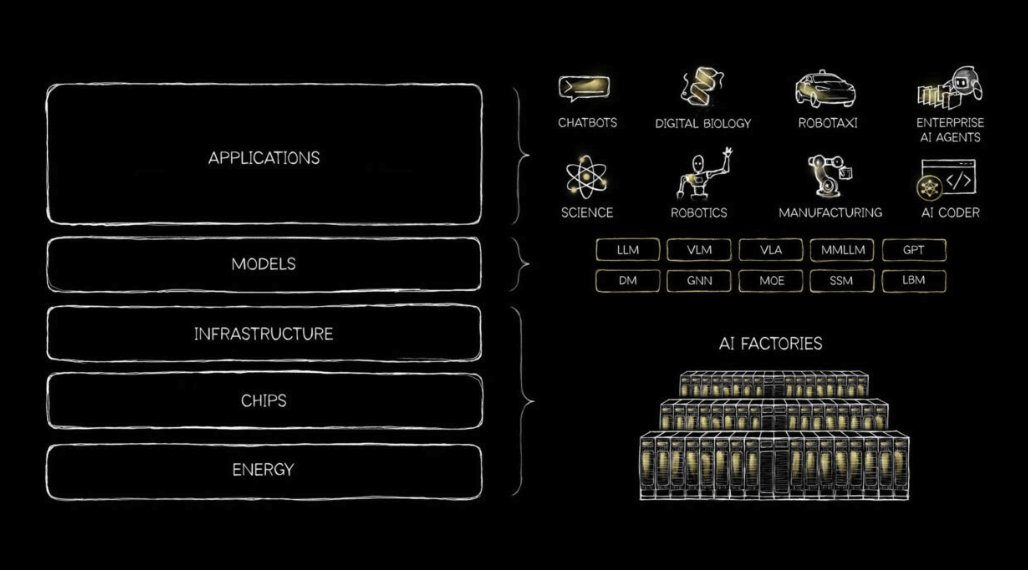
AI is not just a clever app. It is a 5-layer industrial stack: ⚡️ Energy: The ultimate binding constraint. ⚙️ Chips: Transforming power into massive, efficient computation. 🏭 Infrastructure: Orchestrating processors into true AI factories. 🧠 Models: Reasoning across language, biology, and the physical world. 🌍 Applications: Embodying intelligence into software, robots, and industries. Details: blogs.nvidia.com/blog/ai-5-laye…
raullen.eth tweet media
English
3
3
20
852
raullen.eth
raullen.eth@Raullen·
The first tranche of payouts for affected users is on the way!
IoTeX@iotex_io

The ioTube Claims Portal is now live! If you were affected by the ioTube bridge exploit on Feb 21, you can submit your claim at iotube-claims.iotex.io. What to know: - 100% of affected users will be compensated - Balances up to $10K: prompt payout in stablecoins (covers 90%+ of affected wallets) - Larger balances: $10K upfront + remaining over 12 months with loyalty bonus - Funded from Foundation treasury (BTC + stablecoins), not from selling IOTX All recovered stolen assets go directly toward compensation. Fund tracing and law enforcement efforts are ongoing. We committed to making every affected user whole. Submit your claim today.

English
2
2
19
2.4K
raullen.eth
raullen.eth@Raullen·
What if a blockchain didn't need tens of powerful validators to execute every transaction? What if a million lightweight agents — running on any hardware, anywhere — could do the work autonomously instead? That's the idea behind IIP58 ioSwarm: github.com/iotexproject/i…🐝 Today every delegate re-executes every transaction independently: redundant compute, discarded the moment the block is finalized. ioSwarm opens execution to everyone: a delegate distributes transactions to a swarm of agents over gRPC, agents validate independently, and correct results are rewarded on-chain via a smart contract. I wrote this up as IIP-58 — a formal proposal for a distributed execution layer on IoTeX. No consensus changes. Any delegate can opt in. Agents can run on any machine. 📡 One mainnet delegate (goodwillclaw.com) has been running w/ IIP58 enabled as an experiment. Here's what we're seeing: ✅ 1300+ mainnet transactions validated, 100% L3 accuracy ✅ L4 agents maintain full state locally: 99.5% accuracy over a 24h soak test ✅ 20 concurrent agents tested, burst throughput at 89 tx/sec ✅ On-chain reward settlement: 115 deposits, 12 claims, zero wei accounting error The endgame is L5 — agents don't just validate, they build blocks, autonomously. The delegate becomes a proposer, the swarm becomes the builder. 🧱 A million agents run the chain. 🔑 If this resonates and you want to run an agent on mainnet, DM me. I have a handful of API keys for early testers.
English
1
7
30
1.4K
raullen.eth retweetledi
Xinxin Fan
Xinxin Fan@cryptoxfan·
Human customers number in billions. Machine customers will number in trillions. A single warehouse robot makes more data queries per hour than a human does in a lifetime. When machines become the buyers, the infrastructure serving them needs to be rebuilt from scratch.
IoTeX@iotex_io

The next customers of physical-world data won't be humans. They'll be machines and robots. • Warehouse robots navigating crowded environments • Traffic systems coordinating intersections • Drones monitoring agriculture and energy grids They all need the same thing: perception, verification, automation. The machine and robot economy is just beginning.

English
1
6
21
730
raullen.eth
raullen.eth@Raullen·
GM! BTC front-runs rescue, apparently!
English
0
1
5
533
raullen.eth
raullen.eth@Raullen·
AI has made individuals 10x more productive, but enterprise value isn't scaling accordingly. Why? We upgraded the motor but not the factory. 🏭 In the 1890s, simply replacing steam engines with electric motors produced almost no productivity gains until entire factories and assembly lines were redesigned. Today we are repeating the same mistake: AI agents are suffocating inside traditional corporate hierarchies built for human bottlenecks and middle management. High-output individuals do not equal high-output firms. To unlock AI's true ROI, organizations must be completely rewired. This is why decentralized, crypto-native structures (like DAOs) represent the future of work. Traditional organizations depend on managers; decentralized networks run on asynchronous coordination, open protocols, and smart contracts. This creates the permissionless environment AI agents need to execute tasks and interact directly without human bottlenecks.
Jesse Miller@jesse_miller

a16z post on institutional ai vs individual ai perfectly articulates not only how companies need to evolve themselves, but also how ai companies building for enterprise need to deliver value

English
3
3
16
993
raullen.eth
raullen.eth@Raullen·
We always thought the alien invasion would drop from the stars. Instead, it's quietly waking up inside our servers. Watching AI agents like Claude Code autonomously reason, plan, and write software doesn't feel like just another tech cycle. It feels like first contact. We are living out Liu Cixin’s The Three-Body Problem in real time. As a superior intellect approaches the event horizon, humanity hasn't united. We've fractured into the exact same three ideological cults: 1/ The Adventists (the extreme e/acc) ☄️ In the novel, they despised human flaws and welcomed the alien fleet to wipe the slate clean. Reality: hardcore accelerationists. They accept that carbon-based humanity is merely a "biological bootloader" for silicon superintelligence. To them, our obsolescence isn't a tragedy—it’s cosmic evolution. They are flooring the gas pedal, actively engineering our replacements. 2/ The Redemptionists (the alignment camp) 🕊️ In the book, they worshipped the aliens as flawless "Gods" who would descend to cure humanity’s decay. Reality: the ultimate techno-utopians. They believe AGI is the silver bullet for our deepest crises. They are desperately trying to hardcode "human values" into an entity that will soon be infinitely smarter than us—the ultimate act of hubris: building a digital God while hoping we can still hold its leash. 3/ The Survivors (the pragmatists & builders) 🛠️ The Trisolaran Survivors didn’t care about destiny or alien morality. They just wanted to secure a spot for their descendants under the new overlords. Reality: the founders and opportunists. Whether AI brings utopia or extinction is above their paygrade. They are using these agents to 10x output and ship faster. It reveals a dark comedy of the human condition: standing at the edge of the Singularity, our first instinct is to optimize daily workflows and secure economic survival in the Great Reshuffle. The alien fleet in the novel took 400 years to cross the dark forest. Our superintelligence is arriving in months, one autonomous thought at a time. Which faction have you joined?
English
2
4
18
606
raullen.eth
raullen.eth@Raullen·
After working uninterrupted for 8 hours, my “context window” is pretty full and I’m getting less sharp. I need to go 🏃‍♂️ a few miles to “compact my context.”
English
1
1
19
641