Raúl⚡

10.8K posts

Raúl⚡

Raúl⚡

@raulzr

Katılım Temmuz 2013
2.9K Takip Edilen148 Takipçiler
Raúl⚡ retweetledi
Wes Bos
Wes Bos@wesbos·
‼️Do not npm install or deploy anything right now Supply chain attack on axios 1.14.1 - even if you don’t use axios it may be a nested dep. Pin versions or wait until this is resolved
Maxwell@mvxvvll

@npmjs @GHSecurityLab there is an active supply chain attack on axios@1.14.1 which pulls in a malicious package published today - plain-crypto-js@4.2.1 - someone took over a maintainer account for Axios

English
158
1.8K
8.6K
1.4M
Raúl⚡ retweetledi
Sandy Petersen 🪔
Sandy Petersen 🪔@SandyofCthulhu·
We have gigantic creatures in the sea which can sing for hours and have arteries so big you can crawl through them. (whales) We have birds that fly 50,000 miles every year. From the antarctic to the arctic and back again. (arctic tern) We have living creatures which never get old and never die naturally. (jellyfish) We have animals which you can force through a sieve, and they can reassemble themselves. (sponges) We have an ancient line of animals which once had 30 or more successful species, and has gone extinct down to just one single representative, and that representative has conquered the entire world (us). We have horrors that look just like rocks and if you step on them your whole world becomes agonizing pain. (toadfish) We have animals who hide inside other animals, and when you eat that animal, they enter your intestines and live there. (tapeworms) We have plants which live on other plants and never touch the ground. There's a fruit tree that grows around another tree, and eventually kills and replaces it. (strangler fig) We have gliding lizards, marsupials, snakes, frogs, and rodents. What the heck do you need fairies for?
@yducknow

what a boring planet… no fairies, no elves, no mermaids, no dragons, no vampires, no ware wolves….. just bills, stress, gossip, and insufferable people

English
405
4.1K
37.6K
1.3M
Raúl⚡ retweetledi
Aakash Gupta
Aakash Gupta@aakashgupta·
The machine that built the chip in this video should mass-humble every human who's ever lived. ASML's latest EUV lithography system costs $370 million, weighs 180 tons, and requires three Boeing 747s to deliver. It contains over 100,000 individual parts from 5,100 suppliers across 14 countries. It shoots 100,000 molten tin droplets per second with a laser, superheating each one past the temperature of the sun's surface to generate light at a wavelength so short that no natural material on Earth can focus it. So they had to invent new mirrors. Each one is polished with 100 alternating layers of molybdenum and silicon. The surface tolerance is so extreme that if you scaled a single mirror up to the size of Germany, the tallest imperfection would be 1 millimeter. Those mirrors took 20 years to develop. The company that makes them, Zeiss, had to build entirely new metrology tools just to confirm the mirrors were flat enough, because no existing measurement instrument on Earth could verify the precision they needed. The machine prints features at 2 nanometers. That's roughly 10 atoms wide. A human hair is 80,000 nanometers. A red blood cell is 7,000. A single COVID virus particle is 100. These machines are etching functional circuits 50 times smaller than a virus. TSMC is now mass producing 2nm chips in a Kaohsiung fab so large the cleanroom is twice the size of any competitor's. Each 2nm wafer costs $30,000 to produce. The entire 2026 production run was booked before a single chip shipped. Apple, NVIDIA, AMD, and Qualcomm all reserved capacity years in advance. TSMC is spending $28.6 billion just to build enough fabs to meet demand for this one node. The chip that comes out of this process is smaller than a fingernail, runs on less power than a light bulb, and contains transistors that wrap gates around nanosheets of silicon only a few atoms thick. The raw material it started as was sand. The sand cost a fraction of a penny. The civilization that processed it into this started by banging rocks together.
Kyros@IamKyros69

Humans saw stones and sticks and decided to make this

English
127
1.6K
11.5K
735.6K
Raúl⚡ retweetledi
Aakash Gupta
Aakash Gupta@aakashgupta·
The reason software eats RAM is the same reason factories used to dump chemicals in rivers. The cost is externalized. Every mass of inference compute shows up on an engineering manager's AWS bill, broken down to the cent, reviewed quarterly. Every mass of RAM consumed on YOUR machine shows up nowhere in anyone's budget. Chrome could cut memory usage by 60% tomorrow and Google's revenue wouldn't move a single basis point. Docker's 2GB idle footprint costs Docker Inc. exactly $0. Electron's 500MB todo list costs the Electron team exactly $0. The user paid for the RAM. The user pays the electricity. The user deals with the fan noise. The company ships faster because they chose the laziest possible runtime. The token-optimization obsession makes this even clearer. Companies optimize inference cost because inference cost hits their margins. They'll spend six months shaving 200ms off a model response. They won't spend six days reducing a desktop client's memory footprint because that memory belongs to someone else's hardware. This is why the 16GB vs 32GB debate is a trap. You're asking consumers to buy more expensive hardware to subsidize the software industry's refusal to optimize for a resource they never have to pay for. The market will never fix this on its own. The people writing the checks and the people running out of RAM are on opposite sides of the transaction.
Chayenne Zhao@GenAI_is_real

unpopular opinion: 16GB is plenty if software engineers actually cared about memory efficiency. chrome eating 4GB for 12 tabs is not a hardware problem its a software disgrace. docker consuming 2GB idle is not a feature its laziness. we live in an era where people optimize every single token to save $0.001 on API costs but happily ship electron apps that eat 500MB to display a todo list. if the industry treated RAM the way we treat inference compute - obsessively measuring every byte - 16GB would feel luxurious. the hardware isnt the problem, the software is @adxtyahq

English
86
1K
6.4K
252.9K
Raúl⚡ retweetledi
Promakos
Promakos@PROMAKOS_·
Aun sabiendo que es broma (y me ha hecho gracia) merece la aclaración. Los nombres que conocemos son traducciones al castellano a través del griego y el latín. El Mediterráneo oriental llevaba helenizado desde las conquistas de Alejandro Magno, tres siglos antes de Cristo, y el griego koiné era la lengua franca de toda la mitad oriental del Imperio Romano, desde Antioquía hasta Alejandría. Los judíos de las provincias helenizadas llevaban generaciones usando nombres griegos o latinos junto a sus nombres hebreos, algo habitual en cualquier población sometida a un imperio lingüísticamente dominante. Mateo se llamaba Mattityahu, 'don de Yahvé' en hebreo. Juan era Yohanan, 'Yahvé es misericordioso'. Marcos viene del latín Marcus, nombre romano que llevaban muchos judíos helenizados. Lucas era Loukas, probablemente griego de Antioquía, que es una de las razones por las que su evangelio tiene el griego más cuidado de los cuatro. Y Pablo ni siquiera era apóstol original ni se llamaba así: era Sha'ul (Saulo), fariseo de Tarso con ciudadanía romana, que usaba su cognomen latino Paulus en el ámbito gentil. Los Evangelios se escribieron en griego koiné y los nombres se helenizaron primero y se latinizaron después. Que hoy suenen a nombres españoles es el resultado de dos milenios de tradición lingüística y de la particular tendencia que tenemos a castellanizar todos los nombres.
ATLAS@ATLASXARG

Yo disociando pensando en como hizo Jesucristo para encontrar gente llamada Mateo, Juan, Pablo, Lucas y Marcos en Medio Oriente

Español
151
3K
26.6K
1.1M
Raúl⚡ retweetledi
Skely
Skely@123skely·
I love dating astrology-girls. Makes me feel like some barbarian king. I wake up and I’m like WHAT DO THE STARS SAY!?! Shall I be victorious today? Tell me of the omens.
English
251
8.6K
90.4K
1.8M
Raúl⚡ retweetledi
Chayenne Zhao
Chayenne Zhao@GenAI_is_real·
unpopular opinion: 16GB is plenty if software engineers actually cared about memory efficiency. chrome eating 4GB for 12 tabs is not a hardware problem its a software disgrace. docker consuming 2GB idle is not a feature its laziness. we live in an era where people optimize every single token to save $0.001 on API costs but happily ship electron apps that eat 500MB to display a todo list. if the industry treated RAM the way we treat inference compute - obsessively measuring every byte - 16GB would feel luxurious. the hardware isnt the problem, the software is @adxtyahq
aditya@adxtyahq

never buy a 16GB RAM laptop in 2026. you’ll regret it within a week

English
608
6.5K
58.6K
2.2M
Raúl⚡ retweetledi
Alejandro Macias
Alejandro Macias@doctormacias·
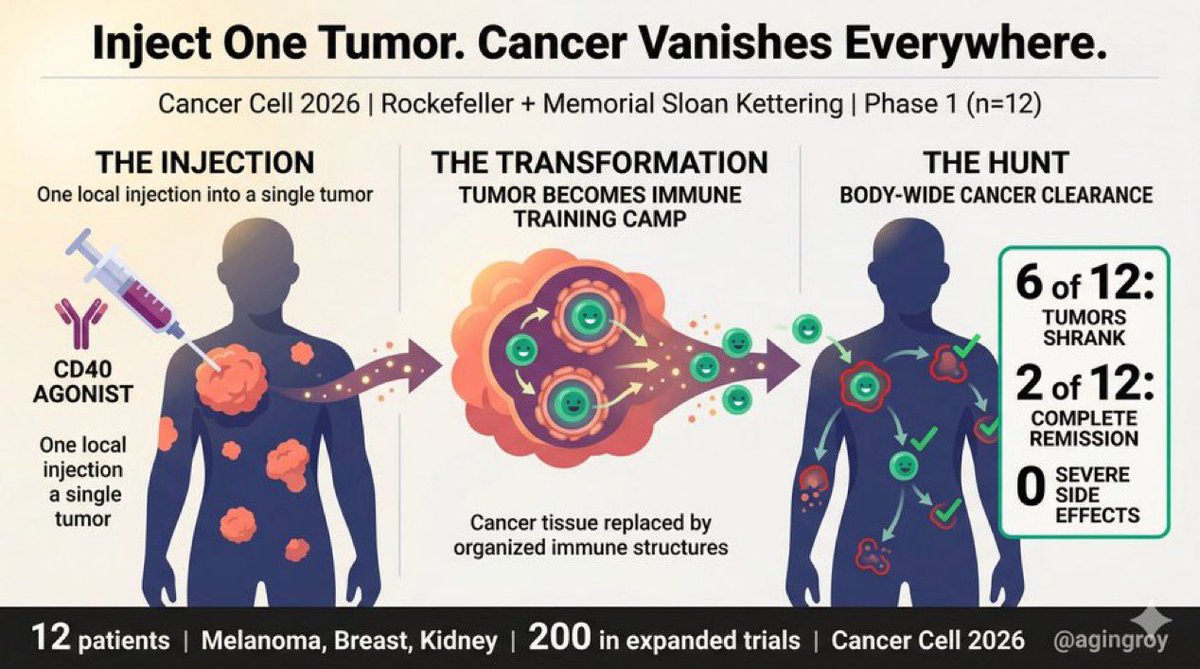
12 pacientes con cáncer metastásico. Melanoma, mama, riñón. Les inyectaron un anticuerpo modificado (agonista de CD40) en un solo tumor. No fue por vía intravenosa. El resultado: los tumores se redujeron en todo el cuerpo. Dos de los 12 pacientes lograron la remisión completa. Los tumores inyectados no solo se redujeron, sino que fueron reemplazados por tejido inmunitario organizado, estructuras linfoides terciarias, que son esencialmente centros de entrenamiento para las células T que combaten el cáncer. Cero efectos secundarios graves. La idea es la siguiente: en lugar de saturar el cuerpo con inmunoterapia y esperar que encuentre el cáncer, convertir un tumor en una vacuna contra sí mismo. Entrenar el sistema inmunitario localmente. Dejar que actúe globalmente. Actualmente, cerca de 200 pacientes participan en ensayos ampliados para el tratamiento de cánceres de vejiga, próstata y cerebro.
Alejandro Macias tweet media
Avi Roy@agingroy

12 patients with metastatic cancer. Melanoma, breast, kidney. Doctors injected a re-engineered antibody (CD40 agonist) into a single tumor. Not IV. Not systemic. One local shot. The result: tumors shrank across the entire body, including at sites that were never touched. 2 of 12 patients hit complete remission. The injected tumors didn’t just shrink. They were replaced by organized immune tissue, tertiary lymphoid structures, essentially training camps for cancer-killing T cells. Zero severe side effects. The concept: instead of flooding the body with immunotherapy and hoping it finds the cancer, turn one tumor into a vaccine against itself. Train the immune system locally. Let it hunt globally. Nearly 200 patients now in expanded trials across bladder, prostate, and brain cancers. Published in @Cancer_Cell by Jeffrey Ravetch’s lab at @RockefellerUniv and @MSKCancerCenter

Español
89
2.3K
6.4K
207.4K
Raúl⚡ retweetledi
andrea
andrea@andreahlland·
- Las peras del olmo: pedidas - La portada del libro: juzgada - Los tres pies del gato: buscados - La gota del vaso: derramada - La mano que tira la piedra: escondida - El agua que lleva el rio: sonada - Los ojos del que cría cuervos: sacados
Español
48
5.8K
29.5K
409.1K
Raúl⚡ retweetledi
Raúl⚡ retweetledi
K
K@iiamkrshn·
Pov: Me as a sperm cell beating 17 potential scientists and 12 president so i can watch reels 8 hours daily
English
51
3.1K
36.5K
531K
Raúl⚡ retweetledi
rue🌿
rue🌿@Ruesavatar·
“Wait mama where do your parents live? Why haven’t I met them?!” “You were just at their house last month baby.” “NO! I was at GRANDMA’S house! Who is your MOM?!” “……..grandma is my mom.” “WHAT?!” 💀
English
75
1.2K
52.9K
448.4K
Raúl⚡ retweetledi
Abhishek Singh
Abhishek Singh@0xlelouch_·
This happens to a lot of devs very slowly: 8-10 hours sitting, late night coding, high stress, bad sleep, random Swiggy meals, too much chai/coffee, weekend “rest” that is actually just more sitting. Many software professionals I know (including myself) have visceral fat, and it's a significant concern. Software engineers really need to watch visceral fat, not just body weight. You can look “not that fat” outside and still be carrying fat around the organs inside. That is the dangerous part. Visceral fat is strongly linked with worse blood sugar, cholesterol, blood pressure, and overall cardiometabolic risk. Waist size is often a better warning sign than just BMI. Then one day you notice: big belly, low energy, brain fog, poor sleep, and blood test numbers getting worse. What to do about it as a software engineer: - Walk after meals. Even 10-15 mins helps break the sitting cycle. - Lift weights at least 2x a week. - Get 150 mins of weekly movement minimum. Brisk walking is enough to start, you do not need to become an athlete. - Eat like an adult: more protein, less liquid calories, less junk, less late-night overeating. - Sleep on time. Stress and poor sleep make fat gain around the midsection worse. - And track your waist, not just your weight. Fact: A lot of software engineers are earning more money every year while quietly building a body that will make them spend that money later. Take care of it early. Your career is long. Your health should last longer.
Dan Go@CoachDanGo

The world's easiest diet to eliminate visceral fat:

English
18
384
6.7K
1.1M
Raúl⚡ retweetledi
santos
santos@santos141100·
Me acuerdo ese sentimiento de ir al cine a los 8 años sabiendo que, durante todo el día, no ibas a vivir una mayor explosión de estímulos y experiencias que en esas dos horas. Hoy, en cambio, el cine es el único lugar en el que sucede una pausa de la sobreestimulación del mundo.
lucas@lucasncsc

la entrada a mi mundo.

Español
183
18.4K
154.9K
2.8M
Raúl⚡ retweetledi
cinesthetic.
cinesthetic.@TheCinesthetic·
Attack on Titan (2013–2023) earns that claim by constantly raising its own ceiling, starting as survival horror and unfolding into something far larger, where every reveal reframes everything that came before it.
cinesthetic.@TheCinesthetic

drop an 11/10 tv show

English
60
1.6K
8.3K
241K