
RAVI

7K posts

RAVI banner
RAVI

RAVI

@ravisain

**Long Term Investor || ** Disciplined Trader || Trading Coach ||**Believe in Analysis & not Forecasting || Not SEBI Registered || Love Trading with Risk Mgmt

India Katılım Ekim 2009
139 Takip Edilen11.8K Takipçiler
Sabitlenmiş Tweet
RAVI
RAVI@ravisain·
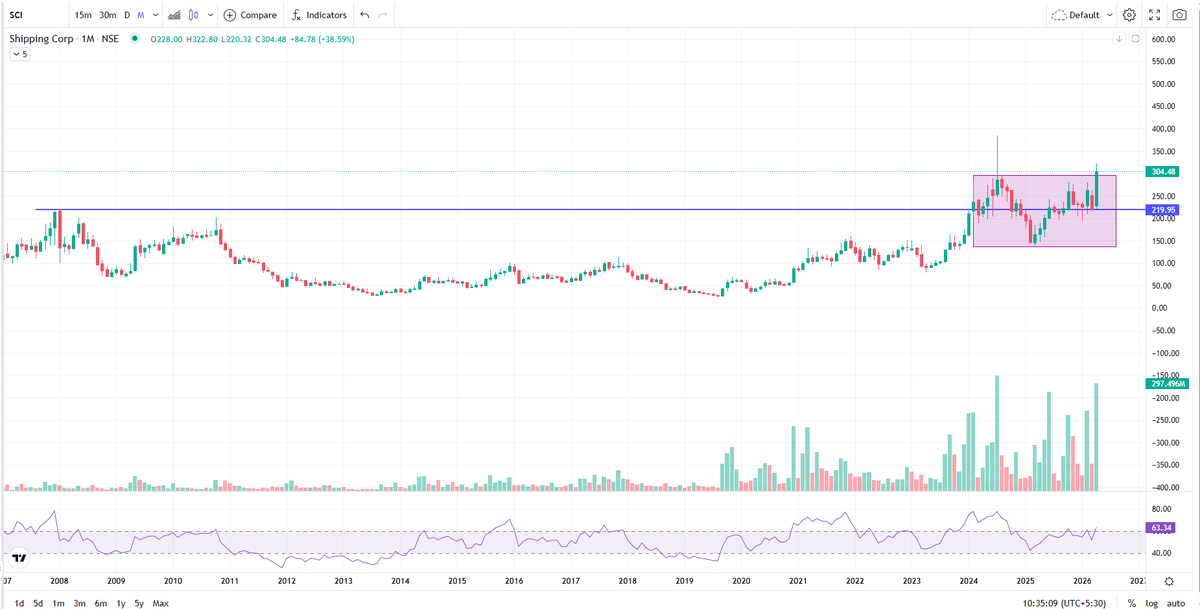
Understanding Risk-Reward Ratios Risk-Reward Ratio: This measures the potential profit of a trade compared to the potential loss, helping traders assess whether the potential reward justifies the risk taken. 1:2 Risk-Reward Ratio Meaning: For every unit of risk (e.g., ₹1), you aim to make ₹2 in profit. Winning Expectancy: To break even, you only need to win 33% of the time. With a 50% win rate, you would be profitable. 1:3 Risk-Reward Ratio Meaning: For every unit of risk, you aim to make ₹3 in profit. Winning Expectancy: You need to win about 25% of the time to break even. With a 50% win rate, your profitability increases significantly. Key Points to Consider Win Rate vs. Risk-Reward: A higher risk-reward ratio allows traders to be right less often while still being profitable. For example, with a 1:5 ratio, you only need to win 17% of your trades to break even. Psychological Impact: Understanding that you can withstand some losses while remaining profitable helps reduce emotional strain, fostering discipline in trading. Trade Management: Setting clear risk-reward ratios before entering trades promotes adherence to your strategy and mitigates emotional reactions to market volatility. Long-Term Success: Consistently applying these ratios can lead to long-term profitability. If your winners are substantially larger than your losers, you can still succeed with a lower win rate. Examples 1:2 Ratio Example: Risk: ₹100 (buying at ₹10, stop-loss at ₹9) Reward: ₹200 (target price at ₹12) Outcome: If you win 4 out of 10 trades (40% win rate):Wins: 4 trades x ₹200 = ₹800 Losses: 6 trades x ₹100 = ₹600 Net Profit: ₹800 - ₹600 = ₹200 1:3 Ratio Example: Risk: ₹100 (buying at ₹10, stop-loss at ₹9) Reward: ₹300 (target price at ₹13) Outcome: If you win 3 out of 10 trades (30% win rate):Wins: 3 trades x ₹300 = ₹900 Losses: 7 trades x ₹100 = ₹700 Net Profit: ₹900 - ₹700 = ₹200 1:4 Ratio Example: Risk: ₹100 (buying at ₹10, stop-loss at ₹9) Reward: ₹400 (target price at ₹14) Outcome: If you win 2 out of 10 trades (20% win rate):Wins: 2 trades x ₹400 = ₹800 Losses: 8 trades x ₹100 = ₹800 Net Profit: ₹800 - ₹800 = ₹0 (break-even) 1:5 Ratio Example: Risk: ₹100 (buying at ₹10, stop-loss at ₹9) Reward: ₹500 (target price at ₹15) Outcome: If you win 2 out of 10 trades (20% win rate):Wins: 2 trades x ₹500 = ₹1000 Losses: 8 trades x ₹100 = ₹800 Net Profit: ₹1000 - ₹800 = ₹200 MOST IMPORTANT TO NOTE You would need to lose approximately 462 consecutive trades (risking 1% of your total capital each time) to bring your capital down to a negligible amount (close to zero). This highlights the importance of risk management and maintaining a disciplined approach to trading. #StockMarket #Tradingview #RiskManagement #Stocks #niftyOptions #trading #moneymanagement
RAVI tweet media
English
1
4
28
18.4K
RAVI
RAVI@ravisain·
Stop Blaming the Market. Start Owning Your Results. Most traders say: “Market manipulated…” “Operator trapped me…” “News ruined my trade…” But growth begins the moment you stop blaming and start taking responsibility. If you’re not getting the returns you desire: ✅ Improve your process ✅ Refine your execution ✅ Learn from every loss ✅ Build emotional discipline ✅ Repeat until consistency becomes your identity The market rewards responsibility, not excuses. Every losing trade can either become: 📉 A reason to quit OR 📈 A lesson that sharpens your edge Winners don’t avoid mistakes. They learn faster than others. #StockMarket #TradingPsychology #TraderMindset #Discipline #Trading #Investing #RiskManagement #FinancialFreedom #PriceAction #TechnicalAnalysis #MindsetMatters
English
0
0
4
211
RAVI
RAVI@ravisain·
Your Biggest Edge in Trading is Self-Belief Most traders are not defeated by the market… They are defeated by self-doubt. The moment you stop believing in yourself: ❌ You hesitate on good setups ❌ You exit winners too early ❌ You fear losses more than you trust your process But when confidence is backed by preparation, learning, and discipline… Everything changes. Believe in yourself. You are capable of far more than you imagine. Every successful trader was once: 📉 Confused 📉 Fearful 📉 Inconsistent What separated them from the crowd was not luck… It was the decision to keep learning, improving, and trusting themselves. Your mindset becomes your market reality. #TradingPsychology #Mindset #SelfBelief #StockMarket #TraderMindset #Discipline #FinancialFreedom #Consistency #TradingJourney #Investing #SuccessMindset #TechnicalAnalysis
English
0
0
3
165
RAVI
RAVI@ravisain·
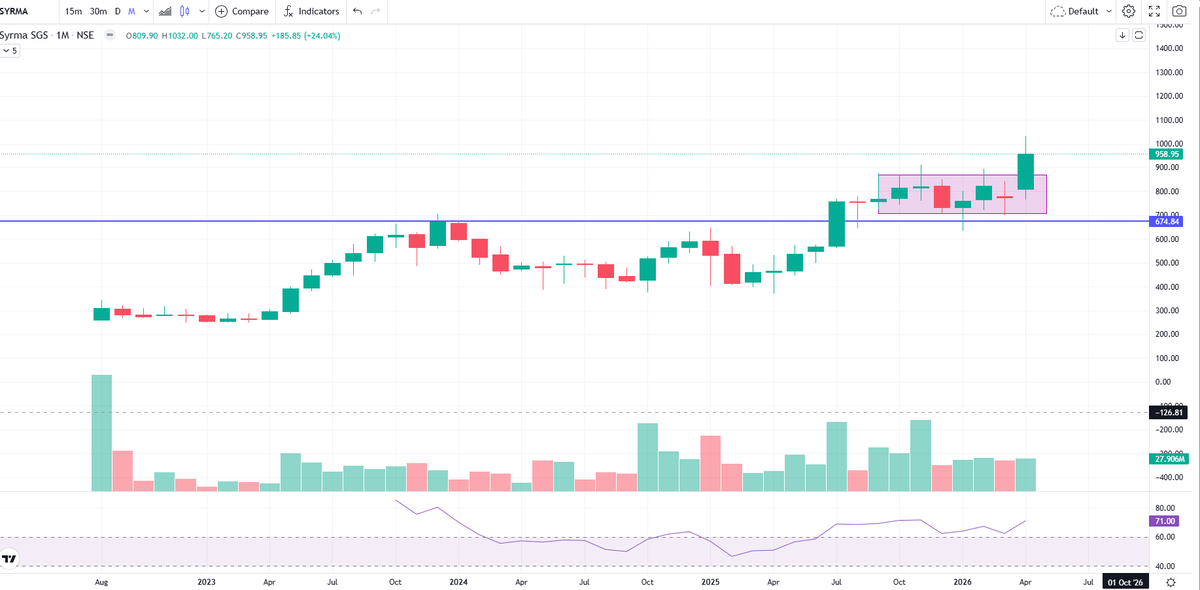
SYRMA looks ready for a new phase of momentum on the Monthly Chart. Key observations: ✅ Multi-month consolidation breakout visible ✅ Strong bullish candle with expansion in volume ✅ Price sustaining above previous resistance zone (~670) ✅ RSI near 70 showing strong momentum ✅ Higher High + Higher Low structure intact The recent breakout after a long sideways base indicates: Institutions may be accumulating quietly. The purple box shows a healthy consolidation after expansion. And now price is attempting a fresh breakout from that range. In strong bull trends: “Consolidation is often preparation for the next move.” As long as price sustains above the breakout zone, bulls remain in control. This is how potential wealth-creating stocks behave on higher time frames: ➡️ Expansion ➡️ Consolidation ➡️ Re-Expansion Monthly charts reveal the real story. Noise disappears. Smart money becomes visible. #StockMarket #SwingTrading #Investing #TechnicalAnalysis #PriceAction #TradingPsychology #Nifty #IndianStockMarket #Breakout #MomentumTrading #SYRMA
RAVI tweet media
English
1
2
33
2.5K
RAVI
RAVI@ravisain·
Legendary trader Linda Bradford Raschke has often mentioned in interviews that she loves trading shakeouts and fake moves. Because the market constantly traps emotional traders. A shakeout usually happens when: • Price breaks support temporarily • Retail traders panic and exit • Stop losses get triggered • Smart money absorbs the supply • Price quickly reclaims the level And then… the real move begins. This is why many professional traders don’t blindly trade obvious breakouts. They wait for: ✅ Trap ✅ Fear ✅ Failed breakdown ✅ Strong reclaim ✅ Momentum confirmation The market rewards patience more than prediction. “The best trades often begin where the crowd loses confidence.” #Trading #StockMarket #PriceAction #TechnicalAnalysis #TraderPsychology #SwingTrading #RiskManagement @LindaRaschke
RAVI@ravisain

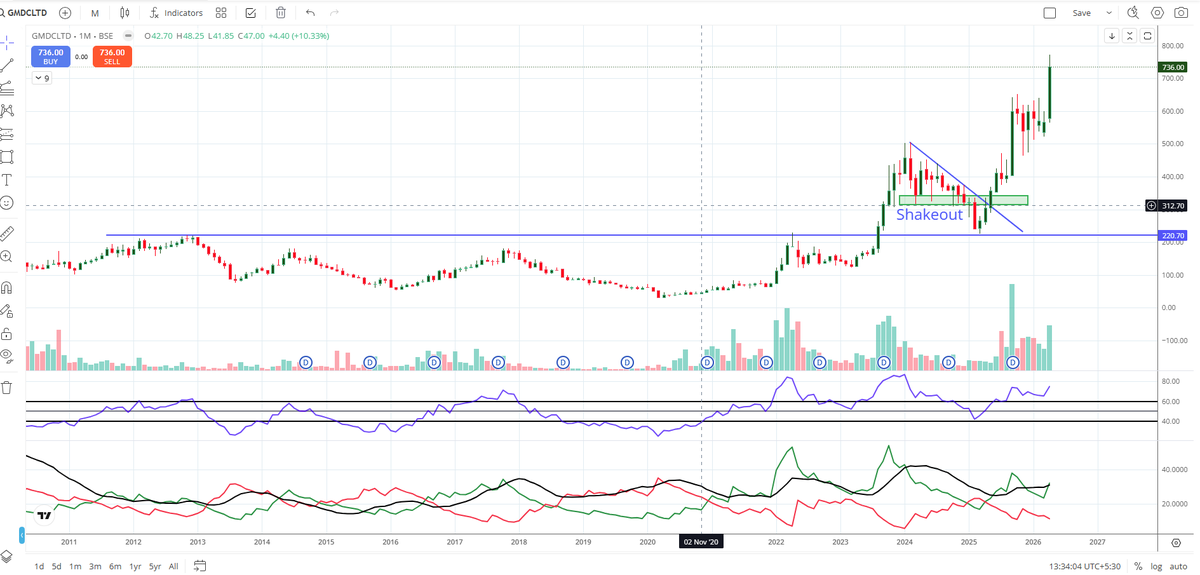
#GMDC Monthly Chart Analysis Most traders saw breakdown… Smart money saw a shakeout. Monthly chart of GMDC is showing a classic institutional behavior: ✅ Multi-year accumulation ✅ Strong breakout ✅ Emotional shakeout ✅ Trend continuation The marked correction phase trapped weak hands near the trendline breakdown. But notice carefully: • Price reclaimed support aggressively • Buyers defended the demand zone • RSI stayed in bullish territory • Monthly structure remains Higher High – Higher Low This is how strong stocks behave. They don’t move in straight lines. They first: → Create fear → Remove impatient traders → Resume the trend The real lesson: “Shakeouts are designed to transfer shares from weak hands to strong hands.” As long as GMDC sustains above the major polarity zone, long-term bullish structure remains intact. Higher timeframe charts reveal what emotions hide. #StockMarket #Trading #SwingTrading #TechnicalAnalysis #PriceAction #Investing #GMDC #TraderMindset #RiskManagement #ChartAnalysis

English
0
0
5
772
RAVI
RAVI@ravisain·
#GMDC Monthly Chart Analysis Most traders saw breakdown… Smart money saw a shakeout. Monthly chart of GMDC is showing a classic institutional behavior: ✅ Multi-year accumulation ✅ Strong breakout ✅ Emotional shakeout ✅ Trend continuation The marked correction phase trapped weak hands near the trendline breakdown. But notice carefully: • Price reclaimed support aggressively • Buyers defended the demand zone • RSI stayed in bullish territory • Monthly structure remains Higher High – Higher Low This is how strong stocks behave. They don’t move in straight lines. They first: → Create fear → Remove impatient traders → Resume the trend The real lesson: “Shakeouts are designed to transfer shares from weak hands to strong hands.” As long as GMDC sustains above the major polarity zone, long-term bullish structure remains intact. Higher timeframe charts reveal what emotions hide. #StockMarket #Trading #SwingTrading #TechnicalAnalysis #PriceAction #Investing #GMDC #TraderMindset #RiskManagement #ChartAnalysis
RAVI tweet media
English
0
1
6
1.3K
RAVI
RAVI@ravisain·
@GauravWara Short term pullback possible. Long term is bullish
English
1
0
3
248
RAVI
RAVI@ravisain·
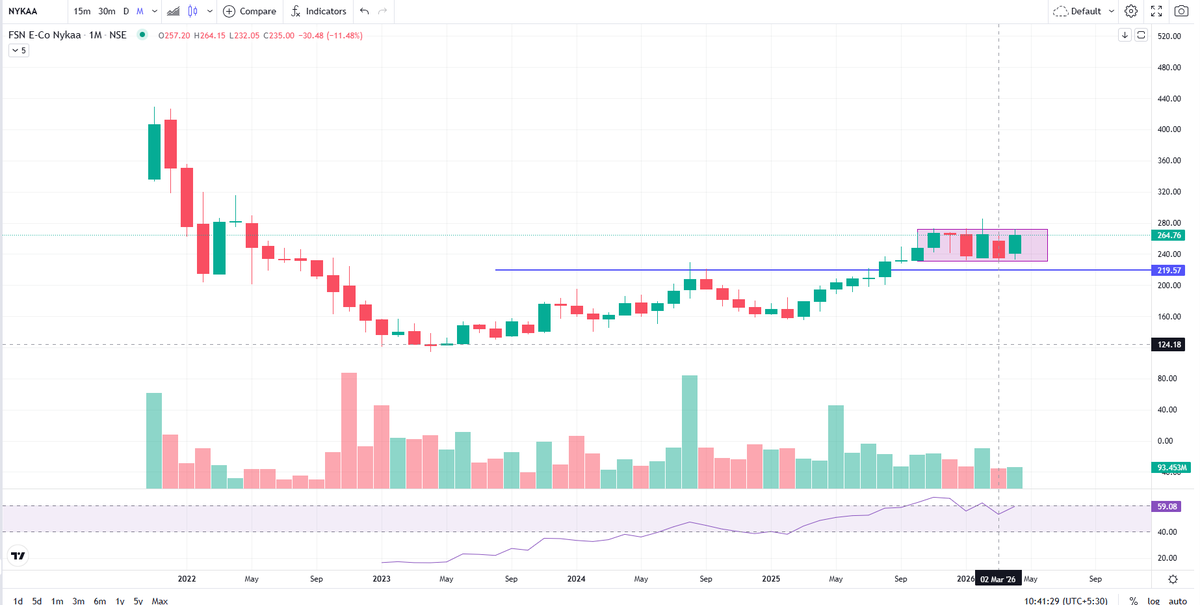
#Nykaa Stock is in tight range since last 7 months. “The 4A Model” 1. Aftermath IPO crash 2. Accumulation Long base formation 3. Activation Breakout above ₹220 4. Appreciation Potential future markup phase This is beautiful example of “Pain Transfer Cycle” - IPO buyers suffered. - Weak hands exited near bottom. - Patient money accumulated silently. - Now market is testing conviction again. Most traders: - Buy excitement - Sell boredom Professionals: - Buy accumulation - Sell euphoria #stockmarkettrading #stockmarket
RAVI tweet media
English
0
0
8
479
RAVI
RAVI@ravisain·
Trading isn’t just charts… it’s psychology. Be honest 👇 Which emotion is the HARDEST for you to control when trading? 🟢 Hope 🟡 Greed 🔴 Fear Vote & drop a comment explaining WHY — your answer might help someone else avoid a bad trade.
English
0
1
2
289