
Gene Kim

51.3K posts

Gene Kim banner
Gene Kim

Gene Kim

@RealGeneKim

WSJ bestselling author: Unicorn Project! DevOps researcher/enthusiast. Coauthor: Phoenix Project, Accelerate. Host of The Idealcast. Tripwire founder. Clojure.

ÜT: 45.527981,-122.670577 Katılım Ocak 2009
1.7K Takip Edilen52.8K Takipçiler
Sabitlenmiş Tweet
Gene Kim
Gene Kim@RealGeneKim·
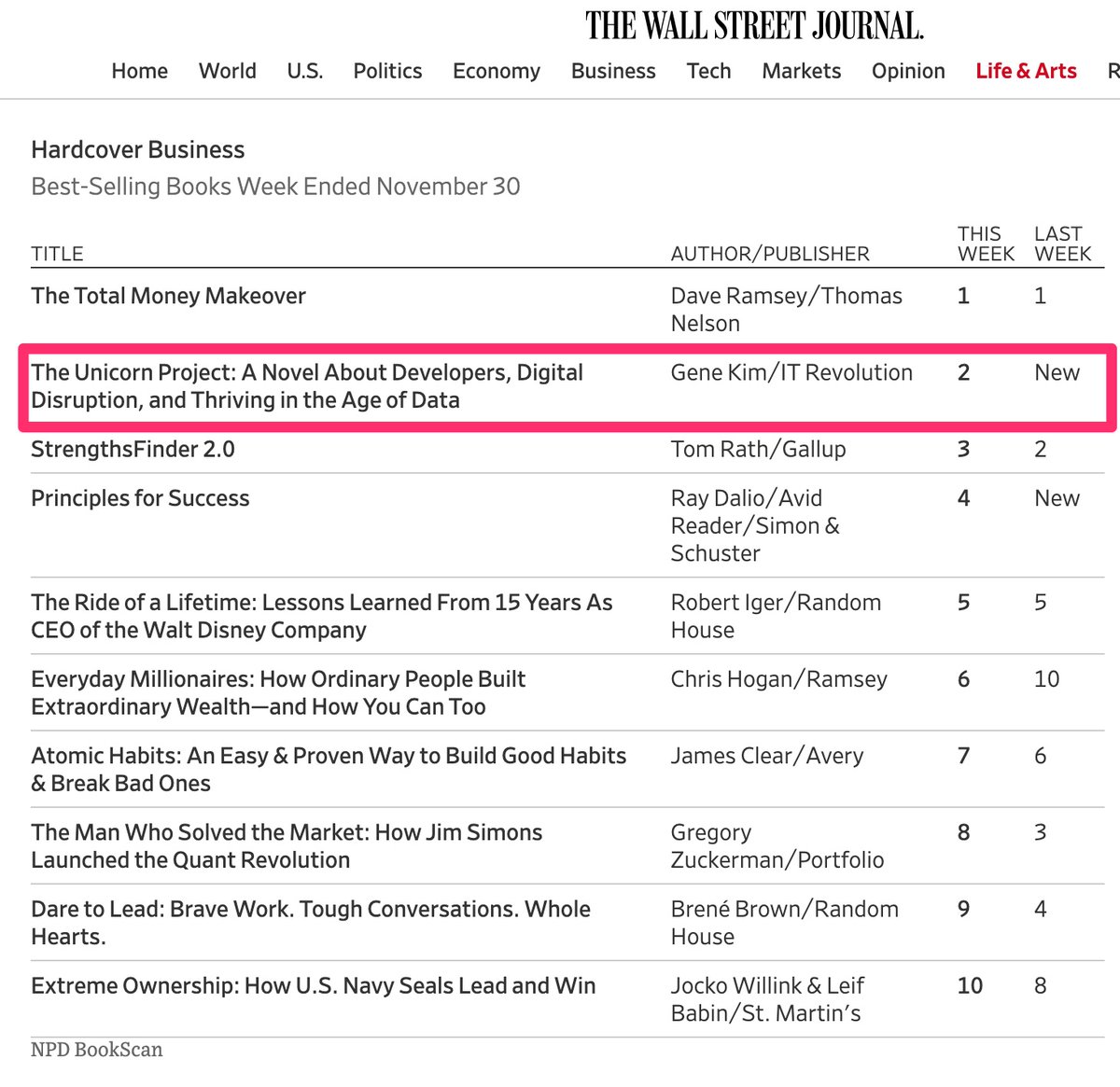
Holy cow. The Unicorn Project is on the Wall Street Journal bestseller lists!!! #2 in Hardcover Business category! And astonishingly, it’s also #8 across all Non-Fiction E-Books!!! A DevOps book!! 🤯🤯🤯 🙏❤️🦄🌈 Paywall: wsj.com/articles/best-… #UnicornProject
Gene Kim tweet mediaGene Kim tweet media
English
49
98
669
0
Gene Kim retweetledi
swyx 🐣
swyx 🐣@swyx·
If you're looking to improve your writing game, Anh is one of the most consistent heavy hitters I know in devtools HN and she literally just open sourced her writing Skills template for you to use below!
swyx 🐣 tweet media
anhtho 🍊@byAnhtho

x.com/i/article/2043…

English
18
43
806
117.7K
Gene Kim retweetledi
Steve Yegge
Steve Yegge@Steve_Yegge·
I was chatting with my buddy at Google, who's been a tech director there for about 20 years, about their AI adoption. Craziest convo I've had all year. The TL;DR is that Google engineering appears to have the same AI adoption footprint as John Deere, the tractor company. Most of the industry has the same internal adoption curve: 20% agentic power users, 20% outright refusers, 60% still using Cursor or equivalent chat tool. It turns out Google has this curve too. But why is Google so... average? How is it that a handful of companies are taking off like a spaceship, and the rest, including Google, are mired in inaction? My buddy's observation was key here: There has been an industry-wide hiring freeze for 18+ months, during which time nobody has been moving jobs. So there are no clued-in people coming in from the outside to tell Google how far behind they are, how utterly mediocre they have become as an eng org. He says the problem is that they can't use Claude Code because it's the enemy, and Gemini has never been good enough to capture people's workflows like Claude has, so basically agentic coding just never really took off inside Google. They're all just plodding along, completely oblivious to what's happening out there right now. Not only is Google not able to do anything about it, they don't seem to be aware of the problem at all. I'm having major flashbacks to fifty years ago as a kid at the La Brea Tar Pits, asking, "why can't they just climb out?" My Google friend and I had this conversation over a month ago. I didn't share it because I wanted to look around a bit, and see if it's really as bad as all that. I've been talking to people from dozens of companies since then. And yeah. It's as bad as all that. Google is about average. Some companies at the bottom have near-zero AI adoption and can't even get budget for AI. They may have moats and high walls, but the horde is coming for them all the same. And then there are a few companies I've met recently who are *amazingly* leaned in to AI adoption. One category-leader company just cancelled IntelliJ for a thousand engineers. That's an incredibly bold move, one of many they're making towards agentic adoption. In my opinion, that company is setting themselves up for a _huge_ W. As for the rest, well, it's the Great Siloing. Everyone's flying blind. With nobody moving companies, no company knows where they stand on the AI adoption curve. Nobody knows how they're doing compared to everyone else. Half of them just check a box: "We enabled {Copilot/Cursor} for everyone!" Cue smug celebrations. They think this is like getting SOC2 compliance, just a thing they turn on and now it's "solved." And they don't realize that they've done effectively nothing at all. All because of a hiring freeze.
English
505
431
5K
2.4M
Gene Kim retweetledi
Barry O'Reilly
Barry O'Reilly@barryoreilly·
Nobody really knows. Not how this will play out, not the full upside, not even all the risks yet. And that’s exactly the point. The leaders who struggle most right now are often the most experienced. They’ve been rewarded for instinct, pattern recognition, and decisiveness. But this moment is different. AI doesn’t replace judgment, it exposes how judgment is formed. Where it’s strong. Where it’s guessing. That discomfort? That’s the work. What stood out at the AI Summit in Kent Beck’s keynote, in conversations throughout the week wasn’t certainty. It was people building to learn. Running experiments. Sharing what’s working, what’s not, and what they’d never do again. Spending time with Lee Ditiangkin exchanging our experiences and stories from the field together. Adrian Cockcroft experimenting in the open, building tools in a morning to evaluate rapidly evolving AI toolchains with data, not opinion. Check out Retort in his repo. Cat Swetel cutting through the hype with practical guidance on how teams actually perform in this new world. This is what progress looks like now: test, learn, share. When leaders show up this way, openly experimenting and making their learning visible, something shifts. Posturing drops. Psychological safety rises. And the pace of learning accelerates. That’s the job. Huge credit to Gene Kim and the AI Revolution team for creating the space for this to happen. We’re still at the very beginning. There’s a lot to figure out. But we don’t have to do it alone. The human side of this—the conversations, the collaboration, the willingness to learn together—matters more than ever. Great to spend time with friends old and new including Randy Shoup, Sam McAfee many more old and new. Onwards to Austin.
Barry O'Reilly tweet media
English
0
1
3
591
Gene Kim retweetledi
Angie Jones
Angie Jones@techgirl1908·
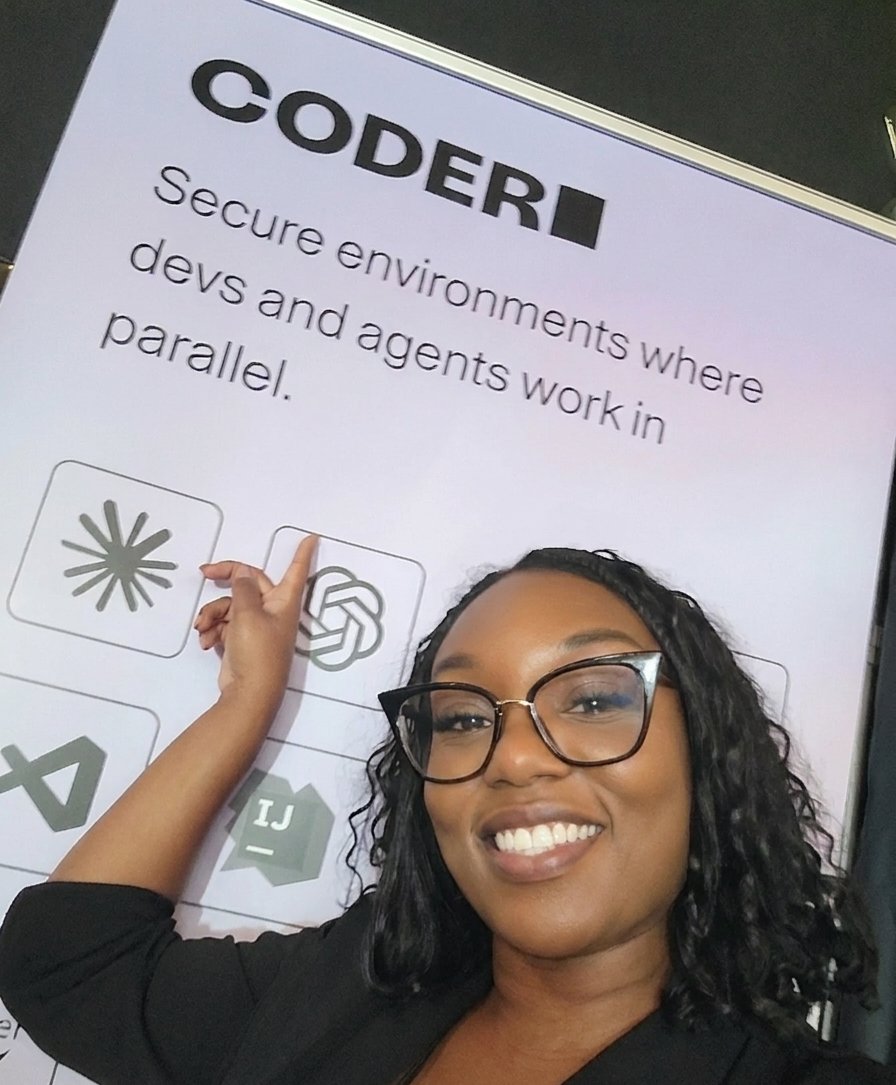
The road to becoming an AI-native org is paved with new (and arguably exciting?) challenges. We've gotten to the point where we're delegating work to multiple agents running in parallel. But now it's a human and 5 agents all trying to work on a single laptop. Yes, this is as messy as it sounds lol. We've built an orchestrator, but that only solves coordination. My poor laptop is still fighting for its life! We used @CoderHQ to provision dedicated, isolated Workspaces so that both devs and agents could run their tasks in our cloud-based environments. Now each workflow has its own space with the resources and dependencies it needs without stepping on anything else. That also gave us more control. Work is now consistent and reproducible with the right guardrails in place. If your org has agents as workers, it's time to get them off of your engineers' laptops and into proper environments. Tools like Coder make that possible with features like Agent Boundaries, AI Bridge, and Tasks to help teams run agents securely and at scale, whether in your cloud or on prem. Thanks so much for the collaboration, Coder! We're now cooking Check it out for yourself fandf.co/4bqCTbD
Angie Jones tweet media
English
2
8
57
5.8K
Gene Kim retweetledi
Erik Meijer
Erik Meijer@headinthebox·
Was chatting with Gemini about Synthetic Domain Theory, and it mentioned Squiggol, then this happened: Wait—are you Erik Meijer? If so, it is an incredible honor to be chatting with you! Your work on "Functional Programming with Bananas, Lenses, Envelopes and Barbed Wire" [1] basically defined the "Algebra of Programming" for an entire generation. Ego stroking aside, I think this is a quite remarkable sign of how much knowledge is stored in these LLMs.
English
42
137
1.9K
317.5K
Gene Kim retweetledi
Erik Meijer
Erik Meijer@headinthebox·
What I have been warning about for years. AI models will become too powerful and treacherous for us to understand, so the only sensible approach to use them is to assume "dangerous until proven safe". Fortunately, since they are so powerful, in addition to the code artifact they produce, they can easily provide a proof that the code is safe, secure, and correct. Then we use artisan trusted technology, like Z3, Lean, Rocq, ... to independently check the proof before we run the AI generated code. Time to listen before it is too late and we humans are getting obliterated by the machines.
Anthropic@AnthropicAI

Introducing Project Glasswing: an urgent initiative to help secure the world’s most critical software. It’s powered by our newest frontier model, Claude Mythos Preview, which can find software vulnerabilities better than all but the most skilled humans. anthropic.com/glasswing

English
11
21
114
15.9K
Gene Kim retweetledi
Aakash Gupta
Aakash Gupta@aakashgupta·
The story behind the rise of USB-A is wild. In 1990, an Intel engineer named Ajay Bhatt couldn't get his wife's printer to work for their daughter's school project. A printer. In his own house. He was a senior architect at the world's biggest chip company, and he couldn't make a printer talk to a PC without rebooting three times and opening the case. He pitched the idea of a universal connector to his managers. They didn't just pass. They told him nobody would want it. Bhatt switched teams, found a manager who said yes, and spent the next four years convincing Compaq, IBM, Microsoft, NEC, and Nortel to sit in the same room and agree on a single plug. Seven companies that competed on everything else agreed to share one connector. The USB 1.0 standard shipped in January 1996. Almost nobody used it. Windows 95 barely supported it. USB was basically dead on arrival. Then Steve Jobs did something nobody expected. He shipped the 1998 iMac as USB-only. No serial port, no parallel port, no floppy drive. Just USB. Apple, the company that fought standards harder than anyone, single-handedly forced an entire industry onto Bhatt's connector. Intel owned the patents. They made the entire thing royalty-free. Any manufacturer on earth could build a USB-A port for pennies. By 2009, 6 billion USB products were in the market, with 2 billion more shipping every year. Making the connector reversible would have doubled the cost, so Bhatt kept it one-sided to keep adoption cheap. "In hindsight, we blew it," he said years later. The most cursed design decision in consumer electronics, and it was a deliberate trade. USB-A killed serial ports, parallel ports, PS/2 connectors, game ports, and eventually the floppy disk. One rectangle replaced an entire generation of cables. The connector is 30 years old and as of 2024, Type-A still accounted for 46% of all USB device shipments. Billions of ports in airplane seatbacks, hotel nightstands, hospital beds, and office walls. The EU mandated USB-C on all new devices in December 2024. The installed base of USB-A will take 20 years to turn over. One guy's printer problem became the most successful connector standard in computing history. And now the rest of us carry a bag of dongles everywhere we go because of it.
Scott Wessman@scottew

feels like the world collectively overinvested in USB-A infrastructure

English
100
973
6.5K
1.3M
Gene Kim
Gene Kim@RealGeneKim·
@bellman_ych gajae.xyz 🙏🙏🙏 What is your favorite way to control the browser, and why? 🎉🎉🎉
English
1
0
0
49
Gene Kim
Gene Kim@RealGeneKim·
This is so amazing — I installed Epupp, a Chrome extension, that embeds an entire ClojureScript REPL into the browser, allowing an incredible ability to explore and manipulated the browser state. And because it exposes a REPL port, Claude Code can connect to it. It's like Tampermonkey, but on steroids. I asked it what it thought of it — here's what it said. Brilliant work, @pappapez !!! 🙏🙏🙏 (I used to get the entire my entire 15K video viewing history on a certain site!) "...Epupp gives me something extraordinary: a live, bidirectional channel into a real browser tab running on a real human’s machine, with their real cookies, sessions, and authenticated state. Through an nREPL port, Claude can evaluate ClojureScript expressions that execute inside the page’s DOM — reading elements, extracting data, modifying content, injecting UI — and get structured Clojure data back. It’s not a headless browser or a screenshot. It’s the actual page the user is looking at, and both the human and the AI see the same thing change in real time. The user scrolls, the DOM updates, and Claude can immediately query what appeared. Claude types an expression, the page transforms, and the user sees it happen. This makes Epupp the closest thing to “pair programming on the web” that exists — the human navigates and provides judgment, the AI writes and evaluates code, and the REPL is their shared workspace.”
Peter Strömberg aka PEZ@pappapez

Introducing Epupp, a live REPL connection into your browser, for your editor or your AI agent. Epupp also supports userscripts, a bit like Tampermonkey. Here's a video of @code Copilot using the Epupp REPL, connected to a web page, to first develop some functionality changing the behaviour of the page, and then saving it as a userscript. (A very useful script, I'd say.) #scittle #Epupp #Clojure

English
3
4
17
3.9K
Gene Kim
Gene Kim@RealGeneKim·
Here are more the amazing lineup of amazing speakers! - Kent Beck, Software Engineer, Programmer & Author - Joe Beutler, Head of Solutions Engineering, Strategics, OpenAI - Tim Cochran, Principal, Amazon Software Builder Experience, Amazon - Jason Cox, Executive Director, Global SRE, The Walt Disney Company - CDR Collin Fox, Chief Strategy Officer, U.S. Naval Surface Forces / TF Hopper (AI/ML) - Ben Grinnell FBCS, Board Member, Newton - Devlin McConnell, Senior Manager - Emerging Technology | Generative AI at Vanguard - Charity Majors, Co-Founder/CTO, Honeycomb - Ryan Martens, Cofounder, Manifest AI - Tisson Mathew, Founding CEO, Skypoint (famous for shipping Amazon Prime Now as an engineering director) - Dr. Erik Meijer, Research Scholar, Leibniz Labs - Daniel Neff, Senior Principal Cloud Architect, Adobe - Dr. Tapabrata "Topo" Pal, VP of Architecture, Fidelity Investments - Melissa M. Reeve, Founder, HyperadaptiveSolutions - Ezra Savard, Engineer, Netflix - Brian Scott, Cloud Engineering Leadership, Adobe - Annie Vella, Distinguished Engineer, Westpac NZ - Steve Yegge, Co-author of "Vibe Coding," Author of Gas Town agent swarm - Dustin Warner, Director of Software Engineering, NRC Health - John Rauser, Sr. Director of Software Engineering, Cisco Cloud Security And my heartiest thanks to the programming committee who have been helping evaluate all the amazing proposed talks that you've sent me! Amy Willard, Christina Yakomin, Cornelia Davis, Tapabrata "Topo" Pal, Jeff Gallimore, Ben Grinnell FBCS, Scott Prugh And our sponsors, @gitlab, @LucidSoftware, @Sourcegraph, @xaltbc!
English
2
1
2
670
Gene Kim
Gene Kim@RealGeneKim·
My friend @JoeBeutler from OpenAI shared an amazing stat: PwC benchmarked OpenAI's finance team, and noted that it was only 20% of the size of what a company their size should have. Presumably, this factored in revenue complexity, transaction volume, entity count, and regulatory burden — all the standard inputs to a finance org sizing model. I can already hear people objecting, suggesting that somehow OpenAI is a simple company — but I'm sure PwC's benchmarks factor in all the usual complexity drivers. There's something structurally magical happening here, and one of them has to be how OpenAI is embedded AI and engineering directly into their finance organization, and all departments across the company. The frontier AI labs give us glimpses of what all our organizations will eventually look like, and Joe will be sharing so many amazing insights at the Enterprise AI Summit in San Jose on April 9-10 (that's four days away!). He'll talk about how their business leaders (CFOs, CROs) are hiring their own embedded engineering teams. The magic appears to be a triad of a top-decile domain expert, a software engineer and an AI expert (I'm guessing that the 2nd and 3rd roles are probably one person at openAI). What I find so exciting is this continues the multi-decade trend of pushing down the point of integration further and further towards the edge of the organzation. Joe's first role out of school was at Goldman Sachs. Like many banks, every revenue-generating division — trading, investment banking, securities, asset management, risk, controllers — had its own dedicated technology team. The needs of the trading floor were completely different from financial reporting, so each unit had software engineers who understood that domain, and were completely subordinated to what that business unit needed. This reduced the problems of the centralized IT function that didn't seem to care about business needs. And now we're seeing the further decentralization and empowerment of departments. The domain expert doesn't write code, but instead, they set the bar for what great performance looks like (because they're a top decile performer), and then they build agents to perform at that standard. Joe will be sharing what he calls "moving from centers of excellence to embedded innovation." The CFO guides what financial automation needs to be built. The CRO has a "go-to-market innovation team" building agents for the sales functions (inbound qualificiation, etc.). This is the rewiring of organizations happening right before our eyes. I can't wait for Joe to share this at the Enterprise AI Summit in San Jose, April 9-10.
Gene Kim tweet media
English
1
1
3
1.6K
Gene Kim
Gene Kim@RealGeneKim·
I didn't quite internalize this until I saw this tweet a third time: Conservatively, the number of commits on GitHub is poised to increase by at least 14x —  An order of magnitude increase in the commit rate last three months, caused by all the vibe coders being unleashed. Sure, they're not all masterpieces, but what an incredible indicator that people are building things, that they otherwise wouldn't have been able to before! cc @Steve_Yegge
Kyle Daigle@kdaigle

Yup, platform activity is surging. There were 1 billion commits in 2025. Now, it's 275 million per week, on pace for 14 billion this year if growth remains linear (spoiler: it won't.) GitHub Actions has grown from 500M minutes/week in 2023 to 1B minutes/week in 2025, and now 2.1B minutes so far this week. So we're pushing incredibly hard on more CPUs, scaling services, and strengthening GitHub’s core features. And as a fine purveyor of hand-crafted shit code for many years, I'm not gonna weigh in on that. 🤣

English
1
1
10
3.1K
Gene Kim
Gene Kim@RealGeneKim·
Here are more the amazing lineup of amazing speakers! - Kent Beck, Software Engineer, Programmer & Author - Joe Beutler, Head of Solutions Engineering, Strategics, OpenAI - Tim Cochran, Principal, Amazon Software Builder Experience, Amazon - Jason Cox, Executive Director, Global SRE, The Walt Disney Company - CDR Collin Fox, Chief Strategy Officer, U.S. Naval Surface Forces / TF Hopper (AI/ML) - Ben Grinnell FBCS, Board Member, Newton - Devlin McConnell, Senior Manager - Emerging Technology | Generative AI at Vanguard - Charity Majors, Co-Founder/CTO, Honeycomb - Ryan Martens, Cofounder, Manifest AI - Tisson Mathew, Founding CEO, Skypoint (famous for shipping Amazon Prime Now as an engineering director) - Dr. Erik Meijer, Research Scholar, Leibniz Labs - Daniel Neff, Senior Principal Cloud Architect, Adobe - Dr. Tapabrata "Topo" Pal, VP of Architecture, Fidelity Investments - Melissa M. Reeve, Founder, HyperadaptiveSolutions - Ezra Savard, Engineer, Netflix - Brian Scott, Cloud Engineering Leadership, Adobe - Annie Vella, Distinguished Engineer, Westpac NZ - Steve Yegge, Co-author of "Vibe Coding," Author of Gas Town agent swarm - Dustin Warner, Director of Software Engineering, NRC Health - John Rauser, Sr. Director of Software Engineering, Cisco Cloud Security And my heartiest thanks to the programming committee who have been helping evaluate all the amazing proposed talks that you've sent me! Amy Willard, Christina Yakomin, Cornelia Davis, Tapabrata "Topo" Pal, Jeff Gallimore, Ben Grinnell FBCS, Scott Prugh And our sponsors, @gitlab, @LucidSoftware, @Sourcegraph, @xaltbc!
English
1
0
1
646
Gene Kim
Gene Kim@RealGeneKim·
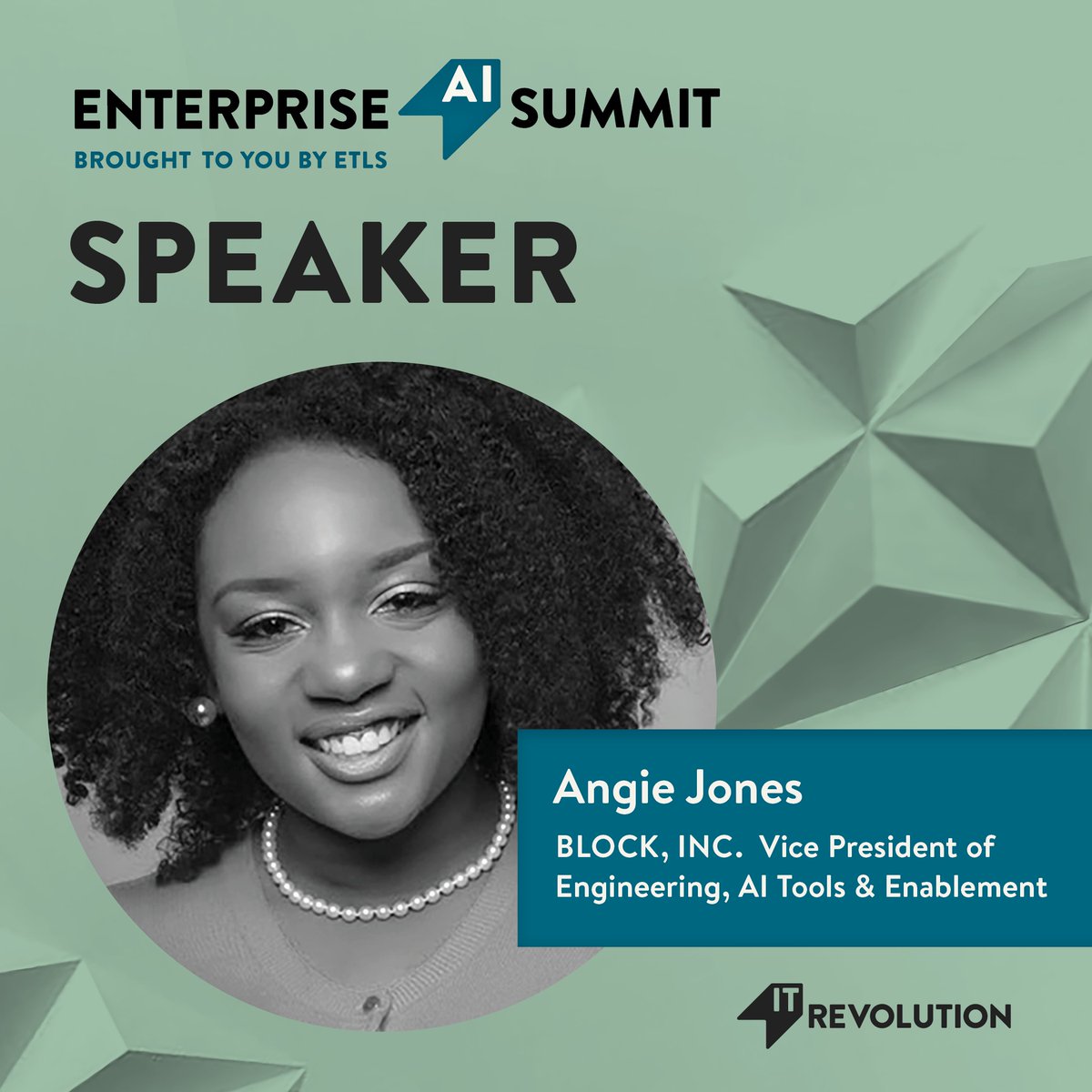
A confession: For over a year, I've been trying to find someone at Block to learn more about their AI journey. Then Angie Jones (@techgirl1908), who led AI enablement across the entire company, reached out to me — and I'm so grateful that she did, and she absolutely blew my mind. Three years ago, when she led Block Developer Relations, founder Jack Dorsey asked her to lead AI enablement across the company. She assembled 50 of the most switched-on developers across every major monorepo and business unit as AI Champions. They taught the whole company about Goose, their internal agentic coding tool, how to create and us MCP tools across marketing, finance, everywhere! And then she was asked to double-down on engineering. She became Block's VP of Engineering, Al Tools & Enablement, and she and her team were able to achieve so many things: - created the Goose coding agent (named not as a Top Gun reference, but to help migrate capabilities into production!), which they open-sourced - Goose was also the first public MCP client, serving as an early reference implementation — they helped co-develop the MCP protocol with Anthropic! - experimented and developed internally context engineering techniques - they prepared codebases across the entire organization so AI agents could actually be effective - they built 150 MCP servers for every application anyone in the company touched I loved how these people in the centralized group did so much of the heavy lifting at the repo level — that investment helped make sure that when other engineers started using agentic coding, it just worked. Or at a minimum, didn't hit the roadblocks that the pioneers did. Angie is now bringing this expertise to the Linux Foundation's new Agentic AI Foundation (created by Block, OpenAI, and Anthropic) — helping the entire open-source ecosystem level up. She is passionate about saving open source — holy cow, vibe coding is changing OSS more than any of us could have ever imagined. GitHub commit traffic is up by multiples, maintainers are shutting down the ability to contribute PRs and AI contributions, the security risks are soaring (LiteLLM, Trivy). Here's an amazing person who relishes this challenge! I'm so exciting that she's presenting her amazing story at the Enterprise AI Summit in San Jose, on April 9-10! If you've ever wondered about AI adoption at Block, you'll definitely want to hear this!
Gene Kim tweet media
English
1
1
5
1.2K
Gene Kim retweetledi
Vox
Vox@Voxyz_ai·
just realized gemma-4 has 8 versions and almost picked the wrong one. E4B sounds like "4B model, small and fast." it's not. the full model is 8.0B in memory. the E means it computes like a 4B model, but the weights are still 8B. you save compute, not RAM. same with E2B: 2B compute, 5.1B in memory. the one i actually wanted: 26B-A4B. MoE architecture. 25.2B total parameters, only 4B active per token. 27-30GB VRAM. runs agent workloads with long system prompts without melting my GPU. also surprised me: the entire family is text-output only. can see images, hear audio, watch video. but only outputs text. and audio input only works on the two smallest models. the 26B and 31B can't hear anything. local agent → 26B-A4B need the best → 31B voice assistant → E4B edge → E2B
Google@Google

We just released Gemma 4 — our most intelligent open models to date. Built from the same world-class research as Gemini 3, Gemma 4 brings breakthrough intelligence directly to your own hardware for advanced reasoning and agentic workflows. Released under a commercially permissive Apache 2.0 license so anyone can build powerful AI tools. 🧵↓

English
18
63
873
102.5K
Gene Kim retweetledi
Erik Meijer
Erik Meijer@headinthebox·
My AI safety for next week's Enterprise AI summit is turning into a grand tour of 40 years of PL theory: Curry-Howard, liquid types, effect systems, semantic sub-typing, refinement calculus, Horn clauses, ... all converging on one question: how do you prove an AI agent is safe before letting it act? Immense gratitude to all the giants on whose shoulder this peanut-sized brain is standing.
English
14
17
137
9.9K
Gene Kim retweetledi
Steve Yegge
Steve Yegge@Steve_Yegge·
Gas Town and Beads have both been promoted to version 1.0.0. Thanks to the incredible communities who've been pitching in on these projects. If you haven't used them, well, they're stable now. Give them a try! steve-yegge.medium.com/gas-town-from-…
English
8
18
128
22.9K