Regarding Semi

1.4K posts

Regarding Semi banner
Regarding Semi

Regarding Semi

@regardingsemi

Semiconductor market data, earnings analysis, and institutional positioning.

Katılım Ekim 2025
488 Takip Edilen726 Takipçiler
Sabitlenmiş Tweet
Regarding Semi
Regarding Semi@regardingsemi·
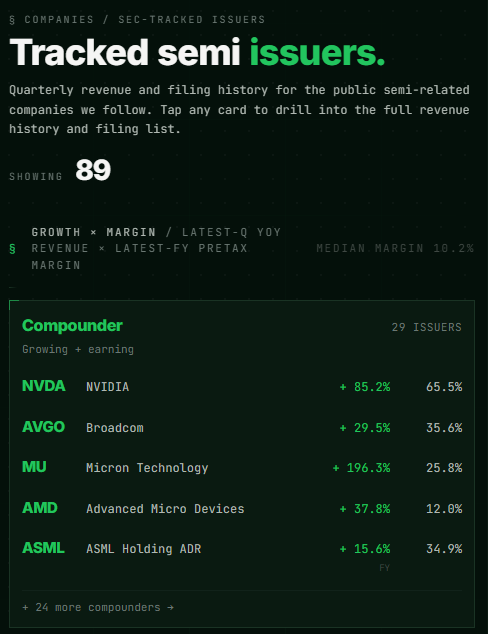
🚨 I’m officially releasing regardingsemi.com. I’ve been working on this with my friend Opus over the last month. It’s not vibe-coded slop, I swear. There’s powerful and useful data in here. The goal is to visualize semiconductor data to help make better investing decisions. Right now, we’re tracking 89 U.S. semiconductor companies. Once I’m happy with the UI, I’ll start adding Japan, Taiwan, and other markets. I’m going to use this thread to go through screenshots and showcase some of the features. I’m adding to it every day.
Regarding Semi tweet media
English
1
1
4
238
Regarding Semi
Regarding Semi@regardingsemi·
$SNOW is going to murder earnings tomorrow. AI has opened up an abstracted data and BI layer inside every enterprise that previously didn’t exist. Cortex is an incredible product too. I was talking to a Snowflake sales rep at a conference last month, and they said they’ve never been busier. Earnings will kill, what the market reaction will be...I'm not sure.
English
1
0
5
892
Regarding Semi
Regarding Semi@regardingsemi·
There’s a lot more inside too. Data is refreshed nightly. Feel free to reach out with feedback or anything else you’d like to see.
English
0
0
0
44
Regarding Semi
Regarding Semi@regardingsemi·
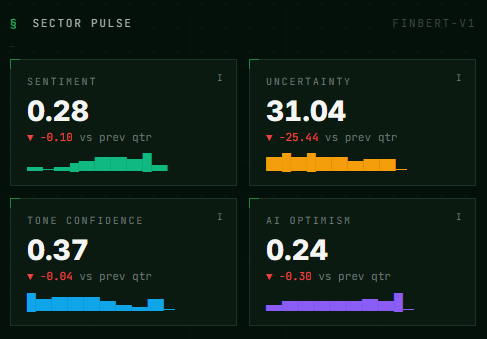
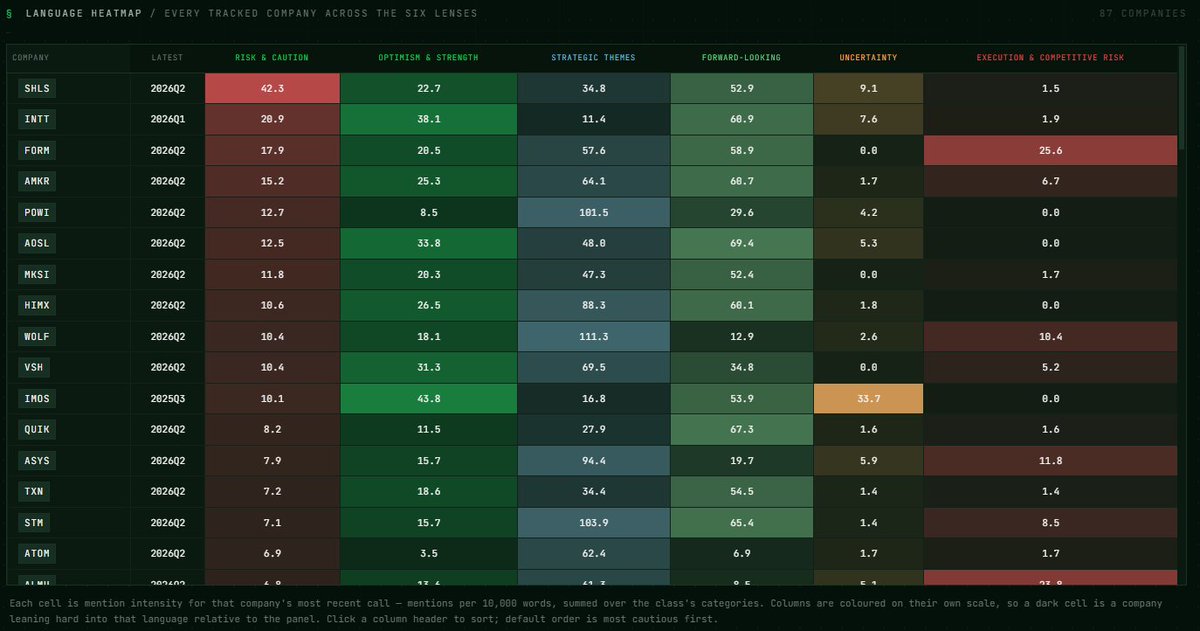
/Language processes every earnings call in the tracked universe with FinBERT, a finance-tuned BERT model. Each sentence gets a positive/negative sentiment score; calls and sectors get length-weighted aggregates. Plus uncertainty, confidence, and AI/data-center optimism metrics.
Regarding Semi tweet mediaRegarding Semi tweet mediaRegarding Semi tweet media
English
1
0
0
57
Regarding Semi
Regarding Semi@regardingsemi·
🚨 I’m officially releasing regardingsemi.com. I’ve been working on this with my friend Opus over the last month. It’s not vibe-coded slop, I swear. There’s powerful and useful data in here. The goal is to visualize semiconductor data to help make better investing decisions. Right now, we’re tracking 89 U.S. semiconductor companies. Once I’m happy with the UI, I’ll start adding Japan, Taiwan, and other markets. I’m going to use this thread to go through screenshots and showcase some of the features. I’m adding to it every day.
Regarding Semi tweet media
English
1
1
4
238
Regarding Semi retweetledi
루팡
루팡@DrNHJ·
Semianalysis) 800VDC 혁명의 내부 $VRT, $NVTS 800VDC 데이터센터 전력 혁명: 심층 분석 1. 전환의 배경: 왜 800VDC인가? GPU 클러스터의 전력 밀도가 랙당 600kW 이상으로 치솟으면서, 기존의 48V/AC 기반 아키텍처는 물리학적 한계에 직면했습니다. 전력은 전압과 전류의 곱이고, 저항에 의한 발열 손실은 전류의 제곱에 비례합니다. 전압을 48V에서 800V로 높이면 동일 전력 공급 시 전류가 약 15배 감소하며, 이에 따라 저항에 의한 발열 손실은 이론적으로 약 220배 이상 줄어듭니다. 이는 구리 배선 무게를 대폭 줄이고, 시스템 전체의 전력 효율을 약 5% 향상시켜, 1GW 규모 데이터센터 기준 연간 50MW 이상의 전력 절감 효과를 가져옵니다. 2. 800VDC로의 4단계 전환 로드맵 이 전환은 단번에 이루어지는 것이 아니라 기술적 준비 상황에 따라 단계적으로 진행됩니다. 1단계: 화이트 스페이스 레트로핏 (2026~2027년) 데이터센터의 AC 백본(변압기, UPS 등)은 그대로 유지하되, 데이터 홀(화이트 스페이스) 내에 'HVDC 파워 랙(Sidecar)'을 추가하여 랙 단위로 전압을 변환합니다. 구글과 메타가 OCP(Open Compute Project)의 'Diablo 400' 사양을 중심으로 초기 도입을 주도하고 있습니다. 2단계: 800VDC 네이티브 컴퓨트 (2027~2028년) 서버 블레이드 내부에서 직접 800VDC를 받아 변환하는 기술이 적용됩니다. 중앙 집중식 AC UPS를 제거하고 랙 단위의 분산형 배터리 백업(BBU)을 사용하여 효율을 높입니다. 이 단계부터 800VDC 도입이 필수가 됩니다. 3단계: 그레이 스페이스의 DC화 (2028~2029년) 데이터센터의 외부 전력 인프라(그레이 스페이스) 자체가 DC로 바뀝니다. 건물 단위에 대형 정류기를 배치하여 800VDC를 건물 전체에 배전하며, AC 배전반과 PDU가 사라집니다. 4단계: SST(고체 변압기) 엔드게임 (2029년 이후) 데이터센터 전력 인프라의 최종 형태입니다. 중압(MV) AC를 받아서 즉시 800VDC로 변환하는 SST가 도입됩니다. 변압기와 정류기를 하나로 통합하여 부피를 90% 이상 줄이고 효율을 99% 수준까지 끌어올립니다. 3. 기술적 핵심 요소 HVDC 파워 랙 (Sidecar): 서버 랙 옆에 배치되는 전력 전용 랙입니다. AC를 DC로 바꾸고, 배터리(BBU)와 슈퍼커패시터를 통해 전력 안정성을 확보합니다. 이는 초기 단계에서 가장 중요한 설비입니다. SSCB (Solid-State Circuit Breaker): DC 배전에서는 AC처럼 전류가 0을 통과하는 지점이 없어 아크(Arc)를 끄기가 어렵습니다. 반도체 스위칭을 활용한 SSCB는 아크 발생 없이 마이크로초 단위로 전류를 차단하는 필수 보호 장치입니다. SST (Solid-State Transformer): 거대한 철심 변압기를 고주파 반도체 변환기로 대체합니다. DG Matrix, Amperesand, Heron Power 등이 이 시장을 선점하기 위해 경쟁 중입니다. 4. 시장 및 투자 관점의 변화 데이터센터의 총 전기 인프라 비용(MW당 약 3.6M~4.8M 달러)은 크게 변하지 않으나, 비용이 투입되는 위치와 구성 요소가 완전히 바뀝니다. 자본의 이동: 기존의 핵심 인프라인 중앙 UPS와 변압기(그레이 스페이스)의 비중은 줄어들고, 파워 랙, SST, 배터리 랙 등 서버와 가까운 설비(화이트 스페이스)의 가치가 상승합니다. 공급망 변화: 고전압(800V+) 반도체(SiC MOSFET) 업체, 고효율 전력 전자 부품 업체, 그리고 이를 통합 설계하는 EPC(엔지니어링·조달·건설) 기업들이 새로운 승자로 부상할 것입니다. 핵심 리스크: 아직 통일된 표준이 없는 접지(Grounding) 방식, DC 전력 안전 규격(NEC 2029 등), 그리고 데이터센터 내부의 AC 기반 냉각 설비와 DC 전력 시스템 간의 조화가 해결해야 할 주요 과제입니다.
한국어
2
25
98
13.9K
Regarding Semi retweetledi
Omer Cheema
Omer Cheema@OmerCheeema·
For people looking to play SpaceX IPO with semiconductors. $STM has quietly become one of the most interesting growth stories in European semis. LEO revenue: $175M (2021) → $600M (2025) → ~$1B (2026E) Cumulative target: >$3B by 2028 LEO market share: ~90% And management says they're "in the early innings." Starlink is the anchor. AST & Kuiper are the upside. Orbital data centers are the optionality nobody's pricing in yet.
English
2
4
47
5.5K
Regarding Semi retweetledi
SuspendedCap
SuspendedCap@ContrarianCurse·
People fucking loveeeee being contrarian, its feel so good and so sexy when it hits I'd say 80% of the time its just non-sensical and horrible risk taking. Many managers where I live are bear posting AI constantly I've posted both sides. I am far from a maxi. But like 6 companies are going to spend 1T next year + prob 2.5x that in indirects and you are going NO WEIGHT Are you trying to die? That is about as bad of risk management as having 80% of the port to the other side
English
27
11
430
96.6K
Cassandra Unchained
Cassandra Unchained@michaeljburry·
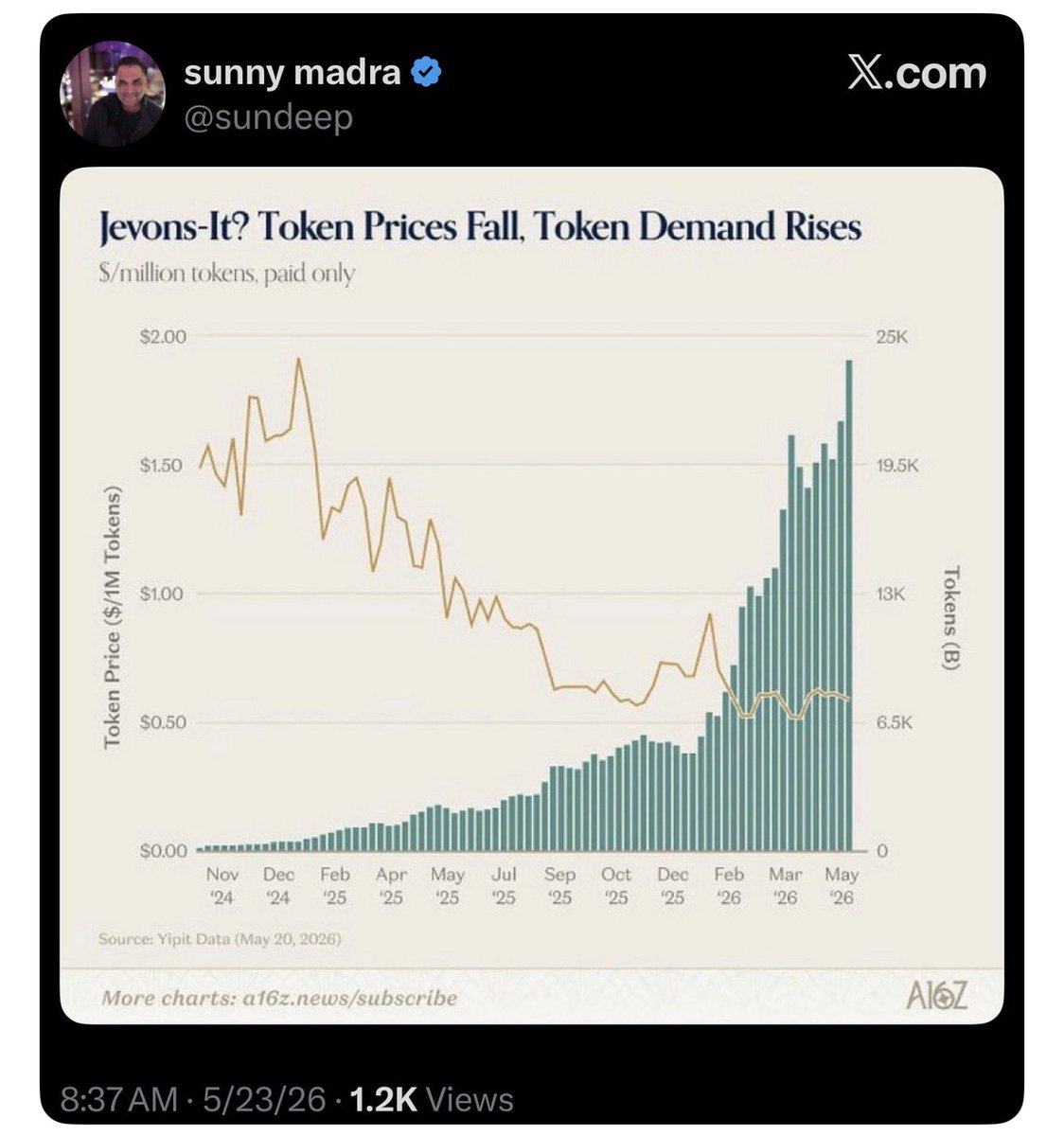
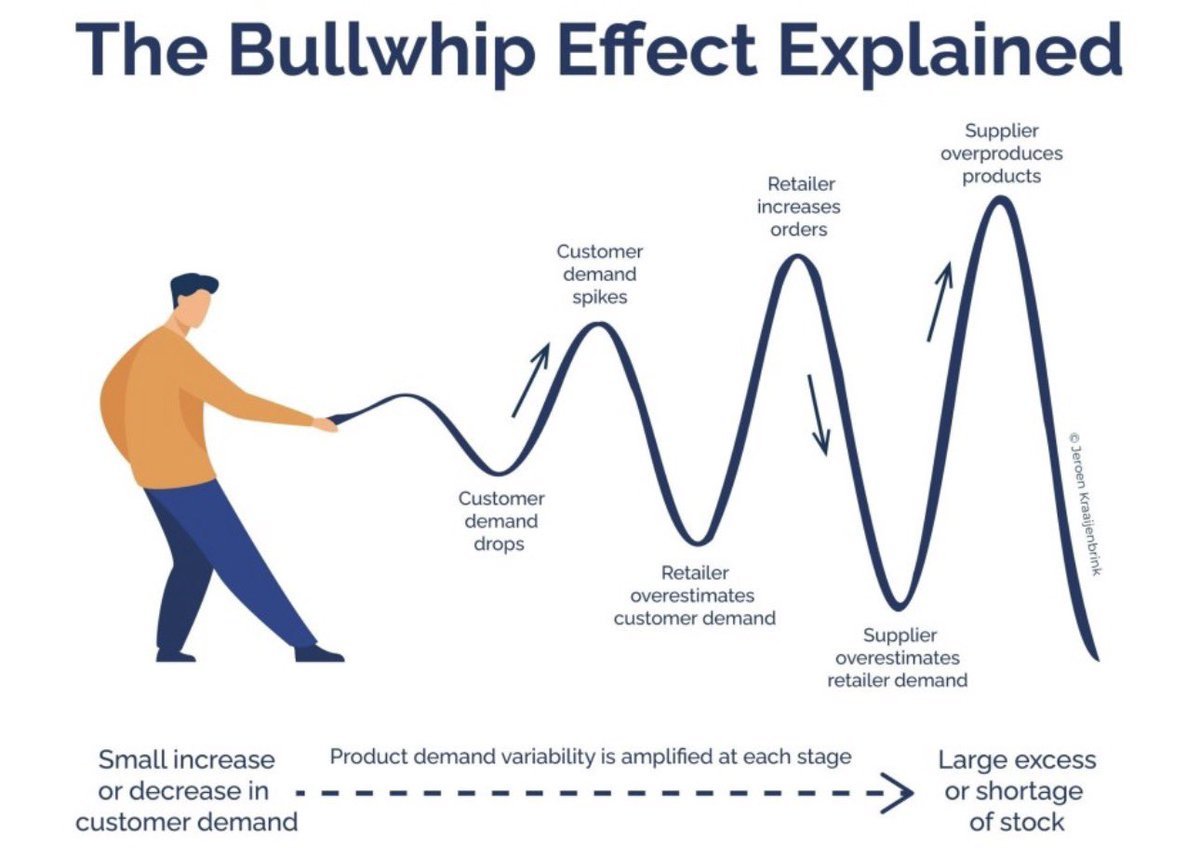
Many are using this chart to prove Jevons Paradox is working. They should look closer at the pattern and read Heretic’s Guide Part III. open.substack.com/pub/michaeljbu… Prices had already fallen for some time when the big token demand lift happened. Tokenmaxxing and benchmarking are much better explanation than Jevons Paradox based on the timeline than prices of tokens falling. In fact this chart may not show Jevons Paradox at all. And, if it does not, that is some massive benchmarking demand that is temporary and sending the wrong demand signal up and down the supply chain. Perhaps skipping a few cycles in the bullwhip effect. michaeljburry.substack.com/p/the-heretics…
Cassandra Unchained tweet mediaCassandra Unchained tweet media
English
68
79
603
192.5K
Regarding Semi
Regarding Semi@regardingsemi·
Anthropic projecting profitability next quarter is a huge story that feels like it’s being completely undiscussed
English
0
0
2
115
Regarding Semi
Regarding Semi@regardingsemi·
@not_ellington Dwarkesh is a software developer. He’s open about a lack of deep hardware understanding. He never claimed to be an expert.
English
2
0
41
3.9K
ellington
ellington@not_ellington·
This episode shows me how insanely little Dwarkesh knows about hardware and has made me second guess his intelligence on the other levels of the abstraction stack. Also the dude lecturing is not communicating very well. This whole episode is very clearly an ad for MatX and a poor one at that because the founder clearly has certain gaps in his hardware knowledge
English
49
20
556
229.4K
Petras 🇱🇹🇺🇦🇪🇺🌍🥦
@regardingsemi @michaeljburry @kakashiii111 It's dead, like all the previous hype waves. x.com/i/status/20585…
Ricardo@Ric_RTP

Microsoft just banned its own engineers from using AI. The tool was literally costing MORE than the humans it was supposed to replace. They lied to you about AI adoption and now the whole narrative is blowing up: Microsoft gave thousands of engineers access to Claude Code six months ago and encouraged them to use it. Engineers loved it and adoption exploded. But then the invoices arrived. Token-based pricing means every query, every code review, every debugging session costs money. At scale across 100,000 engineers, the numbers became so large that Microsoft issued an internal order to cancel nearly all Claude Code licenses by end of June and force everyone onto their own cheaper tool instead. The company that invested $5 billion in Anthropic just told its own people to stop using Anthropic's product because it costs too much. Uber's story is even worse... Their CTO Praveen Neppalli Naga told The Information that the budget he planned for the full year was "blown away already" by April. Uber had rolled out Claude Code in December 2025. By March, 84% of their 5,000 engineers were using it with 70% of all committed code coming from AI systems. Heavy users were burning $500 to $2,000 per month each. Naga himself spent $1,200 in a single two-hour demo session. The company had even built internal leaderboards ranking engineers by how much AI they used. They literally gamified the spending and then ran out of money. Now look at what Nvidia's own VP of applied deep learning Bryan Catanzaro said to Axios last month. Direct quote: "For my team, the cost of compute is far beyond the costs of the employees." This is a VP at the company that SELLS the chips saying that using AI is more expensive than paying humans. Think about what this means for the entire AI narrative. Every CEO on every earnings call for the past two years has said the same thing: AI will make us more efficient, reduce headcount, and cut costs. The stock market rewarded every company that said it. Fired workers, stock goes up. Announced AI adoption, stock goes up. But the actual companies deploying AI at scale are discovering the math doesn't work. The MORE employees use AI, the HIGHER the bill. Goldman Sachs forecasts a 24x increase in token consumption by 2030 as companies adopt AI agents. Gartner just published a report showing that even though individual token prices will drop 90% by 2030, total enterprise AI costs will go UP because agents consume exponentially more tokens per task than basic tools. Meta built an internal dashboard called "Claudeonomics" to track which employees use the most AI. Amazon started pushing engineers to "tokenmaxx," their internal term for consuming as many AI tokens as possible. Both companies are spending hundreds of billions on AI infrastructure this year alone. And Microsoft, the company that bet its entire future on AI, just told 100,000 engineers to stop using the tool they liked best because the per-token bills got out of control. The companies building AI are telling investors it saves money. The companies using AI are finding out it costs more than the humans it was supposed to replace. And even the company that makes the chips just admitted it through its own VP. This is the gap nobody on Wall Street is pricing in. $725 billion in AI infrastructure spending this year across Big Tech. And the first companies to actually deploy these tools at scale are already pulling back because the economics don't work. What do you think?

English
1
0
0
87
Regarding Semi
Regarding Semi@regardingsemi·
@engelmanas @michaeljburry @kakashiii111 Technical employees already recognize the groundbreaking shift. Non-technical employees are still figuring out how to integrate it into their workflows. You’re seeing exponential adoption of Claude Co-work. It’s still way too early.
English
1
0
0
113