sagyr

4.7K posts

sagyr banner
sagyr

sagyr

@relendlabs

building relendlabs (creative ai studio).

trenches Katılım Ocak 2020
197 Takip Edilen158 Takipçiler
sagyr retweetledi
Justin Skycak
Justin Skycak@justinskycak·
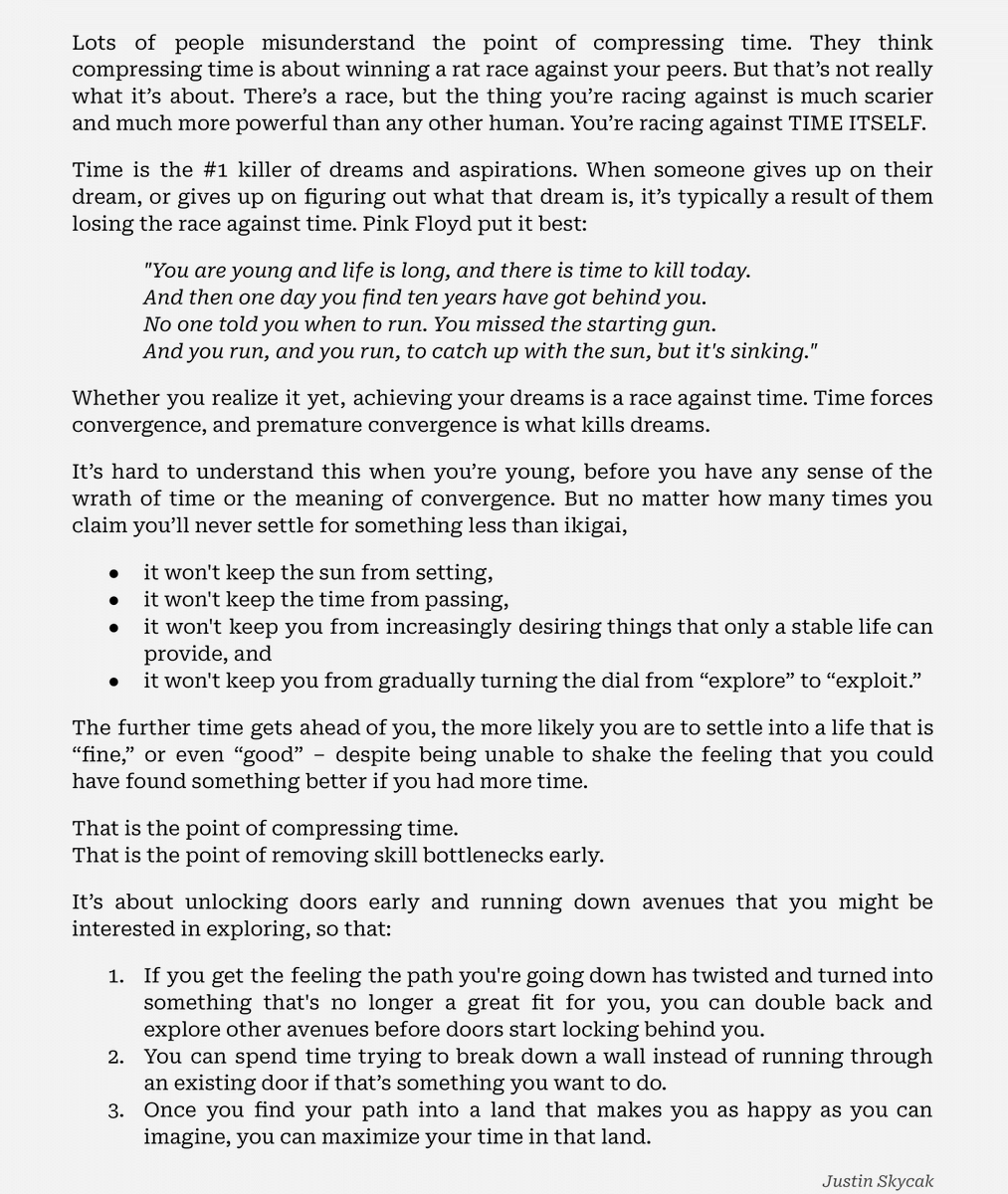
"Your lack of urgency is wasting your potential."
Justin Skycak tweet media
Justin Skycak@justinskycak

The #1 killer of dreams is not lack of potential, but rather lack of urgency.

English
45
1.8K
10.7K
582.7K
sagyr retweetledi
Incentivising
Incentivising@incentivising·
Game theory explains why working harder inside a broken system is the worst response to that system. Because a system is never truly broken. It's just producing exactly the outcomes its own incentive structures were designed to produce, whether intentional or not. Working harder inside this system increases your output in the payoff matrix, but it simply won't change the actual structure of the system's matrix. Thus, the correct response is not more effort. Instead, you must aim to identify whose interests the current structure serves and position yourself in favor of those interests rather than against them. Change the game, or play the game that is actually being played. Either way, you must stop optimizing for the game you wish it to be and start acting realistically.
English
119
1.8K
10.4K
352K
sagyr retweetledi
Karan🧋
Karan🧋@kmeanskaran·
"AI will take your job." But These opportunities will rise: - Inference Engineering for LLMs/VLMs - Demand Forecasting with RL Agents - Data Engineering at scale (evergreen) - GTM Engineering & Strategist - AI Product Managers - DevRel for B2B AI - Mathematician for AI Research - Federated/Distributed Engineering - Networking and Security for AI - AGI R&D Engineering - CUDA GPU kernels - Technical Content Creation with human taste - Sales & Marketing (evergreen) - Teaching AI by Humans - Observability in AI - Solo founder with AI team - Quant Finance with ML - Multi-agent system engineering - Cloud Deployment for AI services - LLMs/SLMs in IoT All technical skills require architecture design, business alignment, and distribution. Coding will never be that tough, but understanding the basics is important. Why? So things won’t be a black box for you. Basics mean concepts, not syntax. Learning these is mandatory to stay relevant: 1. Neural Networks 2. Transformers & LLMs 3. RL 4. Inference for LLMs 5. Linear Algebra 6. Distributed Systems 7. Ops 8. Content Creation (text or video) 9. Marketing and Sales 10. Public Speaking Keep basics clean to stay relevant in next tech wave.
English
13
127
946
34.5K
sagyr retweetledi
Siddharth
Siddharth@siddharthwv·
Game theory + Personal branding + Marketing psychology + Not having an ego + Pattern recognition. Master these and you'll never need a 9-5 again.
English
51
360
3K
51.3K
sagyr retweetledi
by
by@beyoumf·
Pattern recognition + not giving a fuck is the highest form of intelligence
English
141
1.8K
12.3K
197K
sagyr retweetledi
Aditya Tandon
Aditya Tandon@adityatandon02·
The best decision you take as an Engineer is to learn system design early. Specifically in time like this, surely gives you unfair advantage.
English
21
64
957
21.4K
sagyr retweetledi
Reads with Ravi
Reads with Ravi@readswithravi·
Marcus Aurelius wrote this over 1800 years ago: “Think of yourself as dead. You have lived your life. Now take what's left and live it properly.”
English
85
2.7K
22.5K
660.9K
sagyr retweetledi
ₕₐₘₚₜₒₙ
ₕₐₘₚₜₒₙ@hamptonism·
i genuinly feel bad for lazy people because it literally only takes 30 days of obsession to change your entire year.
English
73
590
8.4K
200.2K
sagyr retweetledi
Nicholas Fabiano, MD
Nicholas Fabiano, MD@NTFabiano·
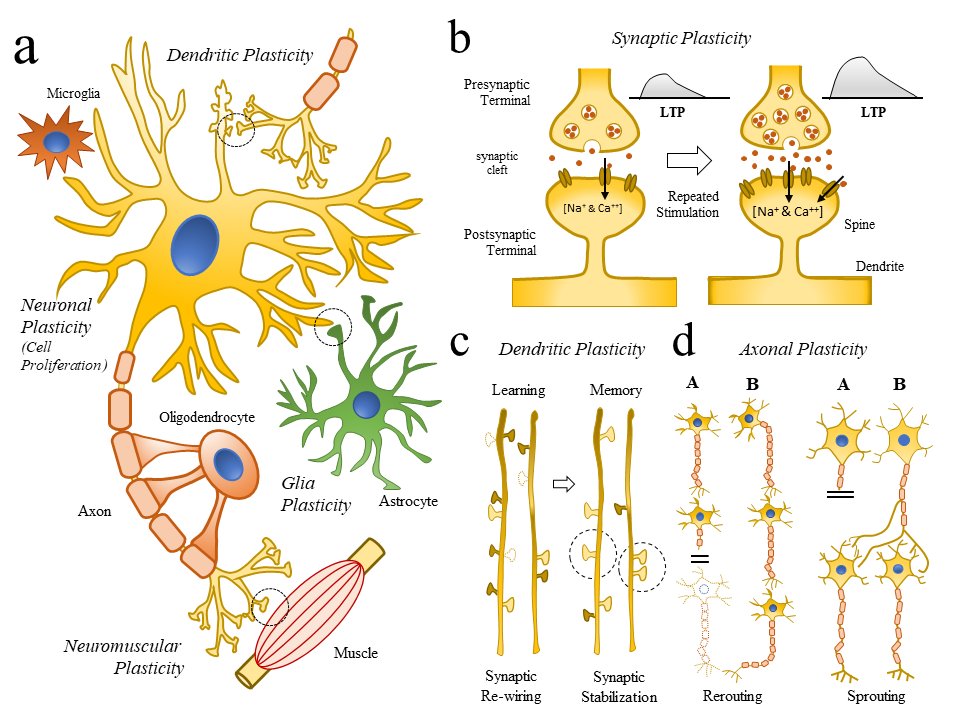
Intelligence isn't knowing more It's the ability to rewire your brain faster.
Nicholas Fabiano, MD tweet media
English
93
667
4.8K
176.5K
sagyr retweetledi
Jay Yang
Jay Yang@Jayyanginspires·
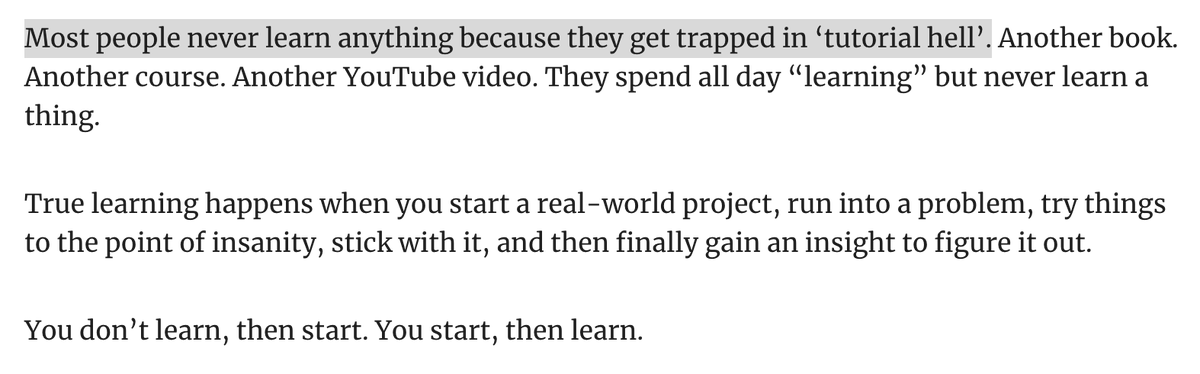
You don't learn, then start. You start, then learn.
Jay Yang tweet media
English
15
17
169
4.4K
sagyr retweetledi
amrit
amrit@amritwt·
agency above everything
amrit tweet media
English
23
220
2.9K
66.5K
sagyr retweetledi
cherrie
cherrie@cherrishkhera·
r/Quant r/finance
r/SecurityAnalysis r/wallstreetbets
r/personalfinance
r/Economics r/stocks r/portfolios
r/investing
r/ValueInvesting
r/FluentInFinance r/business thank me later.
English
75
1.4K
19.4K
842.4K
sagyr retweetledi
Naval
Naval@naval·
Self-directed learning through AIs is an autodidact’s paradise.
English
774
1.9K
19.6K
870.8K
sagyr retweetledi
Anders K. Hvelplund
Anders K. Hvelplund@Falliblemusings·
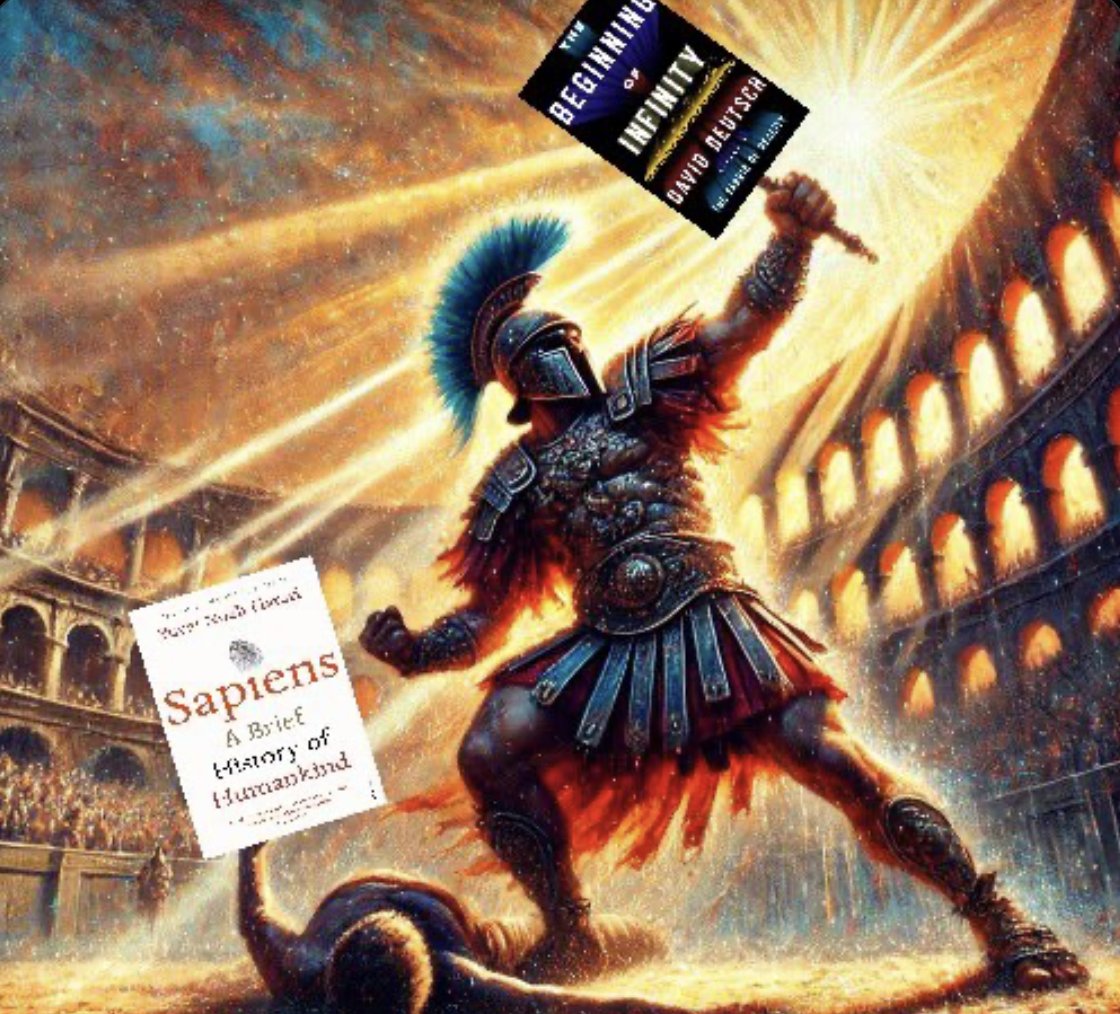
I used to think Sapiens was a great book. Sweeping, provocative, the kind of book that makes you feel like you finally understand the big picture of human history. It's on every CEO's bookshelf, assigned in universities, praised as a masterwork of synthesis. Yuval Noah Harari is treated as one of the serious thinkers of our time. But something nagged at me. Some passages felt off. Claims that human rights are just figments of our collective imagination, not real things, just stories we tell ourselves. That nations, laws, money, justice, doesn't exist outside our heads. That meaning itself is a delusion we've invented to cope. That we're far more powerful than ever before but not happier. That hunter-gatherers had it better because they had no dishes to wash, no carpets to vacuum, no nappies to change, no bills to pay. That sounded depressing to me, but was perhaps just the realistic scientific worldview? What it meant to see the world clearly, without comforting illusions. Then I read The Beginning of Infinity by @DavidDeutschOxf. Deutsch has a concept he calls 'bad philosophy.' Not philosophy that's merely false, but philosophy that actively prevents the growth of knowledge. Ideas that close doors rather than open them. That makes problems seem unsolvable by design. After soaking in Deutsch's framework (it's dense, a bit like digesting a delicious whale), it becomes clear: Harari's books are riddled with bad philosophy. They're smuggling nihilism in under the guise of scientific objectivity. Some examples: On meaning: "Human life has absolutely no meaning. Humans are the outcome of blind evolutionary processes that operate without goal or purpose... any meaning that people inscribe to their lives is just a delusion." On human rights: "There are no gods in the universe, no nations, no money, no human rights, no laws, and no justice outside the common imagination of human beings." On free will: "Humans are now hackable animals. The idea that humans have this soul or spirit and they have free will, that's over." On progress: "We thought we were saving time; instead we revved up the treadmill of life to ten times its former speed." The Agricultural Revolution? "History's biggest fraud." We didn't domesticate wheat, "it domesticated us." On our cosmic significance: "If planet Earth were to blow up tomorrow morning, the universe would probably keep going about its business as usual. Human subjectivity would not be missed." On the future: "Those who fail in the struggle against irrelevance would constitute a new 'useless class.'" Homo sapiens will likely "disappear in a century or two." This is bad philosophy. It tells us our problems are cosmically insignificant, our solutions are illusions, and that progress is neither desirable nor within our control. It's also perfect nonsense. No one would ever go back to being hunter-gatherers. Would you rather worry about your kid spending too much time on Roblox, or face the 50% chance she won't reach puberty? And our so-called "fictions"? They ended slavery. They gave women equal rights. They solved hunger. They eradicated smallpox. They turned sand into computer chips. They got us to the moon, and hopefully soon, to Mars and beyond. These "fictions" are already reshaping the universe, and over time they may become the most potent force in it. Now compare Deutsch: "Humans, people and knowledge are not only objectively significant: they are by far the most significant phenomena in nature." "Feeling insignificant because the universe is large has exactly the same logic as feeling inadequate for not being a cow." "Problems are soluble, and each particular evil is a problem that can be solved." "We are only just scratching the surface, and shall never be doing anything else. If unlimited progress really is going to happen, not only are we now at almost the very beginning of it, we always shall be." Where Harari sees a species of deluded apes stumbling toward obsolescence, Deutsch sees universal explainers, the only entities we know of capable of creating explanatory knowledge, solving problems, and potentially seeding the universe with intelligence. The difference isn't academic. Ideas shape action. If you believe life is meaningless, progress is a trap, and humans are hackable animals with no free will, how does that affect what you build? What you fight for? What you teach your children? Harari's books sell because they flatter a fashionable pessimism. They let readers feel sophisticated for seeing through the "delusions" everyone else lives by. That smug cynicism is corrosive. And it's everywhere: in schools, in media, in bestselling books. More than half of young adults now say they feel little to no purpose or meaning in life. This is what happens when you teach an entire generation bad philosophy. Less progress, less health, less wealth. Less flourishing. And ultimately, a higher chance that civilization and consciousness go extinct. Fortunately, there's another equally well-written, but much truer, account of homo sapiens, appropriately titled 'The Beginning of Infinity'. And this one smuggles no despair in by the backdoor. But let's give Harari credit where it's due. He is right about one thing: if planet Earth blew up tomorrow, we wouldn't be missed. Because there'd be no one left to miss us, just a careless universe, blindly obeying physical laws. We are the only ones who can miss, but we're not going to. We're going to aim, hit, and keep going. Full credit for the amazing meme to @Ben__Jeff
Anders K. Hvelplund tweet media
English
862
1.5K
9.2K
900.1K
sagyr retweetledi
Reads with Ravi
Reads with Ravi@readswithravi·
THIS:
Reads with Ravi tweet media
English
80
2.2K
16.4K
223.8K
sagyr retweetledi
Jay Alto
Jay Alto@theJayAlto·
i have a theory that it takes two weeks of obsession to reach the top 10% of a field, two months to reach the top 1%, two years to reach the top 0.1%, and two decades to reach the top 0.01%.
English
213
904
12K
432.8K
sagyr retweetledi
GREG ISENBERG
GREG ISENBERG@gregisenberg·
2026 is the GREATEST time to build a startup in 30 years I’m 36. I’ve sold 3 startups, helped build companies that raised billions, and backed teams from seed to unicorn. 20 MEGA shifts that make this the BEST time to build in a GENERATION: 1. Hardware got smart. Download open-source AI models from HuggingFace to cheap robots and they're suddenly smart. Opens up tons of use-cases. 2. SaaS is imploding. AI can replicate $500K software for pennies. Enterprise software that took 30 engineers now requires 1 and a Claude Code subscription. Founders will go more niche and more custom and outprice incumbents. 3. Outcome-based pricing is eating subscriptions. With AI agents handling work automatically, founders can guarantee results instead of selling features. This creates a massive arbitrage opportunity to steal market share from rigid subscription models. 4. Vibe marketing is the new marketing. AI agents/tools like Lindy, Gemini and Claude Code Using agents to do personalized outreach, ads and content creation it’s getting good. This is like getting on social in 2005. 5. Social is FYP-ified. Distribution no longer requires massive followings, just content that hits. Founders can build audience from zero without ads and then convert them to owned media channels (text/email). 6. Interfaces are vanishing. Conversations are replacing dashboards across industries. This removes training barriers and means customers can use sophisticated products immediately. 7. Companies are obsessed with efficiency and cutting costs right now. Corporate budgets are getting reallocated to AI. Companies are cutting traditional software spend to make room for AI-powered alternatives. This creates fast-tracked approvals for startups delivering 10x efficiency. 8. 99% of MVPs won't need VC. Low-cost MVPs combined with creator partnerships and AI automation allow bootstrapped scaling. For most software businesses, outside funding is now unnecessary. 9. Global teams. You don’t need to hire in your own city anymore. Opens up tons of arbitrage opportunities and ways to create products unlike before. 10. Millions of creators want to get paid. If you have the right product, the right network of creators, you can hit scale insanely efficiently. Never before did this exist. Next gen founders are building startups community first, software second. 11. Prototyping is nearly instant. With Lovable, Rork etc, you can test ideas in days, not months. MVP speed is basically 1x/week. This creates room for multiple products from small companies (multipreneurship), helps get to PMF faster, 12. LLM APIs create building blocks weekly. I can’t even keep up with how many new APIs/tools coming out from LLMs weekly. Example: Nano Banana pro comes out, probably 1000 ideas built on top of that can be $5M/year businesses. 13. $1m+ revenue per employee. With the leverage of LLMs, community and agents, employees are way more efficient. It won’t be uncommon to generate $1m per employee. This will lead to a rise of "multipreneurship", small teams owning multiple products /businesses. Holding companies will be as common as startups. 14. Superniche is the new niche. Because costs to create software startups is 1/100th, you can service little niches (i call them superniches) and still have a life-changing business. 15. Mobile app ecosystem about to 10X. 2 reasons. First is, adding AI to apps make apps more useful. More useful apps, make more money. Second, 16. Compliance and boring workflows are suddenly buildable. Permits, audits, insurance, payroll edge cases, filings, RFPs. These were “too annoying” for startups before. Agents thrive on rules, checklists, and repetition. The least sexy problems now have the best unit economics. 17. Claude Code killed the “engineering bottleneck.” The constraint is no longer “can we build it,” it’s “do we understand the workflow deeply enough.” The winning founders are ex-operators who encode tribal knowledge into agents. Code is cheap. Taste + domain insight is scarce. 18. The long tail of software is now profitable. Niches that capped at $200k ARR can clear $5M with near-zero marginal cost. 19. Services are quietly becoming software. Manual agencies are one agent away from product margins. 20. if AI can replicate $500K software for $20/month, what’s your moat? distribution, customer service, brand, data etc. REALLY good time to be a world class designer/marketer. (and even more.... but this is getting long already!) We've entered the rarest of windows... when multiple technological shifts collide at once, creating a brief period where small teams can build things that were previously impossible. THE FUTURE OF BUILDING STARTUPS IS DIFFERENT. I know this... This unique moment won't last forever. Markets will adapt. Giants will respond. The window will close. But right now, a founder with clear vision and bias for action can build more in six months than was previously possible in years. (note: if you need an idea to get creative juices flowing, grab one at @ideabrowser) The next generation of great companies is being created right now, many by founders you've never heard of. Some by people who would never have had a shot in previous cycles. That's the beauty of these rare windows. The playing field briefly levels, and the future belongs to those who see it clearly and move first. It's a sacred time, don't bookmark/share this, build something in 2026, will ya? Happy building, my friends. 2026 is yours. Am I wrong?
GREG ISENBERG tweet media
English
264
732
5K
331.6K