Ren Wang

21 posts

Ren Wang

Ren Wang

@ren_wang1

PhD student at Berkeley AI

Katılım Haziran 2019
182 Takip Edilen109 Takipçiler
Ren Wang retweetledi

Tingle Li
Tingle Li@Tingle_Li·
Excited to share our latest work on audio-visual soundscape stylization at #ECCV2024! In this work, we manipulate input speech to sound as though it was recorded within a different scene, given an audio-visual conditional example recorded from that scene.
English
1
5
36
3.4K
Ren Wang retweetledi
Kevin Frans
Kevin Frans@kvfrans·
Functional Reward Encodings (FRE) provide a simple, unsupervised approach to offline zero-shot RL: 1. Learn a robust latent space of reward functions, then 2. Train a generalist agent on *random functions*, such that new tasks naturally map to solutions. kvfrans.com/fre/
English
4
31
173
31.2K
Ren Wang retweetledi
AK
AK@_akhaliq·
Test-Time Training on Video Streams paper page: huggingface.co/papers/2307.05… Prior work has established test-time training (TTT) as a general framework to further improve a trained model at test time. Before making a prediction on each test instance, the model is trained on the same instance using a self-supervised task, such as image reconstruction with masked autoencoders. We extend TTT to the streaming setting, where multiple test instances - video frames in our case - arrive in temporal order. Our extension is online TTT: The current model is initialized from the previous model, then trained on the current frame and a small window of frames immediately before. Online TTT significantly outperforms the fixed-model baseline for four tasks, on three real-world datasets. The relative improvement is 45% and 66% for instance and panoptic segmentation. Surprisingly, online TTT also outperforms its offline variant that accesses more information, training on all frames from the entire test video regardless of temporal order. This differs from previous findings using synthetic videos. We conceptualize locality as the advantage of online over offline TTT. We analyze the role of locality with ablations and a theory based on bias-variance trade-off.
English
0
14
69
31K
Ren Wang retweetledi
Xiaolong Wang
Xiaolong Wang@xiaolonw·
Test-Time Training on Video Streams: Every frame in a test video can be used for training, even without a ground truth label. When deploying your model in a video stream, train it online with self-supervised learning (e.g. MAE). video-ttt.github.io github.com/renwang435/vid…
English
3
13
109
16.9K
Ren Wang
Ren Wang@ren_wang1·
@Azumanga Yes that's a middle ground I can definitely get behind.
English
0
0
1
0
Chris Jefferson
Chris Jefferson@Azumanga·
@ren_wang1 However, I would like to be proved wrong here (although I'm not sure how to do that without risking harm -- offer reviewers the option to be deanonymised?)
English
1
0
0
0
Ren Wang
Ren Wang@ren_wang1·
This latest instance of #ICLR2023 drama really makes me question why reviewers remain anonymous on OpenReview after the review process is over. Authors don't; why should reviewers get to spew vitriolic nonsense under the cloak of permanent anonymity? x.com/CSProfKGD/stat…
Kosta Derpanis (sabbatical in Zurich)@CSProfKGD

#ICLR2023 review debate: Unethical use of language or nothing wrong? Share thoughts below. Full review: openreview.net/forum?id=pfuqQ…

English
1
0
4
0
Ren Wang
Ren Wang@ren_wang1·
@Azumanga And call me utilitarian, but I feel the benefits > risks. On one hand you have nebulous characterizations of potential career blackballing; on the other, you have concrete instances of the mental toll subpar and exceedingly outrageous reviews have on (especially junior) authors
English
1
0
0
0
Chris Jefferson
Chris Jefferson@Azumanga·
@ren_wang1 The problem is there are plenty of senior people who would use their power to punish people who gave them bad reviews. I would strongly discourage PhD students, postdocs or junior academics from ever reviewing at a conference which deanonymised reviewers.
English
2
0
0
0
Ren Wang
Ren Wang@ren_wang1·
@Azumanga I disagree with the "plenty of" qualifier. I have no doubt that there is a small subset of "senior people" who would retaliate against negative reviews. But I think the emphasis here is on *small*. I think we all largely hold true negative reviews != bad reviewers.
English
0
0
0
0
Ren Wang
Ren Wang@ren_wang1·
And maybe even more so than exposing bad reviewers, I'd like to be able go up to good reviewers at a conference and thank them.
English
1
0
1
0
Ren Wang
Ren Wang@ren_wang1·
Deanonymizing reviewers at some point would go a long way towards improving review and discussion quality. This would be similar to some of the motivation behind publicizing all submitted ICLR papers; I'm less liable as an author to submit something half-baked that way.
English
1
0
1
0
Ren Wang
Ren Wang@ren_wang1·
7/7: A special thanks also to @olivierhenaff and the rest of his team at DeepMind for their work DetCon (arxiv.org/abs/2103.10957), which made this subsequent work possible. Incidentally, they also have a concurrent work of a very similar nature at ECCV: x.com/olivierhenaff/…
Olivier Hénaff@olivierhenaff

Self-supervised representation learning is greatly facilitated by the knowledge of objects and their layouts in real-world scenes. Rather than hard-coding these priors, with our new method Odin we found that objects can be discovered from the learned representations themselves.

English
1
0
2
0
Ren Wang
Ren Wang@ren_wang1·
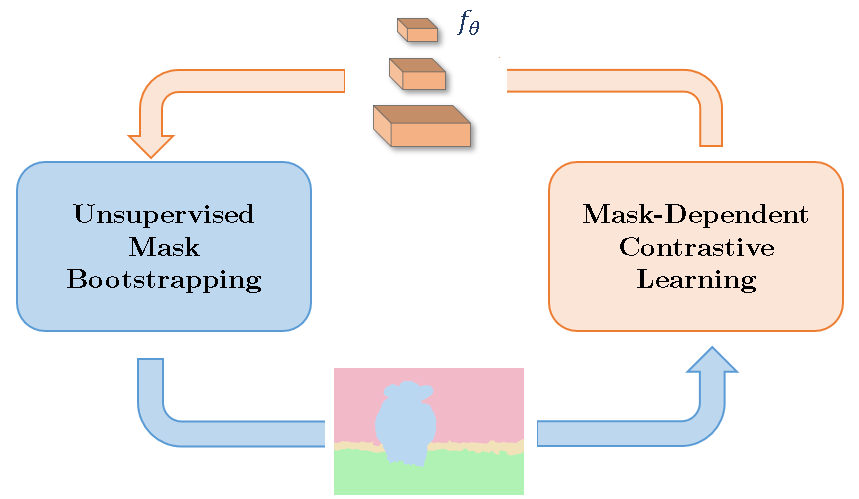
1/7: Excited to share our ECCV work on a new scalable paradigm for self-supervised learning in-the-wild! We iterate ad infinitum between unsupervised generation of segmentation masks and contrastive learning which leverages those masks, all throughout improving representations.
Ren Wang tweet media
English
1
0
0
0