Naty Hoffman retweetledi
Naty Hoffman
5K posts

Naty Hoffman
@renderwonk
Real-Time Graphics Specialist (Retired)
Burlingame, CA Katılım Şubat 2010
250 Takip Edilen7.6K Takipçiler
Naty Hoffman retweetledi


@g_Schellenbaum I don’t disagree with anything you’ve written. Until we have a better model then all these things are worth doing. Separately from that, I have a strong feeling that a better model is out there and we should be spending more effort on finding it.
English

@renderwonk I was neither disagreeing with you nor suggesting everyone do what TCP does. The practical values of having a better model are clear. There's no disputing that.
However, here is some food for thought: (1/6)
English

This might be the most important paper on surface shading to come out in years. TL;DR: microfacet models are wrong and proposed wave-based or hybrid alternatives are wrong too. This is an exciting opportunity for new research! ssteinberg.xyz/2026/04/01/acc…
English

@tonyblu331 @g_Schellenbaum I meant the directional error term specifically - it only works when you have a massive calibrated database of photo references to analyze. It’s not the kind of thing that an artist could paint from scratch when creating a surface from a concept sketch.
English

@renderwonk @g_Schellenbaum Agree, one of the drawbacks of the TCP shading model is the lack of artistic control. Seems like you need to learn how to fly an airplane just to tweak a few sliders. It works beautifully, but definitely an in-house solution.
English

@g_Schellenbaum TCP is a great example of a practical production solution. But it doesn’t replace the need for a model which is robust, artist-controllable and *also* (unlike current models) matches the real world; if anything it shows the need for such a model.
English

@renderwonk You could of course consider it a work-around or a "hack" but TCP addressed this problem directly by using the directional error to correct the shading. It's pragmatic, results-driven and actually works. Jump to 28:20 in the video: gdcvault.com/play/1029339/T…
English
Naty Hoffman retweetledi

We’re excited to welcome Blake Taylor as a keynote speaker at I3D 2026.
More details: #blake-taylor" target="_blank" rel="nofollow noopener">i3dsymposium.org/2026/keynotes.…
Register here: i3dsymposium.org/2026/registrat…
#I3D2026
English
Naty Hoffman retweetledi

We’re excited to welcome Naty Hoffman as a keynote speaker at I3D 2026.
More details: #naty-hoffman" target="_blank" rel="nofollow noopener">i3dsymposium.org/2026/keynotes.…
Register here: i3dsymposium.org/2026/registrat…
#I3D2026
English
Naty Hoffman retweetledi

New blog post!
In "Quantizing tangent frames", we look at various established methods to represent tangent frames in the vertex data, squeeze a few variants into 32 bits per vertex and look at the resulting precision.
zeux.io/2026/04/30/qua…
Retweet, like and subscribe!
English
Naty Hoffman retweetledi

Ultra-fast Screen-Space Refractions and Caustics via Newton’s Method jcgt.org/published/0015…
English
Naty Hoffman retweetledi

The early registration deadline for I3D 2026 at Lucasfilm (May 13-15th) is fast approaching, with only one week left!
Early registration deadline is: 17 April 2026
Register now to secure your spot: i3dsymposium.org/2026/registrat…
#I3D2026
English
Naty Hoffman retweetledi

I've been reverse engineering Apple's, ARM's, and ImgTec's hardware image compression formats. ARM's AFRC is the clear winner, but does native hardware compression make real-time texture encoding obsolete?
ludicon.com/castano/blog/2…
English
Naty Hoffman retweetledi

G. K. Chesterton explains that reading gives a man more lives than he was born with:
“A man who has read a thousand books is armed for life; a man who has read none is easy prey. The man who has read a thousand books has lived a thousand lives. He has seen cities he has never visited, spoken to men who died centuries ago, and walked in worlds that no longer exist. Reading does not merely inform him; it enlarges him. It stretches the boundaries of his own experience until he becomes something more than himself.”

English

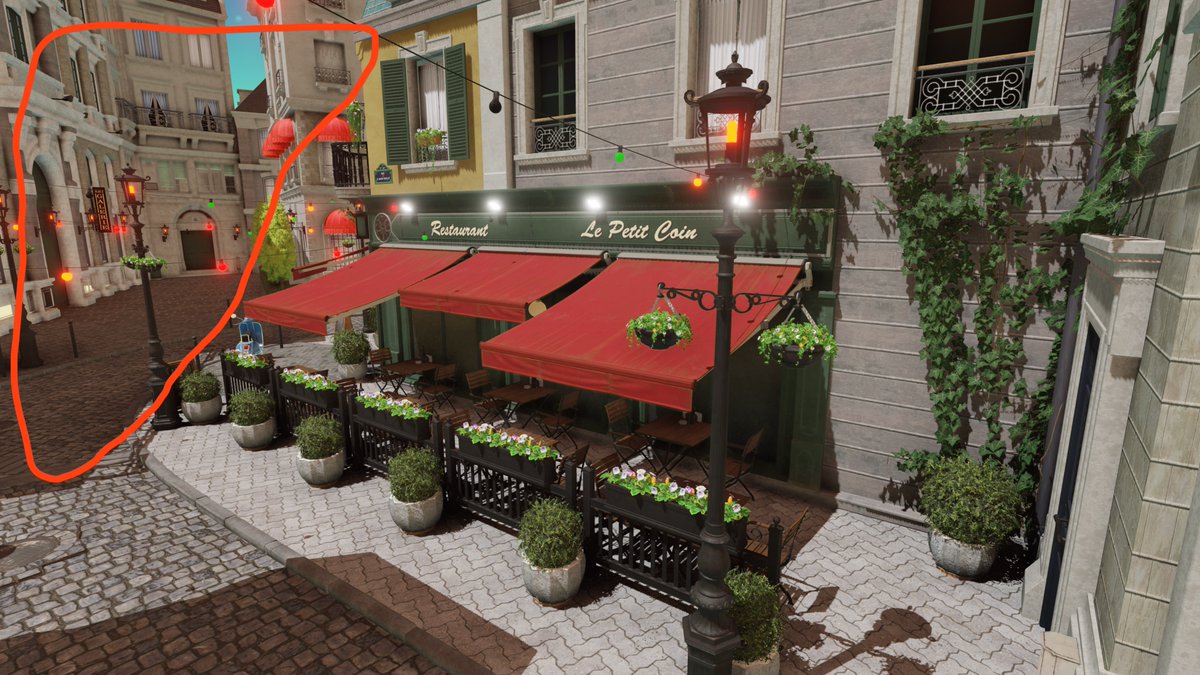
@SebAaltonen Since the AO solution you need is long-distance / low-frequency only (backed up by SSAO for the high-frequency stuff) couldn’t you bake or compute it at an extremely low spatial frequency? Wouldn’t that take care of the storage / memory / compute resource issues?
English

Increasing SSAO kernel isn't going to work, you get very visible screen space artifacts on screen edges. Screen space isn't good enough for large scale AO. We could use some sky-visibility approximation. Distance fields (sphere trace) would require building up distance field from the whole scene, and that takes memory. In a web page total RAM allocation is limited to 1.5GB. Also web page must load fast, so we can't bake big distance fields to disk (server). You could use hardware ray-tracing for it, but WebGPU doesn't have hardware ray-tracing, and we are targeting mobile phones as well. Performance would not be good enough. AC4: Blag Flag had top-down AO. Basically a pre-blurred shadowmap straight from top. Works well with big buildings casting long soft AO. But it's a hack. Not physically correct. And doesn't work in all scenes.
English
Naty Hoffman retweetledi

To encourage more submissions we are extending the deadline for posters by one week, to 27 March 2026.
Poster and demo notification is now extended to 3 April 2026.
More information about poster submissions at: i3dsymposium.org/2026/cfp-poste…
#I3D2026
English
Naty Hoffman retweetledi

A self-contained, portable implementation of Adobe's OpenPBR 1.0 BSDF github.com/adobe/openpbr-…
English