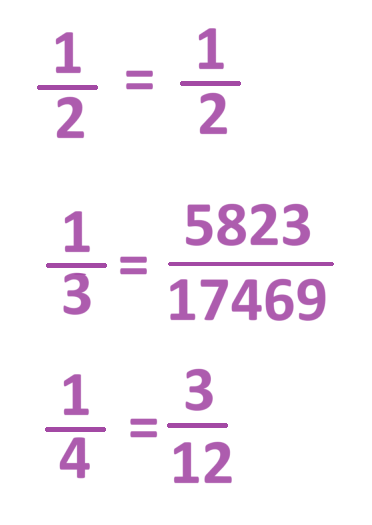
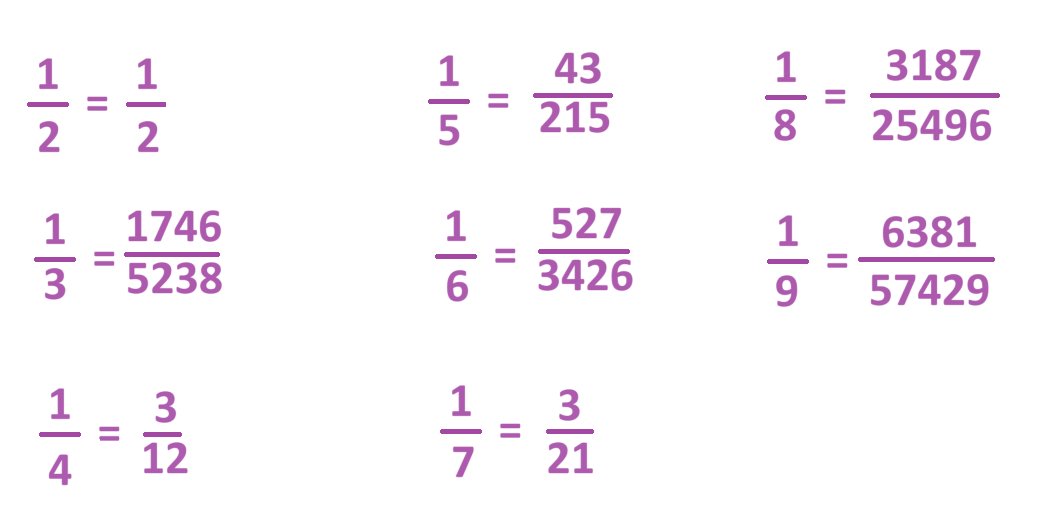
@jamestanton@republicofmath no wonder I was confused. You and I were responding to different questions! When you gave an example for one over six and one over seven, I was still responding to representing 1/3 using values from one to six or from one to seven!
It is possible to express each of 1/2, 1/3, and 1/4 as a ratio of two integers where each of the digits 1, 2, 3, .... (up to some value) are used exactly once.
Is there an easier way to express 1/3?
Base b is "robust" if each fraction 1/2,1/3,..,1/(b-1) is a ratio of two integers expressed in base b that use each digit 1, 2, 3,.... (up to some value) exactly once. (1/b cannot be so expressed. Why?)
@iconjack shows base 10 is robust.
Base 3 and base 4 are robust. Base 5? 6?
Hi! Next month I'm running a learning experience for K-12 teachers called "21st Century Mathematics". Its goal is to help teachers to connect the math they teach with some math that has been discovered in the 21st century.
Info+register: justinlanier.org/21st-century-m…
Pass it along!
@jamestanton Express each 1/n, n= 1, ..., 9 in the simplest form as a ratio of two integers where each of the digits 1, 2, 3, .... (up to some value) are used exactly once.
What about 1/n for n>= 10?
Data from 350,757 coin flips provide strong evidence that when some (but not all) people flip a fair coin, it tends to land on the same side it started.
arxiv.org/pdf/2310.04153…
N>1 cups all upright. A "move" consists of turning all but 2 cups over. (So, each move N-2 cups change state upright/upside-down.)
For which N is it possible to make all N cups upside-down?
[General theory about N cups and turning N-k over at a time?]