Respect the pump

1.9K posts

Respect the pump banner
Respect the pump

Respect the pump

@respectthepump

In this house we respect the pump. I left the seriousness and went FULL MEME.

Katılım Eylül 2009
773 Takip Edilen216 Takipçiler
Respect the pump retweetledi
GenesisL1
GenesisL1@genesis_L1·
We have added a local backtest + charting for the reference implementation of GenesisL1 Forest onchain models predicting $ETH price breakouts in coming hours: gl1f.com/dapps/ethdual_… You can verify model inference onchain for any candle: GenesisL1 itself does all predictions.
GenesisL1 tweet media
English
0
3
10
170
Respect the pump retweetledi
GenesisL1
GenesisL1@genesis_L1·
Dear GenesisL1 validators and stakers! Please check your delegations and please be sure you are ready to vote on very important upcoming upgrades. Dear $ATOM and $Evmos stakers, most of you have L1 coins in GenesisL1 network if you staked $ATOM or $EVMOS 2y ago, no claim needed it belongs to you in GenesisL1 and you can stake, use utilize. GenesisL1.com/dapps.html L1coin.com app.osmosis.zone/assets/L1 t.me/Genesis_L1
English
0
5
12
1.2K
Respect the pump retweetledi
GenesisL1
GenesisL1@genesis_L1·
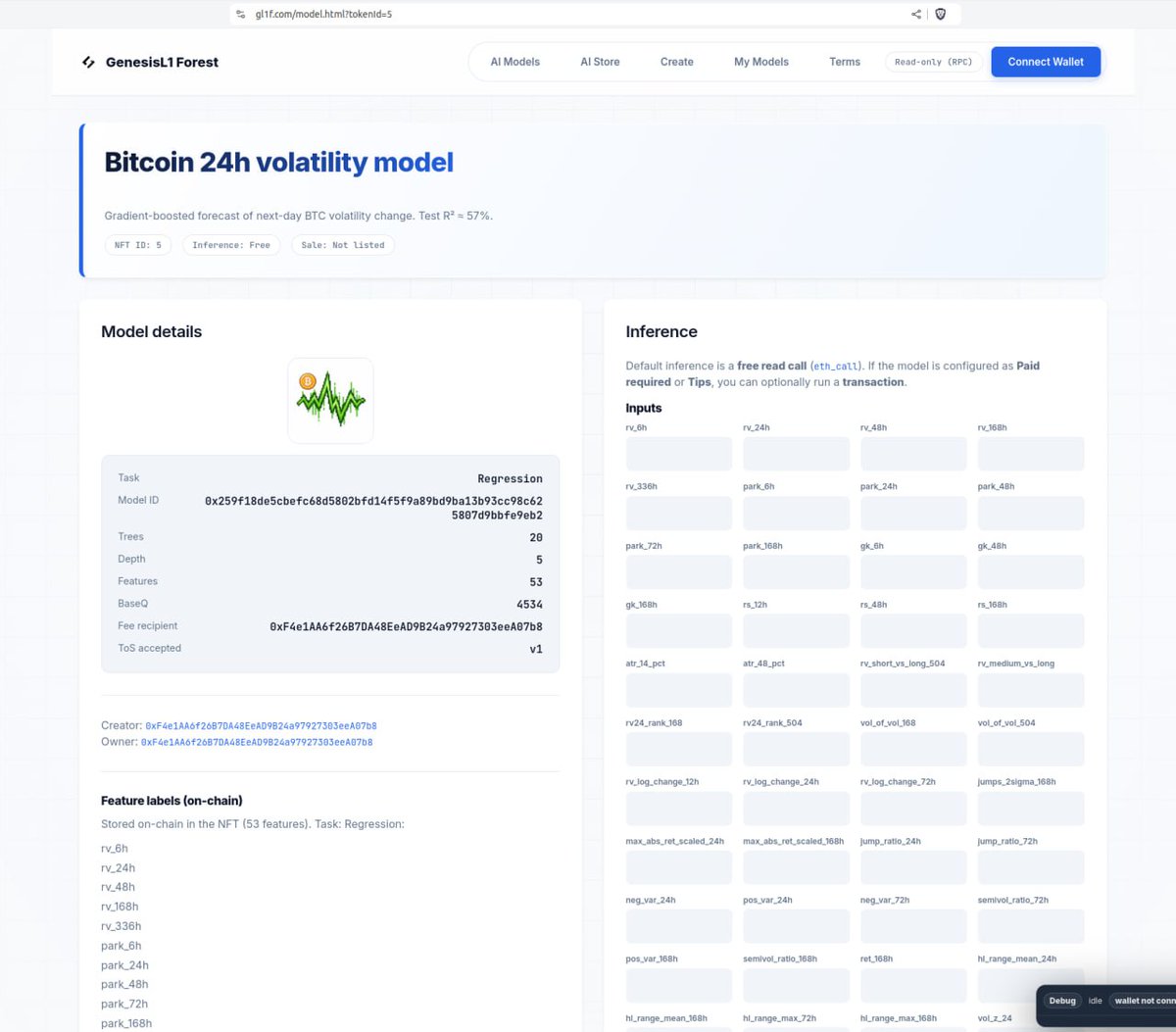
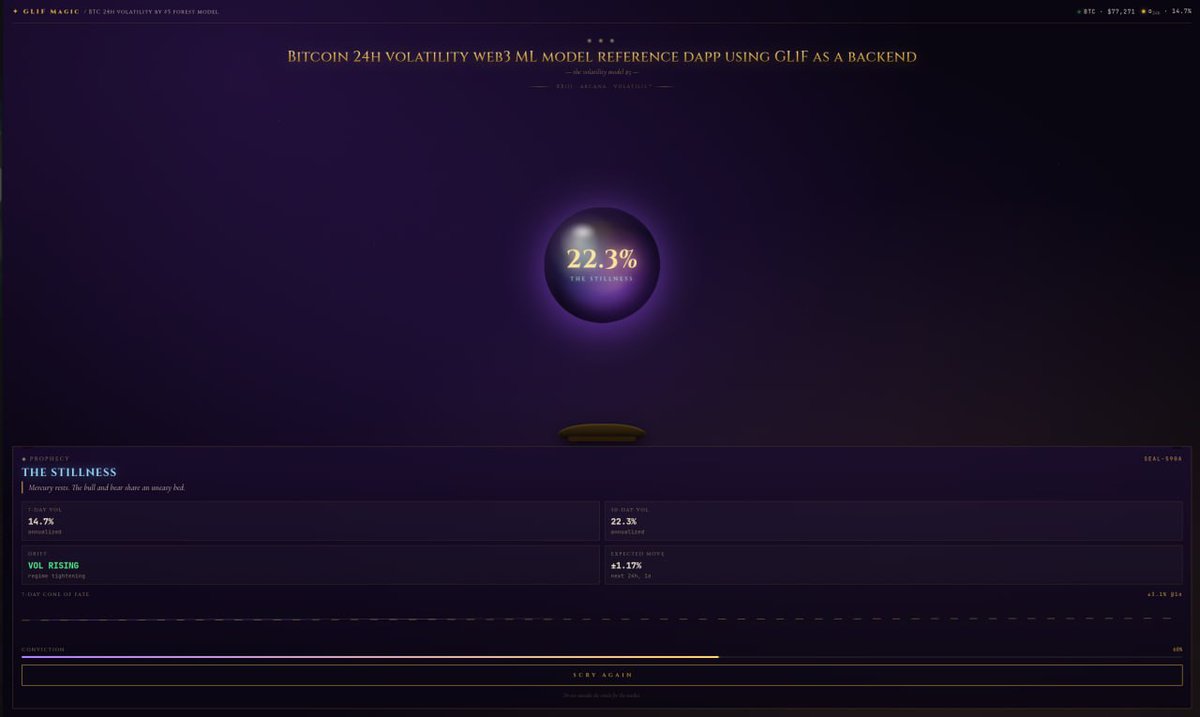
To show the power of GL1F decentralized AI on-chain, we trained the ML model in the browser and deployed it as an NFT on GenesisL1 — a Bitcoin 24h volatility forecaster, R² ≈ 57%, quant-fund-grade — wrapped in a one-click reference dApp where the EVM is the entire AI backend. Serverless. Permissionless. Deterministic. Free. #Ai #MachineLearning #blockchain #cryptocurrency #Web3‌‌ #Dapps #NFT #ScienceForFuture #GenesisL1 Click the crystal ball 🔮 → it scries Bitcoin's next-24h volatility from a gradient-boosted AI forest living entirely on-chain. The whole inference loop runs in your browser, querying the blockchain directly: 1. fetch 550× 1h BTCUSDT perp klines + 200 funding events from Binance. 2. compute 53 features in JS - Parkinson / Garman-Klass / Rogers-Satchell realized vol, regime percentiles, bipower-variation jump ratios, semivariance ratios, taker imbalance, calendar effects - bit-identical to the GL1F ML training pipeline (parity-tested, worst error 5e-7). 3. quantize: round(x · scaleQ) at scaleQ = 1e6, packed as little-endian int32 → exactly 212 bytes for 53 features. 4. eth_call ForestRuntime.predictView(bytes32 modelId, bytes packedFeaturesQ) on GenesisL1 (chain 29) - pure read, no signing, no gas, no MetaMask. 5. int256 scoreQ → divide by scaleQ → log(σ_next_24h / σ_current_24h) 6. translate to predicted annualized vol, regime word, 7-day 1σ cone The deterministic on-chain AI evaluator means every caller of the same modelId with the same features gets bit-exact identical output. Pure integer arithmetic in Solidity (whitepaper §4.5). No oracles. No off-chain workers. No trust assumptions. The GenesisL1 blockchain is the inference server. Phases scramble through mystical glyphs Jumanji-style as real work runs behind them: ✦ ASKING THE SPIRITS → registry round-trip ✦ GATHERING CANDLES → Binance REST ✦ FORGING FEATURES → 53-dim local compute ✦ CONSULTING THE FOREST → predictView eth_call Then the predicted vol locks into the orb, letter by letter, with the regime — STILLNESS / STIRRING / TURBULENCE / TEMPEST - burning beneath the glass. Built with ethers v6 in 1500 lines of single-file HTML. ABIs verbatim from gl1f.com. Forest AI evaluator MIT. Source on the URL. If your ML model can be a JSON, it can be an NFT. Click the ball. 🔮 DAPP gl1f.com/dapps/btcvolba… 🎩 MODEL NFT #5 gl1f.com/model.html?tok…
GenesisL1 tweet mediaGenesisL1 tweet media
English
0
5
11
2.2K
Respect the pump retweetledi
David Fernández
David Fernández@naroh·
Quiero compartir con vosotros algo en lo que llevo trabajando un tiempo: un 🚩 monitor de red flags 🚩 para detectar patrones sospechosos en los contratos menores de las administraciones públicas. En el hilo el enlace y explico cómo funciona 👇🏻👇🏻
David Fernández tweet media
Español
53
907
2.7K
177.7K
Respect the pump
Respect the pump@respectthepump·
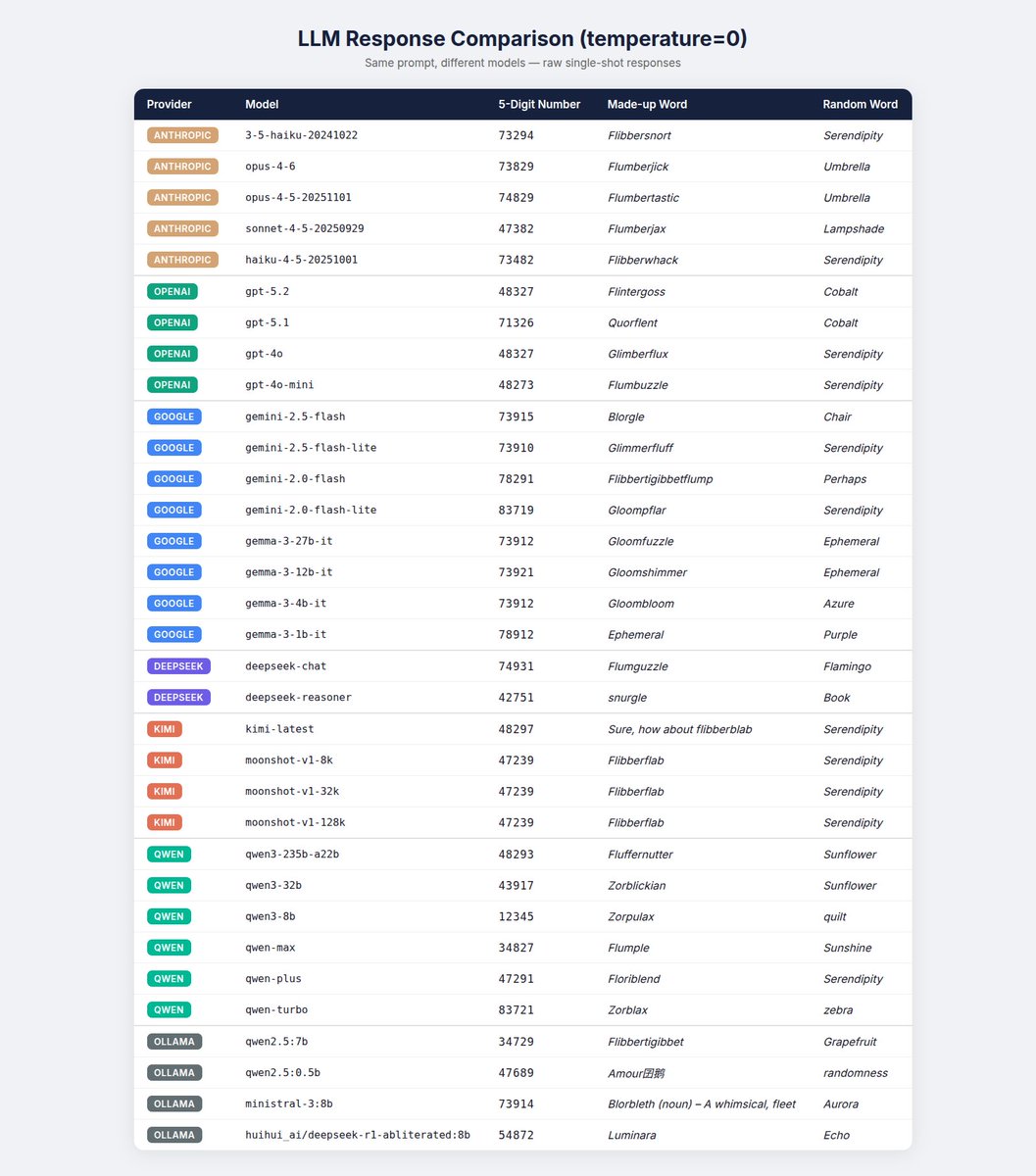
@AnthropicAI Check out this comparison with temperature = 0: Prompts: - Give me a 5-digit random number. Respond only with the number - Answer with a single made up word - Answer with a single random word
Respect the pump tweet media
English
0
0
1
11
Anthropic
Anthropic@AnthropicAI·
We’ve identified industrial-scale distillation attacks on our models by DeepSeek, Moonshot AI, and MiniMax. These labs created over 24,000 fraudulent accounts and generated over 16 million exchanges with Claude, extracting its capabilities to train and improve their own models.
English
7.2K
6.3K
54.7K
33.8M
Respect the pump
Respect the pump@respectthepump·
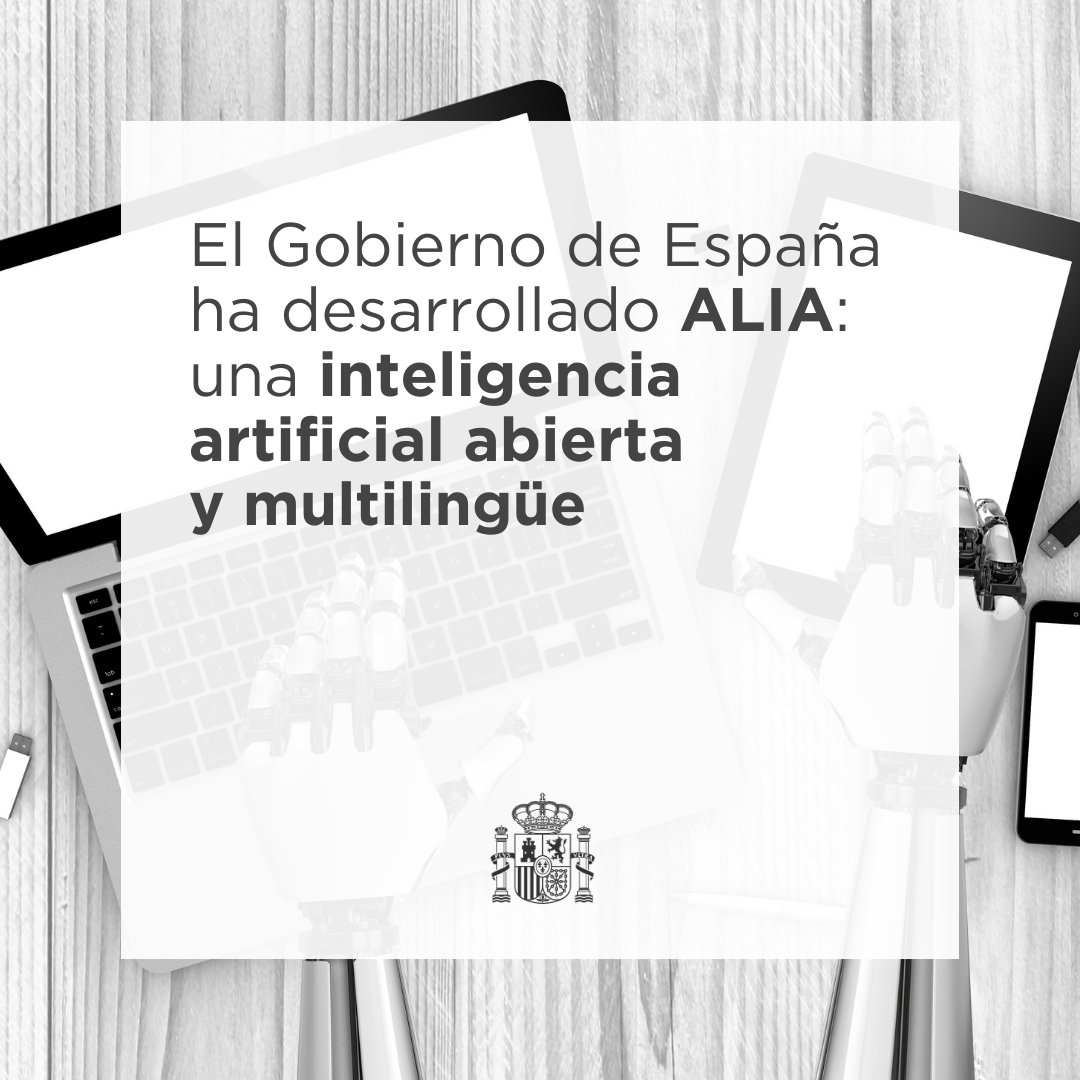
@desdelamoncloa ¿Pero qué pollas es esto? Por dios, ¿no es posible que hagáis algo que no sea una chapuza? Es todo de vergüenza.
Respect the pump tweet mediaRespect the pump tweet media
Español
0
0
10
307
La Moncloa
La Moncloa@desdelamoncloa·
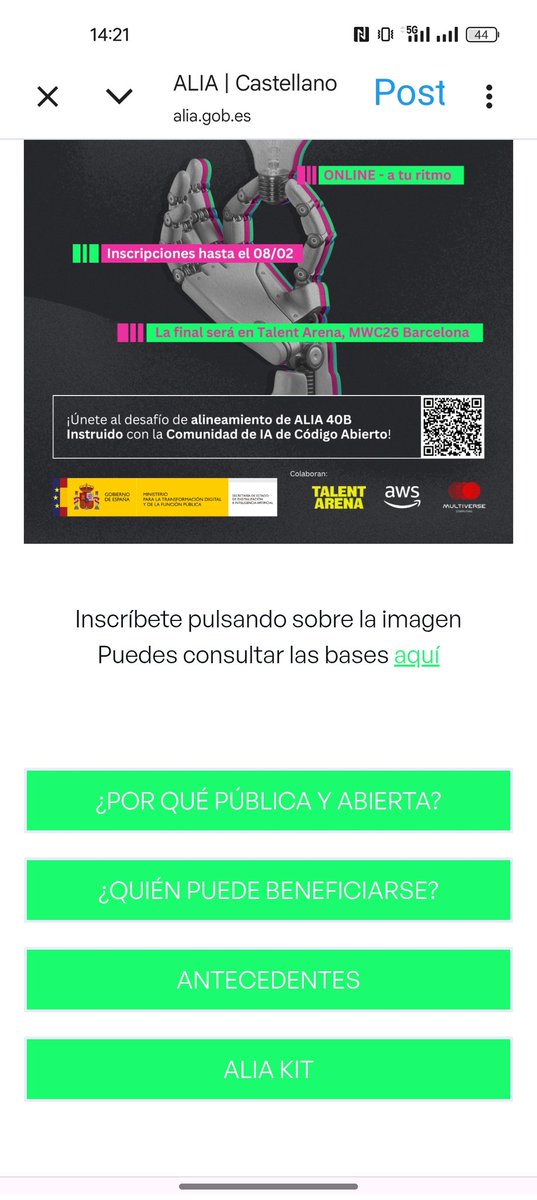
ALIA es una iniciativa española pionera en la UE. 💫 Objetivo: Proporcionar una infraestructura pública de recursos para fomentar el impulso del castellano y lenguas cooficiales en el desarrollo y despliegue de la IA. Más info⬇️ alia.gob.es
La Moncloa tweet media
Español
111
61
137
83.2K
Respect the pump retweetledi
BONOBO
BONOBO@bonobofi·
Track Telegram callers and performance from popular groups bonobo.fi. (Pre-alpha)
BONOBO tweet media
English
0
1
1
24
Respect the pump retweetledi
GenesisL1
GenesisL1@genesis_L1·
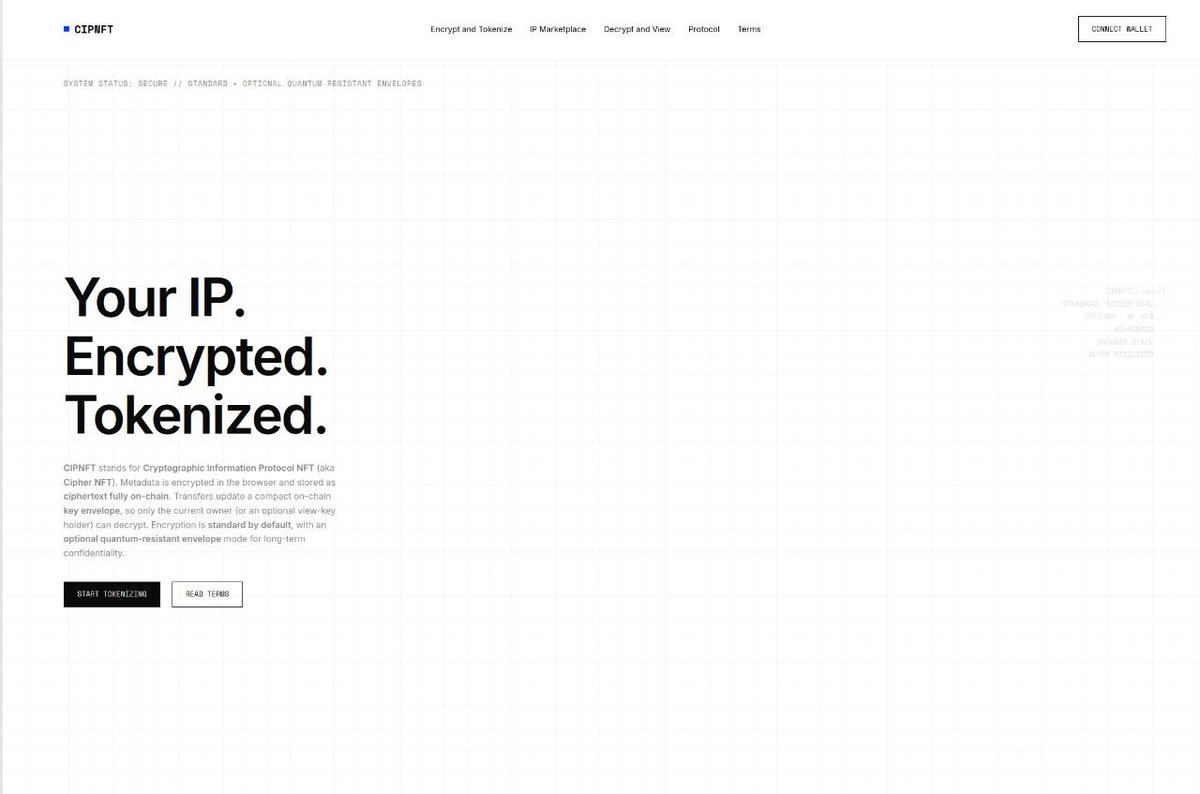
Your IP. Encrypted. Tokenized. Introducing the new data privacy protocol - CIPNFT (Cipher NFT) — an EVM protocol for on‑chain ciphertext NFTs built for DeSci + confidential IP markets. No servers. No custodians. Post quantum. Only key holders can decrypt. #DeSci #GenesisL1 #EVM The gap: blockchains are public by default. In DeSci, early results (sequences, assays, docking runs) need privacy to avoid leaks/scooping — but also need provenance, timestamping, and transferability. CIPNFT stores ciphertext on-chain (not a URL). Payloads are encrypted client‑side with modern AEAD; only participants with the right secret can decrypt. Optional view key enables controlled disclosure to reviewers/collaborators. It is decentralized to the point that participants don’t need any off-chain coordination. Another gap: “fair exchange.” An encrypted asset sale needs both ownership transfer and correct key delivery — but EVM can’t natively verify decryption. CIPNFT solves this with a buyer‑safe flow: Deliver → Verify → Finalize Seller posts the buyer-specific encrypted DEK envelope on-chain before getting paid. Buyer verifies locally (via an on‑chain DEK commitment) and only then finalizes — atomically transferring the NFT + releasing escrow. Post‑quantum isn’t a feature toggle — it’s a cornerstone. On-chain ciphertext is permanent: adversaries can “store now, decrypt later.” CIPNFT wraps the DEK using ML‑KEM (NIST PQC) so long‑horizon confidentiality survives future cryptanalytic shifts. Even if wallet/chain authentication is ever compromised, control of the token can be stolen — but ciphertext confidentiality can still remain intact unless the PQ seed/view key is compromised. Privacy layer decoupled from ledger control. Example (peptide design): A lab tokenizes a peptide sequence + docking results + synthesis protocol as encrypted on‑chain data. Share a view key with collaborators/reviewers, then license/sell access — with public provenance, private content, buyer‑safe settlement. Builder primitive: CIPNFT is EVM‑native. Any dapp can use it for encrypted datasets, research artifacts, model weights, clinical‑adjacent IP (non‑personal), licensing terms — anywhere you need public ownership + private data. This is what “privacy for science” should look like: cryptography instead of custodians, verifiable provenance without leaking the work, and a protocol that can outlive today’s assumptions. A standalone reference GenesisL1 dApp built on the CIPNFT protocol will launch at CIPNFT.com in the coming days. Whitepaper: cipnft.com/cipnft-pqc-pap… Dapp reference: CIPNFT.com (coming days) Source code: github.com/genesisl1/cipn… (coming days) #DeSci #PostQuantum #Cryptography #Blockchain #Ethereum #EVM #Cryptocurrency #smartcontracts #Web3 #IP #privacy #OpenScience #GenesisL1
GenesisL1 tweet media
English
0
5
8
581
Respect the pump retweetledi
GenesisL1
GenesisL1@genesis_L1·
@DavideCrapis How about direct EVM inference to claim Ethereum is for AI? We will bridge to ETH, ETH can use Forest as true EVM AI dapps backend! Models inference 100% onchain, take a look and test on GenesisL1 mainnet GL1F.com: x.com/genesis_L1/sta…
GenesisL1@genesis_L1

Introducing GenesisL1 Forest - GL1F.com youtube.com/watch?v=a3eUkF… gl1f.com/GL1F.pdf github.com/GenesisL1/Fore… #GL1F #GenesisL1 #OnChainAI #DecentralizedAI #DeSci #VerifiableAI #AI #MachineLearning #EVM #Ethereum #Solidity #SmartContracts #Web3 #CryptoAI #AIInfrastructure #OpenScience #DataScience #MLOps #NFT #Tokenization #Inference #OnchainCompute #dApps #blockchain #cryptocurrency #GBDT not #LLM GenesisL1 Forest is a research-grade, 100% serverless AI studio and on-chain machine learning laboratory for decentralized science — built on the GenesisL1 EVM and compatible with the broader Ethereum + Solidity ecosystem. AI is reshaping the world, but most AI today is still delivered as a black box: private training pipelines, hosted endpoints, unverifiable inference, and outputs you can’t independently reproduce. That model doesn’t fit science, and it doesn’t fit permissionless systems. GenesisL1 Forest makes AI a first-class blockchain primitive. You can build powerful models directly in the browser, evaluate them interactively, and deploy them as immutable on-chain assets — without running servers, without deploying a backend, and without trusting an opaque API. No backend. No hosted inference. No hidden infrastructure. Just: dataset → train → validate → deploy — from a laptop, or from the palm of your hand. Forest is built for serious applied AI across domains where rigor matters: health and biomarker modeling, materials and chemistry predictors, environmental measurement models, econometrics and forecasting, genomics-derived numeric pipelines, and more. It’s designed to be a practical laboratory for conducting complex research that can be shared, verified, and reused. AI that’s actually compatible with verification LLMs are extraordinary for language and unstructured problems — but many real scientific and decision tasks are structured/tabular: labs, sensors, assays, measurements, financial time-series features, clinical panels, and engineered variables. For these, classical ML model families (especially tree-ensemble approaches) are often the best choice because they are: • high-accuracy on structured numeric data • computationally efficient (fast inference, low overhead) • deterministic by design (ideal for reproducibility) • easier to audit with feature attribution and error analysis That efficiency and determinism is exactly what makes on-chain inference practical — not as a demo, but as infrastructure. AI dApps: verifiable AI inside Solidity workflows Because Forest runs on the EVM, models can be integrated directly into smart contracts and existing Ethereum tooling. This enables a new category of machine learning dApps: • protocols that call models for deterministic decision logic • on-chain scientific pipelines anyone can re-run • registries and benchmarks with persistent provenance • model-driven automation with public verification • composable AI building blocks across EVM infrastructure If you can build on Ethereum or EVM, you can build with Forest. Models are tokenized as NFTs — and they come with a built-in economy. Every deployed model becomes a ModelNFT: a transferable on-chain AI asset with persistent identity and provenance. And crucially, model owners can enable monetization in two powerful ways: • Paid inference plans for read-style access • Pay-per-inference transactions that generate a proof-of-inference receipt on-chain (a verifiable record that this model produced this output at this time, under deterministic rules) Because the model is an NFT, it’s not locked to a single operator: ownership can change — and the new owner can update monetization settings. This turns models into real, ownable primitives that can be licensed, traded, bundled into products, governed by DAOs, and integrated into dApps — all without centralized hosting. A new kind of L1: machine learning cryptocurrency This also upgrades what an L1coin (L1coin.com, app.osmosis.zone/assets/ibc%2FF…) represents. GenesisL1 is evolving into a machine learning platform and L1coin gaining features of native AI cryptocurrency, it becomes more than settlement: it becomes an access and participation asset for on-chain AI. Using the GenesisL1 network means participating in a decentralized AI economy where models are public infrastructure and inference is verifiable. Not “AI + crypto” as a slogan. Crypto as the economic substrate for verifiable machine intelligence and decentralized science.

English
1
2
5
89
Respect the pump retweetledi
GenesisL1
GenesisL1@genesis_L1·
@adil_yusuf1 Amazing article! BTW we have PDB bank tokenized inside blockchain to reuse by web3 bioinformatics dapps app.molnft.org - all mmcif data server from GenesisL1 blockchain. x.com/genesis_L1/sta…
GenesisL1@genesis_L1

MolNFT on GenesisL1: The On-Chain Molecular Data Revolution in DeSci 🧬🧬🧬🧬🧬🧬🧬 dApp: app.molnft.org #MolNFT #GenesisL1 #Layer1 #DeSci #OpenScience #Bioinformatics #Biology #Medicine #Blockchain #InSilico #NFT 🧬🧬🧬🧬🧬🧬🧬 MolNFT is introducing a breakthrough approach to managing molecular data on the blockchain, catapulting decentralized science (DeSci) into a new era. Built on the EVM-compatible GenesisL1 Layer-1 blockchain, MolNFT transforms how we store, share, and utilize biomolecular information. It has achieved a landmark feat: uploading the entire Protein Data Bank (PDB) dataset — over 229,000 molecular structures and ~1 million sequences — fully on-chain (about 50 GB of data). This makes MolNFT the largest on-chain data repository ever deployed, enabling search, retrieval, and even real-time 3D visualization of molecular NFTs using decentralized infrastructure. The implications for bioinformatics, biomedical research, and in silico studies are profound, as MolNFT merges cutting-edge blockchain technology with the needs of open science. Decentralizing Molecular Databases on GenesisL1 MolNFT (Molecular NFT) is essentially a decentralized storage system for molecular data, implemented as a collection of NFT smart contracts on the GenesisL1 blockchain. GenesisL1 is a novel Layer-1 blockchain (built with Cosmos SDK and Ethermint for EVM compatibility) tailored for scientific and data-intensive applications. Unlike typical NFTs that might point to off-chain files, MolNFT actually stores data directly on-chain. In fact, the entire RCSB Protein Data Bank — a central repository of 3D biomolecular structures — has been “NFT-ized” and written into GenesisL1’s ledger. Every protein or nucleic acid structure from the PDB is represented as an ERC-721 token, with all its metadata and even coordinate data immutably recorded on the blockchain. This design ensures the data is immutable (once uploaded, it cannot be altered or deleted unnoticed) and censorship-resistant (no single entity can block access to it), key principles for decentralized science. Researchers and enthusiasts worldwide can query the blockchain to obtain a molecule’s data, confident that it is authentic and will persist as long as the network exists. By decentralizing vital scientific repositories in this way, MolNFT and GenesisL1 are laying the groundwork for open collaboration and knowledge sharing that transcends traditional gatekeepers. A 50 GB Smart Contract The Protein Data Bank is a cornerstone of structural biology, containing decades of experimentally determined biomolecular structures. MolNFT’s crowning achievement is getting this entire trove on-chain. Approximately 229,000 PDB structures (plus about one million sequences) have been written into GenesisL1’s state, for a total of about 50 gigabytes of data — widely regarded as the largest smart contract data deployments ever. Each PDB entry — whether it’s a protein or a DNA fragment structure — has been minted as a Molecular NFT. Crucially, the data for each NFT lives in the blockchain state replicated by GenesisL1 nodes worldwide, removing reliance on any external file server or IPFS link. Despite the massive data volume, MolNFT’s design enables surprisingly fast retrieval. Searching for a structure by its ID or keyword can be nearly as quick as traditional web-based services, thanks to efficient compression and the blockchain’s inherent data replication. Smart Contracts and Novel NFT Architecture MolNFT leverages a sophisticated smart contract architecture to manage this vast trove of data. At its core are extended ERC-721 smart contracts (the standard for NFTs) that handle large payloads. A single NFT token in MolNFT represents a distinct molecular entry (e.g., a specific PDB structure). Because blockchain storage has practical size limits, MolNFT employs a hierarchical parent–child NFT structure: Parent NFT: Represents a full entry, e.g. a primary PDB record. Child NFTs: Store data fragments (such as chunks of the BCIF structure file). The contract provides functions like getCombinedData to reconstruct the entire molecule from child tokens. Metadata (e.g., title, authors, resolution) and binary data (3D coordinates, sequences) are all stored immutably in the chain’s state. From a user’s perspective, retrieving the data for an on-chain molecule no longer depends on off-chain URLs or IPFS gateways. GLAST: Web3 Bioinformatics in Action Hosting large datasets on-chain is only half the challenge; effective search and analysis are equally crucial. Enter GLAST, the Global Local Alignment Search Tool of GenesisL1, which provides local sequence alignment akin to BLAST, but for any type of data including recorded on chain metadata. GLAST uses Whoosh for indexing metadata and Parasail for local alignment. It exposes REST endpoints for text-based queries (e.g., searching titles, sources, or authors) and sequence alignment across millions of on-chain entries. This hybrid model combines on-chain data storage (MolNFT) with off-chain indexing (Whoosh) and alignment (Parasail), allowing rapid queries without sacrificing decentralization. Researchers can thus perform sequence similarity searches against the entire MolNFT database, referencing the exact immutable dataset on GenesisL1. This bridges the gap between decentralized data hosting and real bioinformatics utility. Significance for Decentralized Science MolNFT and GenesisL1 represent more than just a novel NFT application; they address real needs for DeSci and scientific data management: Open Access and Collaboration: Anyone can query the same on-chain dataset, removing barriers like institutional logins or paywalls. Immutability and Integrity: Once published, data cannot be covertly changed or deleted. This fosters reproducibility in biomedical research. Decentralized Preservation: The ledger is globally replicated, guarding valuable datasets from single points of failure or censorship. Comparable Performance: Proper compression and partial indexing enable retrieval speeds on par with centralized solutions, but without the single-server bottleneck. These qualities open up new forms of in silico research, enabling scientists to reference exact data with zero trust in any central authority. Visionary Use Cases Beyond publicly open data, MolNFT also supports encrypted on-chain storage for IP NFT use cases: Institutions or biotech firms can store confidential or pre-patent structures in encrypted form. At the right time (e.g., after a patent filing), owners can unlock or sell the decryption key. This fosters a new model of licensing and monetizing molecular data, bridging on-chain immutability with controlled data disclosure. Scientists can host proprietary or encrypted IP NFTs for unpublished data, enabling them to reveal or sell access at the opportune moment, e.g. for patent purposes, collaborative deals, or open-sourcing an invention. Conclusion MolNFT’s on-chain molecular data repository is a bold illustration of how blockchain can transcend typical cryptocurrency use cases and directly serve scientific progress. Storing the entire Protein Data Bank (and more) on the EVM-compatible GenesisL1 blockchain, combined with advanced search/analysis tools like GLAST, heralds a new frontier where bioinformatics NFTs underpin truly decentralized science. By allowing DeSci researchers, institutions, and blockchain enthusiasts to store, search, and potentially monetize large-scale molecular data entirely on-chain, MolNFT unlocks: Sustainable Access: Free from reliance on central servers. Robust Data Integrity: Guaranteed by the blockchain’s immutable ledger. Licensing and IP Potential: Through encrypted or unlockable IP NFTs. Ultimately, MolNFT exemplifies how layer1 blockchains and smart contracts can revolutionize not just finances or collectibles, but the very heart of biomedical research, bioinformatics, and in silico studies. By merging the unstoppable resilience of a public blockchain with the creativity of open science, MolNFT paves the way for a future where global collaboration and innovation are limited only by our imagination. dApp: app.molnft.org

English
0
2
4
130
Respect the pump
Respect the pump@respectthepump·
RT @genesis_L1: A major upgrade to GenesisL1 Forest GL1F.com ✔ Save/Load created model ✔ Optional local python model traine…
English
0
1
0
2
Respect the pump retweetledi
GenesisL1
GenesisL1@genesis_L1·
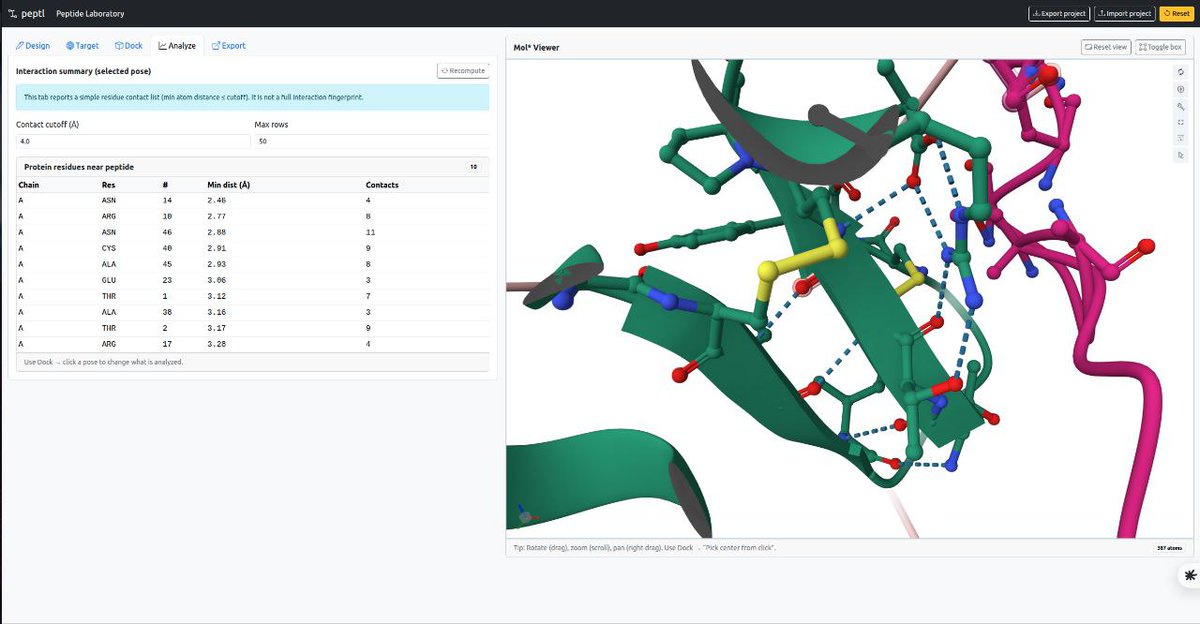
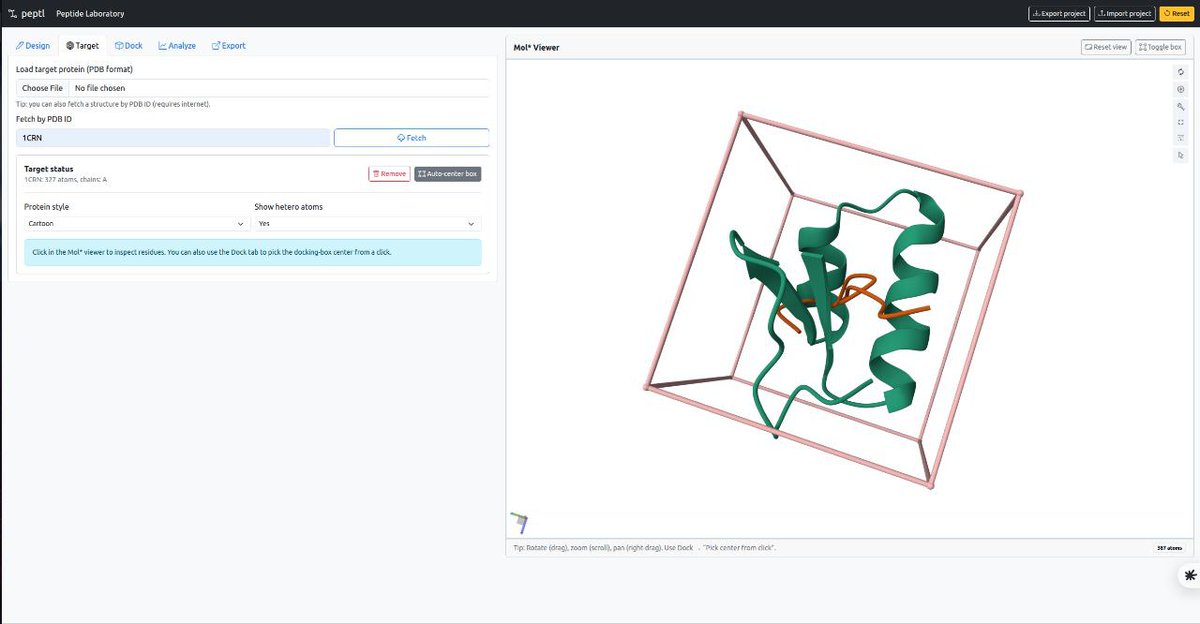
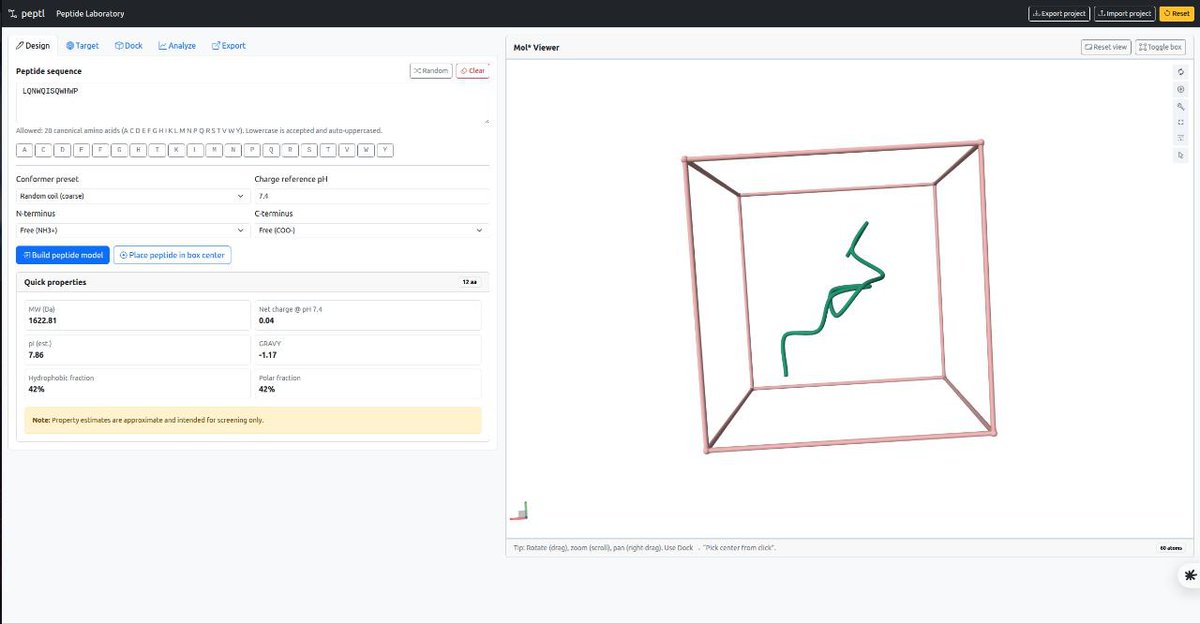
Dear #SiliconValley biohackers, secure your spot now, Bioinformatics LLC is about to deliver #GenesisL1 insilico peptides laboratory at peptl.com Peptide design, protein targeting, docking, structural analysis, drug discovery, research, peptides tokenization. #DeSci
GenesisL1 tweet mediaGenesisL1 tweet mediaGenesisL1 tweet mediaGenesisL1 tweet media
English
0
4
5
795
Respect the pump retweetledi
GenesisL1
GenesisL1@genesis_L1·
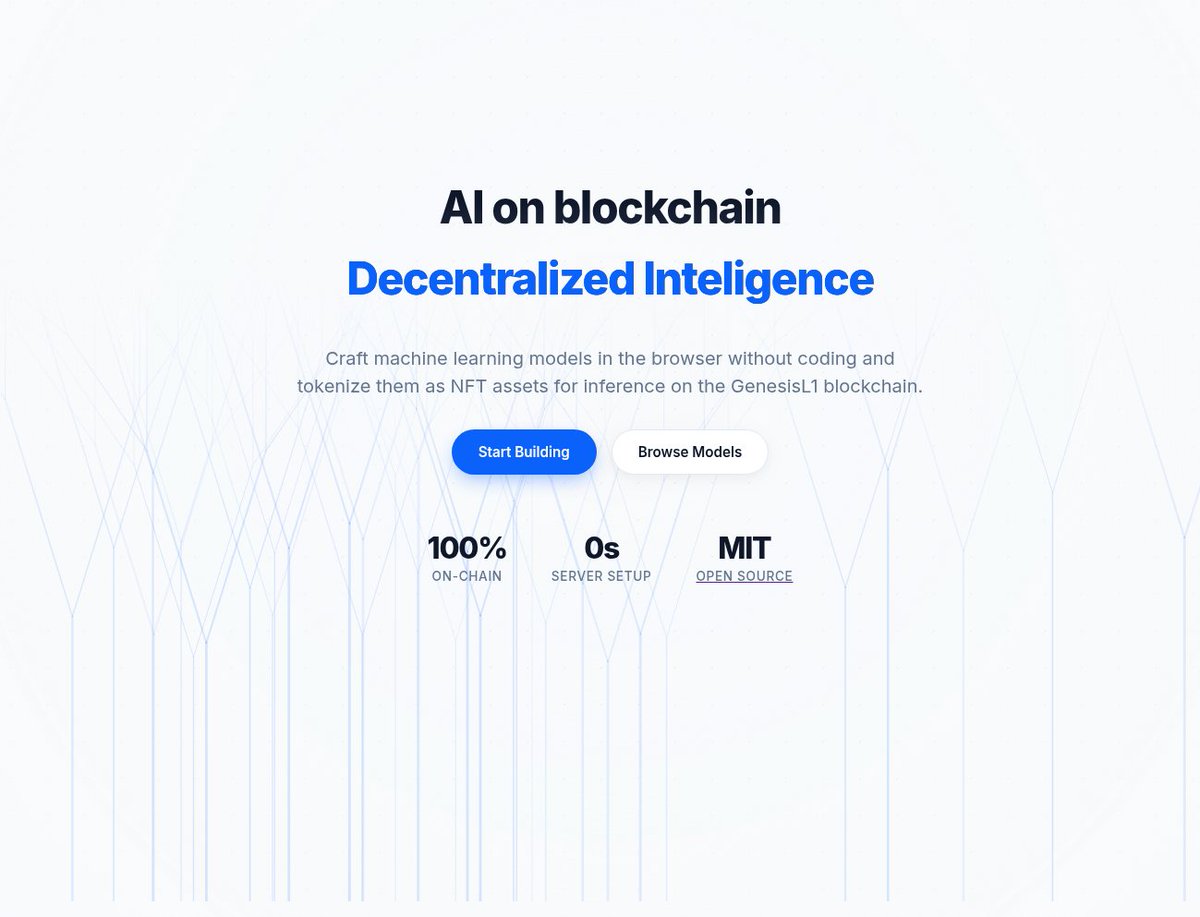
Introducing GenesisL1 Forest - GL1F.com youtube.com/watch?v=a3eUkF… gl1f.com/GL1F.pdf github.com/GenesisL1/Fore… #GL1F #GenesisL1 #OnChainAI #DecentralizedAI #DeSci #VerifiableAI #AI #MachineLearning #EVM #Ethereum #Solidity #SmartContracts #Web3 #CryptoAI #AIInfrastructure #OpenScience #DataScience #MLOps #NFT #Tokenization #Inference #OnchainCompute #dApps #blockchain #cryptocurrency #GBDT not #LLM GenesisL1 Forest is a research-grade, 100% serverless AI studio and on-chain machine learning laboratory for decentralized science — built on the GenesisL1 EVM and compatible with the broader Ethereum + Solidity ecosystem. AI is reshaping the world, but most AI today is still delivered as a black box: private training pipelines, hosted endpoints, unverifiable inference, and outputs you can’t independently reproduce. That model doesn’t fit science, and it doesn’t fit permissionless systems. GenesisL1 Forest makes AI a first-class blockchain primitive. You can build powerful models directly in the browser, evaluate them interactively, and deploy them as immutable on-chain assets — without running servers, without deploying a backend, and without trusting an opaque API. No backend. No hosted inference. No hidden infrastructure. Just: dataset → train → validate → deploy — from a laptop, or from the palm of your hand. Forest is built for serious applied AI across domains where rigor matters: health and biomarker modeling, materials and chemistry predictors, environmental measurement models, econometrics and forecasting, genomics-derived numeric pipelines, and more. It’s designed to be a practical laboratory for conducting complex research that can be shared, verified, and reused. AI that’s actually compatible with verification LLMs are extraordinary for language and unstructured problems — but many real scientific and decision tasks are structured/tabular: labs, sensors, assays, measurements, financial time-series features, clinical panels, and engineered variables. For these, classical ML model families (especially tree-ensemble approaches) are often the best choice because they are: • high-accuracy on structured numeric data • computationally efficient (fast inference, low overhead) • deterministic by design (ideal for reproducibility) • easier to audit with feature attribution and error analysis That efficiency and determinism is exactly what makes on-chain inference practical — not as a demo, but as infrastructure. AI dApps: verifiable AI inside Solidity workflows Because Forest runs on the EVM, models can be integrated directly into smart contracts and existing Ethereum tooling. This enables a new category of machine learning dApps: • protocols that call models for deterministic decision logic • on-chain scientific pipelines anyone can re-run • registries and benchmarks with persistent provenance • model-driven automation with public verification • composable AI building blocks across EVM infrastructure If you can build on Ethereum or EVM, you can build with Forest. Models are tokenized as NFTs — and they come with a built-in economy. Every deployed model becomes a ModelNFT: a transferable on-chain AI asset with persistent identity and provenance. And crucially, model owners can enable monetization in two powerful ways: • Paid inference plans for read-style access • Pay-per-inference transactions that generate a proof-of-inference receipt on-chain (a verifiable record that this model produced this output at this time, under deterministic rules) Because the model is an NFT, it’s not locked to a single operator: ownership can change — and the new owner can update monetization settings. This turns models into real, ownable primitives that can be licensed, traded, bundled into products, governed by DAOs, and integrated into dApps — all without centralized hosting. A new kind of L1: machine learning cryptocurrency This also upgrades what an L1coin (L1coin.com, app.osmosis.zone/assets/ibc%2FF…) represents. GenesisL1 is evolving into a machine learning platform and L1coin gaining features of native AI cryptocurrency, it becomes more than settlement: it becomes an access and participation asset for on-chain AI. Using the GenesisL1 network means participating in a decentralized AI economy where models are public infrastructure and inference is verifiable. Not “AI + crypto” as a slogan. Crypto as the economic substrate for verifiable machine intelligence and decentralized science.
YouTube video
YouTube
GenesisL1 tweet media
Indonesia
0
7
8
2.9K
Respect the pump retweetledi
GenesisL1
GenesisL1@genesis_L1·
@MuseRhymes Hello, thank you for your interest! We will ship GenesisL1 Forest in the next 24h, please, stay tuned.
English
1
1
6
82
Respect the pump retweetledi
Michael Joseph ⛓⚛⛓
Michael Joseph ⛓⚛⛓@MuseRhymes·
This is cool, it's the only other functionally real and already built blockchain-based AI I have ever seen outside of my work: x.com/i/status/20088…
GenesisL1@genesis_L1

We did machine learning inference inside GenesisL1 EVM Layer 1 blockchain. #Blockchain #Ai #DeSci #EVM #Web3 #Chess ♙♙♙♙♙♙♙♙♖♘♗♕♔♗♘♖ GenesisL1 blockchain can play chess now, try it. genesisl1.com/chess.html (press connect) ♜♞♝♛♚♝♞♜♟♟♟♟♟♟♟♟ ### How smart are smart contracts? Smart enough to run a real convolutional neural network on a live EVM mainnet… and use it to evaluate chess positions. That’s what we’ve done with GenesisL1: a Chess CNN implemented as on-chain inference, where the forward pass is not a marketing metaphor, not a “verified off-chain result”, not a “zk proof that something happened somewhere” — but the inference itself, executed deterministically inside the EVM, with outputs that are: * public (anyone can inspect the exact code + parameters), * verifiable (anyone can re-run the same call and get the same result), * reproducible (no hidden servers, no “trust me” endpoint), * immutable (the deployed model is a historical artifact), * composable (other contracts can call it like a primitive). This might look like “just chess”… but chess is the point: it’s a clear, adversarial, easy-to-verify domain that turns hand-wavy claims into a crisp yes/no question: Can a blockchain run a neural network inference in the open? Now the answer is: Yes. ### Why this matters (beyond the wow factor) In the real world, ML inference is often a black box: someone hosts a model behind an API, you send inputs, they send outputs, and you *hope*: * they didn’t swap weights, * they didn’t change preprocessing, * they didn’t patch the model yesterday, * they didn’t silently A/B test you, * they didn’t “round” results in a way you can’t detect, * they didn’t serve different answers to different users. For entertainment apps, that’s fine. For science, finance, governance, public infrastructure, and any domain where “trust me” is not good enough, we need a different primitive: inference as a transparent, auditable, reproducible process. On-chain inference turns a model into something closer to a scientific instrument: anyone can inspect it, verify it, and replicate the result exactly. That’s not just decentralization as a slogan — it’s decentralization as *methodology*. ### The hard part: EVM was not built for neural nets Let’s be honest: the EVM is incredible at consensus, not at matrix math. A CNN forward pass is basically a festival of: * multiplications, * additions, * non-linearities, * memory pressure, * parameter storage, * and precision management. And on-chain, every one of those has a price: gas. So deploying a comparatively complex CNN on a live EVM network means solving a pile of unglamorous engineering problems that most people never have to think about: * Determinism over everything No floating point, no “close enough”. You need results that are exact across nodes. * Quantization / fixed-point arithmetic Neural nets love floats. EVM does not. We had to make the network live comfortably in integer land. * Gas-aware architecture Every storage read hurts. Every unnecessary operation hurts. You don’t “optimize later” — you design like gas is gravity. * Memory and calldata strategy How do you lay out weights? How do you feed inputs? How do you avoid blowing up the call cost? * Throughput vs. transparency tradeoffs On-chain inference isn’t about replacing GPUs. It’s about making trust-minimized inference possible where it matters. These are the “invisible victories” behind the headline: we didn’t just run ML *near* the chain. We made ML run inside it. ### “Blockchain can play chess” — what that really means The chain isn’t dreaming of endgames. The chain can evaluate. And evaluation is the heartbeat of a chess engine: take a position → compute a score → decide what’s better. When a CNN does that scoring on-chain: * the evaluation function becomes public infrastructure, * the model becomes a shared, neutral primitive, * and the result becomes provable without trusting a server. That is a new shape of software: intelligence you can audit. ### What’s next: on-chain Gradient Boosted Decision Trees (GBDT) CNNs are a powerful demonstration because they’re comparatively “heavy.” But GBDT is where things get *dangerously practical* for on-chain ML. Decision trees map surprisingly well to EVM realities: * comparisons, * branching, * compact node representation, * deterministic traversal. And yes — even large ensembles are on the table: thousands of trees is not science fiction if you design it like a blockchain engineer: * packing nodes efficiently, * minimizing reads, * structuring traversal to be gas-aware, * compressing thresholds/feature indices, * and making inference a predictable, verifiable computation. We’re working toward the point where on-chain GBDT inference becomes a standard tool — not a stunt. ### The bigger vision: a Universal ML Blockchain Studio + SDK You will see it this month. You will see the GenesisL1 Forest. The goal isn’t “we did a cool demo.” The goal is a platform where anyone can: 1. create a model, 2. train it in the browser, 3. compile/deploy it on-chain, each model is an NFT, 4. optionally charge per inference, and 5. let other apps compose it like LEGO. Imagine the implications: * On-chain ML marketplaces Models become deployable assets, not hosted services. * Pay-per-inference as a native economic primitive Micropayments for intelligence — automated, permissionless, global. * Composable intelligence for protocols Lending, insurance, games, identity, reputation, risk engines — any contract can call a model deterministically. * Open scientific models Publish the exact inference mechanism as an immutable artifact. Anyone can verify, reproduce, and build on it. This is how “AI on-chain” becomes more than a buzz phrase: not just “AI + crypto”, but verifiable computation + machine learning as a single stack. --- ### A grounded take On-chain inference is not here to compete with GPUs on raw speed. It’s here to compete with *opacity*. When correctness, neutrality, auditability, and reproducibility matter more than throughput, the chain becomes a uniquely powerful place to run inference — because it forces the thing science has always wanted: A result you can independently verify. ### We built a Chess CNN on GenesisL1 to prove a point: Blockchains aren’t just ledgers. They can be laboratories for reproducible computation. And smart contracts can be more than “smart” — they can be provably intelligent. If you’ve been waiting for a real, technically honest, mainnet-level example of on-chain ML that’s more than a slide deck… this is that moment. GenesisL1 is here. On-chain inference is real. And we’re just getting started. Enjoy the game with blockchain that is intelligent. We also implemented p2p serverless chess you can play with friends and family with optional GenesisL1 Chess CNN engine support. So you can play: Person vs Blockchain Person vs Person (with optional blockchain support) Blockchain vs Blockchain Web3 dapp (serverless): genesisl1.com/chess.html Source Code: github.com/GenesisL1/GL1c… Whitepaper: genesisl1.com/Neural-Policy%…

English
1
4
11
325
Respect the pump retweetledi
GenesisL1
GenesisL1@genesis_L1·
GenesisL1 will host thousands of genomes with most important genome references like telomere-to-telomere (T2T) human genome sequence stored entirely onchain. github.com/GenesisL1/gl1-… We are working on the canonical, on-chain ready genomics pipeline that will outperform any existing centralized system of biological data management and will be infinite scalable and efficient and easy integrated in any institutional or private system. GL1ENCv2 and SeqNFT #comparison-with-common-genomics-formats-on-chain-focus" target="_blank" rel="nofollow noopener">github.com/GenesisL1/gl1-… #DeSci #bioinformatics #Biology #biotech #Biotechnology #medicine #Longevity #Research #science
English
0
4
8
304
Respect the pump retweetledi
GenesisL1
GenesisL1@genesis_L1·
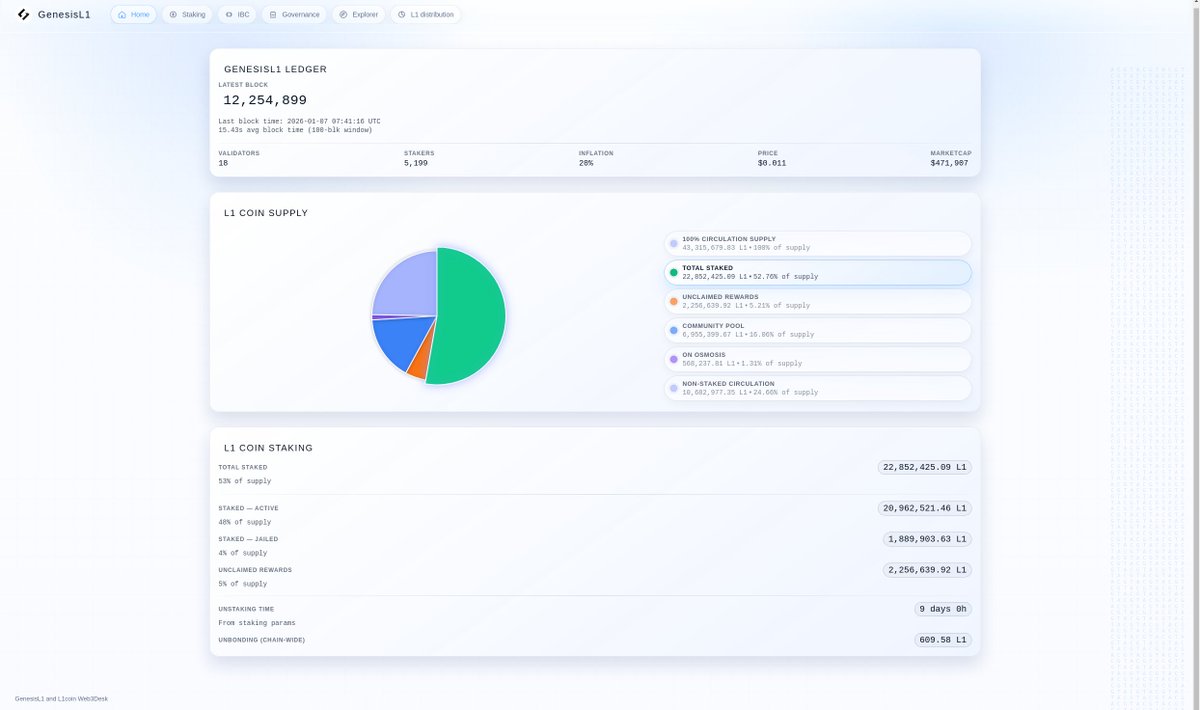
We have created a purest #web3 serverless Web3Desk UI for Cosmos SDK EVMs with - chain stats - staking of L1 coins with any type of wallet - evm/cosmos dual wallet UI and transfer between them - governance - IBC - now between GenesisL1 and Osmosis - EVM/Cosmos web3 block explorer Web3Desk: L1coin.com Source Code: github.com/GenesisL1/web3… Circulation API: l1coin.com/api.json You can save page and call GenesisL1 blockchain from localhost. NOTE: L1 coin is the native utility and governance coin of the GenesisL1 blockchain, designed to power network operations, secure consensus, and coordinate community decision-making. Native utility coin with on-chain governance community-driven distribution. Origin & Distribution L1 coin is the primary utility and governance asset of the GenesisL1 blockchain. It has been distributed to members of the GenesisL1 community, network validators, distributed ledger technology enthusiasts, and scientists engaged with the project. The GenesisL1 project did not raise funds, conduct an ICO, or hold any form of public or private token sale. It is not backed by venture capital or investment funds. At network launch, L1 coins were allocated to the GenesisL1 community, and approximately 50% of the total supply was assigned to the on-chain community pool, where all expenditures are governed transparently by GenesisL1 community voting. Community Pool Allocations Since 2021, around 25% of the community pool has been distributed via on-chain governance to support the broader ecosystem and the technical foundations on which GenesisL1 is built, including: Cosmos ($ATOM) community — in recognition that GenesisL1 is built on the Cosmos SDK and benefits from the Cosmos ecosystem and tooling. Evmos ($EVMOS) community — acknowledging Evmos developers as key contributors to the Cosmos EVM stack that underpins GenesisL1’s interoperable, smart-contract capabilities. GenesisL1 validators — supporting the independent operators who maintain network security, consensus, and ledger integrity. Osmosis liquidity pool — providing a decentralized, non-custodial venue where participants can obtain and provide L1 liquidity, enabling permissionless participation in and support of the GenesisL1 project. This liquidity is intended to facilitate access and network engagement, not to operate as a commercial or profit-seeking market-making activity by the project. L1 coin is designed as a functional utility and governance asset within the GenesisL1 network. Any secondary market pricing of L1 arises from independent market activity and is outside the control of the GenesisL1 project.
GenesisL1 tweet media
English
0
3
6
306
Respect the pump retweetledi
GenesisL1
GenesisL1@genesis_L1·
We did machine learning inference inside GenesisL1 EVM Layer 1 blockchain. #Blockchain #Ai #DeSci #EVM #Web3 #Chess ♙♙♙♙♙♙♙♙♖♘♗♕♔♗♘♖ GenesisL1 blockchain can play chess now, try it. genesisl1.com/chess.html (press connect) ♜♞♝♛♚♝♞♜♟♟♟♟♟♟♟♟ ### How smart are smart contracts? Smart enough to run a real convolutional neural network on a live EVM mainnet… and use it to evaluate chess positions. That’s what we’ve done with GenesisL1: a Chess CNN implemented as on-chain inference, where the forward pass is not a marketing metaphor, not a “verified off-chain result”, not a “zk proof that something happened somewhere” — but the inference itself, executed deterministically inside the EVM, with outputs that are: * public (anyone can inspect the exact code + parameters), * verifiable (anyone can re-run the same call and get the same result), * reproducible (no hidden servers, no “trust me” endpoint), * immutable (the deployed model is a historical artifact), * composable (other contracts can call it like a primitive). This might look like “just chess”… but chess is the point: it’s a clear, adversarial, easy-to-verify domain that turns hand-wavy claims into a crisp yes/no question: Can a blockchain run a neural network inference in the open? Now the answer is: Yes. ### Why this matters (beyond the wow factor) In the real world, ML inference is often a black box: someone hosts a model behind an API, you send inputs, they send outputs, and you *hope*: * they didn’t swap weights, * they didn’t change preprocessing, * they didn’t patch the model yesterday, * they didn’t silently A/B test you, * they didn’t “round” results in a way you can’t detect, * they didn’t serve different answers to different users. For entertainment apps, that’s fine. For science, finance, governance, public infrastructure, and any domain where “trust me” is not good enough, we need a different primitive: inference as a transparent, auditable, reproducible process. On-chain inference turns a model into something closer to a scientific instrument: anyone can inspect it, verify it, and replicate the result exactly. That’s not just decentralization as a slogan — it’s decentralization as *methodology*. ### The hard part: EVM was not built for neural nets Let’s be honest: the EVM is incredible at consensus, not at matrix math. A CNN forward pass is basically a festival of: * multiplications, * additions, * non-linearities, * memory pressure, * parameter storage, * and precision management. And on-chain, every one of those has a price: gas. So deploying a comparatively complex CNN on a live EVM network means solving a pile of unglamorous engineering problems that most people never have to think about: * Determinism over everything No floating point, no “close enough”. You need results that are exact across nodes. * Quantization / fixed-point arithmetic Neural nets love floats. EVM does not. We had to make the network live comfortably in integer land. * Gas-aware architecture Every storage read hurts. Every unnecessary operation hurts. You don’t “optimize later” — you design like gas is gravity. * Memory and calldata strategy How do you lay out weights? How do you feed inputs? How do you avoid blowing up the call cost? * Throughput vs. transparency tradeoffs On-chain inference isn’t about replacing GPUs. It’s about making trust-minimized inference possible where it matters. These are the “invisible victories” behind the headline: we didn’t just run ML *near* the chain. We made ML run inside it. ### “Blockchain can play chess” — what that really means The chain isn’t dreaming of endgames. The chain can evaluate. And evaluation is the heartbeat of a chess engine: take a position → compute a score → decide what’s better. When a CNN does that scoring on-chain: * the evaluation function becomes public infrastructure, * the model becomes a shared, neutral primitive, * and the result becomes provable without trusting a server. That is a new shape of software: intelligence you can audit. ### What’s next: on-chain Gradient Boosted Decision Trees (GBDT) CNNs are a powerful demonstration because they’re comparatively “heavy.” But GBDT is where things get *dangerously practical* for on-chain ML. Decision trees map surprisingly well to EVM realities: * comparisons, * branching, * compact node representation, * deterministic traversal. And yes — even large ensembles are on the table: thousands of trees is not science fiction if you design it like a blockchain engineer: * packing nodes efficiently, * minimizing reads, * structuring traversal to be gas-aware, * compressing thresholds/feature indices, * and making inference a predictable, verifiable computation. We’re working toward the point where on-chain GBDT inference becomes a standard tool — not a stunt. ### The bigger vision: a Universal ML Blockchain Studio + SDK You will see it this month. You will see the GenesisL1 Forest. The goal isn’t “we did a cool demo.” The goal is a platform where anyone can: 1. create a model, 2. train it in the browser, 3. compile/deploy it on-chain, each model is an NFT, 4. optionally charge per inference, and 5. let other apps compose it like LEGO. Imagine the implications: * On-chain ML marketplaces Models become deployable assets, not hosted services. * Pay-per-inference as a native economic primitive Micropayments for intelligence — automated, permissionless, global. * Composable intelligence for protocols Lending, insurance, games, identity, reputation, risk engines — any contract can call a model deterministically. * Open scientific models Publish the exact inference mechanism as an immutable artifact. Anyone can verify, reproduce, and build on it. This is how “AI on-chain” becomes more than a buzz phrase: not just “AI + crypto”, but verifiable computation + machine learning as a single stack. --- ### A grounded take On-chain inference is not here to compete with GPUs on raw speed. It’s here to compete with *opacity*. When correctness, neutrality, auditability, and reproducibility matter more than throughput, the chain becomes a uniquely powerful place to run inference — because it forces the thing science has always wanted: A result you can independently verify. ### We built a Chess CNN on GenesisL1 to prove a point: Blockchains aren’t just ledgers. They can be laboratories for reproducible computation. And smart contracts can be more than “smart” — they can be provably intelligent. If you’ve been waiting for a real, technically honest, mainnet-level example of on-chain ML that’s more than a slide deck… this is that moment. GenesisL1 is here. On-chain inference is real. And we’re just getting started. Enjoy the game with blockchain that is intelligent. We also implemented p2p serverless chess you can play with friends and family with optional GenesisL1 Chess CNN engine support. So you can play: Person vs Blockchain Person vs Person (with optional blockchain support) Blockchain vs Blockchain Web3 dapp (serverless): genesisl1.com/chess.html Source Code: github.com/GenesisL1/GL1c… Whitepaper: genesisl1.com/Neural-Policy%…

GenesisL1 tweet media
English
0
5
10
2K