
Sabitlenmiş Tweet
Rezo🛡₿RRR
10.4K posts


Rezo🛡₿RRR
@rezosh
crypto since 2015 | building where attention lags power
Decentralized Katılım Kasım 2010
2.6K Takip Edilen55.6K Takipçiler
@Cointelegraph AI stocks have been continuously rotating into other sectors related to "AI."
English

⚡️ QUESTION: If AI stocks start to cool, do you think capital will rotate back into crypto?
English
@gmoneyNFT The problem is that CAPEX is big but concentrated... CAPEX is still needed in other sectors (energy, cooling, related industries, etc).
English

@Cointelegraph need RWAs to tokenize the rights for this. x.com/rezosh/status/…
Rezo🛡₿RRR@rezosh
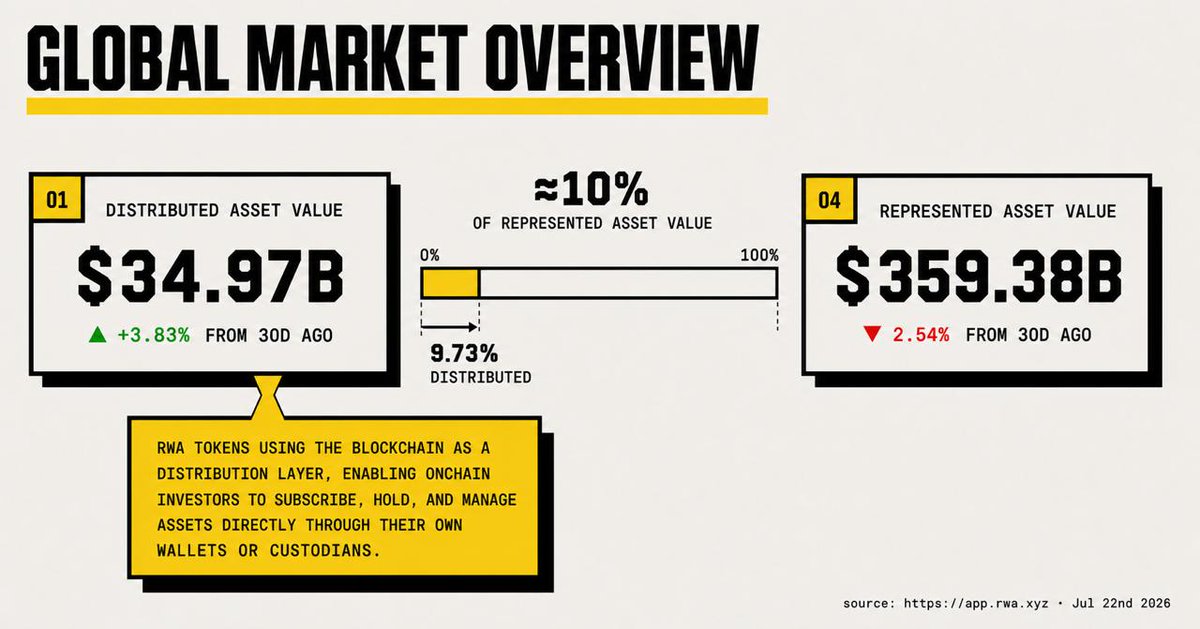
RWA has $359B in assets "represented" onchain, but only $35B actually distributed, and a fraction of that usable in DeFi. The 10x gap is the whole story: we tokenized the paperwork, not the rights. Receipts don't compose.
English
⚡️ Bitwise CIO Matt Hougan: The next crypto bull market will be driven by stablecoins, tokenization, 24/7 trading, instant settlement, and institutional DeFi scaling into the trillions.


English
@Cointelegraph they're going after a bigger piece of the pie. x.com/rezosh/status/…
Rezo🛡₿RRR@rezosh
RWA has $359B in assets "represented" onchain, but only $35B actually distributed, and a fraction of that usable in DeFi. The 10x gap is the whole story: we tokenized the paperwork, not the rights. Receipts don't compose.
English
🇺🇸 LATEST: The Digital Chamber has sued Illinois officials to block the state’s new 0.2% tax on crypto transactions, arguing it unlawfully discriminates against digital asset users.
English
@pete_rizzo_ the mere fact that we're talking about this shows that TradFi isn't being destroyed by crypto, but evolving with it. crypto is also evolving with TradFi and we'll see something very unique come out of this. x.com/rezosh/status/…
Rezo🛡₿RRR@rezosh
Will we destroy TradFi and replace its rails with crypto? No. That’s the ideological stuff we used to push in the early anarchist days of crypto. When you grow up (and when the industry matures), you realize the world doesn’t work that way. You cannot disrupt the entire system. We used to talk about “[R]evolution,” but what’s actually happening is evolution. A real revolutionary break would only come with a total collapse of the current financial and geopolitical order. In that scenario, crypto rails could become the new system, but that hasn’t happened, and I’m not sure we should even want it to. Until then, what we’re seeing is mutual penetration, not replacement.
English

BREAKING: BLOOMBERG JUST REPORTED THE #BITCOIN AND CRYPTO CLARITY ACT IS ABOUT TO PASS VERY SOON
PRESIDENT TRUMP HAS RESOLVED THE ETHICS LANGUAGE
THE BILL IS "ON THE ONE YARD LINE"
A SENATE FLOOR VOTE COULD COME ANY DAY
CLARITY WILL PASS IN AMERICA
GET READY. IT’S HAPPENING 🚀🚀
English
@Kalshi great example of the "merge"... evolution in place, we're seeing the mutual merge, not replacement. x.com/rezosh/status/…
Rezo🛡₿RRR@rezosh
Will we destroy TradFi and replace its rails with crypto? No. That’s the ideological stuff we used to push in the early anarchist days of crypto. When you grow up (and when the industry matures), you realize the world doesn’t work that way. You cannot disrupt the entire system. We used to talk about “[R]evolution,” but what’s actually happening is evolution. A real revolutionary break would only come with a total collapse of the current financial and geopolitical order. In that scenario, crypto rails could become the new system, but that hasn’t happened, and I’m not sure we should even want it to. Until then, what we’re seeing is mutual penetration, not replacement.
English

@Cointelegraph rails need better definitions to build... they're global now, but the permissions aren't yet. x.com/rezosh/status/…
Rezo🛡₿RRR@rezosh
They tokenized UK/US equities, but UK/US residents can't buy them. The rails went global... the permissions didn't.
English
🇺🇸 BREAKING: Senate Republicans have released an updated 616-page CLARITY Act.
English
@glassnode @anti_fragile the effects of agents vs ETFs on Bitcoin could be very different. sharing from an HFT desk perspective. ETFs buy through OTC desks and custodians, bypassing order books, while agents buy on the open market. x.com/rezosh/status/…
Rezo🛡₿RRR@rezosh
Let me tell you about agentic trading from the perspective of an HFT desk. First, let me get rid of the biggest exaggeration in the timeline: agents are not catching up to high-frequency trading. They aren’t, and they can’t. Professional teams have been using AI for years... specialized, streaming, fast, sharpened like a blade. An agent running on a public model is not competing with that setup, and that’s not where its importance lies... what agents actually change is the texture of volatility. The mechanics are simple: - Bitcoin is priced by the last trade... what moves the market is not size, but the flow of transactions. - ETFs (big participants) buy through OTC desks and custodians, bypassing the order books, so their impact is muted. - Agents hit the market directly, and more importantly, they react to the SAME SIGNALS in parallel. The correlation here goes deeper than it looks. Agents sit on the same foundation models... they share the same DNA, and that means they share the same interpretation mistakes. This isn’t strategic correlation, like humans running similar systems, but architectural. That will change once people start fine-tuning agents on their own data and for their own objectives. Today, everyone is drinking from the same well. More volume does not mean smoother markets, and the history of algorithmic trading shows the opposite: when new volume is systematic and correlated, volatility increases. To be honest, at our scale we don’t yet see traces of agent-driven flow. But I wrote recently that, for a professional trading desk, volatility is not a threat, just a working environment. If agents add more of it, we’re ready.
English

Hedges are off, shorts are closed, and ETF flows have flipped positive.
What bitcoin:native needs now is confirmation at the Short-Term Holder Cost Basis at $69k; rejection there puts the lower demand shelf back in play.
Read the full Week On-Chain report👇
glassno.de/4fxLoDW


English
@KobeissiLetter AI agents will make an impact on Bitcoin price maybe more than BTC ETFs will... why? cos ETFs are often bought through OTC desks, and custodians, bypassing the order books. Agents buy on the open market... this is coming from an HFT desk perspective. x.com/rezosh/status/…
Rezo🛡₿RRR@rezosh
Let me tell you about agentic trading from the perspective of an HFT desk. First, let me get rid of the biggest exaggeration in the timeline: agents are not catching up to high-frequency trading. They aren’t, and they can’t. Professional teams have been using AI for years... specialized, streaming, fast, sharpened like a blade. An agent running on a public model is not competing with that setup, and that’s not where its importance lies... what agents actually change is the texture of volatility. The mechanics are simple: - Bitcoin is priced by the last trade... what moves the market is not size, but the flow of transactions. - ETFs (big participants) buy through OTC desks and custodians, bypassing the order books, so their impact is muted. - Agents hit the market directly, and more importantly, they react to the SAME SIGNALS in parallel. The correlation here goes deeper than it looks. Agents sit on the same foundation models... they share the same DNA, and that means they share the same interpretation mistakes. This isn’t strategic correlation, like humans running similar systems, but architectural. That will change once people start fine-tuning agents on their own data and for their own objectives. Today, everyone is drinking from the same well. More volume does not mean smoother markets, and the history of algorithmic trading shows the opposite: when new volume is systematic and correlated, volatility increases. To be honest, at our scale we don’t yet see traces of agent-driven flow. But I wrote recently that, for a professional trading desk, volatility is not a threat, just a working environment. If agents add more of it, we’re ready.
English

BREAKING: Bitcoin ETFs attracted +$900 million in inflows last week, the largest weekly inflow since early May.
This marks a sharp acceleration from +$197 million in inflows in the prior week.
The largest Bitcoin ETF, $IBIT, led the surge, attracting +$193 million last week, after bringing in +$282 million the week before.
Subsequently, on Monday and Tuesday, $IBIT saw additional inflows of +$115 million and +$164 million.
This brings the total $IBIT inflows to +$501 million so far in July, on track for the largest monthly intake since April and the 3rd-largest this year.
Investor demand for Bitcoin funds is rapidly improving.

English
@AshCrypto my idea of the future of crypto has definitely shifted over the years... we won't replace TradFi, we'll evolve into something else. x.com/rezosh/status/…
Rezo🛡₿RRR@rezosh
Will we destroy TradFi and replace its rails with crypto? No. That’s the ideological stuff we used to push in the early anarchist days of crypto. When you grow up (and when the industry matures), you realize the world doesn’t work that way. You cannot disrupt the entire system. We used to talk about “[R]evolution,” but what’s actually happening is evolution. A real revolutionary break would only come with a total collapse of the current financial and geopolitical order. In that scenario, crypto rails could become the new system, but that hasn’t happened, and I’m not sure we should even want it to. Until then, what we’re seeing is mutual penetration, not replacement.
English

US institutional capital is around $70 Trillion.
Only 0.2% of that is currently in crypto.
Clarity Act will unlock that TRILLIONS in institutional capital sitting on the sidelines.
YOU ARE NOT BULLISH ENOUGH.
English

@rezosh agents may tilt volatility, but they still lag raw latency edge. HFT stays king on pure speed, fine‑tuned private models may change that
English
Let me tell you about agentic trading from the perspective of an HFT desk.
First, let me get rid of the biggest exaggeration in the timeline: agents are not catching up to high-frequency trading. They aren’t, and they can’t. Professional teams have been using AI for years... specialized, streaming, fast, sharpened like a blade.
An agent running on a public model is not competing with that setup, and that’s not where its importance lies... what agents actually change is the texture of volatility.
The mechanics are simple:
- Bitcoin is priced by the last trade... what moves the market is not size, but the flow of transactions.
- ETFs (big participants) buy through OTC desks and custodians, bypassing the order books, so their impact is muted.
- Agents hit the market directly, and more importantly, they react to the SAME SIGNALS in parallel.
The correlation here goes deeper than it looks.
Agents sit on the same foundation models... they share the same DNA, and that means they share the same interpretation mistakes. This isn’t strategic correlation, like humans running similar systems, but architectural.
That will change once people start fine-tuning agents on their own data and for their own objectives. Today, everyone is drinking from the same well.
More volume does not mean smoother markets, and the history of algorithmic trading shows the opposite: when new volume is systematic and correlated, volatility increases.
To be honest, at our scale we don’t yet see traces of agent-driven flow. But I wrote recently that, for a professional trading desk, volatility is not a threat, just a working environment.
If agents add more of it, we’re ready.
English
@Grayscale part of the missing piece to support agentic trading. from an HFT perspective, this won't be anywhere close but it will make algorithmic/AI trading more accessible.
x.com/rezosh/status/…
Rezo🛡₿RRR@rezosh
Let me tell you about agentic trading from the perspective of an HFT desk. First, let me get rid of the biggest exaggeration in the timeline: agents are not catching up to high-frequency trading. They aren’t, and they can’t. Professional teams have been using AI for years... specialized, streaming, fast, sharpened like a blade. An agent running on a public model is not competing with that setup, and that’s not where its importance lies... what agents actually change is the texture of volatility. The mechanics are simple: - Bitcoin is priced by the last trade... what moves the market is not size, but the flow of transactions. - ETFs (big participants) buy through OTC desks and custodians, bypassing the order books, so their impact is muted. - Agents hit the market directly, and more importantly, they react to the SAME SIGNALS in parallel. The correlation here goes deeper than it looks. Agents sit on the same foundation models... they share the same DNA, and that means they share the same interpretation mistakes. This isn’t strategic correlation, like humans running similar systems, but architectural. That will change once people start fine-tuning agents on their own data and for their own objectives. Today, everyone is drinking from the same well. More volume does not mean smoother markets, and the history of algorithmic trading shows the opposite: when new volume is systematic and correlated, volatility increases. To be honest, at our scale we don’t yet see traces of agent-driven flow. But I wrote recently that, for a professional trading desk, volatility is not a threat, just a working environment. If agents add more of it, we’re ready.
English

@AshCrypto part of the evolution. institutions adopted Bitcoin as the asset, but not the system. ETH on the other hand is the decentralized, neutral layer. we are evolving. x.com/rezosh/status/…
Rezo🛡₿RRR@rezosh
Will we destroy TradFi and replace its rails with crypto? No. That’s the ideological stuff we used to push in the early anarchist days of crypto. When you grow up (and when the industry matures), you realize the world doesn’t work that way. You cannot disrupt the entire system. We used to talk about “[R]evolution,” but what’s actually happening is evolution. A real revolutionary break would only come with a total collapse of the current financial and geopolitical order. In that scenario, crypto rails could become the new system, but that hasn’t happened, and I’m not sure we should even want it to. Until then, what we’re seeing is mutual penetration, not replacement.
English
ETH is pumping hard against Bitcoin.
Bullish sign for alts.

English
Will we destroy TradFi and replace its rails with crypto? No.
That’s the ideological stuff we used to push in the early anarchist days of crypto. When you grow up (and when the industry matures), you realize the world doesn’t work that way.
You cannot disrupt the entire system.
We used to talk about “[R]evolution,” but what’s actually happening is evolution. A real revolutionary break would only come with a total collapse of the current financial and geopolitical order.
In that scenario, crypto rails could become the new system, but that hasn’t happened, and I’m not sure we should even want it to.
Until then, what we’re seeing is mutual penetration, not replacement.
English
@Cointelegraph DeFi rails still have a lot to capture... which is why we need better guidelines in place. x.com/rezosh/status/…
Rezo🛡₿RRR@rezosh
RWA has $359B in assets "represented" onchain, but only $35B actually distributed, and a fraction of that usable in DeFi. The 10x gap is the whole story: we tokenized the paperwork, not the rights. Receipts don't compose.
English
🇺🇸 NEW: Hester Peirce says crypto vaults and onchain lending strategies may fall under federal securities laws depending on their design.


English
@CoinDesk at the end of the day what really counts is access. x.com/rezosh/status/…
Rezo🛡₿RRR@rezosh
They tokenized UK/US equities, but UK/US residents can't buy them. The rails went global... the permissions didn't.
English

NEW: SEC Commissioner Hester Peirce says crypto vaults and onchain lending strategies could fall under U.S. securities laws depending on how they're structured and managed.
She urged builders to work with the SEC on compliant paths forward rather than "do headstands, backflips, and other gymnastics" to avoid the law.

English
They tokenized UK/US equities, but UK/US residents can't buy them. The rails went global... the permissions didn't.
Cointelegraph@Cointelegraph
🔥 NEW: Kraken parent Payward is expanding xStocks to Hong Kong, UK, European and South Korean equities.
English
you've been pretty consistent on this, saw some of your old posts about agents and how they transact. sharing my 2c also operating an HFT... basically algorithmic trading and "agentic" has been around for a while but only now has it been so accessible.
I think there will be smaller shops or even retail participating in algorithmic and agentic trading cos of how easy AI is to use now.
the path I see to really enable that economy is through crypto/stablecoins... I mean the sub-cent level of crypto is already a HUGE advantage for capital efficiency and just didn't make sense with the regular rails + agents aren't compatible with CBDCs, which can be programmed, so that provides some protection.
even banks and global exchanges are starting to do this: x.com/rezosh/status/…
Rezo🛡₿RRR@rezosh
London Stock Exchange's almost "around-the-clock" move is interesting not cos of the extended trading hours but cos of what it's actually built for... algorithmic trading + AI agents. It's not about convincing retail... It's laying the rails for machines. An eight-hour trading day worked when capital was local... but markets have converged, and global capital needs 24/7 rails. We’ve been in the HFT space for a long time, and we’re now building out our larger asset management platform. The math there is simple: latency + alpha is everything, while an 8-hour window out of 24 immediately wipes out 2/3rds of the time when that alpha could be captured. The crypto leg moves overnight, the traditional one waits for the opening bell, but for an algorithm, that’s not an inconvenience but a serious gap. Crypto solved this years ago with a 24/7 market, guaranteed final settlement, and machine access from day one. The old rails are not catching up with a trend, they're catching up with the architecture.
English

I’ve been banging this drum for the past few years…
Agentic AI is expected to drive $3-5T of commerce by 2030, yet I still think most investors are looking in the wrong place
Crypto isn’t just another AI vertical, it becomes the financial infrastructure that allows autonomous AI agents to transact with one another
Everyone is positioning for AI through semis, hyperscalers & infrastructure, but that only captures the compute layer
As AI evolves from generatin content to executing transactions, agents will need to pay for compute, data, APIs and services autonomously
That requires instant settlement, negligible fees and programmable money, all things blockchain networks were designed to provide
If billions of machines are transacting every day, owning AI companies alone may not be enough, the networks and tokens facilitating those payments could capture a meaningful share of the value
The CLARITY Act could be the catalyst that brings institutional confidence to this thesis by providing regulatory clarity around digital assets while enabling more transparent token structures and stronger ownership rights for token holders
The next decade won’t be focused on owning AI; it’ll be about owning the networks that AI runs on
Franklin Templeton Digital Assets@FTDA_US
English