

Rich Nanda
1.7K posts

Rich Nanda
@richnanda
Deloitte Consulting | Chief Strategy Officer | Author of The Transformation Myth (MIT Press) | #growth #strategy #tech #AI & occasionally #wine #chicagosports
Chicago, IL Katılım Şubat 2010
951 Takip Edilen947 Takipçiler
This exactly why I’m so confident and bullish about the consulting profession into the future. A great time to be innovating and leading.
Steven Sinofsky@stevesi
The Jevons Employment Effect From AI apollo.com/wealth/the-dai… // While AI might make it seem like professional services (law, consulting, finance) get easily replaced, the opposite is happening already including recent graduates. (charts)
English
AI is incredible. While it will create unforeseen opportunity, it will also follow well understood technology diffusion and productivity patterns. A great time to be in the playing field.
Aaron Levie@levie
If you read this and don’t understand why it’s happening it’s an opportunity to reset your understanding of how the real world works. The real world will need a ton of help actually getting agents going in the enterprise. Companies have legacy tech stacks they need to modernize, data in tons of fragmented tools, knowledge that isn’t captured or digitized, and change management needed to actually utilize agents effectively. And they have to do all this while still running their business day-to-day, unlike startups. This is why there is so much opportunity for companies (software or services) to actually deploy agents in specific domains and workflows. This remains a big opportunity for both existing services providers but also tons of new startups as well. Every new technology wave produces a new era of consulting firms that can deliver on that technology. It’s also why the FDE model is going to be alive and well for a long time because companies will want to have their vendor actually help drive the change management and implementation for their new workflows. The people aren’t going away. Far from it.
English

News flash. The sky is blue. The grass is green. Only two sure things in life- death and taxes.
First Squawk@FirstSquawk
OPENAI IS WORKING WITH CONSULTANTS TO SELL CODEX - WSJ
English
Rich Nanda retweetledi

I think AI economic doomers don’t realize just how strong a “this time is different” argument they are making.

English
The cost of early (and often inefficient) innovation. Enterprises and their employees will get better and better with AI and business results will follow. As market results drive growth and performance, budgets for human and token intelligence will grow. But this is the jagged early innings.
Hedgie@HedgieMarkets
🦔Goldman Sachs reports that companies are blowing past their AI inference budgets by orders of magnitude, with inference costs in engineering now approaching 10% of total headcount costs and potentially reaching parity with salaries within several quarters. KPMG surveyed 2,100 senior leaders and found US companies plan to spend an average of $178 million on AI over the next 12 months, with Asia-Pacific firms budgeting $245 million and EMEA $157 million. The two reports together show companies are spending more than planned and intend to spend even more. My Take Inference costs approaching headcount parity is an extraordinary number that most finance teams did not model when they approved their AI strategies twelve months ago. The compute crunch, electrical component shortages, and GPU spot prices up 48% in two months are all flowing into corporate operating costs faster than anyone budgeted for, and Goldman's trajectory suggests it accelerates from here. What I find hard to reconcile is that $178 million average sitting alongside enterprise data showing eight in ten workers are either avoiding AI tools or not using them at all. Companies are committing to nine-figure inference budgets while their own employees aren't using what's already been deployed. I've watched this dynamic build all year and my honest read is that a significant portion of this spending is driven by competitive fear rather than demonstrated returns. Nobody wants to be the company that didn't invest in AI when everyone else did. That's how bubbles get funded, and at some point boards are going to demand a number that justifies it. Hedgie🤗
English
This is not how it’s going to play out. AI will create more jobs not destroy them. Anthropic is a good, perhaps great, company. Dario is wrong and a horrible spokesperson.
TFTC@TFTC21
Anthropic CEO Dario Amodei: “50% of all tech jobs, entry-level lawyers, consultants, and finance professionals will be completely wiped out within 1–5 years.”
English
Exactly the case. AI is a job multiplier.
Boring_Business@BoringBiz_
People are waking up to the fact that AI is a complementary tool for your skill set, and not a complete replacement for a skill If you are already a good coder or writer, AI tools can enhance that skill and make you more productive But if you bad at it, AI is not going to magically solve your deficiency This is the primary reason why I think the fears around AI replacement of labor are overblown
English
Rich Nanda retweetledi

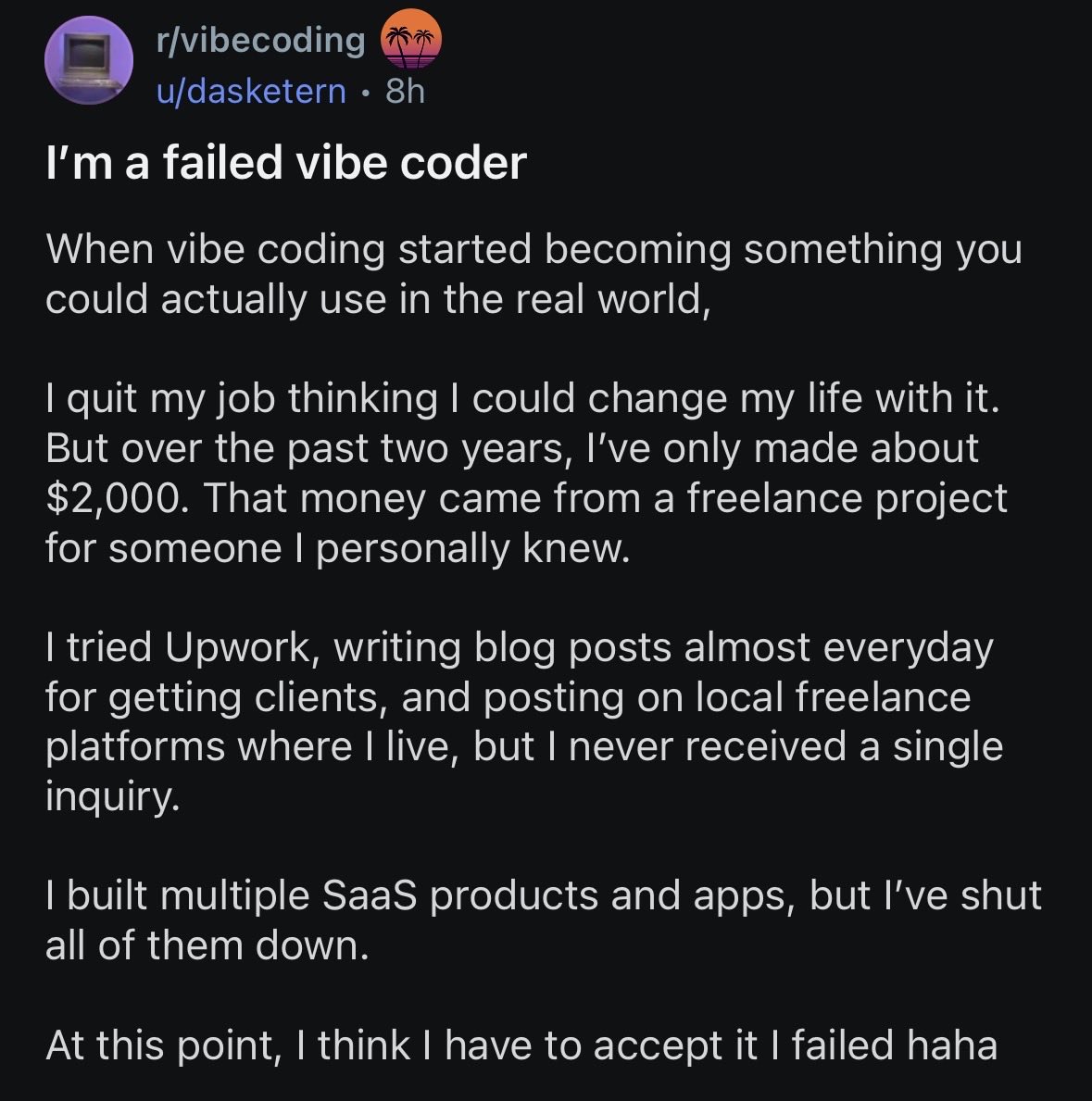
People are waking up to the fact that AI is a complementary tool for your skill set, and not a complete replacement for a skill
If you are already a good coder or writer, AI tools can enhance that skill and make you more productive
But if you bad at it, AI is not going to magically solve your deficiency
This is the primary reason why I think the fears around AI replacement of labor are overblown
English
@BenBajarin "Sowing confusion" is right. The write-up seems a little too anchored on fixed sum TAM.
English

Nice paragraph from Melius on Anthropic's run rate:
Anthropic wants to eat the world.
"That Anthropic update was staggering. The exponential we are seeing below stems from the onset of software being tokenized to replace and
augment a labor TAM that approximates to tens of trillions. It’s in inning one – and your narrative must be aligned with this exponential for your stock
to work. The market is getting it right in SaaS – no platform is safe even as we’ve lost $1.4T in SaaS market cap since Anthropic was worth just $18B in
January 2025. In the Mag 7, Anthropic’s rise is also sowing confusion. Microsoft’s 365 product is at risk from cuts in knowledge workers and it needs to
build its own expensive frontier models (the best part of Office is Anthropic integration). Google competes with Anthropic, while also hosting it on GCP
and supplying chips. Amazon’s retail business is arguably threatened by agents, while the reacceleration of its AWS business hinges on Anthropic.
Much of Meta’s AI strategy competes as well. Nvidia is actually gaining share at Anthropic (ironically through chip buys at AWS), while Apple could
turn out to be a pass-through mechanism. As confusion ensues into the IPOs for Anthropic, OpenAI and SpaceX, we still think you can count on AI semis
being the oil fueling it all. Get ready though, if Anthropic is adding $2B in revenue a week from enterprises, there are bound to be casualties that many
well-regarded management teams don’t see coming."
English
@kimberlywtan That study will surely go down as flawed in the history books, and in no way is the study’s headline indicative of current enterprise progress. We’ve got a ways to go to full diffusion but enterprises are making steady and impactful progress.
English

there's a commonly cited MIT study claiming that 95% of generative AI pilots fail. we find that hard to believe. based on our analysis, nearly 1/3 of the F500 and 1/5 of the G2000 are live, paying customers of a leading AI startup
a16z@a16z
"Based on our analysis, 29% of the Fortune 500 and ~19% of the Global 2000 are live, paying customers of a leading AI startup." a16z.news/p/ai-adoption-…
English
@TheHolyKau @WHOOP But daily charting my lack of recovery was so much fun!
English

Oh you bought a @WHOOP ? Congrats, you like me are yet another person who spent $300 to figure out that eating well, exercising everyday and not drinking alcohol delivers better recovery and sleep
English
Jevons Paradox again and again.
Sir Humphrey 🇺🇦@bdquinn
There's kind of an analogy with what spreadsheets did with a lot of quantitative work. For example, it used to be that it was a chore to run different school aid formulas in our office. Now that you can do it effortlessly, you're just expected to do far more analyses.
English
Rich Nanda retweetledi

Fro @stlouisfed: "Industries with higher AI adoption have experienced faster productivity growth, both in Europe and the U.S. As of now, we do not find evidence that AI adoption is associated with job losses at the industry level."

English
Can't come up with a better list. And then you have to add AI model company "jobspocaplyspe rhetoric" as fuel to the fire -- serves their purposes but doesn't square with the reality of the 4-5 scenarios outlined by @rodriscoll
Rory O'Driscoll@rodriscoll
AI has become the justification for every layoff. It's the perfect excuse card, but there is a lot of spin involved. Every layoff is some combo of the following five very different AI stories. 1. Nothing changed, we just realized we have too many people. We are going to blame AI, but we are bullshitting. This is the AI as an excuse; it was really sloppy hiring, and we are just blaming AI. (See Block) 2. Growth has gone away so now we have too many people. This may be because of AI if you are a SaaS company. All the customer love is now going to AI. But it's less AI as a productivity lift, and more about you just building a less ambitious growth company. (See Salesforce and most every SaaS company) 3. We spent our money on capex to build AI so now we can’t afford as many people. Management may say it’s about AI making us productive (4 below) but my gut is a lot of it is about Nvidia getting our money so now there is none for you. (See Meta and Oracle) 4 We are really using AI the way god intended us to. We don't need as many people. This is the ONLY version of the story that is actually about a productivity increase. It's real, it's happening, but I wonder if it is even the majority of the layoffs. (See some software engineering departments right now) @jasonlk raised a fifth reason that doesn't get talked about enough: we just have the wrong people. Maybe we don't need 20 engineers who all know C++, but rather eight who have strong AI skills. This I think should be happening everywhere. Every time a layoff announcement comes out, I try and mentally categorize per the above.
English
@rodriscoll Can't come up with a better list. And then you have to add AI model company "jobspocaplyspe rhetoric" as fuel to the fire -- serves their purposes but doesn't square with the reality of the 4-5 above.
English

AI has become the justification for every layoff. It's the perfect excuse card, but there is a lot of spin involved. Every layoff is some combo of the following five very different AI stories.
1. Nothing changed, we just realized we have too many people. We are going to blame AI, but we are bullshitting. This is the AI as an excuse; it was really sloppy hiring, and we are just blaming AI. (See Block)
2. Growth has gone away so now we have too many people. This may be because of AI if you are a SaaS company. All the customer love is now going to AI. But it's less AI as a productivity lift, and more about you just building a less ambitious growth company. (See Salesforce and most every SaaS company)
3. We spent our money on capex to build AI so now we can’t afford as many people. Management may say it’s about AI making us productive (4 below) but my gut is a lot of it is about Nvidia getting our money so now there is none for you. (See Meta and Oracle)
4 We are really using AI the way god intended us to. We don't need as many people. This is the ONLY version of the story that is actually about a productivity increase. It's real, it's happening, but I wonder if it is even the majority of the layoffs. (See some software engineering departments right now)
@jasonlk raised a fifth reason that doesn't get talked about enough: we just have the wrong people. Maybe we don't need 20 engineers who all know C++, but rather eight who have strong AI skills. This I think should be happening everywhere.
Every time a layoff announcement comes out, I try and mentally categorize per the above.
English
@ernietedeschi Found this research relevant and timely. The AI lab jobspocalypse narrative is self-serving and misses the intricacy of all the "tasks" that compose any given job in an enterprise. x.com/lugaricano/sta…
Luis Garicano 🇪🇺🇺🇦@lugaricano
Famously (there is a beautiful Works in Progress piece on this) in 2016, Geoffrey Hinton told an audience in Toronto that medical schools should stop training radiologists, since AI would soon outperform them at reading scans. Ten years later, there are more radiologists than ever, and they earn more than they did then. Hinton was right about the task, but he was wrong (so far!) on the future of the radiology profession. Times have never been better for them. The gap between those two claims, the difference between tasks and jobs, is the subject of a paper I have written with Jin Li and Yanhui Wu, and that we release today: "Weak Bundle, Strong Bundle: How AI Redraws Job Boundaries." (Very relatedly we are also finishing the first draft of our book "Messy Jobs" on AI and Jobs!! You will be the first to hear). We start from the observation that the growing literature on AI and labor markets measures the AI shock by task exposure: people count how many tasks AI can perform in a given occupation AI can perform, and infer that more exposure means more displacement. Eloundou et al. published a paper in Science in 2024 that started this literature, and many follow the same logic. The inference they make is that the more exposed tasks, the worse the outcomes. This is incomplete, because labor markets price jobs, not tasks. A radiologist does not just sell image classification, but does many other jobs: triages cases, communicates with other physicians, trains residents, makes the difficult decisions, and signs a diagnosis. The market buys a bundled service. The question AI poses is not whether it can do one task inside the bundle. The question is whether that task can be pulled out. Thread (1/3) dropbox.com/scl/fo/689u1g7…
English

So far, entry-level share of employment in legal, financial, & office admin occupations doesn't look functionally different from pre-2023 trends (the population is aging so important to benchmark).
A bit above trend for legal, a bit below for finance, in line for office admin.

CG@cgtwts
Anthropic CEO: “50% of all entry-level Lawyers, Consultants, and Finance Professionals will be completely wiped out within the next 1–5 years." grad students and junior hires are cooked.
English
@buccocapital @akramsrazor Great assessment of the current moment and sentiment. Which has created even more upside for those willing to place a bet, answer the questions at hand, and get in the game.
English

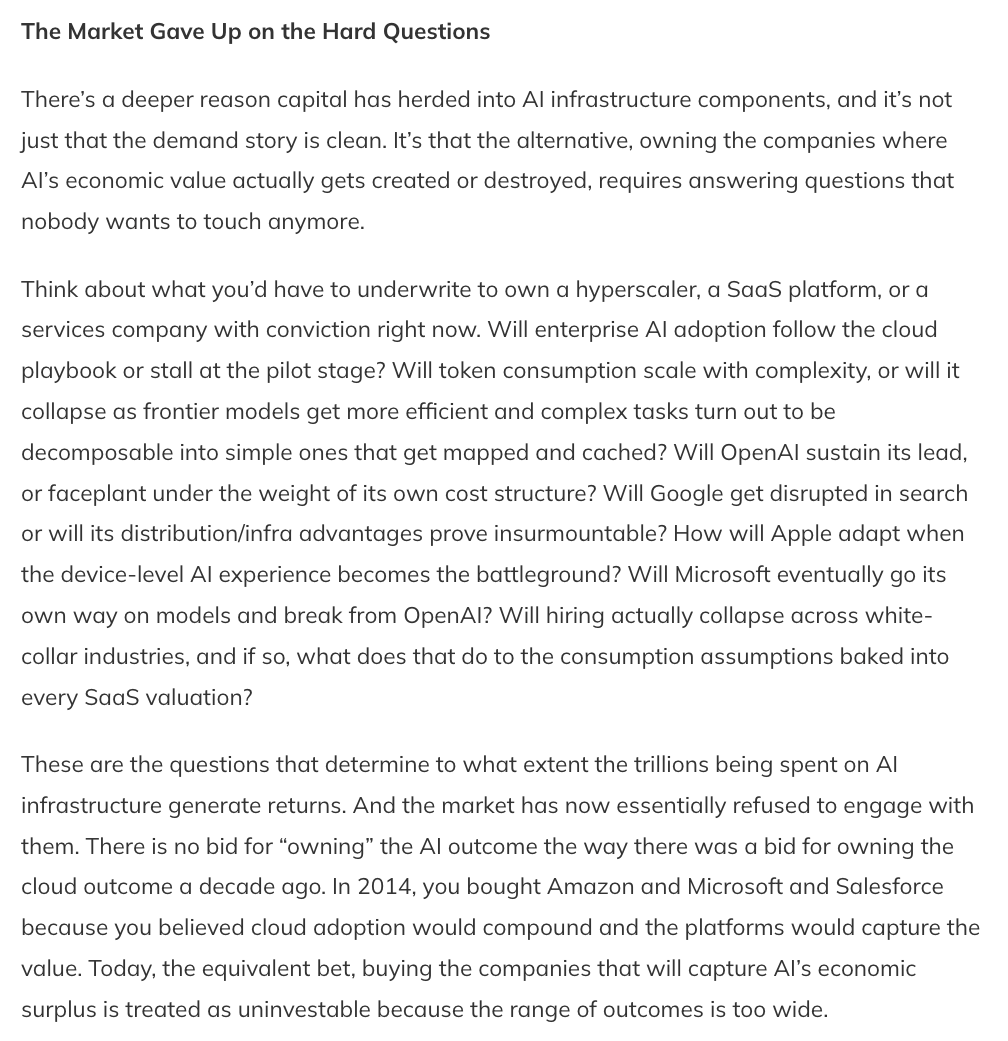
Must read from @akramsrazor
The market has completely given up on trying to figure out who wins from AI. It will only buy the inputs. But:
"If you can't make money in every software, adtech, media, info services biz, and hyperscaler, then why are you buying lasers and cables? The picks-and-shovels trade isn’t insulated from the demand/return question, it's a levered bet on it."
English