

RO2⚡️
12.5K posts

RO2⚡️
@risingodegua
👨💻 Engineering @SpAItial_AI
London, England Katılım Kasım 2011
1.9K Takip Edilen8.8K Takipçiler
@risingodegua @UnslothAI Oh yes so if there's no GPU or your system is not supported, only inference works for now
English

Introducing Unsloth Studio ✨
A new open-source web UI to train and run LLMs.
• Run models locally on Mac, Windows, Linux
• Train 500+ models 2x faster with 70% less VRAM
• Supports GGUF, vision, audio, embedding models
• Auto-create datasets from PDF, CSV, DOCX
• Self-healing tool calling and code execution
• Compare models side by side + export to GGUF
GitHub: github.com/unslothai/unsl…
Blog and Guide: unsloth.ai/docs/new/studio
Available now on Hugging Face, NVIDIA, Docker and Colab.
English
RO2⚡️ retweetledi

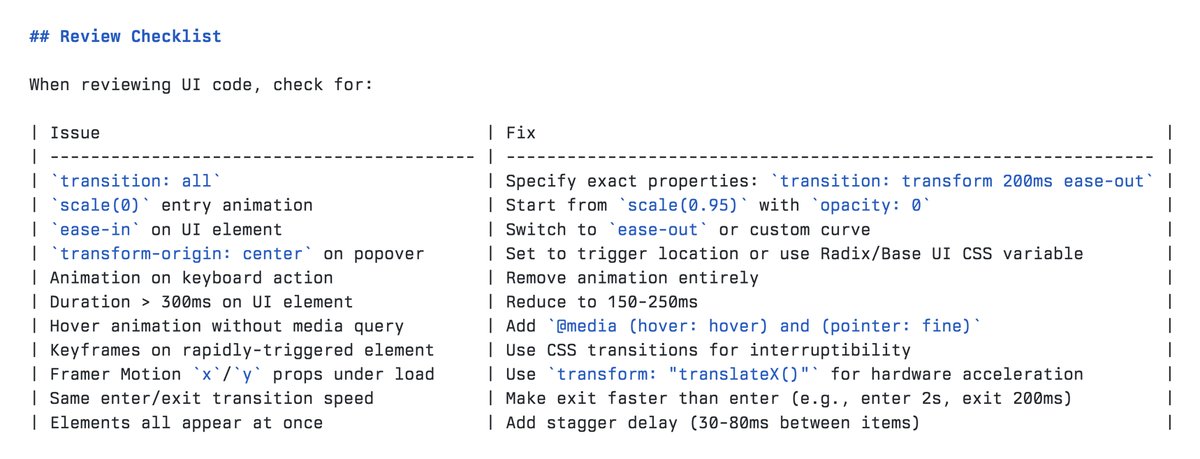
Turned my blog articles into one big design engineering skill that you can use with coding agents like Claude Code or Codex.
It covers animations, component design, principles from my open source projects like Sonner, and more.
emilkowal.ski/skill
English

RO2⚡️ retweetledi
Many 3D generators output Gaussian Splats (3DGS) for fast rendering, flexible deployment, and high visual fidelity.
Static 3DGS aren't world models (no dynamics/semantics) but a true world model must allow distilling 3D-consistent representations for any given time step (3DGS/meshes).
This post-distillation serves a dual purpose:
1) validates physical consistency of the model.
2) extracting explicit representations avoids continuously running a heavy generator, thus saves compute and facilitates real-time interaction.
English
RO2⚡️ retweetledi

I trained a neural network to mimic a forest trail near my apartment (web demo in the post) madebyoll.in/posts/world_em…
English

@risingodegua In what way is it broken? Do you mind sharing a screenshot?
English
Diffusion models clicked for me when I started seeing them through the lens of particle motion.
I built this interactive playground where you too can clickety-clack to understand how drift, noise, and other hyperparams control diffusion.
I hereby submit this as penance for the sin of YouTube edu-tainment 😇
Link in the first comment.
English
RO2⚡️ retweetledi

RO2⚡️ retweetledi


RO2⚡️ retweetledi
The concept of creating an exact digital replica of the physical world has always fascinated me: environments that look and behave exactly like our everyday reality, precisely captured in the digital domain. This is the essence of 𝐖𝐨𝐫𝐥𝐝 𝐌𝐨𝐝𝐞𝐥𝐬, simulated realities indistinguishable from our own. Generating these models is the core mission behind what we are building at @SpAItial_AI.
True World Models must capture both photorealistic appearance and underlying physics, spatially-consistent across the environment. For static scenes, current models already deliver impressive results, unlocking downstream applications from gaming to 3D design. However, the true frontier lies in modeling dynamics, which will enable the training of AI agents whose learned behaviors can bridge the sim-to-real gap, thus unlocking countless real-world applications.
English
Come join us!
Matthias Niessner@MattNiessner
🚀🚀Want to build 𝐖𝐨𝐫𝐥𝐝 𝐒𝐢𝐦𝐮𝐥𝐚𝐭𝐨𝐫𝐬?🚀🚀 We're hiring in Munich or London! Check it out: spaitial.ai/careers SpAItial is pioneering the next generation of World Models, pushing the boundaries of generative AI, computer vision, and the simulation of reality. We are moving beyond 2D pixels to build models that natively understand the physics and geometry of our world. Our mission is to redefine how industries, from robotics and AR/VR to gaming and cinema, generate and interact with physically-grounded 3D environments. We’re looking for individuals who are bold, innovative, and driven by a passion for pushing the boundaries of what’s possible. You should thrive in an environment where creativity meets challenge and be fearless in tackling complex problems. Our team is built on a foundation of dedication and a shared commitment to excellence, so we value people who take immense pride in their work and place the collective goals of the team above personal ambition. As a part of SpAItial, you’ll be at the forefront of the AI revolution in generative AI technology, and we want you to be excited about shaping the future of this dynamic field. If you’re ready to make an impact, embrace the unknown, and collaborate with a talented group of visionaries, we want to hear from you. #worldmodels #GenAI #3D #spatialintelligence
English
RO2⚡️ retweetledi

I spent all of Christmas reverse engineering Claude Chrome so it would work with remote browsers.
Here's how Anthropic taught Claude how to browse the web (1/7)
English
RO2⚡️ retweetledi

yes things are changing fast, but also I see companies (even faang) way behind the frontier for no reason.
you are guaranteed to lose if you fall behind.
the no unforced-errors ai leader playbook:
For your team:
- use coding agents. give all engineers their pick of harnesses, models, background agents: Claude code, Cursor, Devin, with closed/open models. Hearing Meta engineers are forced to use Llama 4. Opus 4.5 is the baseline now.
- give your agents tools to ALL dev tooling: Linear, GitHub, Datadog, Sentry, any Internal tooling. If agents are being held back because of lack of context that’s your fault.
- invest in your codebase specific agent docs. stop saying “doesn’t do X well”. If that’s an issue, try better prompting, agents.md, linting, and code rules. Tell it how you want things. Every manual edit you make is an opportunity for agent.md improvement
- invest in robust background agent infra - get a full development stack working on VM/sandboxes. yes it’s hard to set up but it will be worth it, your engineers can run multiple in parallel. Code review will be the bottleneck soon.
- figure out security issues. stop being risk averse and do what is needed to unblock access to tools.
in your product:
- always use the latest generation models in your features (move things off of last gen models asap, unless robust evals indicate otherwise). Requires changes every 1-2 weeks - eg: GitHub copilot mobile still offers code review with gpt 4.1 and Sonnet 3.5 @jaredpalmer. You are leaving money on the table by being on Sonnet 4, or gpt 4o
- Use embedding semantic search instead of fuzzy search. Any general embedding model will do better than Levenshtein / fuzzy heuristics.
- leave no form unfilled. use structured outputs and whatever context you have on the user to do a best-effort pre-fill
- allow unstructured inputs on all product surfaces - must accept freeform text and documents. Forms are dead.
- custom finetuning is dead. Stop wasting time on it. Frontier is moving too fast to invest 8 weeks into finetuning. Costs are dropping too quickly for price to matter. Better prompting will take you very far and this will only become more true as instruction following improves
- build evals to make quick model-upgrade decisions. they don’t need to be perfect but at least need to allow you to compare models relative to each other. most decisions become clear on a Pareto cost vs benchmark perf plot
- encourage all engineers to build with ai: build primitives to call models from all code bases / models: structured output, semantic similarity endpoints, sandbox code execution. etc
What else am I missing?
Andrej Karpathy@karpathy
I've never felt this much behind as a programmer. The profession is being dramatically refactored as the bits contributed by the programmer are increasingly sparse and between. I have a sense that I could be 10X more powerful if I just properly string together what has become available over the last ~year and a failure to claim the boost feels decidedly like skill issue. There's a new programmable layer of abstraction to master (in addition to the usual layers below) involving agents, subagents, their prompts, contexts, memory, modes, permissions, tools, plugins, skills, hooks, MCP, LSP, slash commands, workflows, IDE integrations, and a need to build an all-encompassing mental model for strengths and pitfalls of fundamentally stochastic, fallible, unintelligible and changing entities suddenly intermingled with what used to be good old fashioned engineering. Clearly some powerful alien tool was handed around except it comes with no manual and everyone has to figure out how to hold it and operate it, while the resulting magnitude 9 earthquake is rocking the profession. Roll up your sleeves to not fall behind.
English
RO2⚡️ retweetledi

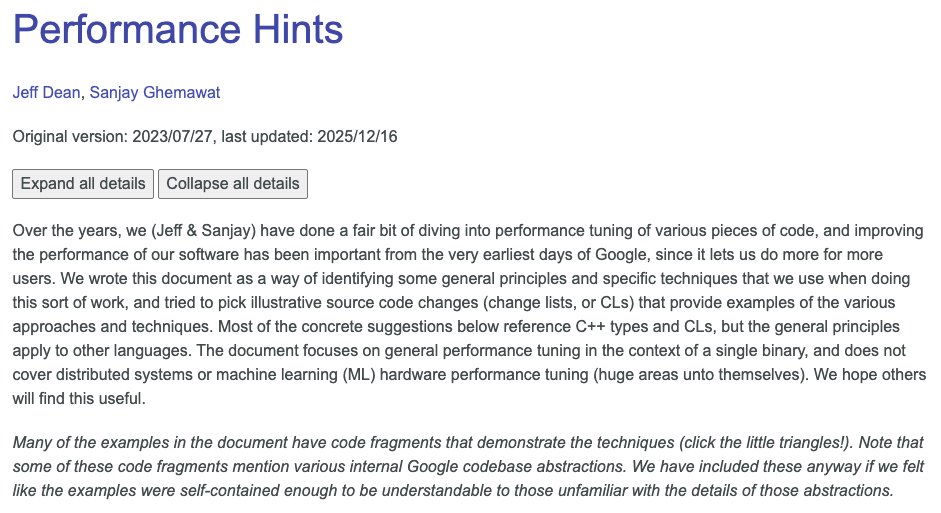
Performance Hints
Over the years, my colleague Sanjay Ghemawat and I have done a fair bit of diving into performance tuning of various pieces of code. We wrote an internal Performance Hints document a couple of years ago as a way of identifying some general principles and we've recently published a version of it externally.
We'd love any feedback you might have!
Read the full doc at: abseil.io/fast/hints.html
English
RO2⚡️ retweetledi
Releasing Echo today is incredibly exciting for me — because it is a critical step for generative AI, enabling the creation of virtual worlds.
Echo is our first world model at SpAItial AI. It turns text or images into explorable 3D environments — spaces you can move through, inspect, and build on. Seeing this work in real time still feels a bit surreal.
My fascination with this goes back a long way: video games, virtual environments, and the idea of capturing the real world in 3D. As a researcher, I spent years working on 3D reconstruction, neural rendering, and scene understanding — all driven by the same question: how do we teach machines to understand the world?
One thing became clear over time: the biggest bottleneck isn’t compute or rendering — it’s 3D worlds themselves. High-quality, consistent environments are expensive to create by hand and don’t scale to the experiences we want to build. In particular, I believe that the ability to generate virtual worlds is ultimately key towards understanding the real world.
That’s why we founded SpAItial AI. We’re building spatial world models that combine geometric understanding with creative generation — models that can generate, edit, and eventually reason about 3D environments.
Echo is just the beginning. For me, this feels like the moment when decades of research finally meet the imagination that got many of us into graphics, games, 3D understanding in the first place.🌍
spaitial.ai
SpAItial AI@SpAItial_AI
🚀 Announcing Echo — our new frontier model for 3D world generation. Echo turns a simple text prompt or image into a fully explorable, 3D-consistent world. Instead of disconnected views, the result is a single, coherent spatial representation you can move through freely. This is part of a bigger shift in AI: from generating pixels and tokens to generating spaces. Echo predicts a geometry-grounded 3D scene at metric scale, meaning every novel view, depth map, and interaction comes from the same underlying world — not independent hallucinations. Once generated, the world is interactive in real time. You control the camera, explore from any angle, and render instantly — even on low-end hardware, directly in the browser. High-quality 3D world exploration is no longer gated by expensive equipment. Under the hood, Echo infers a physically grounded 3D representation and converts it into a renderable format. For our web demo, we use 3D Gaussian Splatting (3DGS) for fast, GPU-friendly rendering — but the representation itself is flexible and can be easily adapted. Why this matters: consistent 3D worlds unlock real workflows — digital twins, 3D design, game environments, robotics simulation, and more. From a single photo or a line of text, Echo builds worlds that are reliable, editable, and spatially faithful. Echo also enables scene editing and restyling. Change materials, remove or add objects, explore design variations — all while preserving global 3D consistency. Editing no longer breaks the world. This is only the beginning. Echo is the foundation for future world models with dynamics, physical reasoning, and richer interaction — environments that don’t just look right, but behave right. Explore the generated worlds on our website and sign up for the closed beta. The era of spatial intelligence starts here. 🌍 #Echo #WorldModels #SpatialAI #3DFoundationModels Check it out: spaitial.ai
English
🚀 Congrats on the release! can't wait to try this out.
SpAItial AI@SpAItial_AI
🚀 Announcing Echo — our new frontier model for 3D world generation. Echo turns a simple text prompt or image into a fully explorable, 3D-consistent world. Instead of disconnected views, the result is a single, coherent spatial representation you can move through freely. This is part of a bigger shift in AI: from generating pixels and tokens to generating spaces. Echo predicts a geometry-grounded 3D scene at metric scale, meaning every novel view, depth map, and interaction comes from the same underlying world — not independent hallucinations. Once generated, the world is interactive in real time. You control the camera, explore from any angle, and render instantly — even on low-end hardware, directly in the browser. High-quality 3D world exploration is no longer gated by expensive equipment. Under the hood, Echo infers a physically grounded 3D representation and converts it into a renderable format. For our web demo, we use 3D Gaussian Splatting (3DGS) for fast, GPU-friendly rendering — but the representation itself is flexible and can be easily adapted. Why this matters: consistent 3D worlds unlock real workflows — digital twins, 3D design, game environments, robotics simulation, and more. From a single photo or a line of text, Echo builds worlds that are reliable, editable, and spatially faithful. Echo also enables scene editing and restyling. Change materials, remove or add objects, explore design variations — all while preserving global 3D consistency. Editing no longer breaks the world. This is only the beginning. Echo is the foundation for future world models with dynamics, physical reasoning, and richer interaction — environments that don’t just look right, but behave right. Explore the generated worlds on our website and sign up for the closed beta. The era of spatial intelligence starts here. 🌍 #Echo #WorldModels #SpatialAI #3DFoundationModels Check it out: spaitial.ai
English
RO2⚡️ retweetledi

Everyone and their mother has something to say about space compute. But no one has comprehensively broken down the physics, energy, cooling, economics, and the real work involved.
So I built a 1st principles model to show you guys myself.
astrocompute.dev

English
RO2⚡️ retweetledi

RO2⚡️ retweetledi

If you've ever seen someone tweet some cool shader and thought "I don't really even know what a shader is and at this point I'm too afraid to ask" - I've written something just for you.
makingsoftware.com/chapters/shade…
English