Rushil Khurana

41 posts

Rushil Khurana banner
Rushil Khurana

Rushil Khurana

@rkonfire

New Delhi, India Katılım Mayıs 2011
48 Takip Edilen13 Takipçiler
Rushil Khurana retweetledi
Deepinder Goyal
Deepinder Goyal@deepigoyal·
If you used to work at Zomato, whether you chose to move on, or I was the one who asked you to leave, this is for you. I know that for many of you, Zomato didn't have the environment, or the leadership you needed at the time. But I know for sure, that you loved being at Zomato, and it is quite possible that you never felt like home anywhere else since you left. We have over four hundred people at Eternal today in their second or third stints. Many of them are doing their best work now. Maybe because they've grown, but also because the company has grown. We are more organised, a little less chaotic, and hopefully, I've learned a few things along the way too. If you haven't reached out because you think the door is closed, or because you think I'm holding onto the past, I'm not. I want you back. There is so much to build at Eternal. We are today, a family of companies. Zomato, Blinkit Quick-Commerce, Blinkit Ambulances, District, Hyperpure, Nugget, and Feeding India. We need people who already know what good looks like here, and who care enough to fight for it. There is no better person for that than someone who has been here, left, grown, and wants to come back. You might say that Eternal is not going to be the same, because I am not the CEO anymore. But ask yourself a question. Did titles ever matter at Eternal? I am still very much here, and I'd love for you to be a part of this next phase of Eternal. If you feel like you have unfinished business here, please don't overthink it. Write to me at back@eternal.com. The Gurgaon pollution is still a bug, but being at Eternal is the feature. Let's talk and find a role that fits your life as it is today.
English
563
513
10.2K
1.1M
Rushil Khurana retweetledi
Deepinder Goyal
Deepinder Goyal@deepigoyal·
Last one on this topic, and I have been holding this in myself for a while. For centuries, class divides kept the labor of the poor invisible to the rich. Factory workers toiled behind walls, farmers in distant fields, domestic help in backrooms. The wealthy consumed the fruits of that labor without ever seeing the faces or the fatigue behind it. No direct encounter, no personal guilt. The gig economy shattered that invisibility, at unprecedented scale. Suddenly, the poor aren't hidden away. They're at your doorstep: the delivery partner handing over your ₹1000+ biryani, late-night groceries, or quick-commerce essentials. You see them in the rain, heat, traffic, often on borrowed bikes, working 8–10 hours for earnings that give them sustenance. You see their exhaustion, their polite smile masking frustration with life in general. This is the first time in history at this scale that the working class and consuming class interact face-to-face, transaction after transaction. And that discomfort with our own selves is why we are uncomfortable about the gig economy. We want these people to look our part, so that the guilt we feel while taking orders from them feels less. We aren't just debating economics. We are confronting guilt. That ₹800 order might equal their entire day's earnings after fuel, bike rent, and app cuts. We tip awkwardly, or avoid eye contact, because the inequality is no longer abstract. It's personal. Pre-gig era, the rich could enjoy luxury without moral discomfort. Labor was out of sight. Now, every doorbell ring is a reminder of systemic inequality. That's why debates explode. It's not just policy. It's emotional reckoning. Some defend the system (“they choose it”), others demand change (“this isn't progress, its exploitation”). And here’s the uncomfortable twist: the unsaid ask of clumsy ‘solutions’ isn’t dignity. It is about returning to invisibility. Ban gig work and you don’t solve inequality. You remove livelihoods. These jobs don’t magically reappear as formal, protected employment the next day. They disappear, or they get pushed back into the informal economy where there are even fewer protections and even less accountability. Over-regulate it until the model breaks, and you achieve the same outcome through paperwork instead of slogans: the work evaporates, prices rise, demand collapses, and the people we claim to protect are the first to lose income. And then what happens? The rich get their old comfort back. Convenience returns without faces. Guilt dissolves. We go back to clean abstractions and moral posturing from a distance. The poor don’t become safer, they become invisible again: back in cash economies, back in backrooms, back in shadows where regulation rarely reaches and dignity isn’t even debated. The gig economy just exposed the reality of inequality to the people who previously had the luxury of not seeing it. The doorbell is not the problem. The question is what we do after opening the door. Visibility is the price of progress. We can either use this discomfort to build something better (which we keep doing continuously as delivery partners are our backbone), or we can ban and over-regulate our way back into ignorance. One of those choices improves lives. The other simply helps the consuming class feel virtuous in the dark.
English
2K
5.2K
25.4K
3.7M
Rushil Khurana retweetledi
Deepinder Goyal
Deepinder Goyal@deepigoyal·
One more thing. Our 10 minute delivery promise is enabled by the density of stores around your homes. It’s not enabled by asking delivery partners to drive fast. Delivery partners don’t even have a timer on their app to indicate what was the original time promised to the customer. After you place your order on Blinkit, it is picked and packed within 2.5 minutes. And then the rider drives an average of under 2kms in about 8 minutes. That's an average of 15kmph. I understand why everybody thinks why 10 minutes must be risking lives, because it is indeed hard to imagine the sheer complexity of the system design which enables quick deliveries. Also, if you've ever wanted to know why millions of Indians voluntarily take up platform work and sometimes even prefer it to regular jobs, JUST ASK any rider partner when you get your next food or grocery order. You will be humbled by how rational and honest they will be with you. Having said that, no system is perfect, and we are all for making it better than today. However, it is far from what it is being portrayed on social media by people who don't understand how our system works and why. If I were outside the system, I would also believe that gig workers are being exploited, but that's not true.
English
1.3K
2.3K
21K
2.5M
Rushil Khurana retweetledi
Deepinder Goyal
Deepinder Goyal@deepigoyal·
Agree. And literally everyone who has a job wants to get paid more. Everyone thinks they deserve better. At the end of the day, market forces decide how much does someone get paid. Companies reliant on gig economy compete very brutally with each other. Demand is more than the supply, which results in gig incomes being more than what many formal entry level jobs in India pay.
Hardik Rajgor@Hardism

The real minimum wage is ₹0. It is called unemployment. Millions of people in India are unemployed. In many small towns and cities, guys in their early 20s leave their houses on a bike, loiter around all day, drink and smoke with their friends and gamble on cellphone games. Countless families are struggling with this - financial burden + social ills. Quick commerce tech-companies have created jobs for lakhs of such people. None of them are forced to work with these companies. They are free to leave and do something else. But they decided to earn a respectful living. More than the national average, more than ₹0. They believe - for the skill they possess, effort that is required, and money they make - this job is better than any other job available in the market. Every person has the right to make that choice for their career. Just like the one you have made with your current job. GoodPeople™ are always free to create better jobs. Talk is cheap. Till then, the wages these 'evil' and 'exploitative' capitalists provide, will help them pay their children's school fees, and buy groceries for the month. Their life is better with this job, than it was, without it.

English
261
907
7.7K
603.3K
Rushil Khurana retweetledi
Deepinder Goyal
Deepinder Goyal@deepigoyal·
Agree. I repeat – gig workers is one of the largest organised job creation engines in India. And we provide insurance, fair, timely and predictable wages. Gig doesn’t need more regulation, it needs less regulation. It will bring more people into the fold, who will be able to earn some money, upskill themselves and later join India’s organised workforce. Not to mention, consistently send their kids to school - which will fundamentally change the fabric of our nation one generation later.
Vinod Chendhil@vinodchendhil

Deepinder is right but very few people will agree to this. We have a Myntra warehouse right next door and it was buzzing today like every day, no one was on a strike or dharna. A lot of the kids who work there are in between jobs when they are unable to find anything else suitable. Are the hours long, yes. But it is still optional it is not bonded labour. People asking for a fixed salary really don't understand how this works. Should we demand better work conditions of course. But saying pay min salary is a slippery slope tbh. The question is simple if there were higher paying alternatives wouldn't they have taken it. The fact is there are none, so this is a good step till they upgrade themselves and find better paying full time jobs.

English
181
863
5.3K
272.4K
Rushil Khurana retweetledi
Deepinder Goyal
Deepinder Goyal@deepigoyal·
I am all for peaceful protests against anything and everything. But violent protests and stopping others who want to work from working is not okay (proof attached). Here’s what we know – a number of these protestors were not even our delivery partners. They were agents of political interests, piggybacking on the narrative to gain political mileage.
Shubhendu@BBTheorist

Mill workers in Kanpur tried to act in a similar fashion. Result: Mills closed down. The next 2 generations of these workers couldn’t not even have 2 square meals a day. The trade unionist who instigated them went on to become a parliamentarian & lived in a plush Lutyens house.

English
587
2K
6.5K
393.9K
Rushil Khurana retweetledi
Nilashma Laha
Nilashma Laha@NilashmaL·
@StarHealthIns @starhealth_ins agents are fooling old age people luring them from their previous service provider citing continuation of all benefits and cover for pre existing illness and then you are conveniently rejecting the claims saying we cant cover pre existing diseases
English
4
12
0
587
Rushil Khurana
Rushil Khurana@rkonfire·
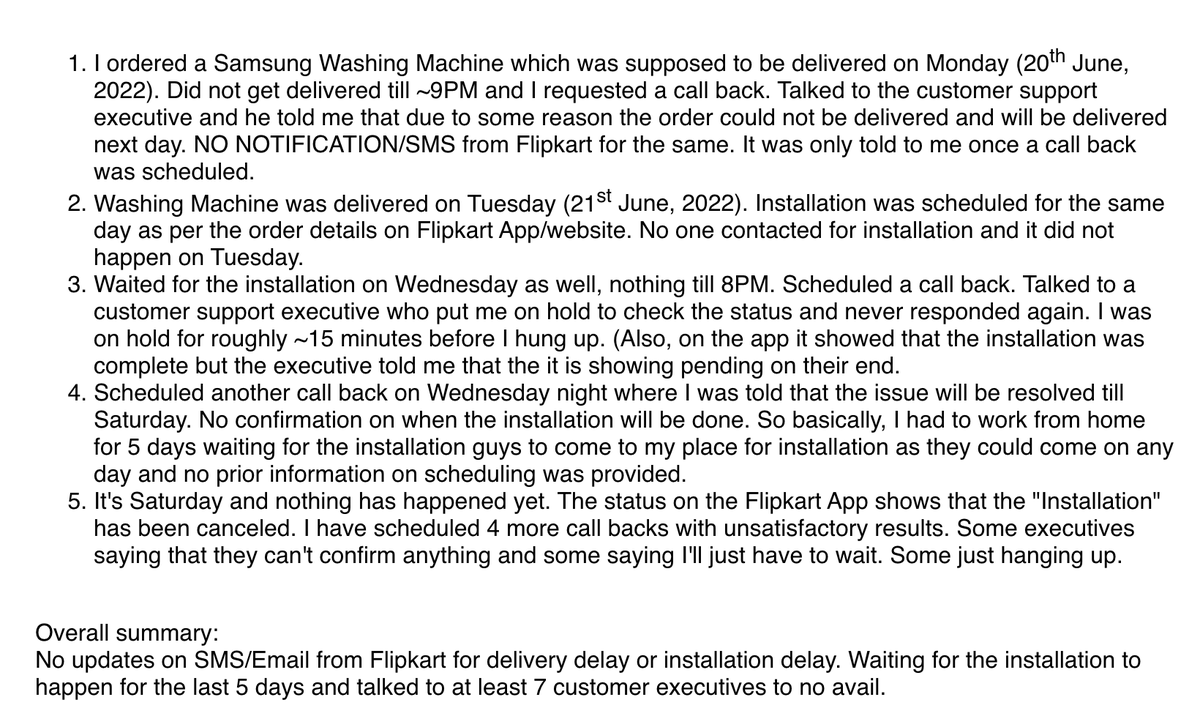
No resolution yet. Just getting messages that resolution date has now been moved to 29th June. Beautifully done @Flipkart @flipkartsupport @_Kalyan_K . Still waiting for the installation after a week of delivery.
English
0
0
0
0
Rushil Khurana
Rushil Khurana@rkonfire·
Want to win 2 x OnePlus SandStone Black Bundles? I just entered to win and you can too. gvwy.io/h73679c
English
0
0
3
0
Rushil Khurana
Rushil Khurana@rkonfire·
@_rendoll these words must have come back now ... sachin 100*100 ..sheer determination inspiring everyone
English
0
0
0
0