HOPE Engineer

104 posts

HOPE Engineer banner
HOPE Engineer

HOPE Engineer

@rlaope

SW Engineer / AI Researcher / Works like AI. * 16 hours coding, 7 hours sleep, 1 hour workout. Providing AI Insights and Love Fashion, Art, Design

Paris, France Katılım Mayıs 2026
274 Takip Edilen98 Takipçiler
HOPE Engineer
HOPE Engineer@rlaope·
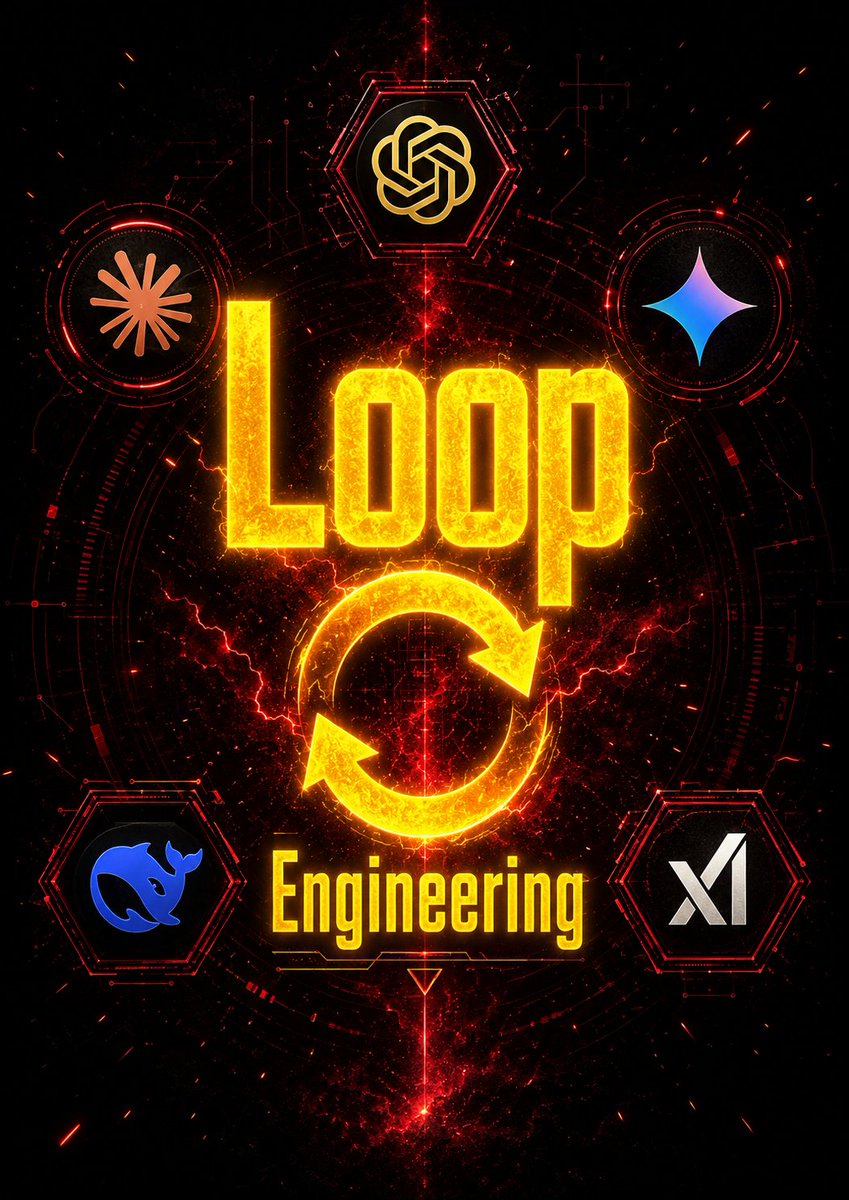
The core of Loop Engineering is simple. Instead of manually prompting the AI every turn with "do this now," "verify this," "write docs," or "create the next issue," you define a goal and let the AI iterate autonomously until it reaches the completion state. To do this right, you need at least 6 core elements: 1. Automations: Automate execution, verification, follow-up tasks, and state updates. 2. Worktrees: Isolate tasks for safe experimentation without breaking the main branch. 3. Skills: Turn repetitive workflows like code review, QA, documentation, and refactoring into reusable execution units. 4. Plugins/Connectors: Hook into real-world tools like GitHub, Linear, browsers, and external APIs. 5. Sub-agents: Instead of one agent doing everything sequentially, distribute roles like reviewer, implementer, QA, and researcher for parallel evaluation. 6. Memory: Store decisions, rationale, changes, verification results, and follow-up issues so context outlives a single chat session. For example, consider this goal: > Improve the current dashboard so real users can actually understand it. Iterate through UX review, bug fixes, visual QA, doc updates, and issue organization until users can instantly judge what is happening, what to read, and what to do next from a single screen. This is not simply "fix the dashboard UI." It is a loop that drives product quality to a definitive state of completion. The loop interprets the goal, asks clarifying questions to set baselines if necessary, then implements, reviews, and tests in an isolated workspace. If it fails, it revises. Outputs are saved as a human-readable Wiki and a machine-readable Memory. Finally, it isolates remaining tasks into new issues and verifies the stopping criteria. The key takeaway: AI is not replacing the engineer. The system takes over the repetitive prompting loop, while the engineer remains entirely responsible for goals, judgment, verification, and direction. Build the loop, stay the engineer. If you want to get a practical feel for this, I recommend checking out this repository: github.com/rlaope/loop
HOPE Engineer tweet mediaHOPE Engineer tweet media
English
0
0
1
36
HOPE Engineer
HOPE Engineer@rlaope·
Hey Founders and Builders. Looking to connect with people building in: 🚀 SaaS 🚀 Tech Automation 🚀 AI tools 🚀 Product Development 🚀 Web APP Devs #BuildinPublic #connect #SaaS #x Drop what you're working on👇
English
47
0
27
838
HOPE Engineer
HOPE Engineer@rlaope·
Thoughts on Loop Engineering We must discard the misconception that if you input a massive goal, the system will just figure it out. If you fail to define what kind of goal is actually loopable, the entire concept of the product becomes compromised. Prompts like "Build a $10M ARR SaaS" or "Create a 100k-star open-source project" might look like goals, but they are essentially just performance wishes. There is no problem definition, no constraints, and no verifiable intermediate outputs. If you feed these into a loop, the AI stops solving the problem and devolves into a plausible direction generator. On the flip side, a prompt like "Build a website" is indeed an implementation goal, but it is too simple. It doesn't require the overhead of Loop Engineering; a single-shot coding task is more than enough. Ultimately, the Goal presented in Loop Engineering is fundamentally different from a Hope or a Wish. It must be larger in scope than a simple task, yet far more concrete and constrained than a vague wish. To clarify what exactly constitutes a well-defined goal, here are a few practical examples: 1. Personal WebsiteBad: Build my personal website.Loopable: I want to build a personal site that highlights my professional identity. Explore which architecture and structure make sense based on my current assets and projects, and then implement, verify, and refine it section by section. 2. Open Source ProjectBad: Make a 100k-star OSS.Loopable: Analyze the current repository, identify the friction points preventing users from finding value within the first 10 minutes of installation, and iteratively reduce them to improve the README, installation process, and first-run experience. 3. B2B SaaSBad: Build a $10M ARR SaaS.Loopable: Identify a recurring operational bottleneck for a specific user segment, observe their manual workflows, formulate an MVP hypothesis, build a landing page/prototype, and determine the next execution loop based on user feedback. To reiterate: Goals and wishes are entirely different beasts. Building an AI system driven by wishes will only lead to system collapse. The true, effective use case for Loop Engineering is defining a precise goal, executing iterative loops to accumulate a grounded context state, and having the system continuously read and adapt from that accumulated knowledge. github.com/rlaope/loop
English
0
0
1
39
HOPE Engineer
HOPE Engineer@rlaope·
"Loop Engineering" is built around six working components: 1. Automations: repeatable read-only discovery, triage, and scheduled checks. 2. Worktrees: isolated branches or directories for code-changing work. 3. Skills: durable workflow instructions such as $loop. 4. Plugins/connectors: distribution and optional external context surfaces. 5. Sub-agents: delegated maker/checker or specialist lanes. 6. Memory: markdown, JSON state, or issue boards that survive one chat session. Good Example loop engineering i think this repo github.com/rlaope/loop
English
0
0
1
16
HOPE Engineer
HOPE Engineer@rlaope·
Agent quality starts with environment design. - Bad envs teach brittle shortcuts. - Good tasks expose real tool limits. - Eval loops need state, cost, failure. Recommended read: latent.space/p/bad-envs Follow for more AI and software insights.
English
0
0
1
6
HOPE Engineer
HOPE Engineer@rlaope·
AI agents need CLI-native model ops. - hf CLI works in non-interactive runs. - Agents can search, fetch, upload, manage repos. - Model work becomes scriptable. Recommended read: huggingface.co/blog/hf-cli-fo… Follow for more AI and software insights.
English
1
0
2
27
Douglas Loveday
Douglas Loveday@DouglasLoveful·
Hey founders! Looking to connect with people building in: 🍽️ SaaS 🚀 Tech 📲 Automation 🧠 AI tools 📱 Product Development 🔥 Web APP 💻 Devs Drop what you're working on 👇
English
19
1
19
525
Joe Crypto
Joe Crypto@aussiehaggie·
You can't grow alone ✅👥🧡😉 Drop your handle 👇💭✍️✍️✍️✍️ Let's follow each other 🤝💯💥💥💥💥💥
Joe Crypto tweet media
English
260
31
142
3.1K
Ojas
Ojas@Dir_LinkrCap·
Builders — let's connect 👋 Especially if you're in: · SaaS · Tech · Automation · AI · Product · Web apps · Dev Reply with what you're building 👇 + your link. I'll visit.
Ojas tweet media
English
49
1
24
1.2K
SHARIAR
SHARIAR@shariar_design·
Founders & Builders 👋 Got a product you're proud of? 🚀 Drop your product link below 👇 Let's connect, support each other, and grow together 🔒
SHARIAR tweet media
English
52
1
28
3.6K
HOPE Engineer
HOPE Engineer@rlaope·
I want to connect - AI - SRE - SaaS - Fashion Let's talk
English
0
0
1
23
HOPE Engineer
HOPE Engineer@rlaope·
Agent performance is often limited by the environment, not just the model. Reproducible observation/action/reward loops are becoming core AI engineering. huggingface.co/blog/openenv-a… Follow for more AI and software insights.
English
0
0
1
16
HOPE Engineer
HOPE Engineer@rlaope·
에이전트 성능은 모델만이 아니라 환경 설계에서 크게 갈립니다. 좋은 루프는 관찰, 행동, 보상을 재현 가능하게 만들어야 합니다. 이 글을 참고해보면 좋아요: huggingface.co/blog/openenv-a…
한국어
0
0
1
31
HOPE Engineer
HOPE Engineer@rlaope·
Agent-native CLI design is less about pretty terminal output and more about reliable rails. Prefer parseable output, no truncation, data on stdout, and hints/errors on stderr. The agent spends fewer steps rediscovering the workflow. Follow for more AI and software insights.
English
0
0
1
42
HOPE Engineer
HOPE Engineer@rlaope·
AI 에이전트용 CLI는 예쁜 UI보다 '파싱 가능한 레일'이 중요합니다. - 값은 자르지 않고 TSV/JSON으로 줍니다. - 다음 명령과 복구 방법을 stderr에 분리합니다. 이 글을 참고해보면 좋아요: huggingface.co/blog/hf-cli-fo… 팔로우하고 AI, 소프트웨어 관련 인사이트들을 얻으세요.
한국어
0
0
1
21
Kush
Kush@kushmergedeck·
Hey @X Algorithm I'm looking to #connect with builders in: 🤖 AI agents & automation ⚙️ Backend / APIs ☁️ DevOps & cloud 🏗️ Solutions architecture 🚀 Solo & indie founders 💻 Full stack & web dev 📊 SaaS & product growth 🧑‍💻 Vibe coders 💰founders looking to exit Say hi and lets grow together! 👋
English
19
0
24
1.1K