Tomas@TomasOnMarkets
📉 End-of-year Fed liquidity squeeze begins
Net Federal Reserve Liquidity has dropped by roughly $105bn since Monday.
This is the start of what will probably be an end-of-year liquidity crunch of between $250bn and $500bn, based on historical standards.
This will likely mean a new and significantly lower low on the Net Fed Liquidity chart.
1⃣ The first part of this liquidity squeeze occurred on Monday when the Treasury General Account balance rose by around $140bn (liquidity drain).
2⃣ The second part will be a slow build in Reverse Repo (RRP) usage (liquidity drain) as financial institutions shift cash into the Fed facility as part of end-of-year balance sheet "window dressing" to meet regulatory requirements, culminating on December 31.
This RRP build doesn't appear to have started yet - I'm expecting it to begin next week.
Fed liquidity will then likely snap back up from January 1 as the rush into the RRP is reversed.
Fed cuts RRP rate
However, we have had a small change to the dynamics at play here.
At FOMC this week, the Fed reduced the RRP rate by 5bps, relative to the target range - which should make holding cash at the facility less attractive.
This shows the Fed is starting to worry about liquidity levels and funding markets, and also shows a level of urgency among members, having only floated the change in November and now already implementing it a month later.
This move will probably mean an accelerated reduction in RRP usage (liquidity injection) in early 2025.
However, I'm not entirely sure how this change might affect the end-of-year "window-dressing" dynamics.
It may dampen the liquidity drain, or it might have no effect at all.
We'll have to wait and watch.
Watch SOFR
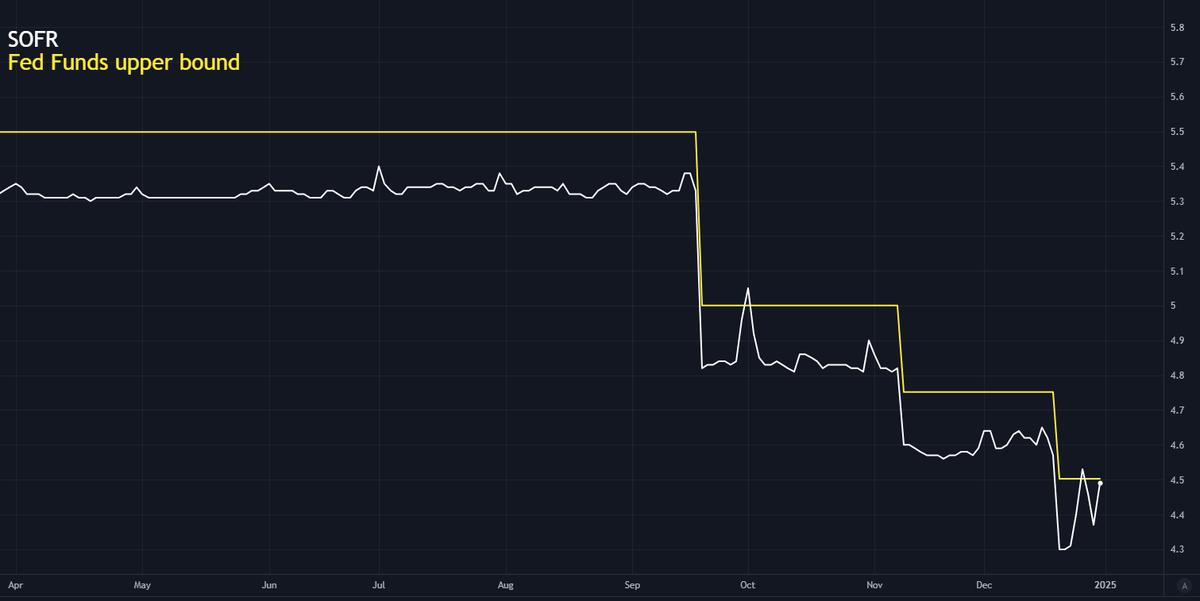
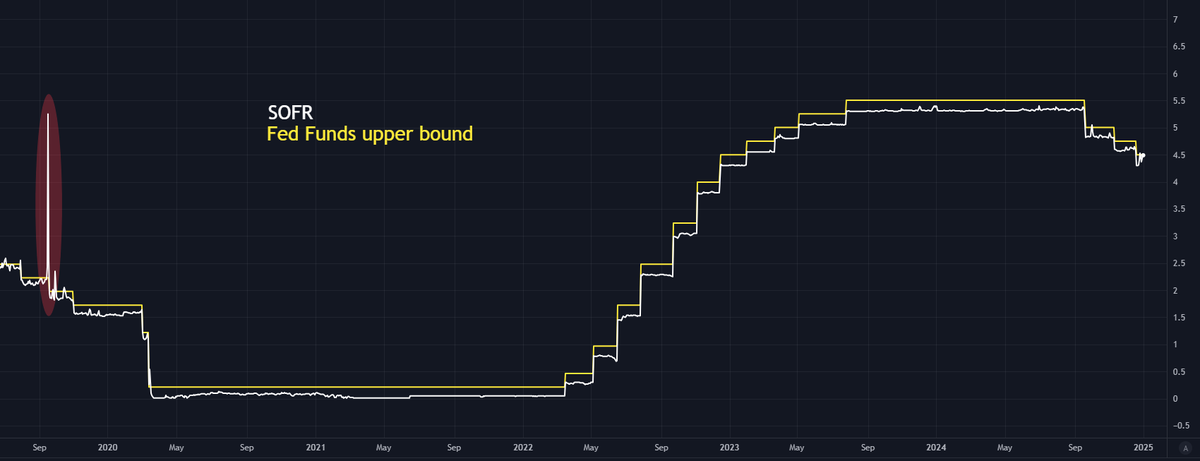
SOFR (Secured Overnight Financing Rate), a key funding rate in the dollar plumbing system, will be the thing to watch for signs of stress in funding markets as liquidity contracts.
SOFR (🟡) generally spikes when liquidity is tight.
There is a high chance of another big spike during the week beginning December 30, in a similar fashion to how it spiked at the end of Q3 (🔴).
SOFR spiking above the upper bound of the "Fed Funds corridor" (🔵) is a big flashing warning sign for the Fed that liquidity is tight.
How will this drop in liquidity affect asset markets?
While there are obviously countless other factors affecting risk asset market pricing, so far since Monday, we see S&P 500 -3% and bitcoin -8%.
There is some evidence that end-of-quarter liquidity crunches negatively affect risk asset markets.
Here are stats taking into account the previous ten end-of-quarter liquidity squeezes:
Since June 1 2022:
🔘 S&P 500 total average daily performance = +0.04%
🔘 S&P 500 average daily performance during end-of-quarter liquidity squeezes = -0.04%
🔘 Out of ten separate end-of-quarter liquidity squeeze instances: five ended S&P 500 green and five ended S&P 500 red
🔘 Bitcoin total average daily performance = +0.24%
🔘 Bitcoin average daily performance during end-of-quarter liquidity squeezes = 0%
🔘 Out of ten separate end-of-quarter liquidity squeeze instances: 6 ended bitcoin green and four ended bitcoin red