Roger C

2K posts

Roger C banner
Roger C

Roger C

@rogerchuakt

Uncovering the hard truths about investing and finance. No noise, no hype, just market reality.

Singapore Katılım Kasım 2012
543 Takip Edilen161 Takipçiler
Roger C
Roger C@rogerchuakt·
@GlobalMktObserv When 30-year real yields hit levels not seen since 2008 while debt sits above $39.5 trillion and interest costs run past $1.2 trillion a year, isn’t the market simply saying the fiscal path is getting harder to fund?
English
0
0
0
1
Global Markets Investor
Global Markets Investor@GlobalMktObserv·
⚠️US Treasury yields are up to the highest level since the Great Financial Crisis: The 30-year Treasury Inflation-Protected Securities (TIPS) yield, a measure of real, inflation-adjusted yields, has risen to 2.96%, the highest level since 2008. This means investors are demanding a much higher real return to hold long-dated US debt than at almost any point in nearly 2 decades, even though the Fed's benchmark rate is currently ~150 bps lower than in 2007. This comes as the US public has exploded to $39.5 trillion, up from $8.8 trillion in 2007. US debt now exceeds 120% of GDP, while annual interest costs have surpassed $1.2 trillion. Adding further pressure, more than $500 billion in AI-related corporate debt issuance is now competing with the government for long-term investor capital. Meanwhile, traders now see roughly a 1-in-3 chance of a Fed rate hike at the July 28–29 meeting, reversing earlier expectations for rate cuts this year as uncertainty around the Fed’s next move increases. As a result, bond market volatility, measured by the MOVE Index, has climbed to a 2-month high. One clear casualty has been the long-duration bond trade: the iShares 20+ Year Treasury Bond ETF has fallen nearly 5% over the past month and has now lost more than half its value since 2020. Rising yields are also becoming a bigger threat to stocks as higher long-term rates raise the discount rate for equities and put pressure on valuations. If fiscal deterioration continues while private-sector borrowing keeps expanding, real yields may have further to rise.
Global Markets Investor tweet media
English
7
25
68
7.2K
Roger C
Roger C@rogerchuakt·
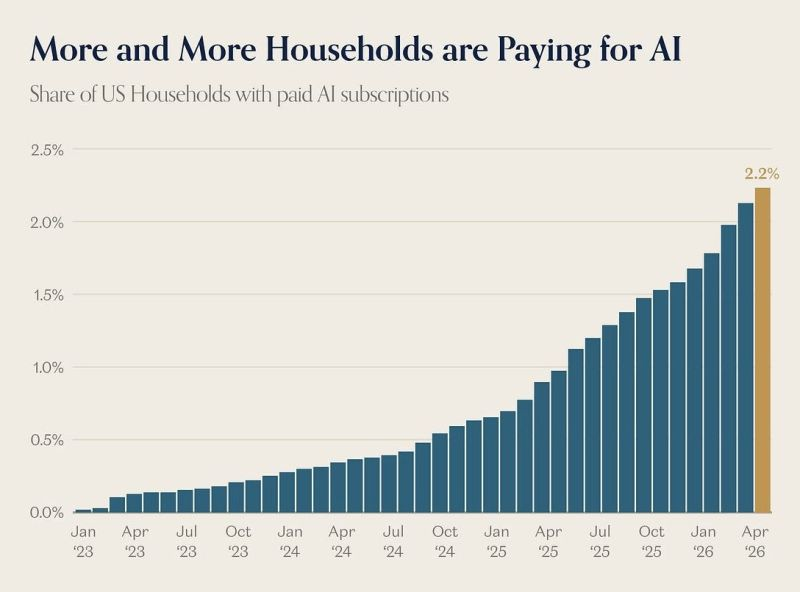
The 2.2% figure is worth watching, but I’m not sure consumer subscriptions are the whole market. Most people may never pay ChatGPT directly. They may pay for AI through Microsoft, Google, their employer, or products where AI is quietly built in. Still, the gap is hard to ignore. Hundreds of billions are being spent today on the assumption that usage will eventually become profitable demand. The real question is not whether people use AI. It is who ultimately pays enough for all this infrastructure.
Hedgie@HedgieMarkets

🦔2.2% of US households pay for an AI subscription as of April. The median spend is $20 a month. More Americans pay for sports betting apps (5%) than pay for AI. ChatGPT has 900 million weekly users but only 5% convert to paid. 37% of consumers say none of AI's uses are helpful. 30% say they're less likely to buy a product marketed as "AI-powered." Companies are spending $600 billion on AI infrastructure this year to serve a market where 97.8% of households don't pay for the product. My Take 2.2% penetration nearly four years after ChatGPT launched. Netflix hit 25% household penetration in a similar timeframe. Spotify hit 15%. The growth is fast in percentage terms but off a base so small that doubling it still leaves you in single digits. The capex projections, the bond issuances, the IPO valuations all assume consumer adoption eventually catches up to the spending. Nearly four years in, it hasn't. The pushback I'll get is that enterprise revenue is what counts and consumer subscriptions are a sideshow. Alphabet's cloud grew 82%. Anthropic reportedly hit $4.5 billion in ARR. But a lot of that enterprise spending is funded by VC money and hyperscaler capex, which makes it circular. Consumer willingness to pay is the closest thing to a genuine market signal, and right now that signal says $20 a month from 2.2% of households. The $600 billion in spending this year is a bet that the other 97.8% eventually show up. I'm not seeing it. Hedgie🤗

English
0
0
0
10
Roger C
Roger C@rogerchuakt·
@HedgieMarkets I suspect the enterprise numbers look stronger, but a large share of that spending still traces back to the same circular capital flows. Four years in, the consumer market has barely opened its wallet.
English
0
0
0
3
Hedgie
Hedgie@HedgieMarkets·
🦔2.2% of US households pay for an AI subscription as of April. The median spend is $20 a month. More Americans pay for sports betting apps (5%) than pay for AI. ChatGPT has 900 million weekly users but only 5% convert to paid. 37% of consumers say none of AI's uses are helpful. 30% say they're less likely to buy a product marketed as "AI-powered." Companies are spending $600 billion on AI infrastructure this year to serve a market where 97.8% of households don't pay for the product. My Take 2.2% penetration nearly four years after ChatGPT launched. Netflix hit 25% household penetration in a similar timeframe. Spotify hit 15%. The growth is fast in percentage terms but off a base so small that doubling it still leaves you in single digits. The capex projections, the bond issuances, the IPO valuations all assume consumer adoption eventually catches up to the spending. Nearly four years in, it hasn't. The pushback I'll get is that enterprise revenue is what counts and consumer subscriptions are a sideshow. Alphabet's cloud grew 82%. Anthropic reportedly hit $4.5 billion in ARR. But a lot of that enterprise spending is funded by VC money and hyperscaler capex, which makes it circular. Consumer willingness to pay is the closest thing to a genuine market signal, and right now that signal says $20 a month from 2.2% of households. The $600 billion in spending this year is a bet that the other 97.8% eventually show up. I'm not seeing it. Hedgie🤗
Hedgie tweet media
English
57
143
614
34.8K
Roger C
Roger C@rogerchuakt·
You don’t achieve financial peace by hitting a number. You achieve it when: • Your expenses no longer control your mood • A market drop doesn’t ruin your week • You can say “no” without calculating the cost • Money stops being the main character in your decisions Financial peace is less about how much you have and more about how little money occupies your mind. That’s the real shift most people miss.
English
0
0
0
7
Roger C
Roger C@rogerchuakt·
In rich countries, #crypto is usually discussed as an #investment. Elsewhere, it can mean dollar access, cheaper remittances or an escape from a weak and restricted local currency. The chart’s “9 out of 10” claim is debatable. But the bigger point stands: sometimes adoption is driven less by greed than by limited options.
Roger C tweet media
English
0
0
0
7
Roger C
Roger C@rogerchuakt·
Google generates US$1 million in profit roughly every 4 minutes. Nvidia takes 4 minutes 23 seconds. Microsoft, just over 5 minutes. But none of these businesses was built in minutes. What looks like overnight wealth is usually decades of compounding finally showing up.
Roger C tweet media
English
0
0
0
7
Roger C
Roger C@rogerchuakt·
@Dearme2_ That’s actual optionality. Most people just end up owned by the lifestyle instead.
English
0
0
0
3
Dear Self.
Dear Self.@Dearme2_·
The real flex is having a lot of money and still choosing a simple life...
English
47
84
693
16K
Nick | Dividend Investor & Educator
Let’s face it. No one saves their way to millions of dollars. You have to invest. Grow your money. Put it to work
English
15
11
143
6.1K
Roger C
Roger C@rogerchuakt·
The real threat is not that Chinese models beat every American model. They only need to be good enough, much cheaper, and easier to customise. That is where the pressure starts. Not on the technology, but on whether America’s enormous AI spending can still earn attractive returns once the models become cheaper and harder to differentiate.
English
0
0
1
174
Bull Theory
Bull Theory@BullTheoryio·
AMERICAN AI MODELS ARE OVERPRICED. China is now competing with top U.S. AI models at a fraction of the cost. Its latest Kimi K3 model charges $15 per million output tokens, half the price of OpenAI's GPT-5.6 Sol. Other Chinese models cost one-fourth to one-sixth as much as comparable American alternatives. Many are also open weight, so companies can customize and run them without sending their data to China. This is why Airbnb, DoorDash, Siemens and Microsoft are increasingly using Chinese models as lower cost options. And markets are starting to reflect this change. After Kimi K3 launched, the semiconductor index fell 1.6%, completing a 10% weekly decline and taking it 20% below its June peak. Kimi was not the only reason, but it added to a much bigger concern. The U.S. spent 23 times more than China on private AI last year, while its best model led by only 2.7%. Five U.S. hyperscalers are now expected to spend more than $725 billion this year. As China closes the performance gap at a lower price, investors are questioning whether America's massive AI spending will generate enough returns.
Bull Theory tweet media
English
45
82
352
25.4K
Roger C
Roger C@rogerchuakt·
@Olking07 Totally aligned with u. That's why they are not on the same pitch
English
0
0
1
4
Olki
Olki@Olking07·
@rogerchuakt True on cash flow, but the debt still introduces failure modes Bitcoin doesn’t have. Rates, vacancies, maintenance, banks
English
1
0
1
31
Olki
Olki@Olking07·
Would you rather have: • $1M in Bitcoin • $5M in real estate (with debt) Which gives you the better future?
English
13
0
7
643
Roger C
Roger C@rogerchuakt·
Costco chose JD. But this is not really a traffic story. JD.com has become Costco’s sole official e-commerce platform partner in China. During its first month of trial operations, the flagship store attracted more than 30 million visitors and nearly 200,000 followers. Some popular Kirkland Signature products repeatedly sold out. Impressive numbers. But visitors are not a moat. The real value JD provides is the infrastructure behind the screen: 📦 Inventory management
🏭 Nationwide warehousing
🚚 Fast delivery
✅ Product authenticity
🛠️ Customer service and returns JD spent years building an expensive and operationally demanding logistics network. That investment may have looked less attractive than running a lighter marketplace. Today, it allows JD to offer global brands something that advertising money cannot easily buy: dependable execution at national scale. For Costco, the partnership provides reach without requiring it to build warehouses everywhere. But there is also a risk. Costco’s moat is built around paid membership, loyalty and exclusivity. Allowing non-members to purchase selected products could attract future members, or gradually make membership feel less necessary. That is what investors should watch. Not merely visitor numbers, but: • Purchase conversion
• Repeat orders
• Membership growth
• Fulfilment economics
• Pricing discipline infrastructure often looks like a cost until someone important needs it. #TheLongGame #Costco #JDcom #Retail #Ecommerce #SupplyChain #BusinessStrategy #Investing
Roger C tweet media
English
0
0
0
21
Roger C
Roger C@rogerchuakt·
@wallstengine I guess the bigger story is that China’s memory industry is no longer competing only on price. It is gaining enough scale and domestic demand to start gaining pricing power too.
English
1
0
2
1.4K
Wall St Engine
Wall St Engine@wallstengine·
CHINESE MEMORY IS NO LONGER THE CHEAP ALTERNATIVE China’s largest DRAM maker, CXMT, is reportedly charging more than Samsung’s roughly $1,240 price for comparable 64GB DDR5 server memory modules. CXMT spent years competing as a cheaper, state-backed alternative. Now, AI data-center demand has tightened conventional memory supply, while Beijing has steered state-owned buyers toward domestic suppliers. Reuters reports CXMT has secured a five-year agreement worth more than $7 billion with ByteDance and another worth over $3 billion with Tencent. The company generated $7.5 billion in Q1 revenue, up 719% year over year, and is preparing to debut in Shanghai following an $8.6 billion IPO. New factories could more than double production capacity to over 600,000 wafers per month.
Wall St Engine tweet media
English
33
138
865
169K
Roger C
Roger C@rogerchuakt·
@Tim_Denning Wealth may attract attention, but it does not automatically earn respect. Money can impress people quickly; character is what makes that respect last.
English
0
0
0
1
Tim Denning
Tim Denning@Tim_Denning·
No disrespect but people respect you more when you’re wealthy.
English
60
39
535
12.5K
Roger C
Roger C@rogerchuakt·
@APompliano The greatest risk is not taking calculated risk in this era
English
0
0
0
5
Anthony Pompliano 🌪
Anthony Pompliano 🌪@APompliano·
Wow. Google is willing to risk the entire company to win the AI race
Anthony Pompliano 🌪 tweet media
English
623
451
8.8K
907.9K
Roger C
Roger C@rogerchuakt·
@Tim_Denning “Just make more money” is easy advice from the outside. Most people need better skills, better opportunities and better decisions and clarity, not a slogan repeated twice.
English
0
0
0
11
Tim Denning
Tim Denning@Tim_Denning·
If money is a problem just make more money. I repeat, if money is a problem just make more money.
English
59
17
252
7.3K
Roger C
Roger C@rogerchuakt·
@NoLimitGains $5 million may be necessary for one lifestyle and excessive for another. Retirement is not about hitting a dramatic headline number, but funding your actual spending, healthcare and inflation for as long as you live.
English
2
0
1
126
NoLimit
NoLimit@NoLimitGains·
It’s crazy how many people think they will be able to retire with one or two million in 30+ years. You will need AT LEAST $5 million to retire comfortably unless you want to eat ramen every day. The sooner you understand this, the better.
English
181
42
1.3K
246.4K
Roger C
Roger C@rogerchuakt·
@MoneyQuotesX Too simplistic. The rich consume too, but they make sure their assets are working harder than their lifestyle.
English
0
0
0
45
Money Quotes
Money Quotes@MoneyQuotesX·
The rich invest, the poor consume.
English
179
385
2.8K
40.9K
Roger C
Roger C@rogerchuakt·
@BrianFeroldi Retirement is not about never working again. It is about never being forced to do work you hate.
English
0
0
0
44
Brian Feroldi
Brian Feroldi@BrianFeroldi·
I know a lot of people who reached early "retirement." Almost all of them are still working. However, they changed what they do and they're all working at a job they LOVE. Getting there should be your real financial goal.
English
17
8
126
22.9K