@pdakean@EvoMellor@AeraOpen@SRCDtweets Yes, lots of exciting developments here, including (I think) the first cluster of open science exhibitors. I’d like to see the other social and behavioral science societies follow suit. Have suitcase, will travel.
With the databraryapi R package, you can store your videos, coding files, and other data on @databrary and securely retrieve, visualize, and analyze them in reproducible workflows from your desktop. Reproducibility by design.
@mcxfrank@SRCDtweets The Task Force that prepared the policy and guidelines to authors will be writing a piece describing our work soon. I look forward to constructive conversations with my colleagues in the open science movement about how to keep the momentum.
@mcxfrank@SRCDtweets I know from extensive conversations with colleagues that there is significant skepticism about some open science practices. I believe we should listen to our critics and work hard to meet their concerns.
@mcxfrank@SRCDtweets My scholarly home is in developmental science. I appreciate the collegiality we maintain despite significant disagreement about substantive scientific matters.
@mcxfrank@SRCDtweets The best way for open science advocates to accelerate the adoption of further open science practices is to submit articles to CD that enthusiastically embrace them.
@mcxfrank@SRCDtweets Further, the guidelines to authors state that SRCD will collect information from authors submitting to Child Development about what they are sharing (or not) and why.
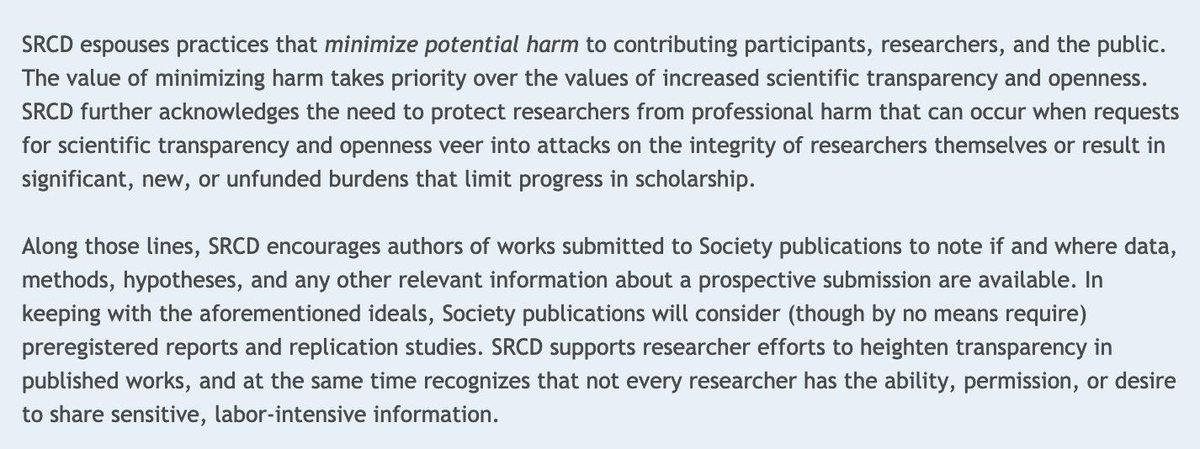
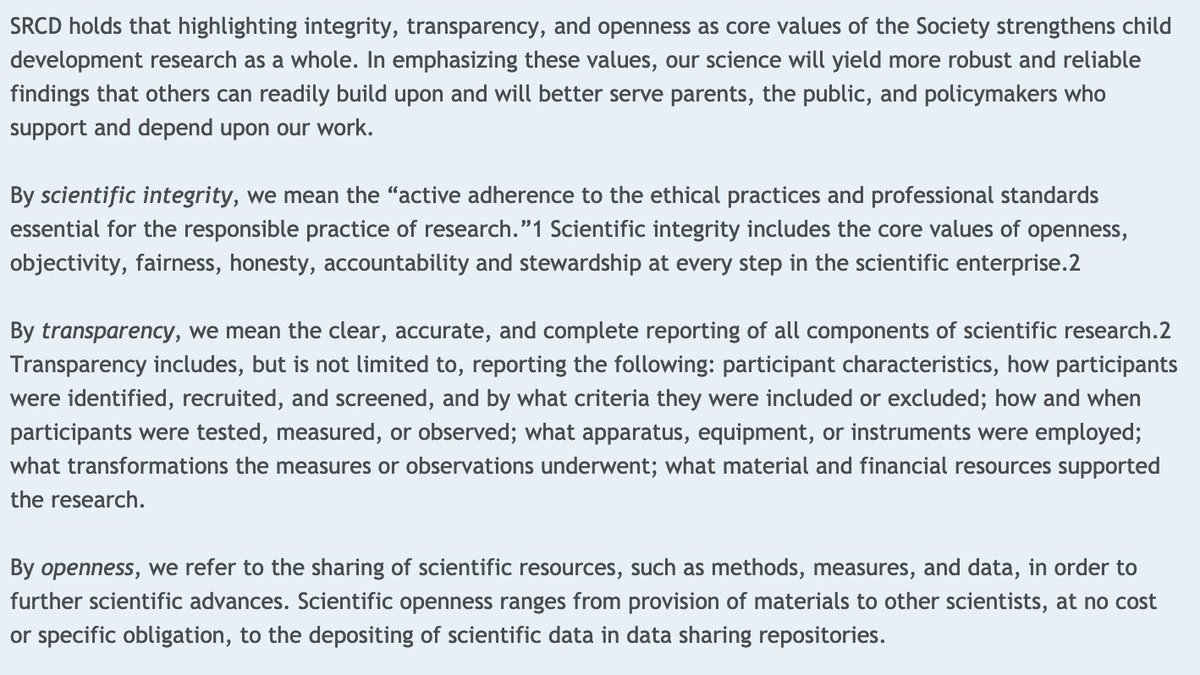
@mcxfrank@SRCDtweets The SRCD policy expresses important points about why openness and transparency are essential values in our work, and it states _why_ practices that support these values are important.
@mcxfrank@SRCDtweets The policy got unanimous support from a Task Force that had quite diverse views on open science. It also received unanimous support from the SRCD Governing Council that also had diverse views on the topic.
@ira_hyman@sTeamTraen@katiecorker@dstephenlindsay@BrianNosek@MichelleNMeyer Databrary allows researchers to share based on the level of permission participants grant. So, primary analyses can be based on the full sample, and some of the (anonymous) characteristics of people who agree to share vs. decline can be communicated to evaluate possible biases.
Hey open science people. If I want an open data badge, I have to add a statement to consent form noting data may be public. How does this change responses from participants? Does the domain of research matter?