Rohan

1.4K posts

Rohan banner
Rohan

Rohan

@rohan_x2

Reading books & Studying markets

Bangalore Katılım Nisan 2014
22 Takip Edilen31 Takipçiler
Sabitlenmiş Tweet
Rohan
Rohan@rohan_x2·
Almost done reading Ignition! Cool explosives & chemistry. All science aside, it's fun to see the number of discarded experiments. If people of high scientific caliber had had their work be pointless, imagine how unnecessary (for lack of a better word) average people are.
English
0
0
0
77
Rohan
Rohan@rohan_x2·
Realized that portfolio management is a whole subject in itself.
English
0
0
0
1
Rohan
Rohan@rohan_x2·
@teortaxesTex I get what you're saying. Anyway, it's sad. The level of delusion I can never... Curious what you think is the primary reason for this narrative? Like too much importance is given to entrepreneurs? Or something like age-old models of business valuation doesn't work anymore?
English
0
0
0
515
Rohan
Rohan@rohan_x2·
Agree. Look at something as popular as Gita. It moves from topics ranging from diet to psychology to knowledge graphs. What I see West did right is distilling knowledge for every citizen. Things hinder widespread literacy in India. Perhaps the same old issues like centuries ago.
bubble boi@bubbleboi

I’ve been reading the Vedas a lot recently, and what’s stood out is how it doubles as an encyclopedia as well as a religious text. Astronomy, medicine, mathematics, metallurgy, linguistics, are all woven through hymns and rituals as one body of knowledge. Simply calling it “religious” forces it into a Western category that didn’t have the apparatus to recognize what it actually was. It’s closer to a tradition of formalized epistemology in which metaphysics, observation, and language form one continuous inquiry, which as a result led Indian civilization to develop along a fundamentally different path because of it. You can see the effect most clearly in the sciences. Around 600 BCE, the Vedic record describes a surgical procedure that matches modern rhinoplasty and is still foundational to reconstructive surgery today. Centuries before Western Europe stopped treating eclipses as supernatural, Indian scholars had calculated the circumference of the earth within 0.2% and explained eclipses as shadows. Centuries before Plato and Aristotle rejected atomism, the Vedic tradition already held that matter is composed of indivisible particles combining into binary and triatomic compounds, transformable by heat. The first formal rules for zero and negative arithmetic appear in the Vedas, along with infinite-series derivations of π, sine, and cosine centuries before Newton and Leibniz. The interesting question is how did they get so much right, so early? My best guess is language. The Vedic tradition is unique compared to other oral traditions as it demanded letter-perfect oral transmission across generations. Around 500 BCE, scholars composed a generative grammar of Sanskrit called Panini so rigorous it anticipates Backus-Naur form, the notation that defines programming languages today, by 2,500 years. Sanskrit is recursive, rule-based, and built to minimize ambiguity. It reads more like mathematics than English. When you think in a language built like that, the precision of the language becomes the precision of your reasoning. The West didn’t formalize this until much later. Kant argued our categories of understanding shape what we can know, Wittgenstein wrote that the limits of language are the limits of one’s world, and Kripke showed that naming doesn’t just describe things, it constitutes what they mean and how we can reason about them. All three touch the same insight which is that thought is downstream of language. The Vedic tradition operated on that insight thousands of years earlier. To the point that they built a whole language first and used it to think clearly about everything else after. I find that all really fascinating.


English
0
0
0
3
Rohan
Rohan@rohan_x2·
@aravind How do you define a "complete system"?
English
0
0
0
2
Aravind
Aravind@aravind·
IMO, the Vedas are everything in one. Chanting them after necessary refinements to the mind, and with intent, one can get revelations about science, as much as about spirituality or surgery. In the age of AI, I will request you to think of the Vedas as quantized, compressed version of a lot of revealed knowledge distilled into the most efficient, lossless sounds called mantras. Most people may, at most, appreciate their rhythms while they see religious intent mostly with bits of philosophy and spiritual instructions here and there. It's like someone appreciating an AI model's training weights and the output they see using a low level computer without having the powerful hardware or knowhow to extract the best knowledge. A truly determined seeker will improve this hardware (or his brain and mind) to be able to extract much knowledge out of the quantized and distilled model (or the Vedas). To the credit of the Vedas, they even provide the necessary steps to build and improve the hardware (body and mind) to extract the knowledge. Many seekers from Patanjali to Sankara have developed complete systems on how to do this. But even if all these systems are lost, and only the sounds of Vedas remain in human consciousness, it will still enable more Patanjalis and Sankaras to emerge and develop systems to realize the Universe complete with all its knowledge. This is the beauty of the Vedas. This is why the Vedas were never just "religion". They are a complete epistemic system engineered for precision, revelation, and infinite expansion of knowledge in our simulation. They enable us to see the entire source code of the simulation (past, present, and future) or access just parts of it to in-vivo improve our experience (by creating science & tech with the revealed knowledge). @bubbleboi is in the process of realizing this, do read👇
bubble boi@bubbleboi

I’ve been reading the Vedas a lot recently, and what’s stood out is how it doubles as an encyclopedia as well as a religious text. Astronomy, medicine, mathematics, metallurgy, linguistics, are all woven through hymns and rituals as one body of knowledge. Simply calling it “religious” forces it into a Western category that didn’t have the apparatus to recognize what it actually was. It’s closer to a tradition of formalized epistemology in which metaphysics, observation, and language form one continuous inquiry, which as a result led Indian civilization to develop along a fundamentally different path because of it. You can see the effect most clearly in the sciences. Around 600 BCE, the Vedic record describes a surgical procedure that matches modern rhinoplasty and is still foundational to reconstructive surgery today. Centuries before Western Europe stopped treating eclipses as supernatural, Indian scholars had calculated the circumference of the earth within 0.2% and explained eclipses as shadows. Centuries before Plato and Aristotle rejected atomism, the Vedic tradition already held that matter is composed of indivisible particles combining into binary and triatomic compounds, transformable by heat. The first formal rules for zero and negative arithmetic appear in the Vedas, along with infinite-series derivations of π, sine, and cosine centuries before Newton and Leibniz. The interesting question is how did they get so much right, so early? My best guess is language. The Vedic tradition is unique compared to other oral traditions as it demanded letter-perfect oral transmission across generations. Around 500 BCE, scholars composed a generative grammar of Sanskrit called Panini so rigorous it anticipates Backus-Naur form, the notation that defines programming languages today, by 2,500 years. Sanskrit is recursive, rule-based, and built to minimize ambiguity. It reads more like mathematics than English. When you think in a language built like that, the precision of the language becomes the precision of your reasoning. The West didn’t formalize this until much later. Kant argued our categories of understanding shape what we can know, Wittgenstein wrote that the limits of language are the limits of one’s world, and Kripke showed that naming doesn’t just describe things, it constitutes what they mean and how we can reason about them. All three touch the same insight which is that thought is downstream of language. The Vedic tradition operated on that insight thousands of years earlier. To the point that they built a whole language first and used it to think clearly about everything else after. I find that all really fascinating.

English
76
541
3.4K
116.1K
Rohan
Rohan@rohan_x2·
@caleb_friesen Drone motors is a niche that I never knew I needed to hear about.
English
0
0
0
12
Caleb
Caleb@caleb_friesen·
Vector Technics manufactures ~5,000 drone BLDC motors a month. They're the largest in India. They hope to scale to 15,000 motors/month soon. Meanwhile, China manufactures millions. Guess what? Most Indian companies still import these motors from China. Why? Low trust in Indian products. This imported > indigenous mindset is antithetical to technological development, economic growth, and India's future prosperity, yet it's pervasive across industries. The belief that "if it's Indian, it must not be good" still lingers in many corners of the subcontinent, despite numerous hardware and manufacturing companies proving that this thinking is misguided and incorrect. I'm thrilled to see companies like Vector Technics putting in years of hard work and risking it all to reverse this mindset and prove to India (and the world) that Indian hardware is synonymous with quality and reliability. India needs hundreds more companies like Vector, building machines, materials, and components indigenously. But it also needs buyers to break out of this imported-first, local-second mindset. Build from India for the world, but also... Buy from India, lead the world.
Caleb tweet media
Runtime@RuntimeBRT

Most of India's drone motors come from China. In 2019, the founders of Vector Technics, @prudhvirajp + Karna Raj, set out to change that in a 400 sq. ft. Hyderabad office. Today, @vectortechnics is India's largest indigenous drone motor manufacturer, producing 5k motors/month.

English
51
457
2.7K
100.7K
utkarsh
utkarsh@utkarsh_k1c·
My best guess is that there existed a society with high density of deep meditators who were consistently able to unlock knowledge from the source energy by resonating with it. Sanskrit as a language is manifestation of that revelation.
bubble boi@bubbleboi

I’ve been reading the Vedas a lot recently, and what’s stood out is how it doubles as an encyclopedia as well as a religious text. Astronomy, medicine, mathematics, metallurgy, linguistics, are all woven through hymns and rituals as one body of knowledge. Simply calling it “religious” forces it into a Western category that didn’t have the apparatus to recognize what it actually was. It’s closer to a tradition of formalized epistemology in which metaphysics, observation, and language form one continuous inquiry, which as a result led Indian civilization to develop along a fundamentally different path because of it. You can see the effect most clearly in the sciences. Around 600 BCE, the Vedic record describes a surgical procedure that matches modern rhinoplasty and is still foundational to reconstructive surgery today. Centuries before Western Europe stopped treating eclipses as supernatural, Indian scholars had calculated the circumference of the earth within 0.2% and explained eclipses as shadows. Centuries before Plato and Aristotle rejected atomism, the Vedic tradition already held that matter is composed of indivisible particles combining into binary and triatomic compounds, transformable by heat. The first formal rules for zero and negative arithmetic appear in the Vedas, along with infinite-series derivations of π, sine, and cosine centuries before Newton and Leibniz. The interesting question is how did they get so much right, so early? My best guess is language. The Vedic tradition is unique compared to other oral traditions as it demanded letter-perfect oral transmission across generations. Around 500 BCE, scholars composed a generative grammar of Sanskrit called Panini so rigorous it anticipates Backus-Naur form, the notation that defines programming languages today, by 2,500 years. Sanskrit is recursive, rule-based, and built to minimize ambiguity. It reads more like mathematics than English. When you think in a language built like that, the precision of the language becomes the precision of your reasoning. The West didn’t formalize this until much later. Kant argued our categories of understanding shape what we can know, Wittgenstein wrote that the limits of language are the limits of one’s world, and Kripke showed that naming doesn’t just describe things, it constitutes what they mean and how we can reason about them. All three touch the same insight which is that thought is downstream of language. The Vedic tradition operated on that insight thousands of years earlier. To the point that they built a whole language first and used it to think clearly about everything else after. I find that all really fascinating.

English
2
3
40
2K
Rohan
Rohan@rohan_x2·
Just watched Project Hail Mary :) (minor spoilers ahead) Towards the end, when Grace was hitting the spaceship to call out to Rocky, nothing scared me more than the lack of echolocation in space. Felt the silence of space vividly.
English
0
0
1
23
Rohan
Rohan@rohan_x2·
@AshwinBadri2 Volatility causing reversion, instead of expansion, being correlated to gamma is something I never had thought about. Well, cool.
English
0
0
0
62
Ashwin Badrinath
Ashwin Badrinath@AshwinBadri2·
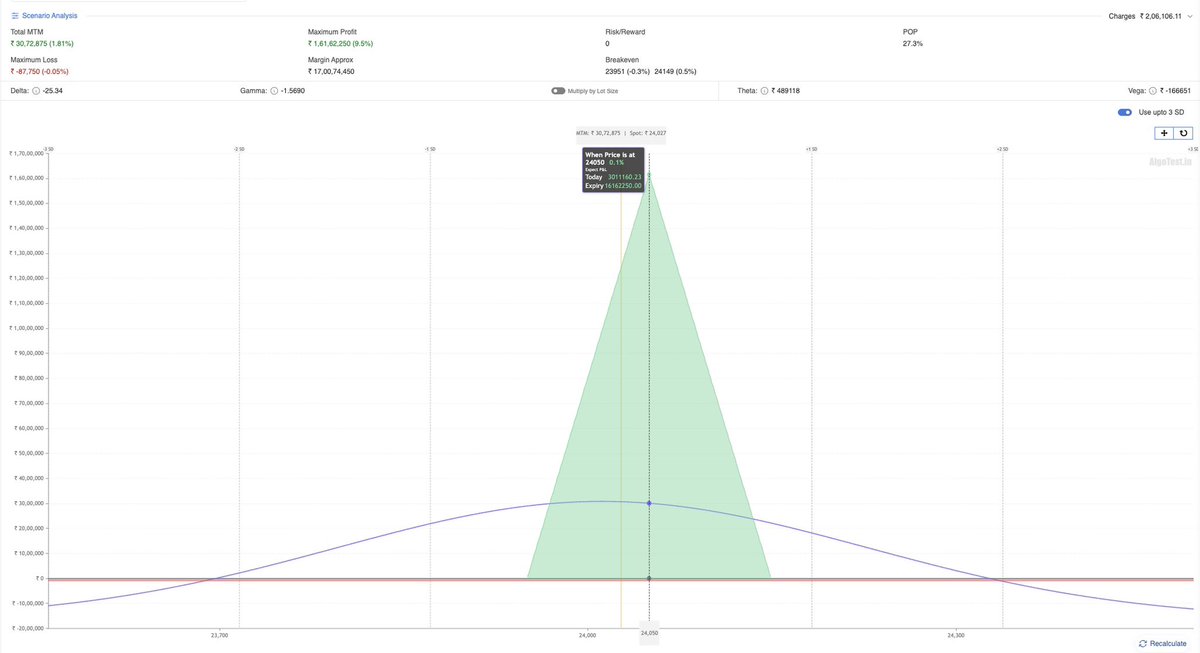
Booked 50% gains, and as we move into an expiry structure, dashboard is screaming one thing: 24,050 magnet. +61,547 Cr net dealer gamma. Positive gamma regime. Pin risk score: 99/100. Strongest dampening exactly at 24,050. 37.3% probability of expiry within a 100pt band despite event risk. That changes the game completely. When dealers are this long gamma, every move gets sold into and every dip gets bought back through hedging flows. Volatility becomes mean reverting instead of expanding. Market starts behaving like it’s attached to a rubber band around max gamma. So instead of chasing direction, I positioned for: 1. theta harvest 2. controlled risk 3. expiry pinning 4. IV collapse into close Risking ~19L to potentially extract >1Cr if spot gets vacuumed into the gamma gravity zone near 24050 by expiry. This isn’t prediction trading. This is positioning around dealer flow mechanics, gamma positioning, and expiry microstructure.
Ashwin Badrinath tweet mediaAshwin Badrinath tweet mediaAshwin Badrinath tweet media
Ashwin Badrinath@AshwinBadri2

Booked 28L. Now sitting on an expiry iron fly where I’m willing to risk the entire 28L for a potential 1.5Cr+ tomorrow. Max loss is approx 90K + 2.5L in charges! This is no longer a directional trade. This is a bet on: • expiry pinning • dealer gamma • theta collapse • liquidity holding together • Trump not doing “Trump things” Tomorrow this either becomes: “greatest screenshot of my life” or a masterclass on why greed arrives exactly after your biggest win.

English
19
4
103
22K
Rohan
Rohan@rohan_x2·
@saketh1998 This is the precise reason why IMO active management > passive management.
English
0
0
1
5
Saketh R
Saketh R@saketh1998·
Nifty 11 Yr CAGR is now around 9%. Barely beating FD returns by 2%, but comes with multiple 20% drawdowns along the way.
English
100
35
871
130.7K
Rohan
Rohan@rohan_x2·
@elonmusk Perhaps just like current blue states? Nah jk. I'm hardly familiar with how america works.
English
0
1
2
7
Rohan
Rohan@rohan_x2·
@Akshat_World The point is: does a linear increase in expenses push people emotionally to find ways to increase their income, though?
English
0
0
1
21
Akshat Shrivastava
Akshat Shrivastava@Akshat_World·
0 people got rich by cutting their expenses. To get rich, you need to grow income. This applies at a national level too. Zoom out and look:- 1) India is asking to cut: let rupee fall, buy less foreign goods, don't buy gold, don't travel abroad etc We are basically cutting (except for taxes of course) 2) US is asking to speculate. Circular financing in AI, IR cuts talks, collab with China etc. Both the markets are great. But, one is cutting while the other is building more leverage. How you play this is a good test of investing :)
English
58
52
691
41.1K
Rohan
Rohan@rohan_x2·
X is one of the best journals I neither had nor intended to maintain.
English
0
0
0
6
Rohan
Rohan@rohan_x2·
@ActusDei Cool article. Except that it sounds like rupee depreciation is purely a consequence of the stock markets. It’s much more complicated than that, I’m afraid.
English
0
0
0
85
Neil Borate
Neil Borate@ActusDei·
Why is the rupee falling while Sensex holds up? Because retail SIPs are doing the heavy lifting - absorbing ₹53 billion of FPI exits over 18 months. Gross FDI is up. But net FDI is near zero - because MNCs & PE funds are repatriating profits at valuations 40-60% above EM peers. Strong markets. Weak currency. Not a contradiction - a consequence. - via Swaminomics
Neil Borate tweet media
English
47
67
375
27.6K
Rohan
Rohan@rohan_x2·
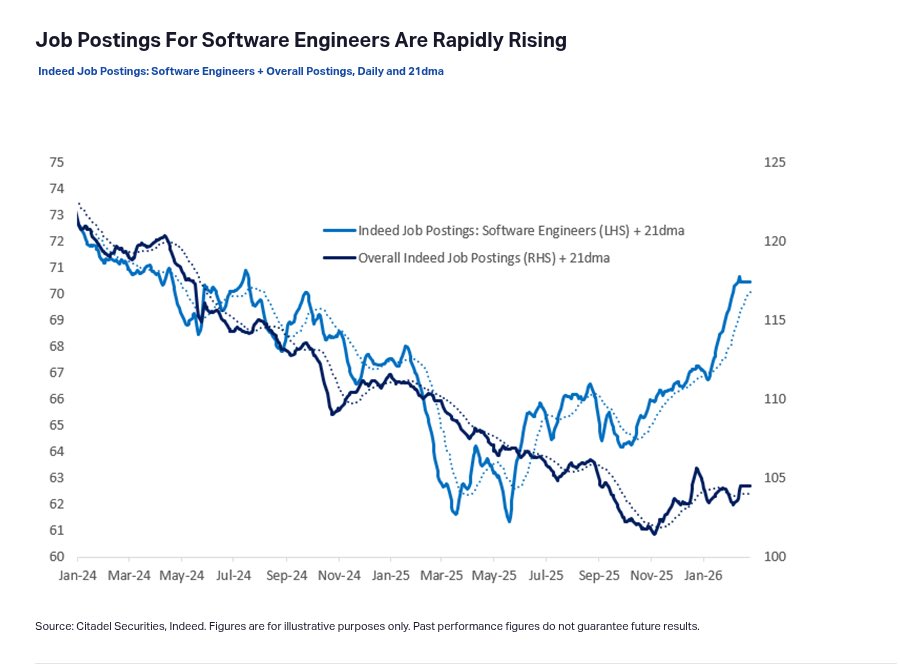
@DavidSacks As Bezos recently hinted, there would likely be a labor shortage rather than a job shortage.
English
0
0
0
5
David Sacks
David Sacks@DavidSacks·
Q: How are job postings for software engineers rising rapidly despite AI agents automating coding? A: Because there’s far more code to manage than ever before. We’re already seeing a 14x YoY increase in GitHub commits, and it’s accelerating. AI has dramatically lowered the cost of writing code, so it’s now being used across far more businesses, applications, and use cases. We’re at the beginning of a massive productivity boom driven by the proliferation of bespoke software throughout the entire economy. Coding has been AI’s breakout use case this year. The fact that it’s increased demand for software engineers — rather than decreased it — should call into question the entire “AI will cause mass job loss” narrative.
David Sacks tweet media
English
825
1.5K
9.1K
1.6M
Rohan
Rohan@rohan_x2·
@kunalvg Dominance of a single country and openness of intel have 0 overlap.
English
0
0
0
13
Kunal Gandhi
Kunal Gandhi@kunalvg·
India should read this twice. Our shot at building globally from here rests entirely on intelligence staying open. If AGI ends up locked inside a handful of labs, our future is bleak. India should be the loudest voice for open intelligence in the world. Build it, back it, defend it. That is the only way the next decade is ours to shape, and the only way we avoid becoming a permanent underclass.
Sreeram Kannan@sreeramkannan

The internet being an open protocol led to multiple frontier ai training on them. Imagine if the internet was instead a closed wall garden like Facebook where a single company controls all the data. There will only be one AGI if ever. Now it’s incumbent on us to ensure that intelligence remains open so that the rest of us can innovate rather than having to depend solely on dario or sama.

English
15
9
97
10.3K
Rohan
Rohan@rohan_x2·
@AshwinBadri2 Damnn! How many years have you been in the game?
English
0
0
0
710
Ashwin Badrinath
Ashwin Badrinath@AshwinBadri2·
Booked 28L. Now sitting on an expiry iron fly where I’m willing to risk the entire 28L for a potential 1.5Cr+ tomorrow. Max loss is approx 90K + 2.5L in charges! This is no longer a directional trade. This is a bet on: • expiry pinning • dealer gamma • theta collapse • liquidity holding together • Trump not doing “Trump things” Tomorrow this either becomes: “greatest screenshot of my life” or a masterclass on why greed arrives exactly after your biggest win.
Ashwin Badrinath tweet media
English
31
8
259
68.4K
Rohan
Rohan@rohan_x2·
Comforting yourself in your head with wishful thinking seems to be a very common occurrence during emotional overloads.
English
0
0
0
7