Rolf Bulk

125 posts

Rolf Bulk banner
Rolf Bulk

Rolf Bulk

@rolfbulk

Head of Semiconductors & Infrastructure @FuturumEquities | No investment advice.

Singapore Katılım Ocak 2026
161 Takip Edilen398 Takipçiler
Rolf Bulk
Rolf Bulk@rolfbulk·
The KOSPI is down a staggering 10% today, as concerns around the $250B Nvidia/OpenAI backstop and homegrown Chinese immersion lithography weigh on $SKHY and Samsung. In our view, concerns about the sustainability of the AI infrastructure cycle are premature. We see no evidence that spending is slowing (Google raised capex $15B just a few days ago), or that AI capex is failing to generate the ROI needed to justify investments. Happy to discuss with CNBC: cnbc.com/2026/07/28/nas…
English
0
0
2
193
Rolf Bulk
Rolf Bulk@rolfbulk·
$ASML’s edge in lithography is underestimated. Worth keeping in mind that ASML already has a competitor in immersion DUV: Nikon, one of the original lithography equipment vendors. Despite that competition, ASML’s market share in DUV immersion has hovered around 95–98% for years. The combination of 1) 1.5–2nm overlay accuracy and 2) consistently high throughput of >300 wafers per hour can only be achieved through decades of iterative hardware innovation and software tuning. You cannot short-circuit that development time easily. Unlikely we will see Chinese tools move beyond the R&D phase over the next few years.
English
0
1
0
121
Shay Boloor
Shay Boloor@StockSavvyShay·
China begins producing its first homegrown immersion DUV lithography systems with deliveries planned for $CXMT. The breakthrough reduces reliance on $ASML at mature nodes but output remains tiny and performance still trails ASML leaving little near-term competitive threat.
Shay Boloor tweet mediaShay Boloor tweet media
English
84
118
969
280.1K
Rolf Bulk
Rolf Bulk@rolfbulk·
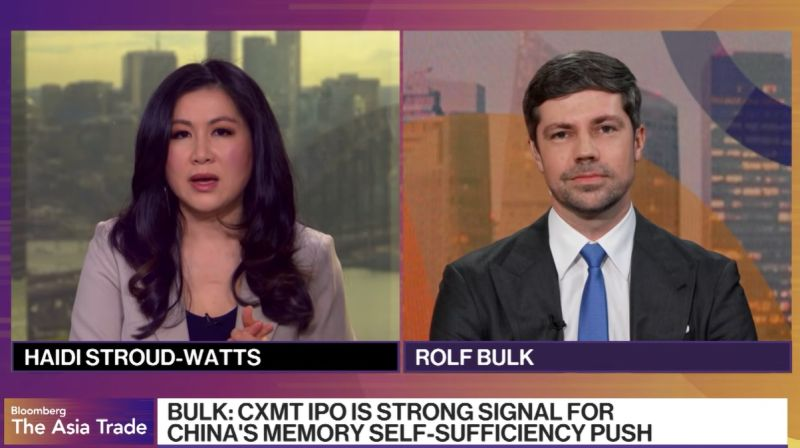
Major IPO in China today, with $CXMT becoming the most valuable company listed on mainland Chinese exchanges. Shares are trading at >6x the IPO price, implying a market cap of ~$540bn. Happy to discuss the listing and broader Chinese tech developments on Bloomberg. The structural DRAM shortage driven by AI infrastructure is allowing CXMT to generate operating margins above 70%, despite its cost per bit being 20–30% higher than Samsung, SK hynix, and Micron. Without access to EUV, CXMT’s path beyond 1a remains unclear. It will need to rely on packaging, design, and materials innovation to narrow the gap with the leading incumbents. Looking forward to seeing how the company progresses over the coming years. youtu.be/QycryeG7OJw?t=…
YouTube video
YouTube
Rolf Bulk tweet media
English
2
3
17
6.9K
Rolf Bulk
Rolf Bulk@rolfbulk·
@StockSavvyShay Sensible move to compete with Groq/Rubin, however, AMD's announcement lacked some visibility on deployments in volume. More difficult when you do not own the full stack, like Nvidia.
English
2
0
2
321
Shay Boloor
Shay Boloor@StockSavvyShay·
$AMD and $CBRS are teaming up on a combined platform designed to deliver faster AI inference. The partnership adds another major contender to the race for premium inference workloads.
Shay Boloor tweet mediaShay Boloor tweet media
English
62
32
428
49.4K
Rolf Bulk retweetledi
Ryan Shrout
Ryan Shrout@ryanshrout·
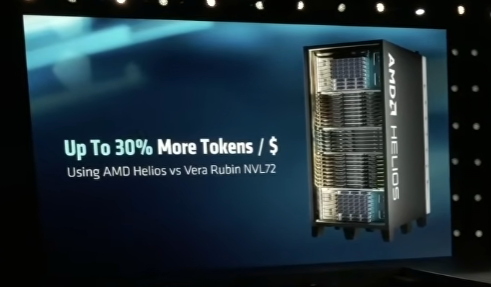
@AMD @LisaSu @AnthropicAI Bold new claim. Helios will offer up to 30% more tokens per $ than Vera Rubin NVL72. Lots of questions about those performance claims though...
Ryan Shrout tweet media
English
1
1
3
339
Rolf Bulk
Rolf Bulk@rolfbulk·
CPU TAM of $220B in 2030, 50% CAGR. Aligns with our forecast. At first sight AMD assumes here an agentic CPU/Accelerator ratio easily exceeding 1x, while host CPU to accelerator ratio looks more stable in back-end of the decade. $AMD
Rolf Bulk tweet media
English
0
0
5
531
Rolf Bulk
Rolf Bulk@rolfbulk·
$1.4T accelerator TAM in 2030, above our base case of $1.1T, which is based on 45-50GW annual deployments in 2030. $AMD
Rolf Bulk tweet media
English
0
0
8
1.1K
Rolf Bulk
Rolf Bulk@rolfbulk·
Google’s $15bn increase to 2026 capex and expectation of “significant” further growth in 2027 align with our view on the sector, and confirm what we heard from TSMC and ASML earlier this earnings season. No signs of the AI infrastructure build-out slowing any time soon. x.com/danielnewmanUV…
English
2
0
11
1.2K
Rolf Bulk
Rolf Bulk@rolfbulk·
Well-signaled deal, but still a major positive for $AMD in our view. - It is not the 6GW headline figure of the Meta/OpenAI deals, but the Anthropic agreement is entirely MI450 series. That makes it a short-term deal and likely only the first step in a broader, multi-generation partnership. - Unlike the Meta/OpenAI deals, no warrants involved. The warrant deals dilute existing AMD shareholders by >1% for every GW deployed. That does not make them bad deals perse, but the economics of the Anthropic agreement are more favorable. - AMD’s commitment to invest up to $5bn in Anthropic “in the future” could position AMD as a cornerstone investor in a potential Anthropic IPO. The Helios racks include Venice CPUs, but no specifics on standalone Venice CPU deployments beyond Helios. We’ll look for more detail on that at AMD’s AI event.
English
0
1
6
184
Shay Boloor
Shay Boloor@StockSavvyShay·
$AMD and Anthropic sign a deal worth tens of billions with Anthropic set to deploy up to 2 GW of MI450 AI chips starting in the first half of 2027. AMD will also invest up to $5B tied to deployment milestones and use Claude to help improve its chip technology.
Shay Boloor tweet mediaShay Boloor tweet media
English
98
118
1.1K
129.4K
Rolf Bulk
Rolf Bulk@rolfbulk·
@StockSavvyShay Curious to see the specific location and plans to power this. Lead times for gas turbines, such as those used for Colossus 2, continue to increase.
English
0
0
0
445
Shay Boloor
Shay Boloor@StockSavvyShay·
$SPCX is exploring a major Texas data center expansion beyond its 1 GW Memphis footprint. SpaceXAI is evaluating multiple sites for a project that could match or exceed its existing 1 GW capacity while supporting more third-party cloud demand.
Shay Boloor tweet mediaShay Boloor tweet media
English
67
66
685
89.3K
Rolf Bulk retweetledi
Daniel Newman
Daniel Newman@danielnewmanUV·
Kimi-k3 is this quarter’s DeepSeek moment. Our July @ETRnews pulse data (more than 1500 enterprises) shows that ~half of U.S. enterprises won’t use Chinese models. So the net is that cheaper models are coming, more intelligence will be used, meaning we still need more compute and Chinese labs won’t flourish in the west.
English
11
5
102
7.9K
Rolf Bulk
Rolf Bulk@rolfbulk·
"Lower margin % at the model layer = more margin $ at every part of the infrastructure layer and is a godsend for software." Well put and I think the crux of the debate.
Gavin Baker@GavinSBaker

Kimi K3 may be an important inflection point for AI. Potentially negative for Anthropic and OpenAI while being net positive for essentially every other company in the world. I mean that very literally. Although the real “Sputnik moment” would be an open-source frontier model that was also token efficient unlike Kimi K3 which is 50-70% more expensive to run than GPT 5.6 per Artificial Analysis. Rationale:   A world where there are only 2-3 dominant frontier labs with 90% inference margins is net negative for every other layer while being awesome for those 2-3 labs. Those labs would become monopsonies for power, data centers, semiconductors and hyperscalers and would obviously vertically integrate over time into all those layers while also completely subsuming the application/software layers.    Anything that lowers margins and increases competition at the model layer is good for every other AI layer: power, semiconductors, hyperscalers, neoclouds and yes even software.   This is why Jensen is so supportive of open-source. An open-source model requires the *exact* same amount of compute to run as a closed frontier model of similar size and architecture. Kimi K3 is roughly the same price as GPT 5.6 Terra on a per token basis, which actually suggests that it is less computationally efficient as I am sure that GPT 5.6 is priced to a higher margin than K3. And given that K3 is a token wastrel, i.e. token inefficient, it is significantly more expensive per task than GPT 5.6 and Grok 4.5, which are much more token efficient. Cost per token and token efficiency (i.e. intelligence density per token) are the drivers of intelligence per unit of cost. The winning AI companies will be those that offer the most intelligence per $ over time.   Lower margin % at the model layer = more margin $ at every part of the infrastructure layer and is a godsend for software. This can happen either through open-source models like K3 at the frontier *or* having a vertically integrated model company like Meta, SpaceX or Google at the frontier. Both outcomes result in a lower margin % at the model layer as vertically integrated model companies don’t really care where the margin $ come from. This is why it was so painful for OpenAI and Anthropic when Google was right there with them from a model competitiveness perspective and why Grok 4.5 and Muse 1.1 were just as important as Kimi K3. 
The reason Kimi K3 is only *potentially* negative for Anthropic and OpenAI is 1) the @ericvishria point that the Claude and ChatGPT products and harnesses may be more important than their models today and 2) the hypothesis that they have much more advanced model checkpoints internally that are already being used for RSI. In the latter scenario, reaching RSI even a few months ahead of other labs might be enough to cement a permanent lead. Time will tell on both points. And likely fairly quickly. Caveat would be that since Kimi K3 is not token efficient and thereby actually more expensive than ChatGPT 5.6, we may need to see a more token efficient open-source model at the frontier or see Grok 5/Composer 4/Muse 2 at multiple points on the Pareto frontier for this potential risk to Anthropic and OpenAI to play out. And I am sure they will both vertically integrate as quickly as possible while continuing the product/harness strength they have shown over the last 8 months.

English
0
0
4
1.4K
Rolf Bulk
Rolf Bulk@rolfbulk·
TSMC: >40% growth this year; room for 35% in 2027. $TSM raised 2026 revenue growth guidance to >40% from >30%, above consensus 35% and us (37%), driven by strong AI demand and a steep N2 ramp. Capex also increased to $60–64bn, with another $100B committed to Arizona. We see room for ~35% growth in 2027; revenue of $233B and EPS of NT$143, 9%/12% above consensus, which likely underestimates the contribution from datacenter CPUs, networking, and HBM base dies. Total AI-related revenues of >$100B next year. TSMC remains one of our top picks. Its growth is agnostic to share shifts between GPUs and ASICs, and to mix changes across accelerators, CPUs, and networking. Positive read-across for rest of the sector (memory, semicap, logic).
Rolf Bulk tweet media
English
2
1
14
7.9K
Rolf Bulk
Rolf Bulk@rolfbulk·
Strong $ASML print. Road to €75 in EPS in 2028. ASML remains our top pick in semicap equipment. Quarter: - €6bn increase in 2026 revenue guidance at >70% incremental gross margin: high-end EUV/ArFi tools for the leading-edge + high margin upgrade business. - Memory revenue set to grow >75% this year. Logic only 15-20%, partly because trailing-edge and China are a headwind. - 2027-28 capacity ramp: 30% EUV and ArFi capacity expansion in 2027, and another 30% under consideration for 2028. That implies ASML plans to ship 85 EUV tools next year; below the high-end of investor expectations, but also up to 110 tools in 2028. In the context of the 2028 number, the small disappointment on 2027 is immaterial. At capacity, revenue could approach €75B and EPS €75 in 2028, 30%+ above consensus (€57B/€55 EPS). That is more a blue-sky scenario rather than a base case, but it eases concerns around EUV as the industry bottleneck. Positive read-across for the rest of semicap.
Rolf Bulk tweet media
English
1
1
4
5.7K