Roy Luo

84 posts

Roy Luo banner
Roy Luo

Roy Luo

@roybluo

GP @ ICONIQ

Palo Alto, CA Katılım Şubat 2014
429 Takip Edilen196 Takipçiler
Roy Luo retweetledi
Eric Glyman
Eric Glyman@eglyman·
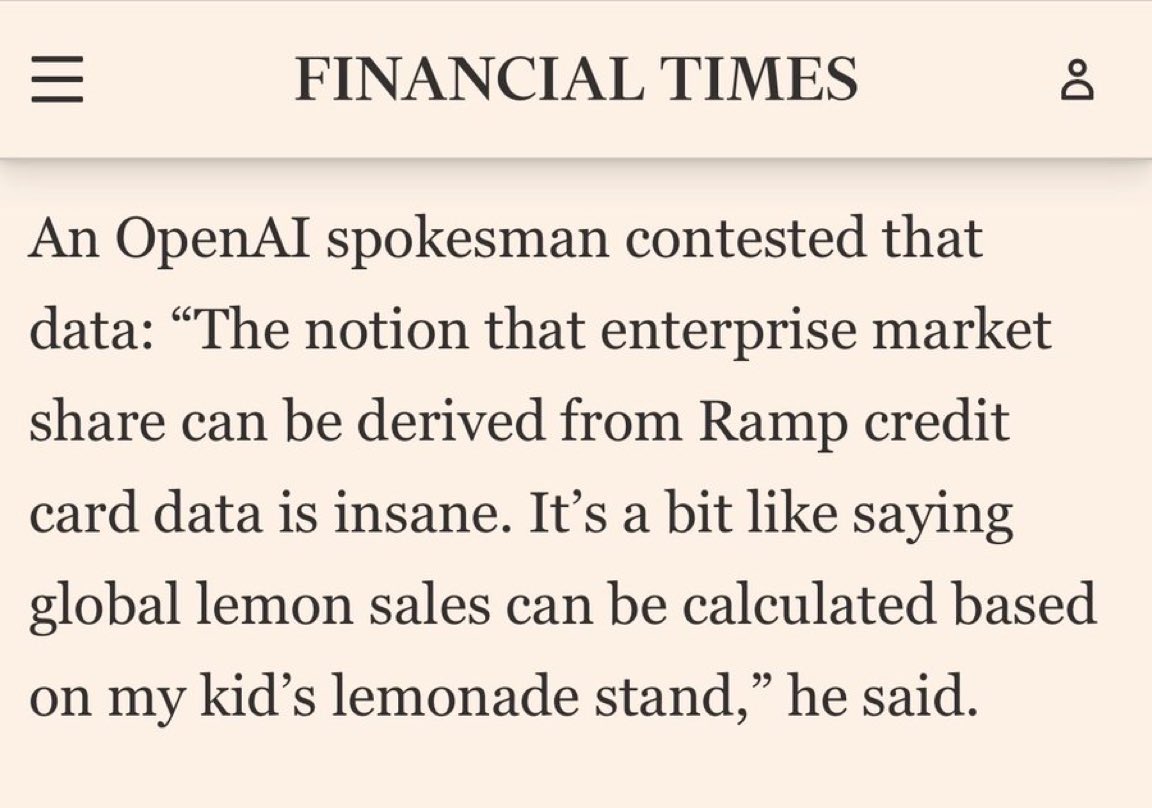
If your kid’s lemonade stand processes 0.5–1% of US GDP, then yes, that’s a fair analogy for @tryramp. Ramp’s data is useful for the same reason it gets cited at all: it is quite consistent with the revenue figures OpenAI and Anthropic release. If it weren’t, no one would care.
Eric Glyman tweet media
English
51
30
1K
567K
Roy Luo retweetledi
Geoff Charles
Geoff Charles@geoffintech·
I think a lot about leverage. In product. In engineering. In finance. The best teams don’t win because they work longer hours. They win because the system around them compounds their effort. Finance is full of high-judgment people doing low-leverage work like coding transactions and reviewing recurring spend. When your best operators spend days each month moving information from one system to another, you’re burning effort on repetition. Over the last few months, we’ve been building toward a different model with customers. Ramp’s Accounting Agent codes transactions at the moment of spend. It fills required fields, learns from historical corrections, auto-syncs low-risk items, and accrues what’s missing so the ledger reflects reality in real time. At @perplexity_ai for example, 97% of transactions are now auto-coded. That means review becomes about anomalies. Conversations shift toward planning. That’s our bar. Not “more automation.” More leverage per person. If we can help finance teams spend their time on decisions instead of data movement, we’ve done something meaningful. We’re early. But this is a step in that direction.
Eric Glyman@eglyman

There are two non-negotiables in accounting: the books must be correct, and they must be ready on time. For decades, companies have satisfied those constraints through an extraordinary amount of manual effort. Highly trained professionals code transactions, re-approve familiar expenses, reconcile mismatches after the fact, and compress all of it into the ritual of month-end close. It works. But it is fundamentally retrospective. Today, @tryramp is introducing an Accounting Agent designed around a different premise: what if bookkeeping happened as the business operated, rather than after it? The agent captures, codes, reviews, validates, accrues, and reconciles spend continuously. It learns directly from the people who understand the nuances best, the accounting team itself, and applies that context in real time. At @perplexity_ai, where velocity is part of the company’s identity, this has allowed their team to stop choosing between speed and accuracy. The majority of transactions are now coded automatically while remaining audit-ready, enabling close to start on day one instead of day thirty. What’s been most striking is how the system learns the subtle, company-specific logic that historically lived only in human judgment. As Jim Romano, CFO at @statesidevodka, described it, the agent is already identifying patterns like when spend belongs in samples rather than travel and entertainment — the kinds of decisions that typically require institutional memory. As he put it, the goal is simple: finance teams should focus on exceptions, not the easy stuff. We’re also seeing the second-order effects emerge quickly. Teams report spending dramatically less time reviewing transactions and substantially more time on planning, analysis, and growth. As one CFO told us, “What used to take hours of manual review now happens automatically. I’m spending nearly all of my time thinking about where the business should go, not retracing where it’s already been.” There is a broader shift underway in accounting. The central question is moving from “what parts of close can be automated?” to “should close even be a discrete event at all?” One belief that increasingly guides our work at Ramp is that information latency inside companies is an invisible tax. When financial truth lags behind operational reality, organizations make slower and often worse decisions. As transaction data becomes inherently digital and systems become capable of learning institutional context, continuous close stops being aspirational and starts becoming inevitable. One thing that surprised us while building this: accounting isn’t constrained by a lack of rules — it’s constrained by how many of those rules are unwritten. Much of financial operations lives in patterns that experienced teams simply know. Seeing software begin to absorb and apply that tacit knowledge has been one of the clearest signals that accounting is entering a new phase. Accounting has always been the record for business reality. Our goal is to help it become something closer to real-time truth. Proud of the team, and grateful to the customers building this alongside us.

English
5
8
155
36.2K
Roy Luo
Roy Luo@roybluo·
Thrilled to be deepening our partnership with @AnthropicAI! Just an incredible journey so far and we at @ICONIQCapital couldn't be more grateful. We're still just in early innings and excited for all the milestones to come!
Anthropic@AnthropicAI

We’ve raised $30B in funding at a $380B post-money valuation. This investment will help us deepen our research, continue to innovate in products, and ensure we have the resources to power our infrastructure expansion as we make Claude available everywhere our customers are.

English
0
0
1
66
Roy Luo retweetledi
Eric Glyman
Eric Glyman@eglyman·
There are two non-negotiables in accounting: the books must be correct, and they must be ready on time. For decades, companies have satisfied those constraints through an extraordinary amount of manual effort. Highly trained professionals code transactions, re-approve familiar expenses, reconcile mismatches after the fact, and compress all of it into the ritual of month-end close. It works. But it is fundamentally retrospective. Today, @tryramp is introducing an Accounting Agent designed around a different premise: what if bookkeeping happened as the business operated, rather than after it? The agent captures, codes, reviews, validates, accrues, and reconciles spend continuously. It learns directly from the people who understand the nuances best, the accounting team itself, and applies that context in real time. At @perplexity_ai, where velocity is part of the company’s identity, this has allowed their team to stop choosing between speed and accuracy. The majority of transactions are now coded automatically while remaining audit-ready, enabling close to start on day one instead of day thirty. What’s been most striking is how the system learns the subtle, company-specific logic that historically lived only in human judgment. As Jim Romano, CFO at @statesidevodka, described it, the agent is already identifying patterns like when spend belongs in samples rather than travel and entertainment — the kinds of decisions that typically require institutional memory. As he put it, the goal is simple: finance teams should focus on exceptions, not the easy stuff. We’re also seeing the second-order effects emerge quickly. Teams report spending dramatically less time reviewing transactions and substantially more time on planning, analysis, and growth. As one CFO told us, “What used to take hours of manual review now happens automatically. I’m spending nearly all of my time thinking about where the business should go, not retracing where it’s already been.” There is a broader shift underway in accounting. The central question is moving from “what parts of close can be automated?” to “should close even be a discrete event at all?” One belief that increasingly guides our work at Ramp is that information latency inside companies is an invisible tax. When financial truth lags behind operational reality, organizations make slower and often worse decisions. As transaction data becomes inherently digital and systems become capable of learning institutional context, continuous close stops being aspirational and starts becoming inevitable. One thing that surprised us while building this: accounting isn’t constrained by a lack of rules — it’s constrained by how many of those rules are unwritten. Much of financial operations lives in patterns that experienced teams simply know. Seeing software begin to absorb and apply that tacit knowledge has been one of the clearest signals that accounting is entering a new phase. Accounting has always been the record for business reality. Our goal is to help it become something closer to real-time truth. Proud of the team, and grateful to the customers building this alongside us.

English
12
24
432
129.2K
Roy Luo retweetledi
Ara Kharazian
Ara Kharazian@arakharazian·
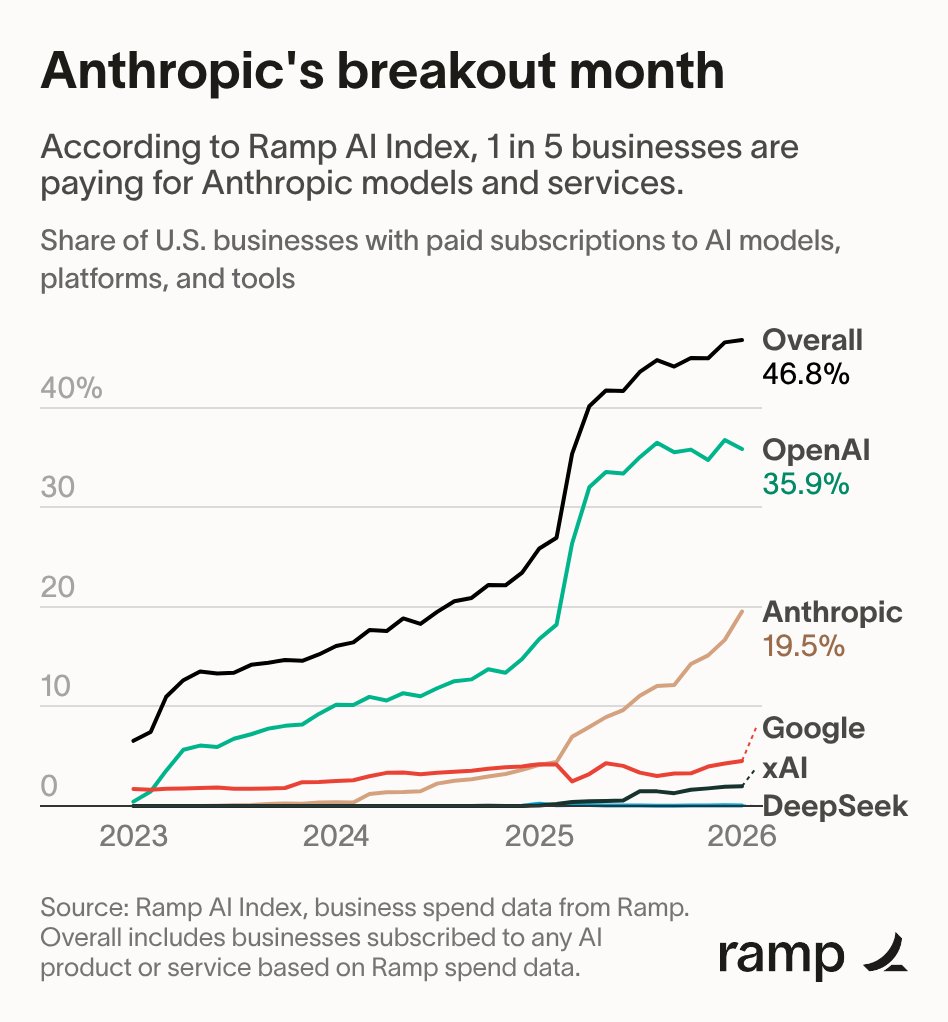
1 in 5 businesses on Ramp now pay for Anthropic. A year ago, it was 1 in 25. Latest Ramp AI Index shows Anthropic surged from 16.7% to 19.5% of businesses while OpenAI slipped to 35.9%. The natural question: is Anthropic winning at OpenAI's expense? I think popular analyses lack a key data point: the overlap in Anthropic's customer base with OpenAI: 79% of Anthropic's customers are already OpenAI customers. And churn rates are nearly identical at 4%. So most of Anthropic's growth is coming from existing OpenAI customers.
Ara Kharazian tweet media
English
16
65
586
64.3K
Roy Luo retweetledi
Eric Glyman
Eric Glyman@eglyman·
Meet Brian. Brian’s been carrying accounting on his back for a long time. Super Bowl Sunday, he finally gets backup.
English
97
113
2.3K
1M
Roy Luo
Roy Luo@roybluo·
So Sam darnold is the first qb to make the sb in his class. Somehow he made it before Lamar, Josh Allen and Baker Mayfield. Wild.
English
0
0
0
60
Roy Luo retweetledi
Eric Glyman
Eric Glyman@eglyman·
Real-time budgets, now live on @tryramp When big purchase requests come through, leads ask “what's the budget and is any left?” The answer should be instant; now it is across all your spend It’s delightfully intuitive to use and saves two of your favorite things: time & money
Ramp@tryramp

RIP 2026_Budget_v8_FINAL.xlsx. Laid to rest on 1/22/2026. Ramp Budgets is now live. Real-time visibility into every dollar your company spends.

English
5
7
146
29K
Roy Luo retweetledi
Eric Glyman
Eric Glyman@eglyman·
People often ask how we balance speed and quality at @tryramp. We don’t. Because speed is how you get to quality. Even the best hitters in baseball miss 70% of the time. A .300 batting average means the world’s best still fail twice as often as they succeed. Building products is no different. Even if you deeply understand your customer, you’ll still be wrong most of the time — it just takes iteration to discover what actually works. Take two teams: Team A ships every 2 weeks. Weeks 2, 4, 6, 8 — all wrong. Week 10 — nailed it. Team B waits for “perfect.” Week 8 — wrong. Week 16 — wrong. Week 24 — finally right. Team A made more mistakes, but found truth faster. Team B “protected” quality and ended up slower, later, and with less conviction. In the real world, there’s no limit to your at-bats per inning. You can swing 100 times if you design your org and culture for it. Speed isn’t a trade-off with quality. Speed is the way to get to quality.
Geoff Charles@geoffintech

At Ramp we ship a new major feature every day - it's impossible for leaders stay up to speed. To keep a high bar without slowing folks down, teams can ship to early access tier whenever they want but need review for general release. Crazy fact: 10% of customers opt into early access because they can't get enough. That's 5000+ businesses. Plenty to work with. To release to general public, teams need to prove this product works and get sign off for heads of eng, product and design. Here is our template: 1. What did we build and why 2. What's the demo in < 3mn (loom) 3. Did we meet our goals in early access (hex dash) 4. Are customers raving about this (LLM on Zendesk tickets, Sprig surveys, and Gong transcripts) 5. Will customers easily discover and start using it (first time user journey) 6. Is sales ready to sell, AM ready to activate, and support ready to troubleshoot 7. Do we have a clear rollout plan (launch tier, pricing, coms) This helps us document decisions, serves as a strong checklist, and feeds our release notes. Most importantly, it keeps the bar high (we expect at least 1 rev of feedback). The best part: most of this template is automated using AI connected to the rest of our business sytems. Leadership has 48h to review or it ships. We think it's a great way to balance speed & empowerment with process and quality.

English
47
134
1.7K
437.4K
Roy Luo retweetledi
Eric Glyman
Eric Glyman@eglyman·
Had a trippy experience. A VC walked me through his thesis for a fast-growing startup. I fed the detail into our experimental AI-analyst-in-a-spreadsheet… it nailed the valuation he bid, then built a full model I could tweak. Today we’re opening it up: Introducing Ramp Sheets
English
54
41
1.2K
316.4K
Roy Luo retweetledi
ICONIQ
ICONIQ@ICONIQCapital·
👏We're happy to welcome @kamranzaki to the ICONIQ Growth team as a Partner! We firmly embrace the philosophy that while technology and strategy are crucial, people truly make the difference. Kamran's experience at @Adyen uniquely positions him to offer guidance and support to emerging leaders and entrepreneurs, and we're thrilled to have him join us. To learn more about Kamran and the trends he's interested in read his Q&A with @mjacobson1003: bit.ly/3SEYdC2
ICONIQ tweet media
English
0
1
4
2.6K
Roy Luo
Roy Luo@roybluo·
Today, @tryramp announced their $300M Series D. They’ve grown transaction volume by 6x since their last raise and are the #1 rated spend management platform in the US. Proud to be a supporter. bloomberg.com/news/articles/…
English
0
0
4
329
Roy Luo retweetledi
Eric Glyman
Eric Glyman@eglyman·
Today, @tryramp announced Ramp Flex, our biggest launch (so far!) this year. We’ll pay your vendors upfront, you pay us back later. 🧵on why we built Flex, Bill Pay (our fastest growing service, 0 -> $1B in ~6 mo) & what it all means for finance teams 👇 ramp.com/blog/ramp-fina…
English
19
45
388
0
Roy Luo retweetledi
ICONIQ
ICONIQ@ICONIQCapital·
Today, @Drata officially launched Secured—a global, interactive community where people can connect and exchange compliance best practices. Congratulations to the Drata team on this awesome platform! 👥Take a look for yourself:
Drata@DrataHQ

Welcome to Secured—the Drata community 🔐 Secured is a global community for compliance and security advocates seeking to learn, connect with peers, and improve their organization’s security posture. See what Secured is all about 👇 community.drata.com

English
1
5
9
0
Roy Luo retweetledi
ICONIQ
ICONIQ@ICONIQCapital·
The @Forbes 2022 @Cloud100 list was just released and we’re thrilled to celebrate the 19 portfolio companies that were named! Thanks to our incredible portfolio leaders, ICONIQ Growth continues to be the most active dedicated growth investor in Cloud 100 companies since 2016.
ICONIQ tweet media
English
1
10
25
0
Roy Luo retweetledi
Tristan Handy
Tristan Handy@jthandy·
Sure, there are a bunch of reasons why we talk about tools and workflow and team construction and not so much about doing data work. I think the main one, though, is the structure of the conversation.
English
5
7
43
0
Roy Luo retweetledi
ICONIQ
ICONIQ@ICONIQCapital·
We are proud to partner with Kendra Tucker, new CEO of @trckstopdotcom, as she leads the company to continued growth and success. We are equally grateful for Paris Cole’s invaluable contributions and unwavering support over the years. Read more here: prnewswire.com/news-releases/…
English
0
5
8
0